Pinecone has introduced Nexus, a knowledge engine built specifically for AI agents.
Instead of repeatedly searching documents with traditional RAG, Nexus compiles knowledge once from sources like data warehouses, CRMs, documents, and Slack into structured artifacts that agents can query directly.
According to Pinecone, Nexus delivers:
- Up to 30× faster responses
- 90%+ accuracy
- Up to 90% fewer tokens than conventional RAG workflows
As AI agents become more autonomous, efficient knowledge retrieval is becoming just as important as the model itself
Pinecone Nexus is in Public Preview.
A knowledge engine that compiles untapped, distributed enterprise data into a layer agents query directly. Answers get faster, cheaper, and more accurate.
Read more: https://t.co/7cEu1tfM2Z
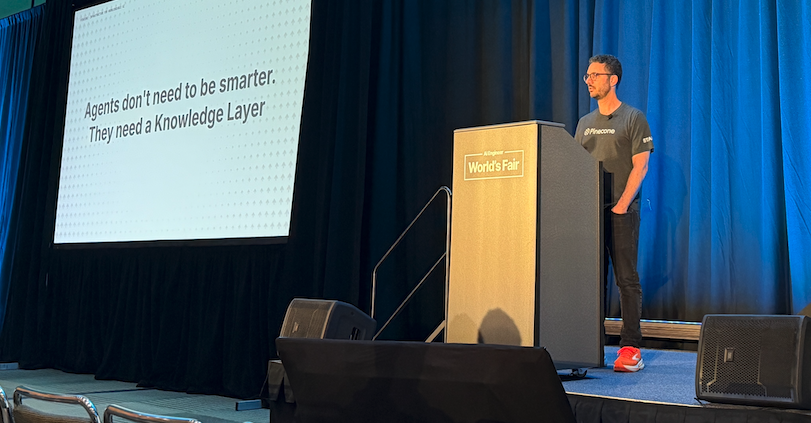
Our Founder and Chief Scientist @EdoLiberty just kicked off the Search & Retrieval track @aiDotEngineer. "Agents don't need to be smarter. They need a Knowledge Layer." We've got a big update on this coming tomorrow...
Most #AIAgents don't fail because of the model. They fail because of the infrastructure around it.
Introducing the Nebius Agents Blueprint: an open architecture for building, operating, and continuously improving agents in production.
https://t.co/r18cYSGNRn
The next generation of Apple Intelligence powers an entirely new Siri: making the apps and experiences you rely on across iPhone, iPad, Mac, and Apple Vision Pro more personal and helpful than ever.
Four weeks, three enterprise customers, same pattern across all three.
Most inference spend goes to retrieval loops. A generic index carries no knowledge of domain, query types, or task structure, so the loop runs before the model can reason. Nexus compiles before the query.
Full results: https://t.co/RhUItkc6BR
95% token reduction. 30x faster execution. 90%+ task completion.
Today at #MSBuild, we announced a major shift to move reasoning upstream: Pinecone Nexus now integrates directly with @Microsoft OneLake.
Traditional AI agents waste tokens stitching raw data together at runtime. At scale, completion rates plummet 60% because we are forcing reasoning engines to do the heavy lifting of data infrastructure.
Pinecone Nexus x Microsoft OneLake fixes the infrastructure wall, moving reasoning upstream.
❌ Naive approach: Agent queries raw data ➔ Stitches chunks ➔ Dumps massive context window into frontier LLM ➔ High latency + exploding token costs.
✅ Nexus approach: Nexus integrates with OneLake ➔ Pre-assembles task-specific artifacts ➔ Agent queries structured data via KnowQL ➔ Instant, cited responses.
The data your agents need already lives in OneLake. Stop rebuilding data pipelines. Enforce RBAC/ABAC instantly, and track tokenomics via a unified dashboard.
📣 Announcement: https://t.co/OGvOHB0r0c
Recently @pinecone introduced Nexus – a new knowledge-engine layer for AI agents that reduces token use by up to 90%.
It’s built on top of a vector database, but shifts reasoning earlier in the pipeline: from retrieval at query time to knowledge compilation before the agent even asks for information.
Instead of giving agents raw files, Nexus prepares task-optimized representations in advance.
These representations include artifacts – structured forms of information tailored to each agent’s specialization and workflow.
For example, a finance agent gets only billing schedules, pricing rules, and usage thresholds.
Pinecone’s VP of Product Jeff Zhu explains it like this:
"The artifact representation can range from markdown files to extracted entities to tables. These artifacts are then indexed for retrieval within Pinecone’s database which support both semantic, sparse, and full text search capabilities so that the right artifacts are retrieved during query time and then composed for the final structured output response from Nexus."
So vector databases are evolving from passive storage layers into active knowledge engines for agents.
Read this to learn what distinguishes vector database in the Agentic Era: https://t.co/B20aFqw7Yd
Our internal AI agent was a brute-force nightmare. 🛑
It burned 40,000 tokens, took 2 minutes, and only hit 68% accuracy just to answer a single question.
Why? Traditional databases are built for humans. Agents don't have that context, so they just guess inside expensive LLM prompts.
We realized we couldn't keep pushing raw data into the LLM. We needed to bring the context closer to the data itself.
That led us to build Pinecone Nexus, a knowledge engine that compiles the exact context a machine needs before it hits the LLM. 🧠🏗️
When we moved our agent to Nexus:
📉 Tokens: 40k → 2k (90% drop)
⏱️ Latency: 2 mins → <500ms
🎯 Accuracy: 68% → 90%+
Our CEO @ashashutosh sat down with @a16z General Partner Peter Levine to share our customer zero story and how we're rewriting the AI stack.
Stop burning tokens on search. Listen here:
👂Spotify: https://t.co/sI8KFylDs1
👂Apple: https://t.co/TtmiQwhNPR