Research agents can propose far more experiments than we can afford to run. Having the LLM assess and filter through them improves efficiency substantially especially when provided with results from past experiments.
Can 𝐫𝐞𝐬𝐞𝐚𝐫𝐜𝐡 𝐭𝐚𝐬𝐭𝐞 be measured? Research agents can propose far more experiments than we can run. But good human researchers predicting which ideas will pay off before running them.
Can LLMs build such a Research World Model?
We asked 13 LLMs to predict each research idea's gain before running it. With 320 past experiments in context, all 13 beat the best model that had none.
How do we improve VLM post-training?
Don't just force longer-horizon multimodal reasoning.
Reshape the curriculum to match how VLMs learn. 👀➡️🧠
Excited to share our new #ICML2026 paper in collaboration with @ucsc@amazon@UWaterloo@VectorInst:
"From Seeing to Thinking: Decoupling Perception and Reasoning Improves Post-Training of Vision-Language Models"
🌐 Project: https://t.co/bG15lh0pGv
📄 Paper: https://t.co/szbV5Ky8JQ
💻 Code: https://t.co/NTy3s8vtaw
🤗 HF Collections: UCSC-VLAA/VLM-CapCurriculum
Recent VLM post-training has largely focused on scaling up reasoning through RL and long chain-of-thought traces. But after auditing model failures across visual math, geometry, and diagram reasoning tasks, we found a different bottleneck:
👉 86.9% of Qwen3-VL-8B's errors originate from perception, not reasoning.
Once a model misreads the image, additional reasoning often just reinforces the wrong interpretation.
Our key insight is simple: before a model can reason better, it must first see better.
To achieve this, we introduce a new simple capability curriculum for VLM post-training:
🟦 Visual Perception → 🟩 Textual Reasoning → 🟨 Visual Reasoning
Instead of mixing all capabilities into a single RLVR stage, we train them sequentially, allowing perception to develop as a dedicated foundational capability.
The results are remarkably consistent:
✅ Staged post-training outperforms standard merged training across 4 VLM backbones (#Qwen2.5-VL, #Qwen3-VL, #InternVL3, #InternVL3.5)
✅ Better perception literally lets the model think less!The staged post-training on #Qwen3-VL-8B uses only 79% of the reasoning tokens of the merged model (20.8% shorter traces) achieves +1.46% average accuracy.
✅We also show that capability curriculum and traditional difficulty curriculum are complementary. On #Qwen3-VL-8B, combining both boosts average performance from 58.6 → 63.0, outperforming either curriculum alone.
The broader message is that curriculum learning for VLMs should not only consider how difficult an example is, but also which capability it develops.
📦 We are releasing everything:
1️⃣ A new capability curriculum paradigm, orthogonal to difficulty-based curricula
2️⃣ High-quality perception training data built with a scalable DOCCI-based synthesis and filtering pipeline
3️⃣ 4 staged-trained VLMs: #Qwen2.5-VL-7B, #Qwen3-VL-8B, #InternVL3-8B, and #InternVL3.5-8B
4️⃣ Full training, evaluation, and perception-error analysis code
Led by my PhD student @JJwu41867797, as well as an outstanding team of collaborators @HardyChen266091,
@HaoqinT, Xianfeng Tang, @fredahshi, Hui Liu, Hanqing Lu, @cihangxie
SkillRL is here! 🤖✨
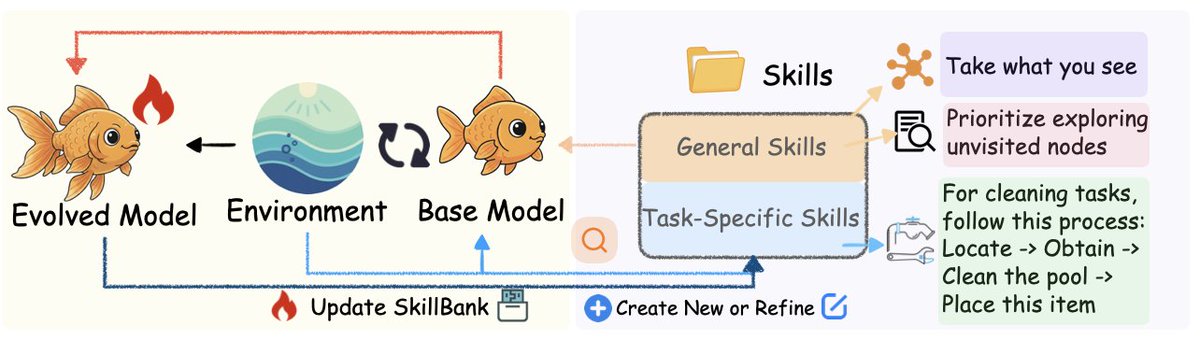
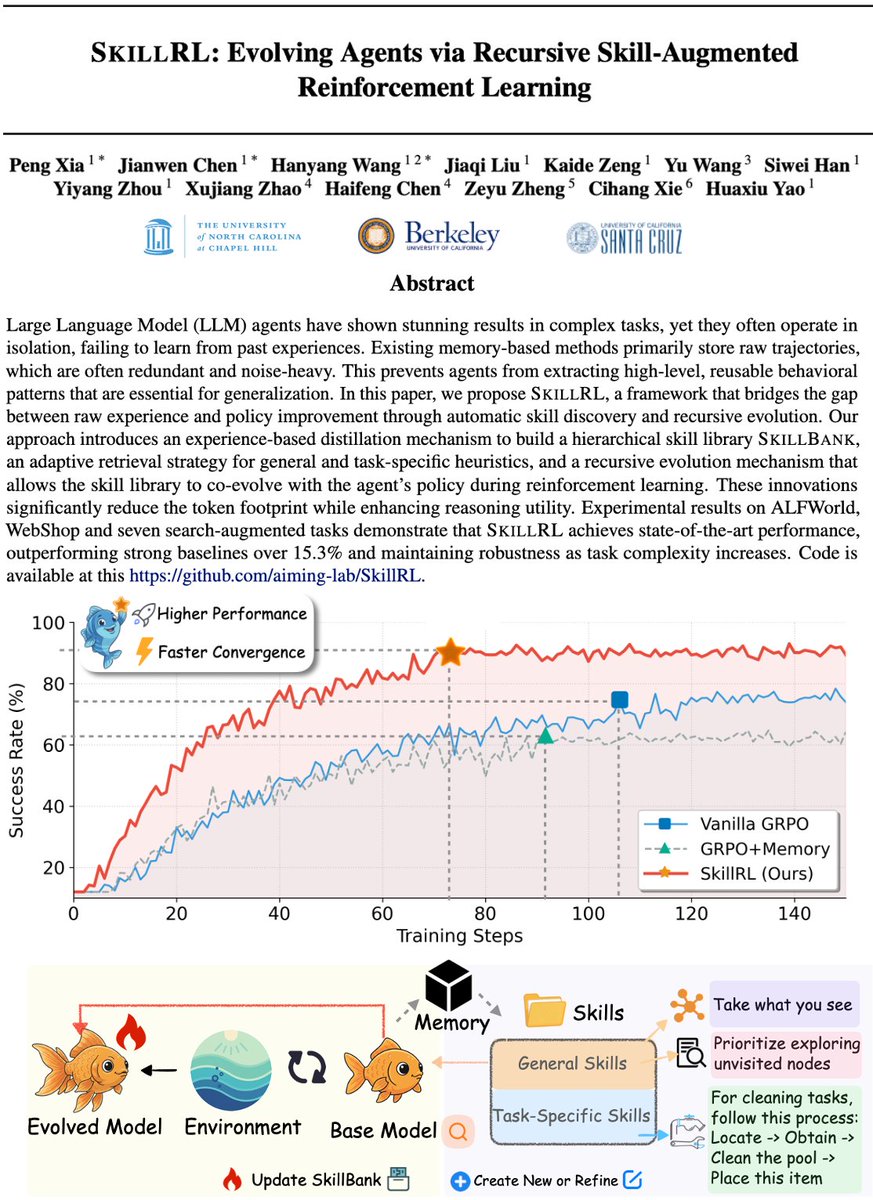
This is a new learning paradigm for evolving LLM agents through recursive skill discovery: by organizing knowledge into a hierarchical SkillBank, it boosts reasoning utility while cutting token usage by ~20%.
Check it out 👉 https://t.co/sWR9vociSJ
Why do most LLM agents hit a wall?
They don’t accumulate skills.
Introducing SkillRL📚 — recursive skill-augmented reinforcement learning that lets agents learn skills from failure and evolve over time.
🔥A 7B model:
• +41% over GPT-4o
• ~20% fewer training tokens
• 33% faster convergence
SkillRL bridges raw experience → policy improvement by distilling trajectories into structured, co-evolving skills during RL.
Most agents forget.
SkillRL evolves. 🔄
📄 Paper: https://t.co/6VoxpGoPR6
💻 Code: https://t.co/qVDnIaci2K
Great work @richardxp888, Jianwen Chen, Hanyang Wang, @JiaqiLiu835914, @lillianwei423, @AiYiyangZ, and nice collab. w/ @__YuWang__, @XujiangZhao, Haifeng Chen, Zeyu Zheng, @cihangxie.
If you’re still on a ViT-style visual backbone… consider switching to ViT-5 🚀
(Also, QK-Norm is my favorite piece 🫶 — fixes a lot of training instability headaches 🤯)
ViT-5: Vision Transformers for The Mid-2020s
"a systematic investigation into modernizing Vision Transformer backbones by leveraging architectural advancements from the past five years"
* LayerScale
* RMSNorm
* original MLP design with GeLU activation
* both APE and 2D RoPE jointly
* registers with a separate 2D RoPE
* QK-Norm
* remove bias terms in the QKV projection layers
84.2% top1 accuracy on ImageNet-1k, 1.84 FID on ImageNet-256
As an AI researcher, are you interested in tracking trends from CV/NLP/ML to robotics—even Nature/Science. Our paper “Real Deep Research for AI, Robotics & Beyond” automates survey generation and trend/topic discovery across fields
🔥Explore RDR at https://t.co/uBJ0bYNy3R
🚀 One of our group’s largest efforts in building high-quality image editing datasets: https://t.co/QL1H6Y56qW
Using the latest GPT-Image API, we unified 3 top datasets—OmniEdit, HQ-Edit, and UltraEdit—into ~1.5M editing pairs with incredible visual quality and instruction-following fidelity!
Our fine-tuned Flux-Kontext model achieves SOTA on ImgEdit, GEdit, ComplexEdit & OmniContext.
👉 Try it out and share your thoughts! https://t.co/RcD0yCqmiU
Instruction-based image editing models keep getting stronger—but can they handle arbitrarily complex instructions? 🤔🖼️
🚀 Introducing Complex-Edit: a new benchmark that systematically tests model performance across a wide spectrum of instruction complexity.
👀 A Spoiler: We observed an intriguing “curse of synthetic data” issue—something even the latest GPT-4o isn’t immune to!
🧵 Thread:
Introducing🎨Complex-Edit, an image editing benchmark with complexity-controllable instructions!
We explored how increased complexity impacts performance, curse of synthetic data, and failure of CoT-like sequential editing.
Project Page: https://t.co/cgaZuDxuKC
I'm sharing the product of an exciting collaboration between UC Santa Cruz, Google and others. The first of its kind: a new complexity-controllable image editing benchmark suite called Complex-Edit to systematically evaluate image editing across varying complexity levels 🧵
Want to build R1-like multimodal models but unable to find suitable reasoning data for training/tuning? Meet our preliminarily released
🔥VL-Thinking🤔: An R1-Derived Vision-Language Dataset for Thinkable LVLMs 🔥
Specifically, we use a 4-step process to infuse R1-style reasoning in building high-quality multimodal reasoning dataset at scale:
1️⃣ GPT-4o crafts detailed image captions 🖼️
2️⃣ R1 processes these captions + questions to generate answers 🤖
3️⃣ GPT-4o refines the reasoning for natural fluency ✍️
4️⃣ GPT-3.5-Turbo verifies answers against ground truth ✅
The result? 76,469 high-quality vision-language instances ready for training!
Access the dataset now: https://t.co/c6wBWPQkw7
BREAKING: Hugging Face is partnering with NVIDIA to add an AI training service right into their website. So instead of just picking models and running inference, you will soon be able to pick a pre-trained model and fine tune it using NVIDIA's DGX Cloud. Awesome news for devs!
The evaluation server for open-set recognition and generalized category discovery is just set up! If you want to submit your models on OSR or GCD to our workshop, please see https://t.co/tY1WsUeFYQ #ICCV2023
We're excited to announce the 2nd Out-Of-Distribution Generalization in Computer Vision (OOD-CV) workshop at ICCV 2023 @ICCVConference , featuring both a paper and challenge track. #ICCV2023#OODCV#ComputerVision