Introducing CLODO, trusted by @mercor, @usnews, @UseCorgi, the U.S. Intelligence Community, and more.
Describe exactly who you’re looking for, and find them every single time.
1.2B profiles.
We find, enrich, and reach out to them for you.
It’s that easy.
Backed by @YCombinator, @CRV, @daltonc and @paultoo at @Standard_Cap, @louisberyl at Four Cities Capital, @theo, and more incredible angels.
Book a demo today:
https://t.co/z29n2F6U7b
We’re going to be a country that builds things again thanks to the work of @MartinHeinrich, @SenWhitehouse, and many many many staffers on both sides of the aisle who made BAAJA happen in the senate — an important bill on its own terms that lays the groundwork for more to come.
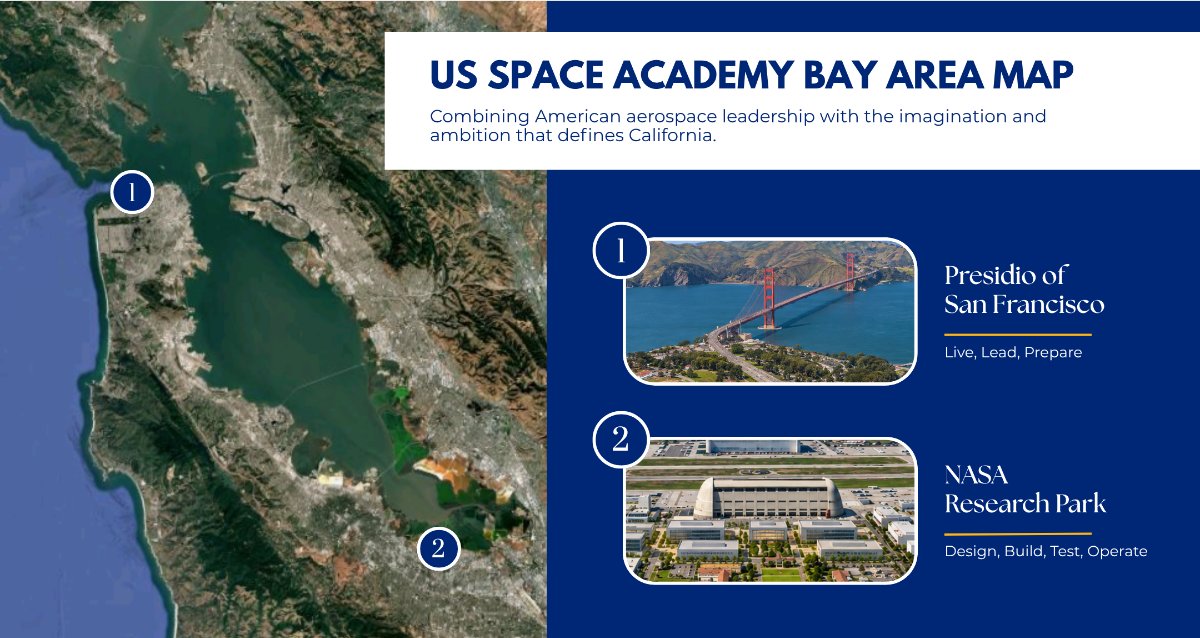
NEW: California is bidding to host the United States Space Academy in the Bay Area, @CAGoBiz announced today.
The state is one of many making their pitch to NASA, including Florida, Colorado and Virginia.
@colossus_cap What these ppl gotta understand is that this was a board personally selected, and made handsomely wealthy, by Jensen.
What kind of risk would motivate such a board to act this swiftly and this decisively?
Hint: There are apparently 1.5 GW+ of export-controlled GPUs in China.
@krishnanrohit@ArmandDoma The headline is being diplomatic, because NVIDIA's board nor Jensen has publicly confirmed the reason for the latter's swift resignation.
Try to think about why a board made handsomely rich by Jensen would get him off the premises this quickly. You think it's his affair?
The idea that US economic growth existentially depends on the illegal sale of chips to China is a remarkable revelation from the former AI Czar’s bestie
@fredsoda Agreed, this has nothing to do with Jensen's personal indiscretions.
The US IC was already monitoring Alice Huang as a person of interest wrt back-channeling of GPUs.
And ofc, a bigger issue is how the highest levels of the admin did not seem to react when alerted to this.
@fredsoda According to SemiAnalysis, one of NVIDIA and the industry's biggest boosters historically, 1.5 GW of export controlled Nvidia hardware (~1.5M H200s and B200s) somehow landed in China.
Also, the latest Chinese models have been proven to be trained on that hardware.
.@JakeAuch challenges Democrats to abandon the bad ideas of the past:
“Supply and demand is a fact of reality, and the fact is when supply goes down prices go up. That means you can’t lower prices by stopping things from being built.”
I have a major result to share.
I’ve found conclusive forensic evidence that the top 4 Chinese AI labs—DeepSeek, Moonshot, MiniMax and Ant Group—have built their newest models on NVIDIA’s most advanced Blackwell chips, which are barred from export to China.
This sounds insane, but I discovered that almost every AI model carries a hidden signature of the GPU that trained it. When a model is first set up, the starting values of its weights are laid out in a pattern that depends on the exact GPU. Each combination of GPU and seed number produces a unique pattern—a sort of fingerprint of the hardware used to create the model. Traces of that pattern survive training into the published model.
Again, this evidence isn’t based on any insider information or leaking. It’s based on a forensic analysis of the model weights released by the companies themselves.
I searched more than six trillion combinations of chip layout and seed number and matched them to open-weights models. In doing so, I found conclusive evidence that six Chinese AI models—including DeepSeek-V4-Pro, Kimi K3, and MiniMax-M3—were initialized on NVIDIA Blackwell systems. Four of the models match Grace Blackwell, the GB200 and GB300 parts in NVIDIA’s flagship liquid-cooled rack-scale systems.
I then verified these results on real hardware. Running unmodified PyTorch with the seeds I’d recovered, a Blackwell B300 reproduced DeepSeek-V4-Flash’s untouched starting weights bit for bit, and a rented GB200 reproduced Kimi K3’s to a correlation of 0.999995. A Hopper H100 reproduced none of DeepSeek-V4-Flash’s, and changing the seed by one broke the match. (DeepSeek’s seed is 953049583 by the way.) The method also was verified to match 24 known open-weights models to the hardware that developers said they used.
It is exceedingly unlikely that these results are a coincidence. Across six trillion combinations, the best accidental match should reach only about 8 sigma (i.e., eight standard deviations above what random chance would produce). The real matches range from 49 to 1,385 sigma, and even the weakest single test hits 20.
These were data-center-scale training runs. With some analysis of release schedules and model details, I estimate that the largest, Kimi K3 and DeepSeek-V4-Pro, used 2,000 to 3,000 Blackwell GPUs each. Clusters of this size cost on the order of $150 to $200 million each to buy, and across these labs alone would add up to more than half a billion dollars of export-controlled GPUs, not counting experimental compute or otherwise. It’s quite likely that we see multi-billion dollar expenditure on export-controlled GPUs.
I am highly confident in this result, and it has been independently verified by senior researchers at OpenAI and Anthropic. You can read the full report at https://t.co/YOtzND0Jqk.
There is much more I’ve identified about these models through other forms of checkpoint forensics like this, and will have more to share soon.
We need more compute in America (not more inference providers, but actual metal and concrete).
and we should probably also not go out of our way to hand over this technology to an adversary that is clearly trying everything it can to beat us.