"S&P 500 has now produced eight separate 1% gains without suffering a single 1% decline during the same stretch ... Going all the way back to 1970, this type of streak has occurred only nine other times."
@FrankCappelleri
One firm controls $11.5 trillion and just made a move that should terrify every retail investor paying attention.
BlackRock, which manages more money than the GDP of Japan, Germany, and India combined, quietly filed to shift $2.5 billion from long-duration US bonds into short-term instruments and commodity-linked assets last quarter.
When the largest asset manager on earth starts repositioning out of bonds and into hard assets, that's not a signal. That's THE signal.
BlackRock built a system called Aladdin. It processes 5,000+ risk scenarios per day across $21.6 trillion in assets. Monitors every bond market, every commodity flow, every currency fluctuation on earth in real time. When Aladdin's models say "reduce bond duration and add commodity exposure," Larry Fink doesn't argue with the machine. He moves $2.5 billion.
If you're sitting in a 60/40 portfolio with long-duration bonds, you are on the other side of this trade. BlackRock is selling what you're holding.
The shift from bonds to commodities has happened three times in the last 50 years. Each time, commodities outperformed bonds by 300-400% over the following 5-7 years. The 1970s rotation. The early 2000s rotation. And now.
Specific plays: physical gold and silver (direct hedge). Copper miners (AI infrastructure demand). Energy companies with low debt and high free cash flow. Uranium producers, 34 countries just signed a pledge to triple nuclear capacity by 2050 and there are only about 8 publicly traded uranium miners of scale.
Avoid: long-duration bonds, unprofitable tech, anything BlackRock is filing to reduce.
i watch institutional 13F filings and fund flow data through tradevision. BlackRock's reallocation isn't a one-quarter blip, it's been building for three consecutive quarters. the rotation is accelerating. you can either front-run it or get run over by it.
(the firm that advises the Fed on monetary policy is simultaneously repositioning its own portfolio away from the assets that monetary policy supports. read that again.)
Since 1957, any random day for $SPX has been higher:
• 1 year later: 72.8% of the time (+8.8% average)
• 6 months later: 68.9% of the time (+4.3% average)
• 3 months later: 66.1% of the time (+2.1% average)
• 1 month later: 61.6% of the time (+0.7% average)
• 1 week later: 56.7% of the time (+0.2% average)
This is the baseline.
Without this benchmark, forward-return statistics are meaningless. They tell you nothing about how bullish or bearish a signal really is.
As a parent, I think this video has taught me something useful.
I recommend that you should try it on your kids, too.
I have also shared it with my wife.
Credit: joe_drummer_boy on IG.
Client walks in. 68 years old. $2.8M net worth.
House is paid off. Worth $950K.
She's living on $38K a year from Social Security.
Tell me how that makes sense.
She brings coupons to restaurants. Buys the cheapest everything.
"I'm not taking money from my retirement accounts. I need that for emergencies."
What emergency costs $2.8M? You're denying yourself basic comforts at 68. You haven't visited your grandkids in Phoenix in 2 years. Your emergency fund has an emergency fund.
She fought me for 8 months.
"My parents taught me never to touch principal."
Your parents also retired with a pension and died at 74.
We finally got her to take distributions last year.
$120K annually from her portfolio. Still only a 4.3% withdrawal rate.
Now she's flying to Phoenix quarterly. Took her grandkids to Disney. And stopped agonizing over every $12 purchase.
She spent 3 years being miserable with $2.8M in the bank.
You don't get a prize for dying with the most money.
The Nasdaq 100 $QQQ closed below its 200-day average for the first time in over a year.
Watch the next 2 weeks.
Every time it lost its 200-day after an extended run and suffered at least a -3.5% drawdown within the next 2 weeks, it led to a bear market.
When the 2-week drawdown was less than -3.5%, 1-year returns were positive every time.
The biggest mistake unprofitable $SPX 0DTE traders make is tracking too many levels.
This hurts decision-making, ruining long-term profitability.
To solve this, we've created a one dead-simple strategy/framework for our community.
Here's everything you need to know:
Happy New Year!
I am watching to see if $QQQ can put in a failed breakdown off of the 50dma. This would be reclaim of the 12/20 low.
I am interested in names that have showed relative strength by making a higher low while index made a lower low. List below.
🔊 𝗚𝗮𝗺𝗺𝗮 𝗢𝗻 𝗶𝘀 𝗽𝗿𝗼𝘃𝗶𝗱𝗶𝗻𝗴 𝘁𝗵𝗲 𝗰𝗿𝘂𝗺𝗯𝘀 𝘁𝗵𝗶𝘀 𝘄𝗲𝗲𝗸 🥐
The “Godfather of Gamma” @jam_croissant joins @OJRenick for a deep dive into his second derivative musings, strategies, & more.
Tune in to Episode 4 at 8pm ET 👇
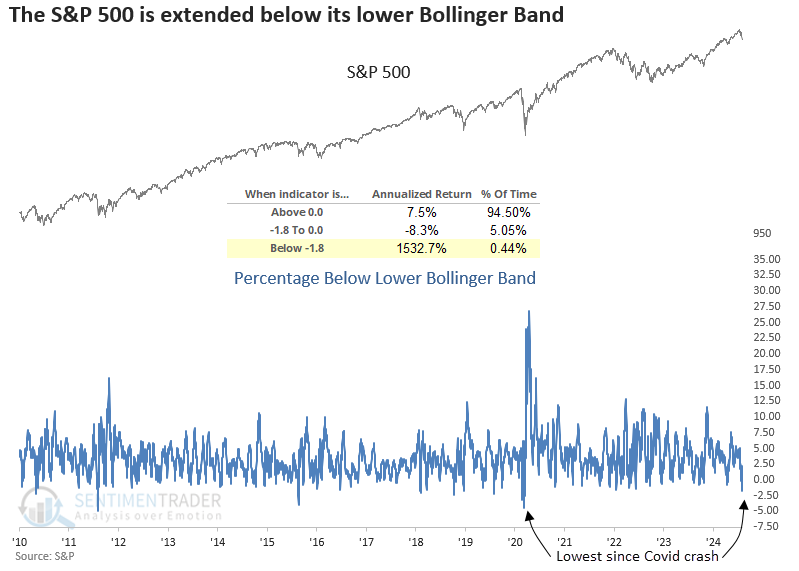
For only the 21st time since 1928, the S&P 500 closed more than 1.8% below its lower Bollinger Band, with the index in a long-term uptrend. Similar price patterns preceded an 85% win rate for the world's most benchmarked index over the subsequent six months.
Random:
The S&P 500 recorded a 2-month pattern of:
1) All-time high monthly close last month
2) -3% or worse decline this month with trailing 6-month returns of 10% or more.
Sounds like it's a warning sign. I thought it'd be a short-term warning sign.
Instead, all white.