Senior Lecturer in Bioinformatics @UniofNewcastle, Director of Research @NclBNS. #rstats, Python, etc. Gateshead/Newcastle resident. Husband. Dad. Views my own.
Our Perspective "Mapping the Transcriptome - realising the full potential of spatial data analysis" is out today in @CellCellPress https://t.co/algatKqe0U. A short thread on this work follows...
How much more money do we need to dump into automating analysis for non experts until we realize that we need to better train scientists to interpret results!
@TrostLab@NCBI@NLM_NIH@StudentsNCL@NCBI@NLM_NIH we have been in contact with NLM Support (case number #CAS-1234575-J7P7W3) as traffic from our network is being rejected; we’ve chased for updates but had no response since 15th Dec. Can you provide an update on our case please?
This is a massive problem @NCBI. As @TrostLab mentions, @NU_ITservice maintain this is a server-side problem, some clarity (and a fix!) would be very welcome:
Dear @NCBI@NLM_NIH
in our institution @StudentsNCL in the UK we cannot access Pubmed or any other NIH/NCBI website anymore. this has been intermittently going on for months!
Out IT says it comes from your side.
can you please look into this!
thanks a lot!
A PhD studentship available with me and collaborators
@LabPeffers
and
@IGM_YoungLab
from October 2024.
https://t.co/rnykokm4Ve
Combining omics data to identify regulators of chondrogenesis. Funded via
@NLD_BBSRCDTP
Deadline to apply 15th January
#bioinformatics#PhD
Bringing 2023 to a close, the new issue features a 3D atlas of the developing human head, how the ineffective control of EBV-induced autoimmunity increases the risk for multiple sclerosis and a machine learning architecture that integrates cell types across single-cell datasets!
To read more of our new issue click👉 https://t.co/DWf0VlDvUt
To quote ourselves, these features mean that the analysis of these types of data should be "spatial by default", and encourage inter-disciplinary collaboration with those in the geographical sciences to help transfer decades of knowledge from that domain
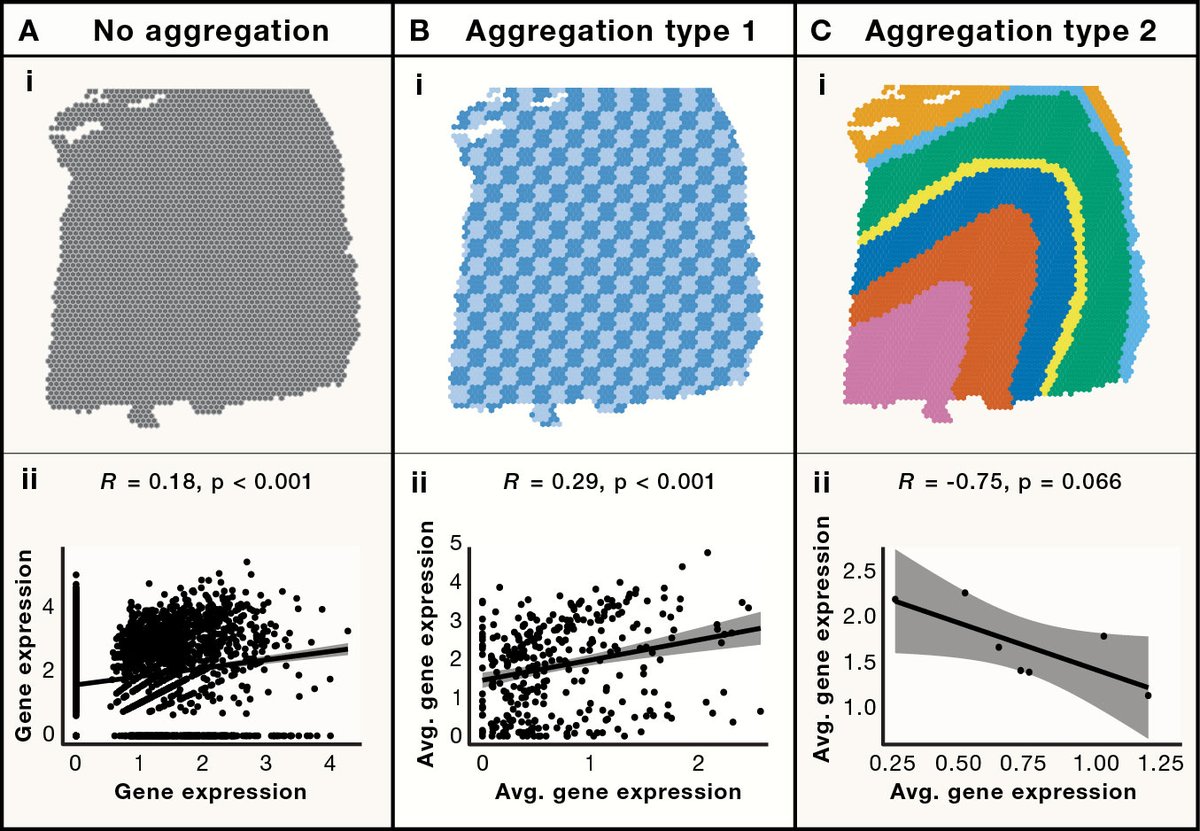
We demonstrate that key features of spatially-resolved data can be shown in biological data (using Visium data by way of example). 1) The modifiable areal unit problem - that the scale you chose for your analysis can strongly influence the results of that analysis
3) spatial heterogeneity - the relationships between variables is not static across space, and local relationships rarely look the same as the global picture
This paper is essentially the manifesto for @LZormpas's PhD work - that the features of spatial data, so well studied in the geographic sciences, manifest themselves in micro-scale spatial molecular biology data.
So happy, particularly for my student (@LZormpas), that the editors saw the value in this commentary. Thanks also to the helpful reviewers. And of course coauthors @lexcomber and @rachelq_ncl!
Our Perspective "Mapping the Transcriptome - realising the full potential of spatial data analysis" is out today in @CellCellPress https://t.co/algatKqe0U. A short thread on this work follows...