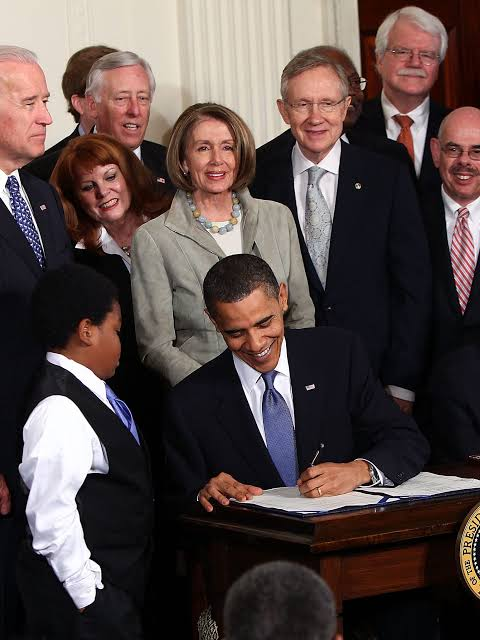
Barack Obama signed the Affordable Care Act in March 2010, guaranteeing you cheaper insurance, more competition, and the ability to keep your doctor. Premiums for individual plans more than doubled between 2013 and 2017. Deductibles climbed so high that millions of technically "insured" Americans still skipped medical care because the out-of-pocket costs were prohibitive.
The government mandated what your insurance must cover, forced healthy young people to subsidize older high-risk pools, and then expressed genuine surprise when prices spiked. Prices always tell the truth.
The 2009 stimulus, officially $831 billion, operated on the Keynesian assumption that government spending creates wealth. Government spending transfers wealth, first taxing or borrowing it from the productive sector, then routing it through political channels where efficiency is nobody's personal concern. The "shovel-ready jobs" Obama later joked about produced no measurable acceleration in recovery. The recession that followed 2008 should have cleared in 18 months, as previous sharp downturns historically did when left alone. The Obama recovery took a decade and delivered the weakest GDP growth of any post-war expansion on record.
Dodd-Frank, signed in 2010, weighs 2,300 pages. Community banks spent compliance budgets they never had, and roughly 1,900 small banks vanished between 2010 and 2016. The big institutions that actually caused the 2008 crisis absorbed the regulatory cost with ease and used the new complexity as a competitive moat. Regulations written by large players consistently protect large players. The middle-class small-business owners who needed credit found fewer lenders willing to offer it.
Obama also expanded drone warfare to seven countries, assassinated American citizens without trial, and extended the surveillance state through a reauthorized PATRIOT Act, which undermines any libertarian's case that the Democratic Party is less hostile to civil liberties than its competition.
Then there was Cash for Clunkers, which destroyed 690,000 working cars in 2009 by crushing them with sodium silicate. Mechanics lost parts inventory. Buyers on a budget lost affordable transportation. Prices for used cars spiked. You paid more so dealers could move new inventory.
A generation of voters watched the government spend $5 trillion across two terms, nationalize health insurance markets, regulate finance into oligopoly, and print money through three rounds of quantitative easing that inflated asset prices and rewarded those who already owned property. You paid higher premiums, earned lower real wages, and watched your savings earn nothing in a deliberately suppressed interest-rate environment. The bill always arrives later. You see the ribbon cutting and the document signing, but you feel the damage to your pocket only years later.
@PulteHomes It’s been more than a year, still no solution on the flooring issue reported . This is not we expected from a national builder like @PulteHomes .
@PulteHomes need to work sincerely on quality control checks promised to customers during the purchase process. Homes delivered with all kinds of issues major and minor.
Look at the flooring and painting jobs.
Sri Swaminathan Gurumurthy delivers the Sri S G Sundaraswamy Memorial Lecture on 20 September 2026 at the Sai Hira Global Convention Centre, Prasanthi Nilayam.
View Recording: https://t.co/akJW4zA9ZP
Photos: https://t.co/ZhCU436EgZ
@sgurumurthy
All-In Summit: Bill Gurley
(0:00) Bill Gurley takes the stage at the All-In Summit
(1:29) Bill's Presentation: Searching for Feynman
Links to additional resources mentioned in talk and used in research:
https://t.co/LrixEr9Bw6
@bgurley
This is your sign to stop voting Democrat
Keep in mind, DMV vehicle registration renewal fees like this are billed every year. There is no limit to how much California Democrats will steal from you
This should be illegal
A Universal Message of Love All-Serve All Resonates at the BRICS Summit in New Delhi
A beautiful moment of shared values & spiritual unity emerged as the Chairperson of BRICS WBA, Monica Monteiro, expressed her appreciation for the universal message of love and selfless service.
On Labor Day, the charging peak load was 116 cars plugged in at once, at 11.4 MW.
All electrical loads will eventually transition to solar + storage. The giant fusion reactor in the sky is free.
@TeslaCharging Early Trip to LA: No coffee, food and limited restrooms
Tesla Superchargers should be near fast food and available restrooms near i5 no matter what time of day or night. Timing is of course is within reason for fast food restaurants. The vending machines aren’t cutting it.
Neil Movva (@neilmovva) started his career at Nvidia, working on GPUs and kernels, and has an unusually deep understanding of inference, from software to chips to power.
We spend a lot of time on each of those layers, how they connect, and where the important tradeoffs are.
What makes this conversation special is how detailed it is (like a 401-level class), yet Neil makes it remarkably clear and easy to follow.
Today he runs Sail Research, a company building infrastructure for agents to make tokens as cheap as possible.
We discuss:
- Latency versus throughput
- Why there are no bad chips, only bad pricing
- The end of kernel engineering
- Buying chips and power no one else wants
- New chip architectures
- Nvidia lore + his contrarian view of the company
- Open source and the frontier labs
I learned a ton. Enjoy!
TIMESTAMPS
0:00 Intro
0:38 Building a “Token Factory”
4:21 The Future of Background Agents
13:09 Nvidia and the GPU Stack
23:27 Chips, Memory, and Transformers
36:14 The Future of AI Training Data
44:32 Chip Scarcity and Compute Arbitrage
52:44 Reinventing the AI Data Center
59:01 Power and the “Scavenger Strategy”
1:10:10 Open vs. Closed AI
@naval The total combined intelligence of all the living beings since the beginning of the evolution is probably still a drop in the ocean when compared to the divine consciousness.
Michael Froman, the president of the Council on Foreign Relations and a former US Trade Representative, published a piece in @ForeignAffairs today titled “The Next Global Economic Crisis Could Be Made in China.”
I have been writing about this topic for a while, so I read it carefully. His argument overlaps with what the data has been showing for some time, and I think it is worth walking through in simple terms, because you do not need an economics background to follow it.
An economy runs on four engines. Homes get built, factories produce, households spend, and the country sells to the world. In China, three of these engines are struggling at the same time, and the fourth was never fully developed.
Property broke first. Home prices have fallen for 35 straight months, the longest streak on record. Chinese families hold 60% to 70% of their wealth in their homes, and independent estimates put the number of empty apartments somewhere between 65 and 80 million. New home sales have more than halved since 2021.
Factories were the answer to the property bust. Build more, export more. The output came, but the profits did not. Factory activity contracted for eight straight months in 2025, factory gate prices have been falling for more than three years, and close to 30% of industrial firms are losing money. More production, less profit.
Household spending is the engine that was never built up. In most economies it is the largest one. In the United States it is about 68% of GDP, and in the European Union roughly 52%. In China it is under 40%, and that was a design choice. Wages and savings were channeled toward building and exporting instead. Now, with home values falling, families are saving even more. Retail sales have slowed to a crawl and even turned slightly negative this spring.
That leaves exports, the last engine running. The trade surplus reached almost $1.2 tn in 2025, growing about three times faster than world trade, and net exports drove roughly 30% of China’s growth last year. Froman’s point is that the math has a limit. Sales cannot grow three times faster than customers’ incomes forever. Either demand runs out, or trade barriers go up. Both are already visible.
The question I tried to answer in my July report is where the losses from all of this have gone. The official answer is almost nowhere. Chinese banks report that only 1.52% of their loans have gone bad, roughly unchanged from before the property crash. Comparable crashes took bad loans to 5.6% in the US after 2008, 13.6% in Spain, and above 25% in Ireland. Applying those historical precedents, my estimates put the losses sitting inside the Chinese financial system somewhere between $3.9 tn and $12.2 tn, with a central case near $7.7 tn, against buffers of about $1.28 tn and state injections of $74 bn so far.
More here: https://t.co/eJO1NBjJJk
I may be wrong on the exact numbers. I do not think the direction is wrong.
The known fix is to grow household spending. Japan is a reminder of how long that takes. It began rebalancing in 1991 as one of the richest countries in the world, and the process still meant more than 15 years of cleaning up banks and two lost decades of growth. China is starting from a much lower income level, with a population that is already shrinking.
To be clear, none of this points to a collapse tomorrow. China has tools other countries did not have, and the most likely path is a slow, Japan style workout, absorbed quietly by savers over many years. What the Froman piece suggests to me is that this view is no longer a contrarian one. The open questions are who pays, and how long it takes.
Answering them means dismantling the machinery that built the miracle, which is why I titled my January piece “The Elephant No One Wants To See”.
Michael Froman’s article: https://t.co/Kpb2TDOqJI
My report and the January piece: https://t.co/JEEVUF0bQ2
@MikeFroman #China #Growth
AI and quantum computing aren't rivals. They're complementary technologies that will accelerate one another.
AI helps us discover patterns. Quantum computing helps us understand nature with unprecedented precision. Together, they'll unlock breakthroughs across science, medicine and energy.
Worth reading from @TheEconomist.
https://t.co/rpA8b2iDkJ
@donttouchxanax Beautiful lecture to set the initial intuition of the students in their first class to understand the complex subject in future classes. 🙏🏽