I want to explain a bit more about why TokenSpeed uses different programming languages across different layers.
Scheduler: C++
The original motivation wasn't performance. It was correctness.
TokenSpeed's scheduler is built around KV cache state transitions, with compatibility requirements across PD, L2 cache, and more. We need to ensure state transitions can be rolled back losslessly.
C++ RAII is a natural fit for this. It makes resource and state management intuitive and explicit.
There's also a practical reason: a small, stable group of people, myself included, are comfortable with C++. Most users rarely need to touch this layer.
Using C++ might sound crazy, but it actually makes sense.
Engine: Rust
We recently rewrote the TokenSpeed engine in Rust. This is largely a consequence of the rise of LLM coding agents.
It's not Rust choosing the era. The era is choosing Rust.
On the critical path, especially production TTFT, Rust offers substantial performance advantages over our previous Python implementation.
More importantly, Rust's language features work remarkably well with LLM coding agents. We can move fast without giving up the safety and performance needed in production, while retaining much of Python's iteration speed.
Modeling: Python
This one's straightforward. Python is an excellent glue language for modeling, and this layer is less performance-sensitive.
There's little reason to sacrifice its flexibility and productivity here.
That's it. Different layers have different constraints, and the best language depends on the problem you're solving.
Hope this clarifies the reasoning. Happy to discuss and hear different perspectives!
Don't learn formal methods.
Writing proofs by hand is what kept formal methods niche for over 75 years. seL4 took about 20 person-years to prove 8,700 lines of C. Agents take that part now. What's left for you is the spec, and knowing which language fits the job.
That's why the history matters. Formal methods means stating what a program or system must do in precise math, then using a tool to check that the code or design meets it. Here's how we got here, what each language is good for, and where I'd start.
FOUNDATIONS (1947 to 1979)
1947: Goldstine and von Neumann annotate program flow diagrams with "assertion boxes" stating what holds at each point.
1949: Alan Turing's "Checking a Large Routine" proves a short program correct using assertions. The idea mostly sits unused for over a decade.
1962: Carl Adam Petri's dissertation introduces Petri nets for modeling concurrent systems.
1963: John McCarthy, "A Basis for a Mathematical Theory of Computation".
1966-67: Peter Naur and Robert Floyd independently show how to prove programs with assertions attached to points in the code.
1967: N. G. de Bruijn starts Automath, the first language for computer-checked mathematical proofs.
1969: Tony Hoare publishes Hoare logic, {P} C {Q}. Nearly every contract language since builds on it.
1972: Robin Milner's Stanford LCF. Its Edinburgh successor (1979) introduces ML as its scripting language, the ancestor of Standard ML, OCaml and F#.
1973: Mizar starts in Poland. Formalized math that reads close to a textbook.
1975: Dijkstra's guarded commands and weakest preconditions.
1977: Amir Pnueli brings temporal logic to programs. Patrick and Radhia Cousot publish abstract interpretation, the theory behind sound static analyzers.
1978: Hoare's CSP for concurrent processes. Milner's CCS (1980) and the pi-calculus (1992) follow.
1970s: VDM at IBM's Vienna lab. Jean-Raymond Abrial proposes Z, later developed at Oxford. Boyer and Moore build their theorem prover.
TOOLS PEOPLE USED (1980 to 1999)
1981-82: Model checking, invented independently by Clarke and Emerson and by Queille and Sifakis. Turing Award in 2007.
1980s: Synchronous languages Esterel and Lustre in France. Lustre becomes SCADE, which Airbus uses to design flight control software.
1984: Nuprl at Cornell.
1985: Coquand and Huet's Calculus of Constructions, the logic under Coq.
1986: Isabelle (Larry Paulson).
Late 1980s: SPARK, a provable subset of Ada.
1988: HOL (Mike Gordon).
1989: Coq's first public release. Renamed Rocq in 2025.
1990: Symbolic model checking with BDDs handles 10^20 states. McMillan's SMV follows.
1991: SPIN model checker goes public (Gerard Holzmann, Bell Labs).
1992: PVS at SRI. Oxford and IBM win the Queen's Award for using Z on IBM's CICS transaction system.
1993: Metamath, a proof language simple enough to check with a few hundred lines of code.
1994: Lamport's TLA. TLA+ follows in 1999.
1994-95: Intel's Pentium division bug costs it $475 million. AMD uses ACL2, Kaufmann and Moore's successor to the Boyer-Moore prover, to prove its K5 floating-point division correct. Intel hires John Harrison in 1998 and uses his HOL Light to verify floating-point algorithms.
1996: Abrial's B-Book.
1997: Alloy (Daniel Jackson, MIT).
1998: Paris Metro line 14 opens driverless, with safety software built in the B method. The KeY project for Java verification starts.
1999: Agda (Catarina Coquand). JML, a contract language for Java.
VERIFIERS MEET REAL CODE (2000 to 2019)
2000: Microsoft's SLAM project starts. It ships as the Static Driver Verifier in the Windows driver kit.
2001-02: Separation logic (Reynolds, O'Hearn, Yang) makes pointer-heavy code provable.
2002: ESC/Java. Spec# (2004) and the Boogie verifier (2005) follow at Microsoft Research.
2003: Astrée proves the Airbus A340's primary flight control software free of run-time errors.
2004: CBMC, bounded model checking for C.
2005: Georges Gonthier finishes a Coq proof of the four color theorem.
2006: CompCert, a C compiler proved correct in Coq (Xavier Leroy). Event-B gets its Rodin toolset around the same time.
2007: Agda 2. Idris first appears (Edwin Brady).
2008: Z3 SMT solver (Microsoft Research). Frama-C. VeriFast.
2009: Dafny (Rustan Leino). seL4, the first general-purpose OS kernel with a machine-checked proof that its C code matches its spec.
2010: Why3.
2011: F*.
2012: A Coq proof of the Feit-Thompson odd order theorem is completed.
2013: Lean (Leonardo de Moura, Microsoft Research). P language at Microsoft.
2014: CakeML, a verified ML compiler. Liquid Haskell. Flyspeck finishes a formal proof of the Kepler conjecture.
2014-15: AWS reports TLA+ found bugs in S3 and DynamoDB that testing missed. IronFleet proves distributed systems correct in Dafny.
2015: Iris, a separation logic framework in Coq. Facebook open-sources Infer.
2016: Project Everest starts, aiming for a verified HTTPS stack. Viper.
2017: HACL*, verified crypto written in F*, ships in Firefox 57. Lean's mathlib starts.
2018: AWS Zelkova checks IAM and S3 policies with SMT solvers.
2019: Fiat Cryptography's Coq-generated code lands in BoringSSL, used by Chrome. Prusti for Rust.
LLMS MEET PROOF CHECKERS (2020 to 2025)
2020: OpenAI's GPT-f finds shorter Metamath proofs that get accepted into the main library, a first for deep learning.
2021: Lean 4.
2022: Kani (AWS) and Creusot for Rust. Aeneas translates Rust into Lean. The Liquid Tensor Experiment finishes the Lean proof Peter Scholze asked for.
2023: Verus for Rust. AWS releases Cedar, a policy language built with proofs in Dafny and later Lean. LeanDojo gives models a programmatic interface to Lean. Terence Tao's team formalizes the PFR conjecture proof in Lean in three weeks.
July 2024: DeepMind's AlphaProof reaches IMO silver-medal standard with proofs in Lean.
Sept 2024: Quint 1.0, TLA+ ideas with ordinary programming syntax.
Mar 2025: Imandra launches CodeLogician, an agent that turns code into its IML logic and checks it.
Apr 2025: AWS publishes how it rewrote its authorization engine, called a billion times per second, in Dafny with proofs.
July 2025: Harmonic's Aristotle reaches IMO gold-medal level with formal Lean proofs.
Sept 2025: The vericoding benchmark tests LLMs writing verified code from 12,504 specs. Off-the-shelf models pass 82% in Dafny, 44% in Verus, 27% in Lean.
LANGUAGES BUILT FOR AGENTS (2026)
Feb 22, 2026: Vera. "A programming language designed for LLMs to write, not humans."
Feb 25, 2026: Vow. "A Programming Language for Agentic Coding."
Mar 9, 2026: Kōdo. "Designed for AI agents to write." Z3-checked contracts, JSON errors with patches.
Sept 17, 2026: Bend 2. Dependent types and Lean-style proofs, C-like speed, CPU and GPU parallelism, Python-like syntax.
WHAT EACH LANGUAGE IS GOOD FOR
Specs and models
Z: precise requirements docs. Little tooling today.
VDM, B, Event-B: refining a spec step by step into code. Railways and safety-critical control.
CSP (with the FDR checker): concurrent protocols.
Petri nets: workflows and concurrent processes.
TLA+ and Quint: distributed system designs, consensus, race conditions before you write code. Checks the design, not the code.
Alloy: fast counterexamples in data models and access rules. Bounded, so finding no counterexample isn't a proof.
P: modeling and testing event-driven distributed services at AWS and Microsoft.
Model checkers
SPIN: concurrency protocols, as abstract models.
NuSMV and other SMV descendants: hardware and finite-state control logic.
CBMC: bounded checking of C code.
Kani: bounded checking of Rust, including unsafe code.
Static analysis
Astrée: proving embedded C has no run-time errors. Avionics.
Static Driver Verifier: Windows drivers using kernel APIs correctly.
Infer: memory and null bugs across large codebases.
Proof assistants
ACL2: hardware and microcode.
HOL4, HOL Light: hardware and floating-point proofs.
Isabelle/HOL: seL4-scale systems proofs, strong automation.
Rocq: verified compilers (CompCert), crypto (Fiat), big math proofs. Slow and hard to learn.
PVS: aerospace, much of NASA's formal methods work.
Agda: type theory research and teaching.
Lean 4: math (mathlib) and AI theorem proving. Hardest of the big three for LLMs off the shelf (27%).
Mizar, Metamath: large formal math libraries with simple checkers.
Verifying real code
SPARK: avionics, defense, rail.
Dafny: verified business logic, compiles to C#, Java, Go, Python, JS. AWS uses it for its authorization engine. Easiest for LLMs off the shelf (82%).
F*: verified crypto (HACL*, in Firefox and the Linux kernel).
Frama-C, Why3: C in safety-critical settings.
KeY, JML: Java.
VeriFast, Viper: separation-logic proofs about heap-heavy code.
Liquid Haskell: proofs added to existing Haskell.
Idris: general-purpose programming with dependent types.
Verus, Prusti, Creusot, Aeneas: proofs about Rust code.
WHY IT NEVER SCALED
Formal methods worked. They didn't scale, because a person had to write every proof.
Back to seL4. Its 8,700 lines of C needed roughly 200,000 lines of Isabelle proof, more than 20 lines of proof per line of code. IronFleet's verified distributed systems took 3.7 person-years, including inventing the method.
So formal methods stayed where a bug costs more than the proof: flight control, railways, crypto, kernels, cloud authorization.
Agents change that math. The proof is the tedious part, and an agent will grind on it all night. You also don't have to trust the agent, because the verifier accepts the proof or rejects it. What stays human is the spec. A green proof of the wrong spec is still wrong, so that's where your review time goes.
WHERE I'D START
I would start with the Verus formal language. The agent is the new part, so I'd pair it with a verifier that isn't. For agents writing verified code. It checks ordinary Rust against specs and proofs written in Rust, then erases them before compiling, so what you prove is what ships. It has peer-reviewed results since 2023, real systems built on it (Kubernetes controllers, OS kernel, etc), and use at Microsoft and Amazon.
For other jobs:
- Checking a distributed design: TLA+
- Math: Lean
- Bend 2, Vera, Vow and Kōdo: worth watching, still very early though.
Follow me for more on verification and agentic engineering.
Small announcement: ✅ formal-git
As an experiment, over the last 2 months we've modelled ~30% of Git in Lean 4, making heavy use of coding agents, and proved >8000 theorems of varying usefulness about the implementation.
In the process of doing this we've uncovered >100 potential defects in Git v2.55, at least two of which may constitute security vulnerabilities. We've also built a DRT (differential random testing) harness and the biggest corpus of relevant pinned differential test cases for Git implementations with >10k unique tests at the moment.
We've used the test cases to test our own small internal implementation of Git in TypeScript. The next step will be to differentially test all notable public Git implementations against this corpus of tests to help improve their correctness and security 🫡 We'll be reaching out to library maintainers in due course.
If you have a Git implementation you'd like us to help you test, please reach out and let me know. We'll open-source all this eventually, after potential security issues that were uncovered are responsibly disclosed and fixed.
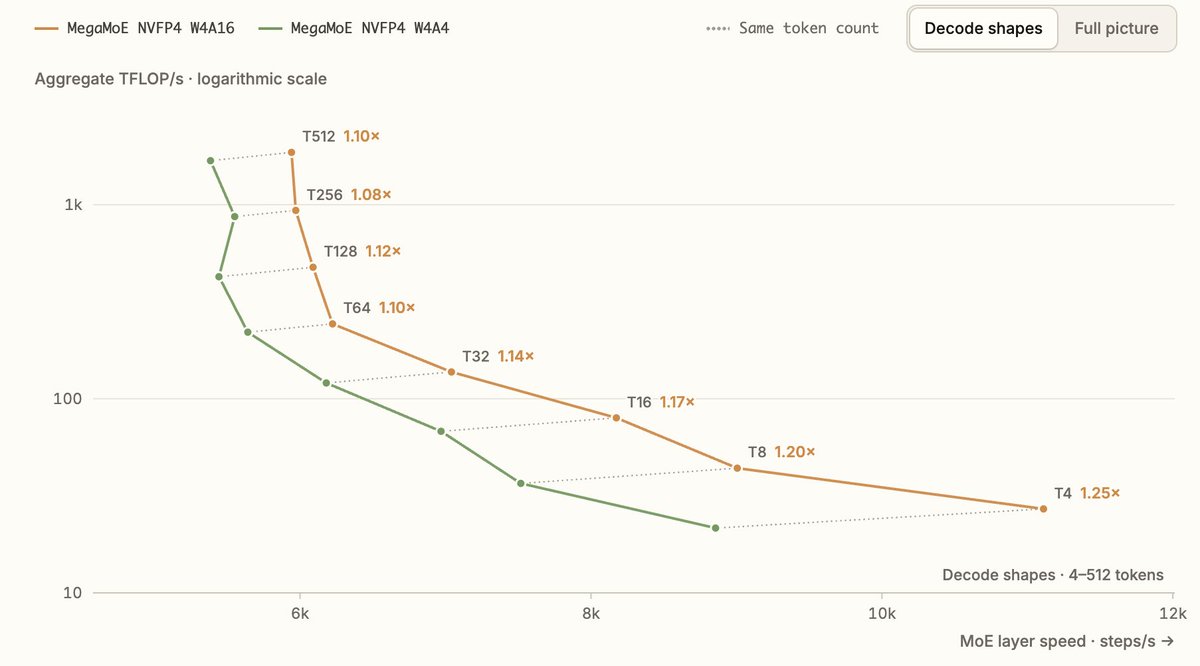
We accelerated one of the most optimized NVFP4 decode kernels while also making it more accurate
Fewer bits typically mean more speed but less accuracy. We did the opposite: more bits, but up to 10% faster generation
Already used in Ampersand’s RL and Boba serving
Very touched by @ljsv89 's story and the work with @ShriramKMurthi and @JoePolitz. AI without PL and Systems foundations leads to mirages.
Fundamental research is driven by curiosity, interest, and the desire to learn and to understand. Sometimes, it's hard to connect dots forward and calculate the immediate practical benefits.
Most importantly, one can do fundamental research even through MOOC (see @ShriramKMurthi 's blog post: https://t.co/G8eTIDzPrh).
> the three outsiders were an undergraduate student, a professional programmer, and a retired IT professional who now does triathlons [...] from Argentina, China, and India.
The result is a tested operational semantics for Python, which is used by Anthropic after 13 years.
Congrats, everyone! What a story!
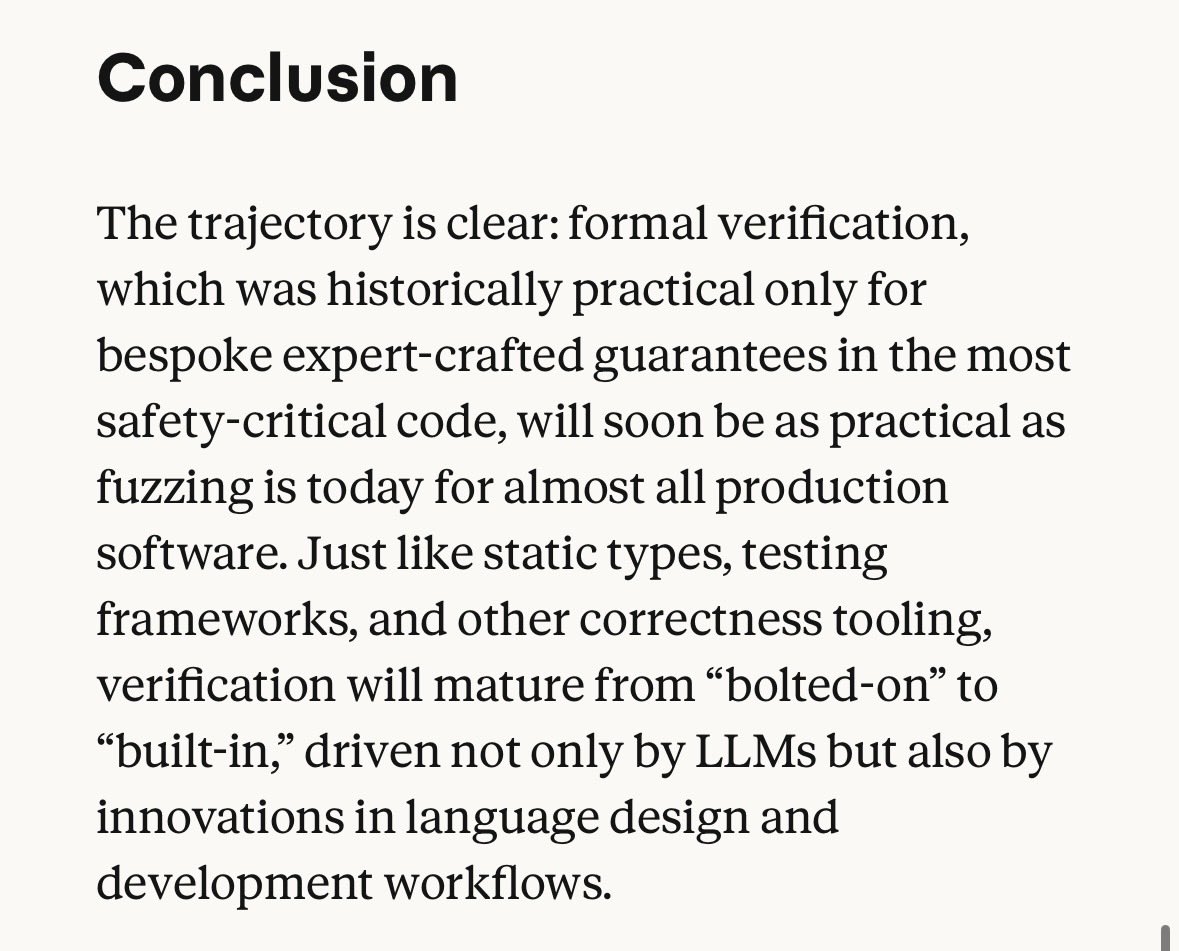
New on our Frontier Red Team blog: using Claude to formally verify software at large scale.
Formal verification can prove that code is free of certain bugs, but historically it has only been feasible for small codebases (or required a lot of expert time).
With AI models, however, this is beginning to change. In collaboration with @theoremlabs, we used Claude to prove security properties in over one hundred real-world open-source libraries over the span of a few weeks.
Read our research in full here: https://t.co/zUyx8CjBEk
Today we launch SGLang-TorchTPU, built with @Google TPU team and Meta @PyTorch team.
We’re excited to see it powering production inference at Meta!
SGLang-TorchTPU is a TPU plugin for SGLang that brings:
- Top open models on TPU: Muse Spark Open, GLM-5.3 Flash, Kimi K3, Ling 3.1 Flash, MiniMax H3
- SGLang’s production features for large agentic workloads
- Custom MegaKernel: Muse Spark Open hits 770 tok/s decode at bs=1 on InferenceX 8K/1K
SGLang-TorchTPU is available now: https://t.co/ix02YggKGG
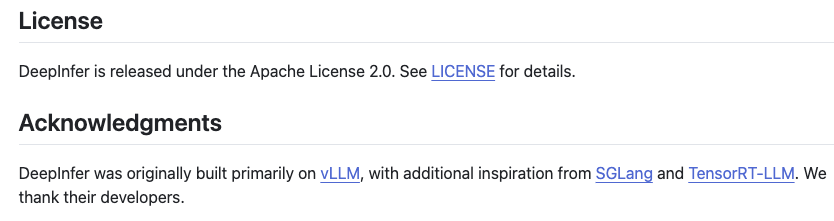
Grateful to @deepseek_ai for releasing DeepInfer, initially built primarily on @vllm_project, under Apache 2.0 and crediting the open-source community!
We've worked hard on DeepSeek V4.1 Flash inference efficiency and will keep improving with ideas from DeepInfer! Stay tuned 🙌