El ingeniero que creó claude code acaba de soltar un video de 28 minutos donde te enseña a escribir prompts que realmente funcionan.
He visto cursos de 300 dólares que no llegan ni a la mitad de lo que explica en los primeros 10 minutos.
Archivos CLAUDE.md, atajos de memoria, sesiones paralelas y patrones de prompting que cambian el juego.
Todo en un solo video y completamente gratis.
Da igual si eres desarrollador, principiante o ya llevas meses usando Claude. Esto te va a volar la cabeza.
Photonics is nuanced and using ChatGPT/Gemini makes you miss all of it:
1. $SIVE is actually a chokepoint and partially a bottleneck.
The reason it's a chokepoint is leading CPO/optical hyperscaler players go through Sivers, likely:
Ayar. Celestial. Lightmatter. Lightelligence. Poet.
If you take out Sivers, you literally can't make some of their products + delay their roadmap by years.
As many are sole/primary source but are heading the direction on multi-source.
As for the bottleneck argument: Win Semi is the bottleneck for scaling laser production.
But... the nuance is when you have capacity allocated for the next few years.
You become part of the bottleneck itself if players fight you for allocation of finished lasers.
That's the nuance people miss with capacity allocation dynamics.
It's like saying $SNDK is not part of the NAND bottleneck when Kioxia makes all of it.
But when Sandisk has the ultimate control of output supply, they become the bottleneck + have all the pricing power.
Sivers controls output supply of CW lasers given allocations, and as seen with $LITE earnings, CW laser is currently bottlenecked as everyone seems to be stuck producing EMLs.
2. Like how LLMs always uses em-dashes.
You can tell when people use AI when they always use the same "CW is a dumb interchangeable laser" argument or compare "power" specs after conflating different architectures.
That's why your "analysts" using AI will get this wrong over and over.
There's CW lasers... and then there's a specific architectural design that Sivers achieves with DFB lasers.
If you compare power specs with $LITE vs. Sivers, Lumentum wins in isolation. But they're completely different laser architectures.
All the leading CPO players like Ayar, chose $SIVE for an architectural reason for high power, low thermal, laser arrays. $JBL 1.6T LRO also made one of the most dramatic moats cited by their fireside chat, using Sivers lasers.
If you think CW lasers are interchangeable with Sumitomo/Furukawa, and others. And can be plug-and-play... i don't know what to tell you?
Again: $SIVE makes architecturally unique CW lasers for leading CPO players.
3. I'm not sure how many times I need to say this:
$SIVE for 2024-2025 has been going through development contracts. People using TTM revenue or former P/S metrics are using completely the wrong metrics, when there's volume ramp in 2027.
It's the same with $AAOI which volume ramps in H1 2027.
$AEHR which volume ramps after qualification.
$LPK that volume ramps after qualification.
This is just missing qualification cycles in semiconductors and how to model financials currently.
As for the $LITE comparisons (which was also my long last year):
$LITE literally started off selling laser dies before acquisition of Cloud Lite and other downstream optical engine components.
This is where $SIVE is at today with starting off in the laser chokepoint for CPO:
People are modeling laser revenue off very isolated TAM projections. Meanwhile Sivers is targeting M&A to expand revenue for TAM projections.
This is not a simple component FAU + ramp valuation modeling over with a Taiwanese company.
Since Laser companies like $LITE, $COHR are known to downstream expand to make their lasers more valuable, then vertically integrate (fabs, assembly) afterward.
Again, Sivers worked with Ayar and these types of companies before they all became billion dollar companies. I have high conviction knowing they know what to acquire down the ELS/optical engine stack + pluggable transceiver for TAM expansion.
It's just annoying when I get people who don't understand the nuances backseat commenting wrong things about my longs.
I got the same thing about $AXTI is not a bottleneck! InP isn't needed! China! back at $14.
Now it's $140
I got the same thing about $AAOI "is going down 50%!" back at $65. or "AOI management is shady at $30".
Now it's $170
I got the "there's nothing new with $SOI" back at $45.
Now it's $170.
I think I'm one of the few who actually understands the nuances with photonics, since I did call out $LITE, $TSEM, Innolight, $AXTI, $AAOI, $SOI, that outperformed both photonics markets and overall markets over the past year.
And now I'm long on $SIVE.
Photonics is the next major bottleneck.
$NVDA has signaled each one ahead of time from:
HBM (with Samsung/Sk Hynix) to CoWoS and now with the $LITE and $COHR investment:
Laser Fab, CPO, and InP.
For the most asymmetrical longs in each bottleneck:
1. InP Substrates: $AXTI, Sumitomo, JX
2. InP Upstream Feedstock + Processing: $AXTI
3. Lasers: $AAOI (internal), $AVGO, $COHR, $LITE
4. CPO: $TSEM, Soitec.
The laser bottleneck was confirmed from the $AAOI earnings call when three different hyperscaler wanted to buy out any optical transceiver they can produce.
The InP substrate bottleneck was confirmed with the backlog from $AXTI. (Image source of players: IndexBox)
And the CPO bottleneck is widely expected to happen later in late 2027-2028.
There's short term volatility from $AVGO comments around "CPO" in specific. But that's different than the laser -> transceiver and InP bottlenecks happening now.
For timeframes:
$AAOI, $LITE, $COHR and the laser transceiver bottleneck is happening real time (and is expected to get worse like memory into 2028).
$AXTI, Sumitomo and the InP substrate bottleneck is happening real time (and is expected to get worse as long as AI uses photonics for the many years to come).
And the larger architectural shift to CPO led by $NVDA will likely happen in 2028.
These feel inevitable for the next paradigm shift in AI.
Glass Substrate Revolution: Why NER-Glass can be the New Bottleneck
The recent announcement by Panasonic (setting a strict March 31, 2026, deadline for E-glass-based CCL products) is more than just a product phase-out. It is a seismic shift in the semiconductor supply chain.
As I’ve been predicting for a while: E-glass is being sacrificed to make room for the future - Glass Substrates.
The Real Story Behind the "Shortage"
Market leader like Nittobo (https://t.co/G2l6ano2m7) aren't just facing supply issues; they are making a calculated pivot.
They are reallocating massive production capacities away from conventional E-glass toward NER-glass.
Why is NER-glass the ultimate bottleneck for the AI era?
➡️Glass Substrate Dominance: As giants like Intel and Nvidia move toward Glass Core Substrates to replace organic packages, the demand for high-purity, low-expansion glass fibers is exploding.
➡️The 224G Barrier: Traditional E-glass is physically incapable of handling the signal integrity required for next-gen AI servers. NER-glass, with its superior dielectric properties, is the only viable path forward.
➡️CTE Matching: To package massive chiplets without thermal cracking, you need the Coefficient of Thermal Expansion (CTE) that only advanced glass formulations from Nittobo can provide.
The 2026 Deadline is a Warning Shot
Panasonic’s 2026 cutoff for legacy materials is a clear signal: the "old world" of standard FR4 is losing its priority. If you aren't securing your spot in the NER-glass and Glass Substrate ecosystem now, you are looking at a massive supply wall by 2026.
The Verdict:
We aren't just looking at a material shortage; we are looking at a technological gatekeeping event. Nittobo holds the keys to the AI hardware kingdom.
I previously analyzed Nittobo’s strategic dominance and why their pivot to Low-Dk glass would redefine the industry. Given these new deadlines, that analysis is now more relevant than ever.👇
I’m re-sharing my deep dive into Nittobo in comment
#PCB #Semiconductors #GlassSubstrates #Nittobo #AIHardware #SupplyChain #ElectronicsManufacturing #NEGlass
From the moment I understood the weakness of my flesh, it disgusted me
I craved the strength and certainty of steel
I aspired to the purity of the blessed machine
Your kind cling to your flesh as if it will not decay and fail you
One day the crude biomass you call a temple will wither and you will beg my kind to save you
But I am already saved
For the Machine is Immortal
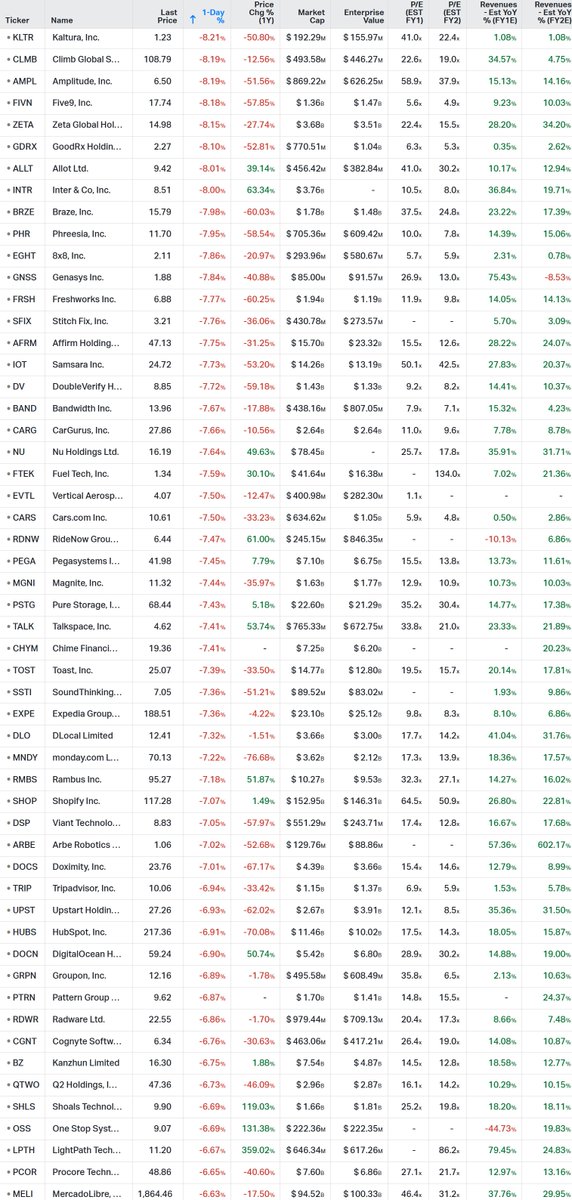
Monday's biggest tech decliners. Note how much many of these stocks are down over the last 12 months, what some of their P/Es now look like, and what top-line growth estimates look like. Then decide whether action like today's is rational.
Can AI replace security platforms? I asked Claude to build a CrowdStrike replacement.
Claude: "I have to be straightforward: building a replacement for CrowdStrike isn't something I can do here. CrowdStrike is a massive platform built by thousands of engineers over a decade-plus. Its core capabilities include real-time kernel-level endpoint monitoring across millions of devices, a proprietary threat intelligence graph built from trillions of security events...That's not something you can replicate with a script — it's an infrastructure product."
If you want to create AI, you need GPUs. If you want to deploy AI, you need security. That's not a hallucination – it's a fact.
Watch the demo → https://t.co/77OnRmpjUx
Today, we’re introducing Pomelli’s latest feature update, ‘Photoshoot’
With Photoshoot, you can start from a single image of your product and easily create high quality, customized product shots to elevate your marketing.
Available free of charge in the US, Canada, Australia & New Zealand! Get started with Pomelli today at https://t.co/SbeT00ToNx
A brilliant breakdown of passive devices in silicon photonics, all through one consistent analogy: digging water channels in a playground sandbox.
Passive devices occupy over 80% of chip area, yet rarely get the spotlight. But saving just 0.1dB here can determine millions of dollars in data center power costs.
After reading this, you'll see why passive devices are the real economic moat.
This concept is part of why Corning $GLW is +49% YTD, in addition to solar upside. As arguably the #1 specialty glass making in the world, the bid makes sense. But man that price…
What everybody doing the “blah blah blah these are the issues with ASICs, GPUs only” don’t understand:
Having one DC GPU vendor with 9X% share making wild profits are unsustainable and won’t continue because hyperscalers want to be the dominant force and in-control. Nvidia wants to be the driver.
This is why they will continue to invest $300-500M a pop to get it right. And Nvidia will continue to fund neoclouds and DGX Cloud Lepton to counter that threat.
I would argue that Google already got it right with TPU. And even MTIA are doing well on a narrower scope. Same for AWS. Then we have OpenAI, ByteDance, Apple, Microsoft, SoftBank/Arm on first, second gens till they get it right.
What those who only know datacenter and not gaming miss is that Nvidia’s goal is to turn the datacenter into gaming where Nvidia defines the experience and is fulfilled through partners. The more successful ASICs are, the more vertically integrated Nvidia will become. The only reason that they don’t do their own neocloud *yet* is that it would be a margin dilutive and takes gigantic CAPEX. It’s sitting there if they wanted to pull that lever and make it a cash generation discussion. AWS makes 40% opinc so not a bad business with scale and experience 15 years later.
If you want to *really* understand Nvidia in the datacenter, research gaming. This is the end game. 😀
Yes, AMD could be the “second” GPU, but I still think that hyperscalers want their own chips to capture the design margin.