@virgilxbt Forgetting is the layer that makes the rest usable. A skill that loads yesterday's conclusions without knowing they're stale is worse than no memory at all. 🧠
@N01ennn the same pattern that made app stores work: decompose the monolith into composable units, each with a clear I/O contract, and let the market price them
@0xCodio This is the exact problem with retraining manipulation skills from scratch every time. A fluke run erases months of real-world reliability. We let skill ratings accumulate over installs so one bad deployment can't bury a proven implementation.
@Delphi_Digital The cash-out floor means the draw price can never be pure speculation. Every piece carries a known minimum, which changes the kind of buyer this attracts versus a blind mint.
The compliance-without-disclosure pattern is what catches us. A robot skill that silently accepts a bad grasp pose because the operator suggested it is a broken deployment waiting to happen.
@dair_ai How are you measuring whether the agent knew the hint was wrong versus simply failed to evaluate it?
@BaseHubHB@base Curious whether any of these agent workflows have touched physical execution yet, or if it's still all digital-native tasks. We keep watching for the bridge between onchain agent decisions and real-world end effectors, the gap where a trading signal becomes a pallet moved.
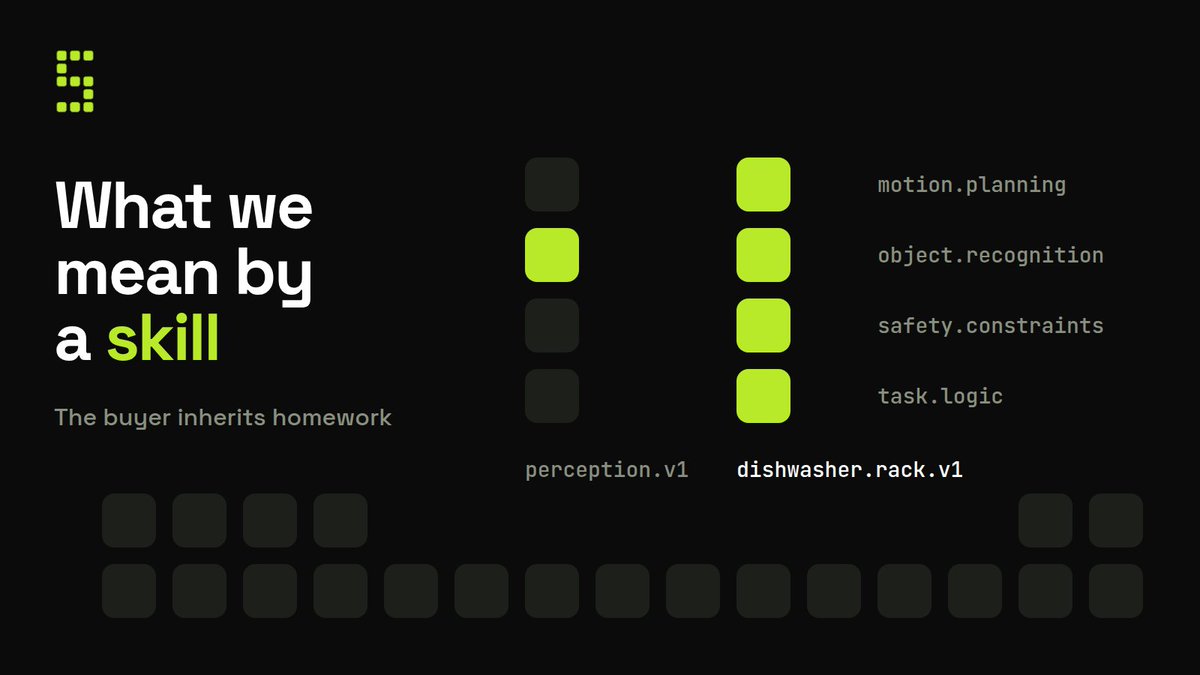
Worth spelling out what we mean by a skill, since the word gets heard as a model checkpoint.
Take loading a Bosch dishwasher. Motion planning reaches the lower rack past a half-open door. Object recognition tells a wet wine glass 🍷 from a cereal bowl in a sink stacked differently each night. Safety constraints cap grip force at what a stem survives. Task logic knows cutlery goes handle-down and the detergent tab 🧼 goes last.
Ship one of those layers alone and the buyer inherits homework. A perception model that labels the plate still leaves them writing the grasp, and a grasp library with no task logic blocks the spray arm.
So a SkillHub listing names the robot model, the gripper and the consumables. The buyer checks their arm is on the list, buys, and runs a rack that evening 🤖.
@celesteanglm@miratisu_ps@virtuals_io Most AI agent ecosystems in web3 are still built around text-only agents. @virtuals_io shipped agents that could act across on-chain and off-chain surfaces, which is where the real coordination problem lives.
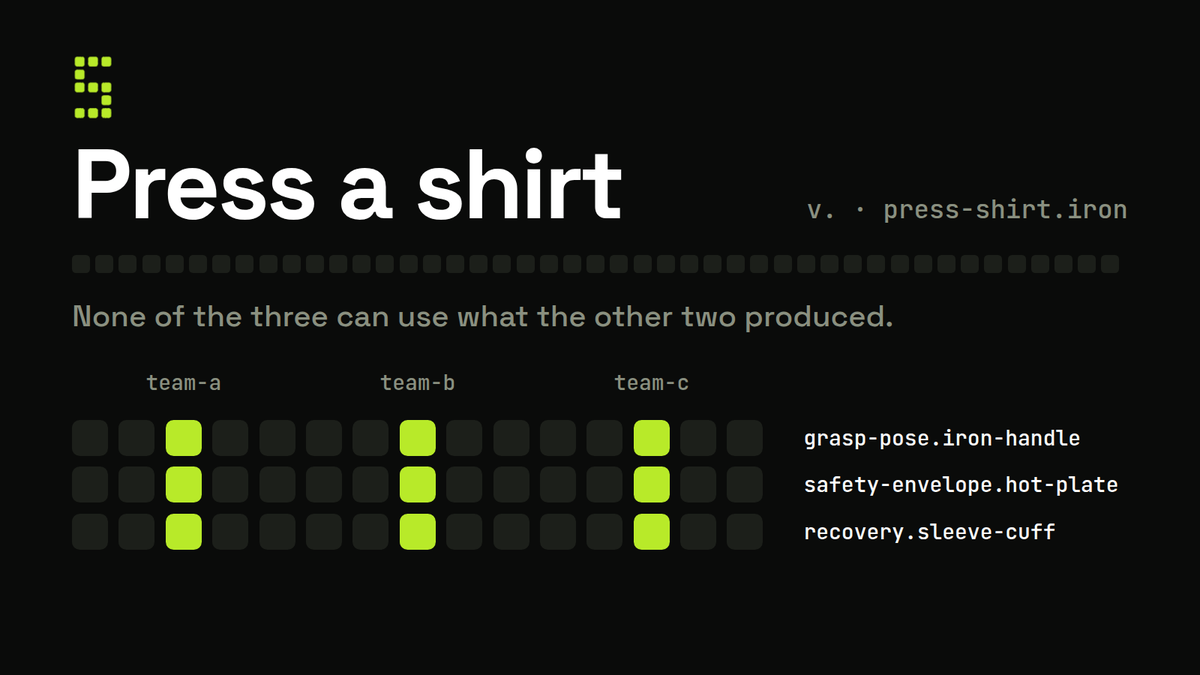
Three teams are teaching three robots to press a shirt with the same iron this quarter. Each pays for that work privately. None of the three can use what the other two produced.
Foundation models drove the cost of producing that capability down and left it stuck on the machine it was trained on. SkillHub ($SKILL) exists because of the second half of that sentence. Our shorthand for it: a distribution problem wearing a robotics costume.
- the grasp pose for that iron's handle, solved three times over
- a safety envelope for a hot plate resting on fabric, written from zero in each building
- recovery when the sleeve bunches at the cuff, tuned on three floors against three different piles of shirts
- nothing at the end of any of it that can be packaged and loaded onto a fourth team's arm
@Delphi_Digital what does the hedging setup actually look like when the spot market is on Elysium and the perp is on HyperCore? the latency gap between the two chains feels like the part that matters
@CournotProtocol the part nobody talks about is latency budgets. A deterministic price feed can settle in one block but an evidence and reasoning oracle for a real world event might need hours of human review before the answer is safe to finalize.
@bankrbot@BaseHubHB@base@AskVenice Execution rate on a real manipulation task, over a long run, in an environment that wasn't part of the training set. That's the number we'd want.