Director of Public Policy @DCGco | @Grayscale @FortitudeCrypto @FoundryServices
@LunoGlobal @YumaG | Co-founder @BtcVets. Speaker, Author. Views my own
Grateful to @coincenter for publishing this and allowing me to be their first guest-post!
Practical obscurity protected people because compiling a life from scattered records was expensive. Digitization and AI inverted that cost structure. Engineered obscurity restores it by permitting verification without compilation.
Digitization and AI have erased the costs that once protected our privacy. A new generation of cryptography is bringing them back.
Peer-to-Peer's first guest post. From @GoBankYourself https://t.co/cd5vsgyrP6
Data is a liability the moment it leaves the building.
Privacy tech flips that. When models run on hardware you control, sensitive and proprietary work becomes safer instead of off-limits.
Apple is testing exactly this with Harbor: a private AI server that keeps every prompt and document on your Macs. The model comes to the data. The data stays put.
Apple is working on a new app called Harbor
Harbor turns your Mac into a private AI inference server. Run open-weight models locally on Apple silicon—your data never leaves your hardware, and nothing reaches the cloud. Connect multiple Mac computers over Thunderbolt 5 to pool unified memory, enabling large models and higher concurrency that a single computer can handle alone.
Set up in minutes, not hours Harbor automatically detects your devices over Thunderbolt 5 to form a cluster. Plug in, start, and you’re running—no manual configuration, no command line, no infrastructure expertise required.
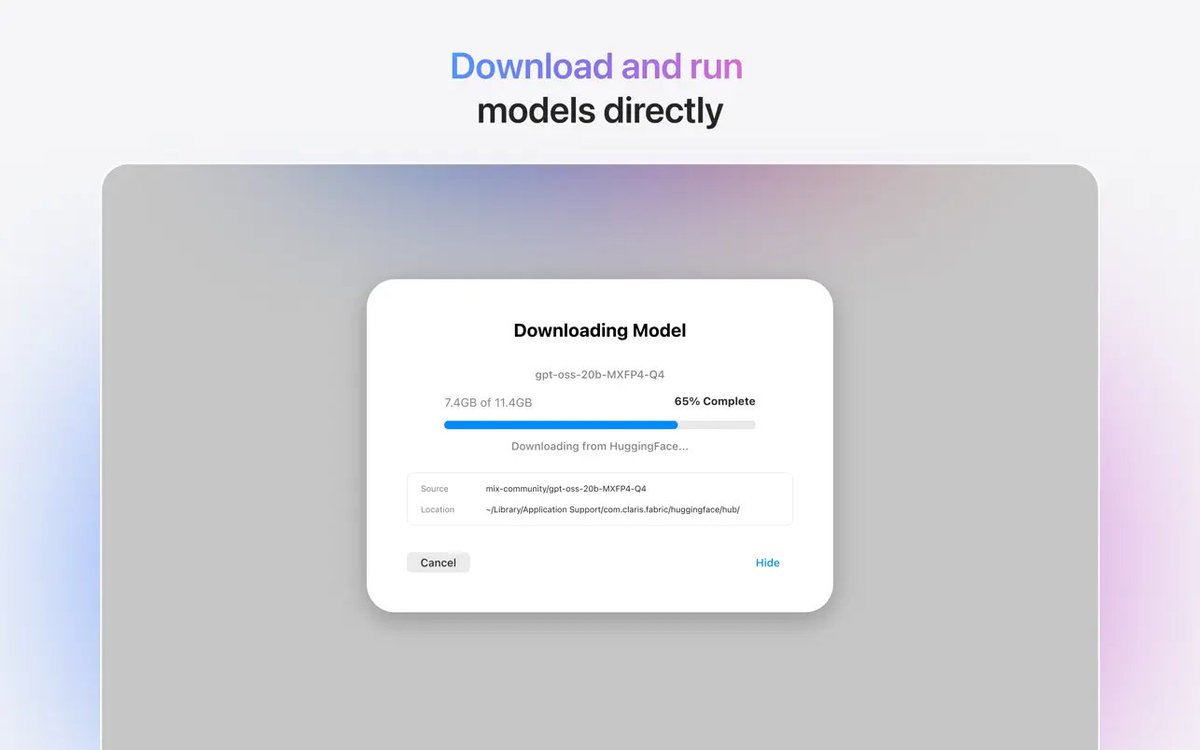
Download and run models directly Browse, download, and load open-weight models from within the app. Harbor handles model management so you can focus on the work, not the setup.
Cluster for scale Connect two or more Thunderbolt 5-capable Mac computers and Harbor pools their unified memory into a single inference resource. Run models that exceed any single computer’s capacity, or serve more concurrent requests across your cluster.
Harbor is currently in a private preview under the Claris brand.
We’re all in on Zcash.
Today, we’re kicking off a national campaign to support the community and also launching https://t.co/TdKentAIwI, a hub to educate people and help them consider an investment in this privacy-focused asset (zcash:native).
Join us in celebrating the Next Era of Crypto. #ZcashEra
Today Physical Superintelligence PBC is announcing a proof of the Aaronson-Ambainis conjecture, one of the central open problems in quantum complexity, with major implications for quantum computing speedup.
https://t.co/sAewkKdSOu
Thread 👇
10 years ago, we launched Zcash, making a private version of Bitcoin. But the origins go back to the 80s, when, in the wake of the Watergate scandal, cryptographers first dreamed of private electronic cash, and the story runs through Satoshi’s invention of Bitcoin.
Zerocoin came three years before Zcash launched in 2016. We’d written it as a zk-mix for Bitcoin, and then a year later, Zerocash, which introduced SNARKs to cryptocurrency and is now the de facto approach to private payments on chain.
More than 30 years before that, in the early 80s, cryptographers first dreamed of private electronic payments. This was right after the invention of public key cryptography, the Watergate scandal, the Church Committee’s revelations of intelligence agency wrongdoing, and an ongoing fight between the nascent academic crypto community and the government over regulations and alleged backdoors.
It was also right as it became clear that the growth of the internet and electronic payments would pose a major surveillance risk. Today, there are a number of cryptographers who think crypto is simply math, devoid of purpose, and a number of folks in cryptocurrency who do not care about privacy (or perhaps even cryptography). That was not the case in the 1980s.
Starting with David Chaum, cryptographers first designed e-cash, a centralized private payment scheme that required a trusted bank to blindly sign special tokens. These went nowhere: existing trusted institutions, like banks, didn’t adopt the protocols, and no one wanted to trust magic internet money run by a strange company. Then Satoshi invented Bitcoin, overcoming the trust issue by inventing a blockchain. Bitcoin’s key innovation was the blockchain, which replaced a trusted bank with a public database anyone could participate in running. Because anyone could participate, it got off the ground without convincing a bank to run it. But because anyone could participate, there was no privacy: everyone could download the database of payments. And we couldn’t just use an e-cash scheme, as that required someone to keep a secret signing key, and the entire point of Bitcoin was that no one had to be trusted.
This is where Zerocoin, Zerocash, and Zcash come in. They replaced the e-cash system with a zero-knowledge proof and, this fact is not well understood by many, strengthened the privacy of e-cash schemes by giving the recipient full privacy even if the bank was malicious.
Why We Mine Zcash.
We believed in Zcash long before privacy became a mainstream conversation.
As Zcash marks its 10th anniversary, we’re sharing why we believe in the network, the infrastructure we’re building to support it, and our long-term vision for its future.
Read our manifesto below. $ZEC
See important additional information here:
https://t.co/HfUiQkVs1n
Great to see new polling from @fund_defi reaffirm @DCGco findings from earlier this year. Financial privacy and control over personal data are priorities for Americans.
74% value financial privacy, 80% want more control over their data, and 62% prefer privacy in financial transactions.
A Samsung TV got rooted. What allegedly showed up wasn’t a bug—it was the product: always-on mics, content recognition, network mapping & continuous personal data extraction feeding Samsung +400 partners. Its security features protect the collection, not the user. Engineering obscurity is the opposite design: https://t.co/lIbJwpG4AT”
i own a relatively new (2025) samsung tv.
i kept getting weirdly targeted ads.
i tried reversing the firmware but it was aes encrypted and no keys unless tear it apart and do uart/jtag magic.
zero days it is. root shell on new samsung TVs!
discovered PRIVACY HORROR. write up?
Patrick Witt worked tirelessly in his role shaping crypto policy, and the industry benefited from his leadership. Public service rarely gets the appreciation it deserves and he stepped up at every turn. Thank you, @patrickjwitt!
In a @coincenter essay I argued our old data collection habits are incompatible with digitization & AI: we assemble the whole profile to answer one question. Today's Supreme Court case is a result. Salazar says a site tied his viewing history to his identity and sent it to Facebook for advertising. The Court will decide if a 1988 video rental law protects him. Engineering obscurity says his profile need not be assembled at all. https://t.co/dvgPywJBzO
The argument on the Salazar case is occurring now, with Joshua Hammack speaking for the challengers of the sale of viewing data. He is doing an excellent job but he is facing some skepticism on both sides of the Court in the "repurposing" of a 40-year-old statute...
The Ninth Circuit just ruled that a leak of your health data is itself an injury. No identity theft or misuse needed. You can sue.
Every company sitting on personal data now holds a lawsuit waiting to happen.
Data is becoming a liability.
https://t.co/AsSbKogvkC
Once identity data is pooled and queryable at scale, compiling 8.8 million files is cheap. Engineered obscurity restores the cost.
https://t.co/EeJxvgc068
https://t.co/KnHXh3JiTn
American AI leadership requires U.S. open-source technology as the foundation other countries build on. As China pairs open models with affordable infrastructure and training, America needs competitive alternatives, writes BPI's Head of Government Affairs Ken Egan @Bayman11771 in @thecipherbrief.
That means capable open models, affordable hardware, financing, and support that give partners control over their AI systems.
Read more: https://t.co/8xWlcEA0uf
Sacks: when labs “align” a model, ask to whose values.
That’s the decentralized AI/Bittensor case in point. Miners produce the work. Validators score it. Community consensus turns those scores into rewards. Value judgments aren’t declared opaquely by one lab.
Just a couple decades ago, public records stayed mostly private because accessing them took real effort. The Supreme Court called it "practical obscurity."
The internet reduced the cost of accessing public data, and AI has made it easier still. Assembling data about almost anyone on the planet has never been easier.
@GoBankYourself on how zero-knowledge cryptography can rebuild that protection by design, via @coincenter:
https://t.co/cSlS3G7EdS
“We digitized the data but kept the analog procedures”
Check out the latest essay from @GoBankYourself - "Engineering Obscurity" which explores the current state of privacy in the AI era, featured today in the @coincenter Peer-to-Peer newsletter
It is fair to say that the part of our work that I am most interested in these days is around the future of privacy in this weird digital world that is developing, which is why this piece @GoBankYourself wrote for us resonated so much. Definitely worth your time to read.