Deep in the Canadian Arctic, we joined Canada North Outfitting in pursuit of walrus. A hunt where even a 20-yard shot can be one of the toughest you'll ever make.
Our latest film, The Arctic Circle, is LIVE. Watch now: https://t.co/TYTO7SHOlU
In this video, Marc Andreessen says he practices "zero" introspection. As little as possible. He just wants to move forward.
The internet turned it into a meme for days.
I think he's right. And I'll go further.
Overthinking, the need to dissect every emotion, to rationalize everything, to replay everything: it's a cancer of our time.
For a simple reason. The moment you live in rumination, in whining, in resentment, constantly looking for who attacked you and who owes you something, you block your creative potential. You stop moving. You go in circles inside your own head.
And that's usually what eats you alive. Not other people. Not events. The loop.
Epictetus wrote it two thousand years ago: men are disturbed not by things, but by the views they take of them.
In France, that loop is supercharged by one thing: there's no growth anymore.
When the pie grows, everyone can hope for a bigger slice by building. When the pie stops growing, the only way to get more is to take from someone else. So people watch, compare, accuse. Resentment becomes the national sport.
No growth, no hope. No hope, no reason to move forward. And without movement, all that's left is rumination. The worst of all worlds.
If you want out, two things.
First: don't take anything personally. Nothing.
Second: separate your identity from your actions and your ideas. You are not what you say. You are not your last post, your last project, your last opinion.
Paul Graham nailed it in 2009 in an essay that became a Silicon Valley classic: Keep Your Identity Small. The more an idea becomes part of who you are, the less you're able to discuss it rationally. Every criticism feels like an attack.
Flip it. The day you accept that everything you say can be challenged, and that you can be wrong, you stop taking almost anything personally. A critique of your idea is no longer a critique of you. It's information.
That's Karl Popper's stance: I may be wrong and you may be right, and by an effort, we may get nearer to the truth.
People often ask me how I handle everything I get thrown at me here. That's the answer. I spend my time thinking out loud, knowing I can be wrong.
If someone gives me constructive feedback, great: I learn something.
If someone attacks me ad hominem, I mostly feel sorry for them. Because that's someone who's stuck. Someone who needs to destroy to exist. They're trapped in exactly the loop I'm describing.
Now zoom out.
I believe our comfort-based societies, rotted by cultural leftism, have manufactured neurosis at scale.
A culture that teaches you you're a victim, that every word can hurt you, that your feelings are facts, that the world owes you reparation. Jonathan Haidt and Greg Lukianoff documented it in 2018 in The Coddling of the American Mind: protect people from every discomfort and you make them fragile.
The result: I think a huge number of adults today are still teenagers.
Not in age. In mind.
We stopped teaching courage. We stopped telling kids that life is hard, that it's supposed to be hard, and that this is exactly what makes you grow. So a big part of the adult population stays stuck in a teenage mental state. Everything is about them. Everything is unfair. Every frustration is a wound.
And a teenager in an adult body is fragile. Very, very fragile.
The numbers are there. In France, around 8.5 million people were prescribed at least one psychiatric drug in 2022, according to the national health insurance system. Roughly 3.3 million on antidepressants, nearly 3 million on anti-anxiety meds. Among 12 to 25 year olds, antidepressant use jumped about 60% between 2019 and 2023.
I'm not saying these people are weak. Many are genuinely suffering, and these treatments save lives. I'm saying a society that produces this much psychological pain should ask what it's teaching its kids.
There's a line from the novelist G. Michael Hopf that sums it all up:
Hard times create strong men. Strong men create good times. Good times create weak men. And weak men create hard times.
Ibn Khaldun described the same cycle in the 14th century.
We're living the third line.
The great builders of history didn't spend their lives watching themselves think. They looked ahead. They built.
Introspection locks you inside your head.
Action gets you out.
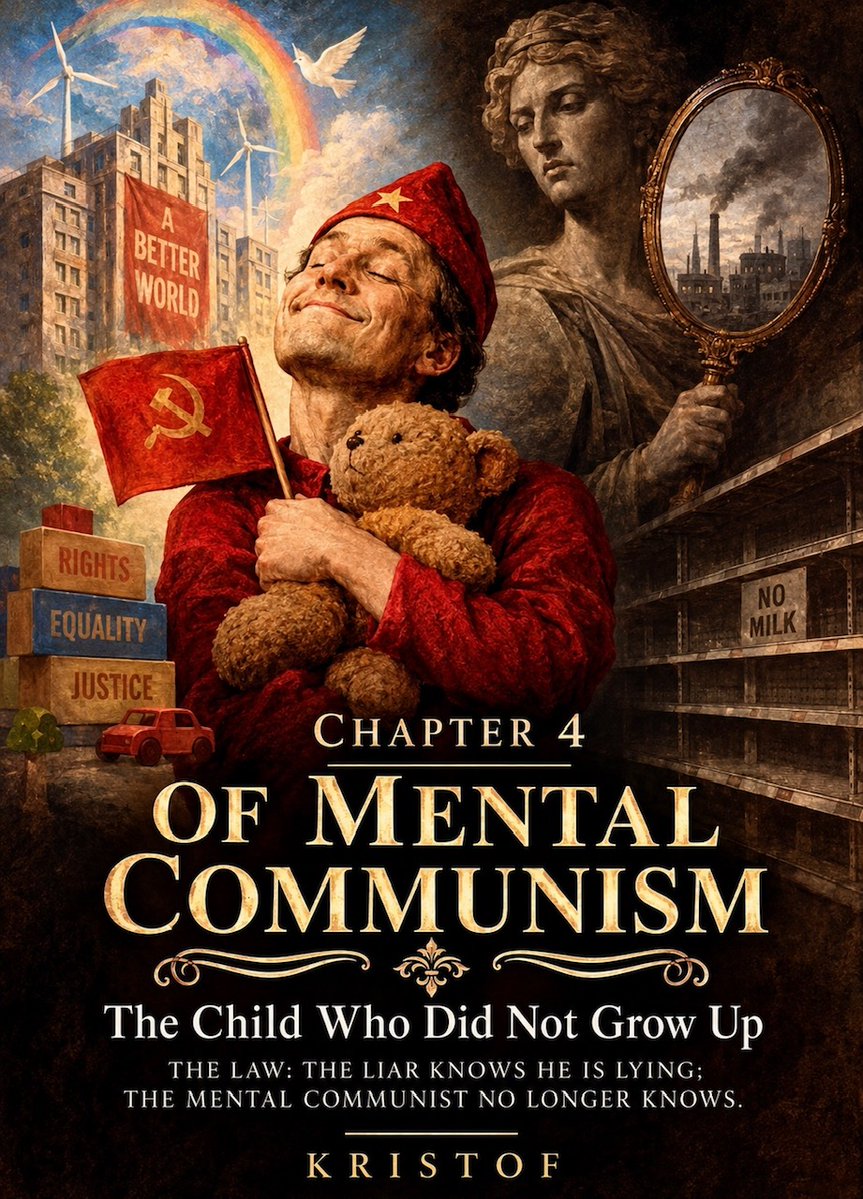
Chapter 4 – Of Mental Communism: the Child Who Did Not Grow Up.
The law: the liar knows he is lying; the mental communist no longer knows.
§1. Communism only partly fell in 1989. The regime fell – the party, the censor, the secret police. The habit of mind survived, and it traveled west. We call it mental communism: communism without the secret police, carried in the head. The liar of the old regime knew the truth and hid it. The mental communist has gone beyond the Lie. For him, reality does not exist – only wishes, words, poses and power.
§2. The greengrocer knew. When Havel's greengrocer put the sign in his window, he did not believe a word of it; he wanted to be left alone. That was the Lie in its classic form: everyone knew, nobody said. But a lie repeated long enough changes the people who repeat it. The first generation lies out of fear. The second repeats out of habit. The third believes – unless reality intervenes. In the East, it did: the empty shelf taught every day what the newspaper denied. In the West, comfort kept reality away. That is why communism ran out of believers where it ruled – and found new ones where it never did. The West kept the dream because it never had the wound. In the end, the Lie no longer needs liars. It has believers.
§3. Psychologists show small children a sponge painted to look like a rock. A three-year-old cannot hold both ideas at once – what a thing looks like and what it is. Around four, he can: it looks like a rock, but it is a sponge. At about the same age, he learns the harder lesson: wishing does not make it so, saying does not make it so, and the world has its own rules. Normally, children figure it out around four. The mental communist does not. He still believes that what is declared becomes true. Declare a right to housing, and houses appear. Print money, and wealth appears. Ban a word, and the thing disappears. The child says: I want. The mental communist says: I have a right to.
§4. In a child, this is fantasy, and it is charming. In an adult, it becomes delusion. In an adult with power, it becomes policy – and the rest of us have to live inside it. At best, the mental communist lives in models: the plan, the spreadsheet, the forecast, the simulation. When the model and the world disagree, he does not correct the model. He concludes that the world is wrong – and sets out to correct the world.
§5. Appearances come before reality. A child wants the costume, not the job. The mental communist is the same: what matters is to look good, not to do good. The right words, the right flag in the profile picture, the right slogan on the right tote bag. The wind turbines count for more than the electricity, the electric car for more than the coal that charges it, the intention for more than the result. Being good would require reality to check the work. Looking good requires only an audience. That is why he gathers where reality never checks: in the faculty, the newsroom, the NGO and the ministry.
§6. When reality does not exist, only power remains. If there are no facts, only narratives, then the only question is who controls the narrative. "Is it true?" gives way to "Who is speaking?" and "Whose side is he on?" A child who does not get what he wants throws a tantrum. A man who never grew up, given power, passes a law – then another to punish those who notice it does not work.
§7. Mental communism is a luxury. It survives only where someone else pays for reality: the parents, the taxpayer, the next generation. It fell in the East because there was nobody left to pay. It flourishes in the comfortable districts of Paris, London and New York, among people who have never borne the cost of their opinions. Communism forced the East to grow up. Comfort let the West stay a child. And the state, as it grows, becomes the last parent: the one who pays for everything, forgives everything, and never lets the child meet the world.
§8. You cannot refute a wish with a fact. Facts do not reach a mind for which reality does not exist; they bounce off as insults. So the mental communist does not answer the fact. He answers the person: racist, fascist, extremist. Arguing with him is like explaining to a three-year-old that the rock is a sponge. You are right, and it changes nothing. Children grow up in only one way: reality teaches them, gently or brutally, provided no one shields them from it. The mental communist is the child who was always shielded – by his parents, then by the university, then by the state.
The counter: the cure for a child who will not grow up is not argument. It is consequence. Do not shield him from reality, and do not pay for his wishes. Let every opinion carry its cost, and let those who vote for a policy live under it. Each time the cost of an idea falls on the man who holds it, a little mental communism dies. Reality is the only teacher he cannot cancel. Our task is not to replace it – only to stop standing between him and it.
Next: Chapter 5 – Of Its Fuels: Envy and Fear.
Ambre a raison, les gauchistes et les droitards sont câblés différemment.
C'est la fameuse étude de la heatmap gauche/droite (Waytz, Iyer, Young, Haidt & Graham, 2019)
Deux tempéraments opposés se distinguent. Le conservateur concentre sa compassion sur ses cercles proches. Le progressiste la concentre sur des cercles lointains et abstraits.
Et cette différence explique pourquoi l'un parle du monde pendant que l'autre parle des siens.
Pour le comprendre, il faut donc lire l'étude de Waytz, Iyer, Young, Haidt & Graham, publiée dans Nature Communications (vol. 10, article 4389, 2019).
C'est en fait un ensemble de 7 études. Les deux plus importantes ont interrogé environ 14 000 personnes, avec une seule question : où va la préoccupation, vers le pays ou vers l'humanité ?
Le résultat ?
Plus on se dit conservateur, plus on s'identifie à son pays (0,28) et moins à tous les humains (−0,34). Même sens sur les valeurs : la sécurité de sa nation (0,46) contre l'universalisme (−0,41).
Les auteurs nomment ça "parochialisme" et "universalisme".
Le plus intéressant dans cette étude, c'est comment les personnes répartissent les unités d'attachement. 131 personnes répartissent 100 unités morales sur 16 cercles, de la famille immédiate jusqu'à toutes les choses qui existent.
Là, l'affectation a un coût d'opportunité. On arbitre.
Comme en économie : lorsque vous choisissez une alternative, vous renoncez aux autres. La préoccupation et l'attachement sont exclusifs, ils ne se partagent pas. Ils excluent donc nécessairement.
C'est pour cela que le progressiste attribue ses unités vers le lointain. Il ne peut pas les donner en même temps à "L'Humanité" entière qu'il ne connaît pas et à ses voisins qu'il connaît pourtant.
Quand on augmente les unités à attribuer, on pourrait s'attendre à ce que les individus répartissent mieux les unités entre les cercles d'affection.
Bah en fait, non.
Le total ne change pas. La quantité de préoccupation est la même.
Si on sort du champ de cette étude on peut dire que le progressiste qui affiche une empathie plus vaste a en réalité une empathie plus diluée et floue, qui ne peut jamais s'exercer concrètement, car il est impossible d'aider ou de rendre service à des entités-totem lointaines.
L'Humanité avec un H, c'est bien un de ces totems.
C'est l'inverse du conservateur, qui ne distribue pas sa compassion dans des causes abstraites et inatteignables. Il l'investit concrètement sur des individus qu'il connaît, avec qui il interagit au quotidien.
En bref, "l'amour de l'Humanité" est précisément ce qui dispense d'aimer les hommes. C'est, poussé à sa logique ultime, un antihumanisme.
Socialists often mistake sanctimony for compassion.
Compassion is caring enough about others to voluntarily invest your own time, money, or effort in helping them.
Sanctimony is congratulating yourself for your moral superiority while demanding that others bear the costs.
There's no virtue in volunteering someone else's money, labor, or property to satisfy your moral ambitions, especially when you're willing to use force to obtain it.
You're claiming moral credit for investments you never made and calling those who refuse selfish.
Recently I was talking with a guy from the bourgeoisie. Good schools, good job, good manners.
I asked him: "Do you think there are too many people on Earth?"
He said yes. Without a second of hesitation.
I asked him why.
He gave me two reasons. First: there aren't enough resources. Second, and I'm quoting him word for word: "I'm afraid of the masses."
That second sentence chilled me. Because it admits what the first one disguises.
This guy didn't come up with that opinion on his own. Nobody is born a Malthusian. You become one. And this belief has a history, authors, institutions, and funders.
It starts with Thomas Malthus, an English clergyman who argued at the end of the 18th century that population would always grow faster than food, and that famine would take care of the surplus. There were 1 billion of us. Today there are more than 8 billion, and humanity has never eaten better in its entire history.
In 1968, Paul Ehrlich publishes The Population Bomb. He predicts that hundreds of millions of people will starve to death in the 1970s. It doesn't happen. Norman Borlaug and the Green Revolution feed the world. Ehrlich never apologizes, and gets invited on every show for the next fifty years.
In 1972, the Club of Rome, founded by an Italian industrialist and a Scottish scientist, commissions a report from MIT: The Limits to Growth. Computer models, collapse scenarios, resource depletion. The book becomes the bible of an entire generation. Degrowth is its direct descendant.
In 1980, economist Julian Simon makes a bet with Ehrlich: the price of five metals, chosen by Ehrlich himself, will fall within ten years. By 1990, all five had fallen. Simon wins. Why? Because a human being is not a mouth to feed. A human being is a brain that solves problems. The ultimate resource is us.
Fifty years later, the story hasn't changed. It just changed outfits. It's no longer "there won't be enough wheat," it's "your child has a carbon footprint." Studies get published explaining that not having children is the most ecological thing you can do. People discuss it at Davos, between two private jets.
Bill Gates said it himself on the TED stage in 2010. He presents an equation to bring CO2 emissions down to zero, and the first term of that equation is P. People. He then explains that with vaccines, healthcare, and reproductive health, we could lower population projections by 10 to 15%. Nobody is talking about killing anyone. It's more subtle, and in my view more disturbing: a large part of the elite sincerely sees human beings as a variable to be reduced in an equation.
And what happens when a technocratic elite actually takes this dogma all the way? You get China. In the late 1970s, Song Jian, a missile engineer for the regime, discovers the Club of Rome's work, runs his own projections, and convinces the Communist Party. The result: the one-child policy. Hundreds of millions of abortions and sterilizations, many of them forced. Today China sits around 1 child per woman and is set to lose a massive share of its population by the end of the century.
Meanwhile, look at the numbers. South Korea: 0.8 children per woman. Taiwan: 0.7. Spain: 1.1. Japan: 1.14. And France, long the champion of Europe, has dropped to 1.56. In 2025, for the first time since World War II, my country recorded more deaths than births.
Elon Musk has been saying it for years: population collapse is a far bigger danger to civilization than climate change. If people don't have more children, civilization will crumble. Japan will eventually cease to exist if nothing changes. And just yesterday: so many cultures are dying out. People call him alarmist. The curves prove him right.
Now do a simple exercise.
Take all 8 billion humans and pack them into a cube. It would be less than a kilometer on each side. All of humanity, in a volume smaller than a single neighborhood.
Even better: if all of humanity lived at the density of Paris, it would fit in an area smaller than France. The rest of the planet would be empty.
And the next time you fly, look out the window. Paris to San Francisco is hours over Greenland, the Canadian Arctic, deserts, forests, mountains. Emptiness. Thousands of miles without a single light. Cities cover roughly 1% of the Earth's land.
We are not too many. We are tiny.
And above all, we are far too few for what lies ahead.
If we want to leave this cradle, build cities on Mars, mine asteroids, build orbital habitats, and then head for the stars, we won't need 8 billion humans. We'll need a trillion. Just to get started. Every human is a genetic and cultural lottery ticket. The more humans there are, the more Newtons, Pasteurs, and Von Neumanns. The more engineers, builders, artists, and explorers. Genius is a law of large numbers.
So let me be clear.
Everything you think you know about overpopulation is dogma. A dogma born with an English clergyman, turned into equations by the Club of Rome, enforced with a truncheon by the Chinese Communist Party, and recycled today by the degrowth left and the salons of Davos.
It's not science. It's a worldview in which humans are a problem rather than a solution. And behind the resources argument, there is almost always what the guy I was talking to was honest enough to say out loud.
Fear of the masses.
The problem was never that there are too many of us. The problem is that soon there will be too few.
When the Muslim population in a country is less than 2%, they are a peace-loving minority that poses no threat to other ethnic groups. United States 1.1%, China 1.8% for example.
When the Muslim population is 2-5%, they begin to push for government authorization to enforce Islamic law in Muslim enclaves, recruiting new members from prisons and the streets, with disturbances occurring in Muslim enclaves. Such countries include: Australia 3.2%, Canada 4.9%, Italy 4.8%.
Denmark 5.4%, Germany 6.7%, United Kingdom 6%, Spain 5.3%, Thailand 5.4%
When the Muslim population reaches 5-10%, major disturbances erupt in Muslim enclaves; they advocate for the introduction of halal foods, ensuring that halal food practitioners are Muslims; they pressure chain supermarkets to label shelves with halal certifications, threatening those who refuse to comply. Such countries include: Denmark 5.4%, Germany 6.7%, United Kingdom 6%, Spain 5.3%, Thailand 5.4%, Philippines 5%, Sweden 7.1%, Switzerland 5.9%, Netherlands 5.5%.
When the Muslim population approaches 10-20%, nationwide riots occur; Muslims issue a series of demands, such as building large mosques in enclaves, granting super-national and super-legal privileges, forcing non-Muslims to follow Muslim customs, and criminalizing "expressions of dissatisfaction with Islam." Such countries include: France 10.8%, India 14.6%, Israel 18.4%, Russia 13%.
When the Muslim population is 20-60%, jihadist militants sporadically massacre non-believers, burning down Christian and Jewish places of worship; other ethnic groups either convert to Islam out of fear of being killed or are killed by Muslims; the country experiences massacres and ongoing terrorist attacks. Such countries include: Ethiopia 33%, Bosnia 50.7%, Chad 55%.
When the Muslim population reaches 60-80%, Islamic law replaces secular law, establishing a theocratic regime that persecutes all other non-believers in the name of the state, massacres Christians, and imposes taxes on non-believers using Islamic law as a weapon. Such countries include: Lebanon 67.8, Albania 60%, Malaysia 63%, Qatar 77.5% (Qatari citizen 100%).
When the Muslim population is 80%-98%, the country lives in daily intimidation, violence, and jihad, carrying out ethnic cleansing and massacres, with the state expelling non-believers. Such countries include: Sudan 96.6%, Bangladesh 90%, Egypt 93%, Indonesia 87%, Iraq 99.6%, Pakistan 97%, Palestine 98%, Syria 90%, Turkey 94%.
When the Muslim population is 98 to 100%, the Islamic people welcome the "House of Islamic Peace." In theory, this should be a time of peace, as everyone is Muslim, living in harmony without internal strife—but in reality, it is nothing like that; peace is not achieved, because in 100% purely Islamic countries, Muslim groups of different sects attack each other, vie to become the leaders of domestic Islamic law, and seek to eliminate other Muslim factions for all sorts of reasons. Such countries include: When the Muslim population is 80%-99%, the country lives in daily intimidation, violence, and jihad, carrying out ethnic cleansing and massacres, with the state expelling non-believers. Such countries include: , Afghanistan 100%, Somalia 99.6%, Yemen 100%. Maldives 99%, Mauritania 99.6%, Morocco 99%, Niger 98.2%, Iran 99.5%
Most political conversations should start with the words:
"You are a mental communist. The world doesn't work like that."
Why?
Because the people who go into politics and journalism alike are the ones who have a model of the world in their head – and want to enforce it.
Every model is wrong. It is a model, not reality. But they are also the people with neither the humility nor the intelligence to recognize that. These people are proud.
The engineer tests his model against reality. When the bridge cracks, he changes the model. The farmer, the doctor, the shopkeeper, the mother of four – reality corrects them every single day.
The mental communist does the opposite. When reality doesn't fit the model, he changes reality. A new law, a new ministry, a new program – and when that fails too, a bigger one.
Hayek explained why the worst get on top: the power to plan other people's lives attracts those most certain they know how others should live, and the system rewards them for it. The humble don't run for office or write editorials. They build things.
In Poland we had a whole state run by people with a model of the world. The world didn't work like that. The shelves were empty.
So we need two things. Put people into politics who have met reality – who built something, ran something, paid for their own mistakes. And give whoever is in charge as little power as possible, because every model is wrong, and the damage grows with the power behind it.
The best politician is the one who knows his model is wrong – and therefore wants as little power as possible to enforce it.
So yes, start the conversation with this: "You are a mental communist. The world doesn't work like that."
Then show him how it does.
Capitalism has a win condition. Socialism does not.
Here's why, explained so simply a 10-year-old could get it. It starts with a book written in 1944 by an Austrian economist named Friedrich Hayek: The Road to Serfdom.
Imagine a classroom of 30 kids. One day the teacher says: "From now on, I decide what everyone eats for lunch, which games you play at recess, and who sits next to whom. It's fairer that way."
First problem: the teacher doesn't know what you like. You hate carrots. Your friend is allergic to peanuts. Lucas wants to play football, Emma wants to draw. 30 kids, 30 different wishes. Nobody can know all of that, not even the smartest teacher on Earth. Hayek called this the knowledge problem. The information needed to run an economy is scattered across millions of heads, and it can't be gathered in one office.
Second problem: the kids start fighting. "Why does he get the window seat?" "Why football again?" Before, everyone just chose for themselves. Now every choice is a fight, because every choice is made for everyone.
Third problem: the class can't agree on a plan, so someone says "we need one person in charge who just decides." This is Hayek's key insight. Planning doesn't fail because planners are evil. A plan needs everyone to agree on the same goals, and free people never agree on everything. So the plan needs force to work.
Fourth problem, and it's the scariest one: who wants that job? The kind kid doesn't want it, because the kind kid doesn't want to force 29 people to eat carrots. The job attracts the one who likes giving orders and doesn't mind punishing those who disobey. Hayek wrote a whole chapter on this, called "Why the Worst Get on Top." It doesn't happen by accident. It happens by selection.
Here's the trap. When the person who controls your lunch also controls your job, your home, your shop and your newspaper, they control your whole life. You can't say no, because there's nowhere else to go. Controlling the economy doesn't mean controlling one part of life. It means controlling the means to every goal you have.
That's the road to serfdom. Nobody votes for a dictator. People vote for "someone should fix this," then for "give them more power to fix it," and one day they wake up with no one left to say no to.
The USSR, Maoist China, Cambodia, North Korea, Cuba, Venezuela. These are different countries with different cultures and languages, and the story has the same ending every time. When a script produces the same ending every time, it isn't bad luck. It's the script.
Now capitalism. Back to the classroom. Instead of one teacher deciding everything, every kid can trade. You give me your carrots, I give you my apple, and we both walk away happier. Nobody needs to know what everyone wants, because prices do that job. A price is a message telling millions of strangers what's scarce and what's wanted, with no one in charge.
That's the win condition. In capitalism, you get rich by making something other people freely choose to buy, so your success depends on serving others. In a planned system, you get ahead by pleasing whoever holds power. One rewards usefulness. The other rewards obedience.
And this isn't theory. Two centuries ago, almost every human being was extremely poor. In 1990, about 38% of humanity still lived in extreme poverty. Today it's under 10%. More than a billion people escaped it in a single generation. It happened when China, India, Vietnam and South Korea opened up to markets, trade and private enterprise. The largest reduction in poverty in human history came from letting people trade.
So why do so many people hate capitalism?
Because what they hate usually isn't capitalism.
They hate the bank that got bailed out with their taxes while they lost their house. They hate the giant company that writes the regulations so no startup can compete with it. They hate rent they can't afford because building new homes has been made nearly impossible. They hate the lobbyist who gets a subsidy while the small business owner drowns in paperwork.
Look closely at each one, and you'll find a state handing out privileges. A bailout is not the market. The market would have let the bank fail. A regulation written by incumbents is not competition. It's protection from competition. None of this is capitalism. It's cronyism, which is what happens when businesses stop competing for customers and start competing for politicians.
People see the symptom and blame the wrong cause. They say "capitalism failed" and ask for more state. That gives more power to the same people who created the problem, and it puts us right back on Hayek's road.
The answer to bad capitalism isn't less freedom. It's less privilege. That means fewer bailouts, fewer protected incumbents, fewer permits, and more people allowed to build, compete and trade.
Capitalism has a win condition: make things people want. Socialism has an end condition: someone has to be in charge. And history keeps showing us who ends up in that chair.
The Useful Idiot: A Natural History
Specimen: Western, educated, well-meaning.
Habitat: universities, NGOs, quality newspapers, dinner parties where the wine is good and the opinions are better.
Status: abundant.
The useful idiot is not exactly stupid. This is the first and most important thing to understand. Stupidity would be a defense. The more precise diagnosis is what we in Poland call pół-inteligent – the half-wit. Not the bottom of the intelligence distribution, which is too obviously lost to be useful. Not the genuine top, which tends to develop the inconvenient habit of following arguments wherever they actually lead. The sweet spot: smart enough to absorb a complex ideological framework, to deploy its vocabulary with confidence, to feel the social rewards of appearing sophisticated – but not quite sharp enough to interrogate the framework itself. Enough horsepower to run the program. Not enough to question who wrote it. The pół-inteligent is the useful idiot’s technical specification. And the specimen is typically convinced – this is crucial – that it is among the most independent thinkers in the room. The delusion is important. Remove it and the whole architecture collapses.
The species emerges in conditions of comfort and safety, which is why it proliferates in precisely the societies it works to undermine. It requires a baseline of security – enough that the consequences of being wrong about power remain abstract, theoretical, someone else’s problem. Eastern Europeans, who paid in flesh and decades for the privilege of understanding what the useful idiot enables, are able to see this as naivety so profound it becomes a moral failure. Not innocence. Culpable ignorance dressed as virtue.
Observe the specimen in its natural habitat. It discovers The Cause sometime between the ages of 18 and 24, usually at an institution of higher education, usually through social contagion rather than solitary reasoning. The Cause varies by generation – Soviet sympathies, third-worldism, postcolonial theory, current-year identity grievance – but the structure is invariant: a clean division of the world into oppressors and oppressed, a designated villain class, and a role for the specimen as enlightened ally. The emotional reward is immediate and substantial. Belonging. The claim of moral clarity. The warm superiority of the awake among the sleeping.
What the specimen does not perceive – what it is structurally prevented from perceiving – is that it is being used. Lenin coined the phrase, and he meant it with cold precision. The useful idiot is not a partner in the project. It is infrastructure. It provides legitimacy laundering: translating raw power-seeking into the language of justice, making the predatory appear compassionate, and doing so with enough genuine conviction to be convincing. The cynics who run the operation cannot do this themselves – cynicism is legible. True believers are required. The useful idiot’s sincerity is its primary value to those who deploy them. And so Lenin used them – and so does Islam now.
The specimen’s lifecycle has a melancholy third act that it rarely anticipates. When the project advances far enough – when the institutions are captured, when the Overton window has moved sufficiently – the useful idiot becomes inconvenient. It knows too much about the earlier, more honest phase. It has friendships across the new fault lines. It retains, sometimes, inconvenient principles from when principles were the point. The revolution, as it industrializes, prefers newer models: fully formed apparatchiks with no memory of idealism to complicate their loyalty. The useful idiot is retired, marginalized, occasionally denounced by the very movement it spent decades building. It dies puzzled. It never quite understands what happened.
We've all seen the very surprised lady in Paris...
History is littered with these figures. Western intellectuals who defended the Soviet project through the show trials, the Holodomor, the Gulag – and who spent the rest of their lives in various stages of retrospective rationalization. Fellow travelers who called Solidarity troublemakers, who thought the dissidents were exaggerating, who trusted the official version over the testimony of people who had lived it. Their names are recorded. Their counterparts today are producing content, signing letters, and occupying endowed chairs.
The useful idiot is not the enemy. It is the weapon. Understanding the difference matters – because the weapon can, in principle, be disarmed. It requires only one thing: contact with reality at sufficient intensity and duration to override the social rewards of the delusion. This happens. Some recover. Eastern European experience – the unignorable, undeniable, lived reality of what the project actually produces – has cured more than a few.
The cure is not pleasant. It requires admitting that one’s most cherished moral identity was constructed by people who found it useful. That the independence one prided oneself on was curated. That the dinner party consensus was not wisdom but a lie. Most cannot make this admission. The identity investment is too great. They double down instead – find new framings, new rationalisations, new ways to explain why this time is different, why the critics are the real problem.
They remain, to the end, useful.
My friends, here's the funny thing: we think we're living in a complex system.
They talk to us about multiple crises, multifactorial causes, endless "context." But step back, and the fight we're watching today is almost biblical in its simplicity.
It's the eternal fight. Freedom versus control. The individual versus the mass. The one who creates versus the one who confiscates. Capitalism versus communism.
And today, communism is infecting the West. Deeper in some countries than others, but everywhere. Not with tanks. Not with gulags. In a far more insidious way.
Antonio Gramsci understood this back in the 1930s, from a prison cell in Mussolini's Italy. The revolution had failed in the West because the people didn't want it. So he changed strategy: stop trying to seize power by force, and conquer the culture instead. Win the schools, the universities, the press, the arts. Impose your words, your assumptions, your morality. Make your ideas the "common sense" of the age. Once the culture is conquered, political power falls on its own, like ripe fruit.
In 1967, Rudi Dutschke gave it a slogan: the long march through the institutions.
Fifty years later, look at the result. The universities. The legacy media. The schools. The senior civil service. The NGOs. HR departments. A huge share of the institutions that govern our lives has been captured.
And yet the peoples never wanted this. They were never asked. And the one time they were asked, they said no.
That is the paradox of our time: entire nations governed by ideas their own peoples reject.
So look at the map. France. The United Kingdom. Germany. Sweden. Belgium. The Netherlands. Ireland. Canada. Different languages, different histories, different voters. The same chaos. The same paralysis. The same ruling class reciting the same catechism.
So stop looking for explanations everywhere. Stop looking for scapegoats. It's not the Jews' fault. It's not the boomers' fault. It's not the fault of the Muslim neighbor who works and raises his kids in peace. It's not the fault of the twenty-year-old who was never taught anything else.
Yes, some of them may be caught up in the effects of this system. Some may have benefited from it, voted for it, repeated its slogans. But never focus on the effects. Focus on the root cause. Attack the root cause, and the effects disappear on their own.
You don't cure a fever by fighting the thermometer. You cure it by killing the infection.
And the scapegoat is exactly the trap Marxism sets for us. Divide, designate a culprit, turn people against each other, so that everyone fights the symptoms and nobody touches the disease. Let's not hand them that gift.
The enemy is ideas. Marxism and all its offspring: class struggle turned into identity struggle, self-hatred turned into virtue, guilt turned into a political program. And the people who carry those ideas into power, we beat them on the very ground where they won: at the ballot box, in the institutions, in the culture. With votes, with arguments, with work. We take back what they took, institution by institution, exactly the way they did it.
In 1848, Marx ended his Manifesto with a call: "Workers of the world, unite!"
Today, I answer him:
Peoples of the West, unite.
Not against a people. Not against a religion. Against an idea that has already left tens of millions dead and now wants to finish the job on our soul.
And when we win, get ready.
Because what's waiting on the other side is an abundance the West has never known. AI, energy, science: we hold the most powerful tools in human history. The only thing holding us back is this mind virus that teaches us to be ashamed of succeeding.
The day it falls, everything comes back.
The return of merit. The return of courage. The return of hierarchy, the kind that rewards excellence instead of punishing it. The return of a society where the goal is no longer to complain about each other, but to impress each other.
We will build beautiful things again. The cathedrals of our time. Cities people actually want to live in. Works worth passing down. We will throw immense celebrations again, the celebrations of proud, joyful, living peoples who no longer need to apologize for existing.
But all of it goes through one thing: killing the disease that's eating us alive. Mental communism. The woke mind virus. Self-hatred dressed up as virtue.
Our ancestors built Athens, Rome, Chartres, the Renaissance, the Enlightenment, the Industrial Revolution, the conquest of space.
We will not be the generation that let it all go.
We will be the generation that took it all back.
Premise:
Incentives drive all human behavior.
The corollary:
How to destroy a country:
A vast social security and support system that serves as a magnet for those who would rather not work.
An open immigration policy that does not screen immigrants to determine their ability and willingness to provide for themselves and their families.
An open immigration policy that does not screen for political and/or religious ideologies that are a threat to the country.
Economic incentives large enough to incentivize immigrants on the state dole to have large numbers of children, but insufficient for educated and economically productive mothers to be able to quit to raise a family.
The declining fertility of the most educated and productive women due to their delay to begin a family as a result of their desire and/or need to advance their careers, among other reasons, to live a life they deem consistent with their educational achievements and/or to repay their student debts.
Amnesty programs that give citizenship and voting power to illegal immigrants without consideration of their economic productivity or their threat to the country due to their religious or political ideologies.
The changing demographics and increased population due to the above factors.
The state responding to protests by increasing social support.
The continued failure to punish and hold accountable violent and looting rioters.
Government managed by a massive and growing unelected bureaucracy.
Government fraud, waste, and abuse contributed to ballooning budgets.
Anti-business legislation that makes it difficult for businesses to compete in a global marketplace being disrupted by AI, including restrictions on firing even poorly performing employees.
Overly burdensome, globally uncompetitive, corporate taxation.
Continuous increases in personal taxes to raise funds to provide for the rapidly growing welfare state.
The substantial majority of the tax burden levied on a small percentage of the population.
A growing percentage of the electorate paying no taxes and receiving welfare.
The introduction or threat of a wealth tax including the taxation of unrealized gains, i.e., taxes on paper wealth.
The flight of the most productive business builders and highest taxpayers to lower tax countries with lesser security concerns.
A growing percentage of the electorate voting for candidates that support increased welfare and laws favorable to, and/or that match the cultural and ideological needs and desires of a growing unproductive immigrant population.
The rapid rise in anti-semitism and inadequate efforts to address this hatred.
Increased borrowing by the state to fund the growing social burden.
Higher sovereign interest rates due to all of the above.
The resulting need to reduce expenditures to make the math work.
Increasingly violent protests that make life less livable for the productive and law abiding citizens leading to their accelerated departure.
And so on…
My post about France went viral. Thousands of likes. Many Americans told me: "Democrats aren't socialists. America will never be France." I want to answer that seriously, step by step.
Start with a simple observation. Look at what has gotten cheaper in America over the last 25 years: TVs, phones, software, clothes, toys. Now look at what has exploded: college tuition, healthcare, childcare, housing.
What separates the two lists? The first lives in competitive markets. The second is exactly where government is most involved: subsidies, mandates, licensing, zoning, regulation.
College. Washington lends students almost unlimited money. Universities know the money will always come, so they raise tuition and hire more administrators. The student pays the bill for twenty years. More government money, higher prices.
Housing. Why can't a nurse buy a home in the city where she works? Not because of capitalism. Because of zoning laws, permits, environmental reviews, years of procedure to build a single building. The most expensive places to live in America are the places where it's hardest to build. When building is nearly illegal, prices explode.
Healthcare. The patient almost never sees the price. A third party pays, regulations limit who can compete, and costs climb year after year with no one able to say no.
So here is the trap. The problems you suffer from are not the failure of free markets. They are the places where the market has already been replaced by the state. And the solution you're being offered is more of the same.
That's the Trojan horse. It always works the same way. A real problem. A generous-sounding promise. A program that makes things worse. Then the failure of that program becomes the argument for the next one. People who lived under communism in Poland learned to recognize the lie and the mask the lie wears. The lie never presents itself as a lie. It presents itself as compassion.
In France we are at the end of that road. Debt we can never repay. Young people who can't afford a home. Our best people leaving. And every few years our cities burn. Nobody voted for this. They voted for one more generous promise, fifty years in a row.
If you're a Republican, share this with the Democrat in your life. Not to win an argument. To start a conversation.
If you're a Democrat, I'm not asking you to switch teams. I'm asking you to look at the pattern. Wherever the state took over, life became unaffordable. Don't fix the failures of government with more government.
Stay American. Ask for less state, not more.
🔘 What We Defend, What We Fight For – What This Is All About
In Warsaw in 2017, beside the monument to the Uprising, Donald Trump said: "Our values will prevail." He listed them – faith and family, symphonies, innovation, the rule of law, free speech, the dignity of every life, liberty, sovereignty. A good list. But a list is not a framework.
The Polish historian Feliks Koneczny offered one. A civilization, he said, is a method of organizing collective life – and no society can live by two incompatible methods at once. Poland, for him, was the eastern outpost of Latin civilization: Greece, Rome, and Western Christianity.
That civilization was built in layers.
🔘 From the Greeks
Truth, goodness, beauty. Spiritual goods above material ones – that is the Latin order of things.
Science. Reason, evidence, open to criticism, open to new methods. Freedom of inquiry, limited only by the protection of human beings. Copernicus studied in Kraków. Marie Curie was born in Warsaw.
🔘 From Rome
Law. Justice is giving each person their due. No retroactive laws. No one forced to incriminate himself. Poland guaranteed – long before England’s Habeas Corpus – no imprisonment without a court judgment.
Two spheres. Public and private are distinct. The state is not the ruler’s property, and governing a territory does not mean owning everything in it. Law is subject to ethics – passing a statute does not make it right.
Property. A basic right, protected against the state itself. Koneczny judged every civilization by three things: family, property, inheritance. In the Latin model, all three protect the person against an all-powerful state.
🔘 From Christianity
The Ten Commandments. The foundation of personal and public morality.
Universalism. No one is above moral judgment – not by birth, not by rank. A Polish scholar argued before a church council that pagan peoples had the right to their own states and could not be converted by the sword.
The person. Each person answers for his own acts. No collective guilt, no herd. Self-reliance is a virtue. John Paul II built his philosophy on this.
Dignity. Every human life has it, regardless of age, health, or ability.
The family. Monogamous marriage. Parents and children above the clan.
Time. Not to be wasted. A bond between generations – memory of the past, responsibility for the future.
Self-government. Society organizes itself from the bottom up, and rulers and ruled answer to the same morals. "Nothing about us without us." Ten million Poles lived it in Solidarity.
Defense. A duty of citizens, not a job for hired soldiers.
Subsidiarity. The higher level does only what the lower ones cannot – the family first, then the town, then the region.
The nation. A spiritual and cultural community held together by allegiance, not blood. "Ruthenian by origin, Polish by nation," as one Renaissance writer described himself.
🔘 The Modern Layer
Liberty – yours ends where another’s rights begin. "For our freedom and yours" – a Polish motto.
Free speech – full, won against censors, kept alive under Communism by émigré and underground presses.
Religious toleration – the state does not impose a faith. While Europe burned heretics, Poland was a state without stakes. Its king: "I am not the king of your consciences." This fits with the Commandments: conscience binds the person; the state compels only what law may compel.
Pluralism – different faiths and ways of life under one law. Catholics, Orthodox, Protestants, Jews and Armenians shared the old Commonwealth.
Excellence – not just living alongside each other, but learning from the best.
🔘 So
Only when we know what these values are and where they come from can we argue about them seriously. Are they sound? Do they hold together, or pull apart? Are they worth defending?
Trump said our values will prevail. They will – if we can still name them. A civilization that cannot say what it stands for has already started to lose it.
Whether Lindsay Clancy meets Massachusetts' legal definition of insanity is the least interesting part of this case to me. By far the most interesting, and disturbing, part is how people have reacted to it.
I understand that criminal responsibility matters legally, and that an insanity finding doesn't automatically mean someone goes free. MA allows continued psychiatric confinement when the legal requirements are met.
Personally, her mental state may change how I think she should be treated, it doesn't change how long I think she should remain confined after killing three children. Society needs protection whether someone knowingly does something horrific or is mentally unwell enough to do it without understanding it. I'm not going to relitigate every detail of her mental state here. That's not the point of this post.
The point is the line between understanding someone and excusing what they've done.
You can have empathy for anyone. Understanding the circumstances that led someone to do something terrible is human and natural. You can recognize their suffering without condoning what they did.
But with some of the reaction to this case, compassion became identification, identification became advocacy, and advocacy became exoneration.
There are people who identify so strongly with her that they appear to have decided upon her innocence first and then worked backwards on the facts of the case.
To be clear, wanting her to receive treatment or a fair trial isn't what I'm criticizing. Neither is believing, based on the evidence, that she wasn't criminally responsible. That's different from deciding she couldn't possibly have done it and inventing another story.
Further, when people say “the system failed her”... which system? And how?
She saw multiple mental health professionals. Patrick worked from home, and the family had hired a nanny in the months before the killings. This wasn't a situation where nobody was trying to help.
Does that prove her treatment was adequate?
No.
Both Lindsay and Patrick have filed lawsuits alleging failures in her medical care, including problems with diagnosis or medication. Those claims are disputed and should be evaluated on the evidence.
But that's exactly where the discussion needs to get specific. What did the system do wrong? What intervention was missing? What policy or treatment change do you believe could have prevented the deaths, and why?
For the people whose answer is always that she wasn't supported enough: at what point does she receive enough support that you're willing to consider her own responsibility?
The amount of support isn't a test of someone's mental capacity. But “she needed more support” isn't an answer to every question about responsibility either. I'm asking whether there is anything that would change your conclusion, or whether the blame will always move to someone else.
Even establishing that somebody else failed her wouldn't automatically settle the question of her responsibility. Those aren't mutually exclusive.
An explanation is not an excuse. Offering an excuse is not the same as establishing that someone wasn't responsible. And compassion is not exoneration.
Mental illness does not automatically mean the absence of agency. Illness and responsibility can occupy the same human being at the same time. Whether, and to what extent, they did here is something to establish from evidence, not identification.
And then there are the people claiming Patrick killed the children, despite Lindsay admitting that she strangled them. Her defense is about her mental state, not that Patrick did it. Even her own lawyer, Kevin Reddington, said on September 9, discussing the conspiracy theories about Patrick: “She knew that it was just terrible what he was going through.” So some people are constructing a version of events that the woman they're defending isn't even claiming.
How does someone get so invested in sympathizing with her that they’re willing to accuse the father who lost his three children, without evidence?
I find that morally repugnant.
Sympathy for her does not entitle one to rewrite what happened or invent guilt for someone else.
And yes, most of the people I'm seeing do this are women. That makes me question how much of this is compassion for mental illness, and how much is identifying with her so strongly that acknowledging what she did becomes uncomfortable.
Supporting women cannot mean refusing to acknowledge what a particular woman did. And identifying with someone's experience cannot become a reason to apply a different standard to them.
If women truly want respect and equality, then they need to adopt another thing men learn early in their life: responsibility for their actions.
Consider the reverse.
A father kills his three children. His defense argues that he was experiencing psychosis and the same degree of impaired understanding or control alleged here.
Would you extend the same compassion? Would you be as determined to defend him? Would you entertain baseless theories that his wife did it, despite his own admission?
These are genuine questions. If your answer changes depending on whether it's a mother or a father, then ask yourself what principle you're actually defending.
Let me go ahead and give my answer, that there is precisely zero chance a man would have ever received that kind of support for the atrocities he committed.
Regardless of how good or bad a husband & father Patrick was, he is a victim too. He lost all three of his children. And acknowledging that Lindsay may have suffered terribly does not change the basic moral reality of what happened here.
The 3 kids: Cora, Dawson & Callan are the ones whose lives were taken.
Their mother strangled them.
One by one.
The last thing they saw was their mother's twisted face choking them before they fell unconscious.
That fact isn't in dispute, whatever the eventual legal conclusion about her responsibility.
I find it disturbing how easily the discussion can become about everyone except them.
You can understand someone without condoning what they've done. You can care about mental illness without making excuses for baseless accusations against somebody else. And you can feel compassion for Lindsay without turning her into the central victim of what happened, nay what she did, to her children.
I cannot condone what Lindsay did. It’s a repugnant and evil act. It’s antithetical to the very nature of motherhood & parenthood. And I am appalled at the way society is responding to this.
The children should not become a footnote in the story of the person who killed them.
All foreign cultures are inferior to American culture. All of them. Every single one. Everyone knows this. It’s why they all try to come here and no one here wants to move to Guatemala or India.
Foreigners in America today are demonstrably less likely to assimilate than those who immigrated here 20, 50, or 100 years ago. Instead of leaving their languages and customs and pagan religions behind, they are coming here, building enclaves for their diasporas, and voting as ethnic blocs. This is the opposite of assimilation.
Because their cultures are objectively inferior, their refusal to assimilate therefore degrades American culture. Because American culture is objectively superior, this degradation makes America worse off. And when America is worse off, Americans are worse off.
Making America worse by importing inferior foreign culture is bad. Making Americans pay for the privilege of watching their country decline is bad. Replacing Americans in their own country is bad, because we are a people and this is our home and reducing our heritage and birthright to a mere global economic zone is bad.
Working to eradicate Americans and American culture is bad. Opposing the takeover of your own country and the degradation of the very culture that made your country the greatest country in the history is not only not racist, not xenophobic, not-whatever-dumb-gay-term-is-now-being-used-to-morally-extort-you-into-giving-away-your-country—it is the only natural response to what is being done to America.
Foreign culture is inferior to American culture, and we are all sick and tired of constantly being subjected to it while being told it’s not happening.
Patriarchy wasn't invented. It was EARNED.
Men didn't sit in a circle one day and say "how do we oppress women?"
They were too busy trying not to let their entire bloodline get WIPED OUT by animals or invaders or bad weather.
Before feminism. Before 9-5s. Before police. Before DoorDash. There was nature, and nature is TRYING TO KILL YOU.
Someone has to kill the bear, the wolves before it kills your baby.
Something has to fight the rival tribe that wants to rape your wife and behead your sons and steal your land.
Something has to lift the boulders, chop the trees, climb the trees, build the wall, dig the trench, stand watch at 3AM in -20 degrees while his family sleeps.
Who? Tell me who does that? Women?
MEN DID IT. Because only men COULD do it.
Patriarchy is not a conspiracy. It is biology meeting survival. Men took the role of the expendable sex because someone HAD to be expendable.
And expendable they were.
The deal was simple and brutal: Women are protected and cherished inside. Men are sacrificed outside.
Women got safety. Men got the grave.
That system built every civilization on earth. Every house you live in, every road you drive on, every freedom you have was paid for by male corpses you will never know the names of.
So when you say "patriarchy oppresses women," what you really mean is "I'm ungrateful that men died so I could live long enough to hate them. If they had given you rights and freedom 400 yeats ago, humanity would have gone extinct.
Her commentary exposes a critical confusion around the concept of "rights," and it's very important, but it'll take me a second to get to the point:
1. Women generally conceive of "rights" as privileges or entitlements, i.e., things they're allowed to do. Thus, more "rights" means more "freedom."
This concept of rights can defined as "being without constraint." The primary influence here is Rousseau.
2. Men, on the other hand, tend to think of freedom as a state of undisturbed accountability, i.e., "being without restraint," i.e., no one is preventing them from acting but they're fully accountable for the results.
The primary influence here is Locke, and it's more prominent in the U.S., whereas the other variant is more common elsewhere.
The meaning of this is that men tend to associate rights as a restriction on others.
Women tend to think of rights as an obligation on others.
So, the statement "I have the right be safe walking the streets at night" is nonsense to a man. He thinks he has the right to walk at night and he has the right to defend himself from attack, but the claim that he has the right to be "safe" is incoherent.
To a woman, the statement means "it is the duty of others to ensure that I am able to do this thing."
Another example is "I have a right medical care." This means "someone is obligated to provide this to me" in the Rousseauean sense. In the Lockean sense, it means "It is morally permissible for me to use violence to acquire healthcare."
So, to a man, rights are a static thing that define their relationship to coercive force, i.e., under what conditions they can use force or it can be used against them.
To women, in general, rights can increase. You can get more of them. This is why a constant political concern is "expanding rights." They're using the state to compel more and more people to service their list of expectations.
The result of all of this is that men and women have radically different emotional responses to rights because:
1. To women, this means the more rights they have, the more people are working to satisfy those rights.
More rights = more provision, security, and so on. It means more people are working to take care of them. Rights are the means by which they manufacture of collective/public husband or father.
2. To men, their rights are static but whether or not they're respected by the state is in question. Thus, "more rights" means more domains in which the state isn't interfering, which means FEWER people are working on his behalf and more is on his plate.
Thus, emotionally, "more rights" to women feels good, whereas "more rights" to men feels burdensome or even scary.
For women, "rights" are an unqualified good. More is always better because it has no relationship to their personal aptitude or character.
For men, rights mean more is on their plate and they might actually not be capable of handling that, and so limiting or restricting rights accordingly could be to their own benefit.
Rights, to a man, depend on capacity. This is why children don't have full rights, along with dementia patients, and so on. Your rights correspond to your capacity.
But not to women. Rights are a measure of how much you're being supported by the community. Thus, children and even animals have "rights." It's a measure of care and support, and has nothing to do with capacity.
So this woman says that white women have so many rights, this is what she means. She means that Western society is largely oriented towards taking care of white women, and said women don't appreciate that.
It has nothing to do with the Lockean notion of rights as defining a moral constraint and duty.
This is why women hold on to the notion of voting as a "right" because if it is a right then it's necessarily good because it's "more." If we just started saying "your duty to vote" instead of "your right to vote," fewer women would be as emotionally attached.
A huge amount of politics in a liberal democracy is explained by this concept.
No modern political event will make sense until you understand the two reasons why a man will hate you.
He will hate you because you harm him, which is easy to understand.
And he will hate you because he harms you.
No, that's not backwards. That is what you must understand.
Here's how it works.
Once upon a time, a man was given an ultimatum. He had to dissociate himself from me, or his long-term benefactor would withdraw all support.
Some people deliberate from principle, while others examine their bread to determine with side it is buttered on. I try not to judge people too harshly if they don't have much butter.
But, suffice to say, he followed his benefactor's commands, despite having nothing in particular against me.
But he then began to dislike me, and make childish comments behind my back. This was utterly predictable if you understand how humans work.
See, having acted against me, he needed to feel that his actions were just.
A man who has harmed you needs you to deserve it, so that he can still feel good about himself. And he will find excuses to think that, because humans are good at telling stories.
Welfare takers don't hate you even though your taxes keep them alive. They hate you because your taxes keep them alive.
The criminal underclass doesn't rob you because they hate you. They hate you because they rob you.
The teeming brown hordes of the third world don't hate you because of history. They hate you because they want to ruin your country and take all your stuff.
Bernie Sanders doesn't try to tax away everything you have because he hates you. He hates you because he wants to tax away everything you have.
It's important to understand this difference.
If a man hates you because you have hurt him, you can appease him. You can apologize, you can make amends, and he can forgive you if he chooses to.
Because forgiving you doesn't violate his self-image.
But if a man hates you because he has hurt you, then you can never appease him. The more you are kind to him, the more you try to placate him, the more sympathy and understanding and gifts you provide, the more he will find reasons to hate you.
Because if you are good, then he is bad. So you can never be good in his eyes.
This is why no amount of sympathy is ever enough. This is why reparations for fictional injuries are a demand that never ceases.
This is why communists want to kill you, no matter how much you benefit them. And the more you do for them, the more they will hate you and want to kill you.
You must never turn the other cheek unless you struck first. You must never apologize unless you have actually done wrong.
You must never pay the Dane-geld, or you will never be rid of the Dane.
You have to fight them. You have no choice.
Because they do not hate for your sins. They hate you for theirs.
And they will continue to hate you until you punish them. Only when they have been punished do they stop needing to tell stories about how you really deserved what they did.
Mercy is for after you take vengeance, not before.