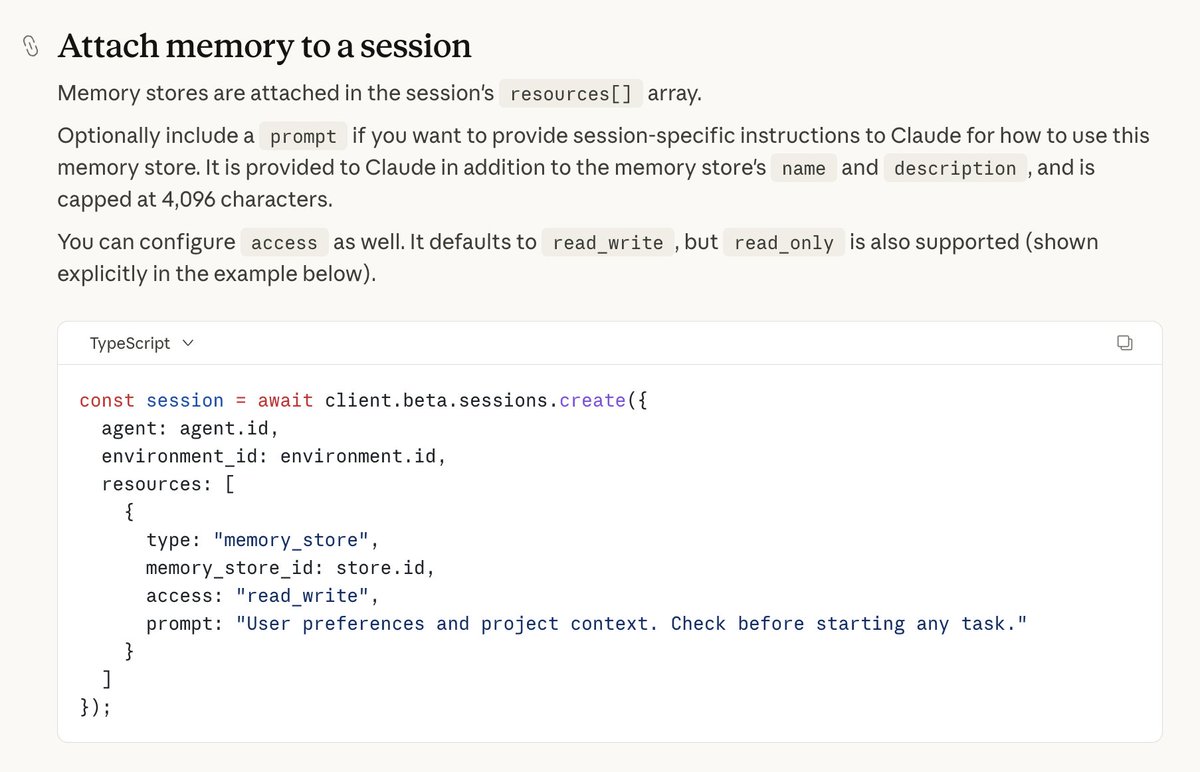
The new Anthropic managed agents API is basically the Letta API that we've had since a year ago, but closed source and with provider lock-in. They even have read-only memory blocks and memory block sharing -- something which was unique to the Letta agents for a long time.
Funny enough, we actually don't think this is the direction agents are going to go. Having API interfaces for memory blocks and tools is certainly convenient - you can spin up stateful agents as API services with just a few lines of code. But its also limiting: LLMs today are extremely adept at computer-use, and representing their memories in this way limits the action space of agents and their ability to learn.
It's important to remember that just because something comes out of a frontier lab, doesn't mean its the "right" answer long-term. The Letta API ~1 year ago was somewhat of an antipattern in a sea of agent framework libraries offered by every lab. But now, stateful agent APIs are becoming the new norm - especially as providers try to lock in memory/state into their platforms to increase switching costs (which is exactly why we believe memory should live outside of model providers)
If you want to see what the future is going to look like, follow @Letta_AI
There is no care for another without care for yourself
There is no being with another without being with yourself
There is no loving another without loving yourself
Only in Bangalore would you find that your cab driver is a daily @cursor_ai user working as an SDE from 10am to 6pm and driving from 7pm to 3am. Rationing the $20 over the entire month has not been easy, understandably so.
Here’s a piece by @goodfellow_ian, @sunfanyun, and me arguing that use of symbolic representations and game virtual world data offers the best path to building action-conditioned multimodal world models that enable reliable prediction and planning for long-horizon tasks.
The advantages of symbolic language representations in this context was also recently argued for in new work from @physical_int: https://t.co/aooV2WN1oY .
it's incredible how much of 2023 was spent talking about RAG.
We used to have a vector db of a bunch of components from popular design systems and we would fetch from that vector db. spend like months on this approach. it never really worked that well
https://t.co/a3FRm3MihS
🧠📈A new foundation model for #neuroscience! In the latest Deeper Learning blog, @yuven_duan and @KanakaRajanPhD describe their state-of-the-art POCO model, which accurately forecasts neural dynamics across individuals and species.
https://t.co/09NmLviDNg #NeuroAI
My inbox is flooded.
If you're looking a code-first canvas, here you go:
Everything generated is React code. Export to Claude Code/Cursor via the @magicpatterns MCP. Use your design system.
The code-first era of design has arrived... a year ago.
https://t.co/Pg8otK6LUO
"But that isn't nearly enough. The entire industry needs to do a better job of talking to everyday people and getting them to see a better world is possible." agreed
The AI backlash is here.
This post has a million views.
People hate technology.
They hate innovation.
They see that it is coming for their jobs.
Coming for their way of life.
Innovation is asking them to do more work. To spend nights and weekends learning about AI and building new things.
They hate that. And I've seen it my entire career as people tell me over and over again that they don't like what I'm pitching them.
How many have gone to an Apple store and had a demo of the Vision Pro? Even in Silicon Valley I keep finding smart people who refuse. And my consumer research outside the valley shows far far greater resistance.
There are couple other such posts this morning going viral:
@zachweinberg: https://t.co/U3YDp3Qn08
@tszzl: https://t.co/u9RInhe6uv
Here's the real problem.
Let's say you burn down Silicon Valley.
The Chinese are coming and coming with cars that will eviscerate the rest of the auto industry. Americans can't see that because we tax the heck out of them and keep them from selling here.
And soon they are coming with robots. Americans can't see that because they aren't like me meeting with robot pioneers here and in China. Or watching the robot community here on X (or understand what they are talking about with their highly technical talks about world models and reinforcement learning.
And they are coming with AI models. Most Americans are sticking their heads in the sand and ignoring what's going on on @huggingface and here on X. I talk to entrepreneurs around the world who keep telling me they are building businesses on Chinese models because they are cheaper and better.
And they are coming with entertainment businesses that will eviscerate Hollywood. Most Americans see AI artists as anti human. The Chinese don't.
The only way out of this +is+ innovation. That's where any new jobs are gonna be.
So go ahead and burn down Silicon Valley and San Francisco.
That won't save your job and will doom America to being a poor country subservient to the Chinese.
And, yes, we need to do a better job of explaining the role of innovation.
But that job is bigger than what I can do.
Why?
Because people hate innovation and want to stick their heads in the sand, and even, roll back innovation, my posts aren't getting any reach here on X outside of a small group of innovation supporters.
Well, I'll keep supporting the innovators. I made lists of almost all of them, 37,000 in AI alone, and 7,600 AI companies: https://t.co/9eRY65x3IQ
But that isn't nearly enough. The entire industry needs to do a better job of talking to everyday people and getting them to see a better world is possible.
For now all they hear is "you are taking my job."
And they aren't wrong about that either. Which makes this all so difficult to get people onto the side of innovation.
building mxflo, the tiktok for games.
everyone thinks people don't make games because coding is hard, but really it's just too slow. our insight is that if you make games disposable like memes where you can remix a viral moment or roast a friend in 1 tap, people will share them everyday.
The @Stripe Atlas team just published their year in review. Because Atlas now incorporates so many startups (23,000+ thus far in 2025), it's an interesting snapshot of broader ecosystem trends. Some of the findings that I thought were interesting:
• Atlas incorporations grew 36% Y/Y. More than 20% of Delaware C Corporations are now started with Atlas. (Delaware corporations are started for lots of reasons, obviously -- large companies creating subsidiaries, etc. -- so Atlas represents some larger fraction of overall startup creation.)
• Founders of Atlas companies can come from anywhere and Europe was the fastest-growing region (+48% Y/Y). My speculative hypothesis is that this is because dealing with incorporation is very annoying and bureaucratic in many European countries, and the knowledge that you can just use a US corporation is becoming more widespread. A lot of European leaders are aware of these issues and I'm hopeful that they'll act.
• Multinational founding teams are 79% more common (among multi-founder teams) than they were in 2017. This feels like a straightforward dividend of remote work, but the effect size is surprising to me.
• Time-to-revenue is accelerating. Remarkably, the median Atlas startup that incorporated in 2025 generated 39% more revenue in its first 6 months than its 2024 counterpart. And while there were more incorporations than ever this year, it is also true that a growing fraction of companies reached $100k of revenue within 6 months. That is, both quantity and some kind of quality (at least in revenue terms) are increasing. I'm not exactly sure how to explain this. I think the null hypothesis is simply that AI and stablecoins have opened the aperture of possibility, a vast surge of startups is mobilizing, and customers are eagerly flocking.
• The variance is increasing. While the median company generated 39% more revenue than last year, the 90th percentile company generated 52% more, and the 99th generated 67% more. Again, this is a year-over-year change -- pretty striking. This trend aligns with the anecdotes: startups like @cursor_ai and @Lovable (both of which incorporated with Atlas) are posting truly unprecedented revenue growth figures.
One of my favorite aspects of Stripe is getting to see trends like these play out in real time. If you're interested in building tools that directly enable this entrepreneurship and innovation, you should get in touch.