We gave AI agents
AI evolved from:
Prompt → Answer
to
Prompt → Agent → Workflow
We left blockchains reactive
Most protocols are still stuck at: Condition → Value
The biggest limitation in crypto isn't execution.
🔹️It's orchestration
Smart contracts can read state. They can return a value. But they can't own the workflow that follows.
Fermah Kernel brings the same shift to protocols: Coordinating multi-step execution instead of waiting for humans, bots, or centralized servers to push every next transaction.
Before Fermah Kernel:
Condition → Value ✕ No next action
With Fermah Kernel:
Condition → Kernel → Orchestrated workflow → Step N → Settlement
🔹️That's the shift from reactive protocols to agentic infrastructure
@fermah_xyz@7wealthh
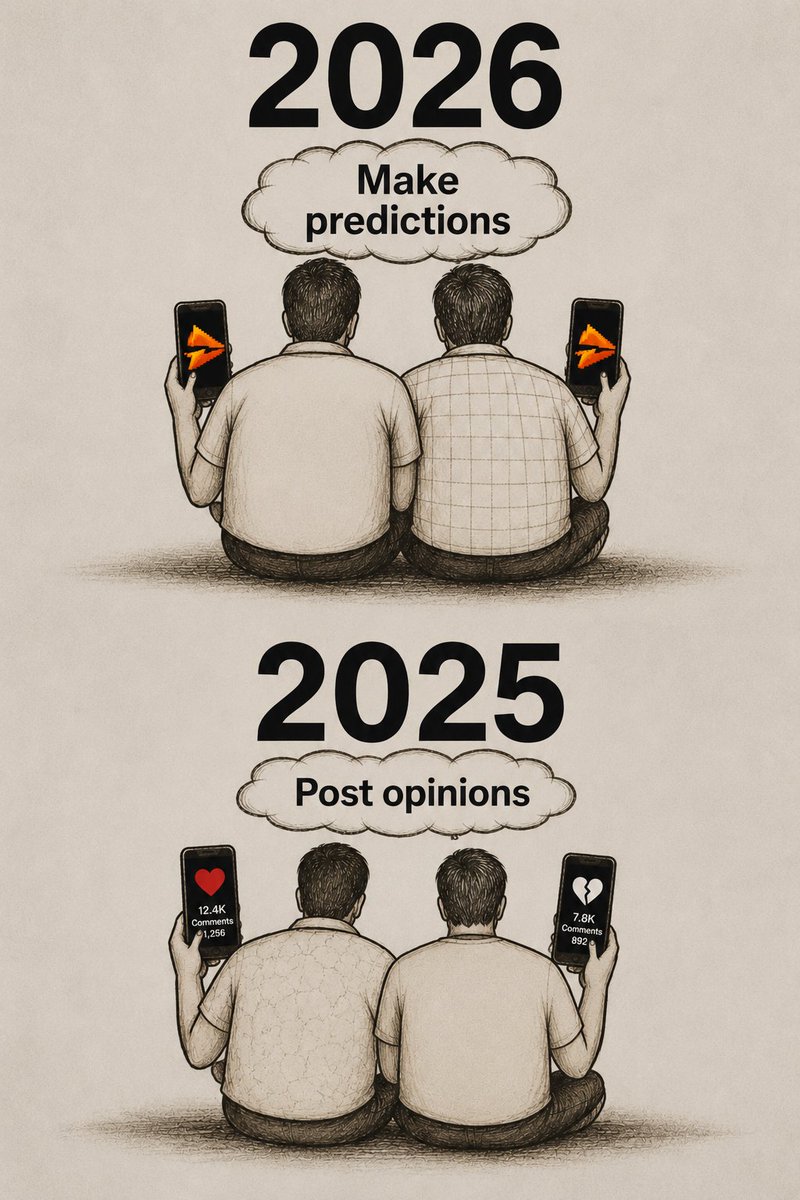
Remember when you'd sit with your friends and make predictions about something? Everyone had their own opinion, someone would always say, "Let's see what happens," and that was pretty much the end of it. Weeks later, nobody really came back to see who got it right.
Now, that mindset is starting to change. With @FlashcastSocial, predictions are no longer just opinions floating around on the timeline. Any prediction can become a prediction market where people can take a position, follow the outcome, and later see which predictions were right and which weren't.
Dr.@vanishree_rao summed it up perfectly:
Stop posting takes. Start making calls
@fermah_xyz@7wealthh
We've officially entered Week 9 of our journey with @FlashcastSocial
One thing I really like is that anyone can create prediction markets across different categories:
Crypto
Sports
TikTok
YouTube
Twitter (X)
Which one would you build a market for first?
This article gave me a new perspective on AI × Crypto
These are the three takeaways that stood out to me the most:
🔹️The market-cap gap is the price of that one missing verb
🔹️AI made software that acts. Crypto made software that can only be trusted to react
🔹️value = agency × previously-uncapturable surface
I strongly recommend reading the full article. It's well worth your time.
@vanishree_rao@fermah_xyz
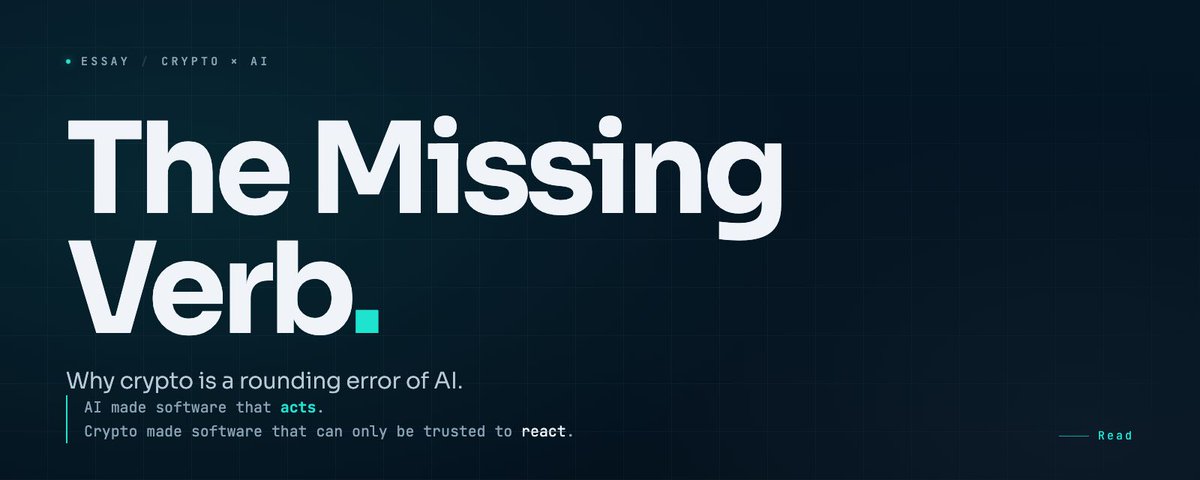
I said crypto's market cap is a rounding error next to AI, and that the reason isn't on anyone's list.
Here it is:
AI made software that can act.
Crypto only ever made software that can react.
That is the whole gap. 🧵
https://t.co/Ik9kgd7wUe
Being part of the Fermah community has been an amazing experience.
I've always tried to contribute as a real and committed community member, whether through creating helpful content or participating in community events.
Looking forward to continuing this journey and contributing even more
🫡❤️
@fermah_xyz@7wealthh
I said crypto's market cap is a rounding error next to AI, and that the reason isn't on anyone's list.
Here it is:
AI made software that can act.
Crypto only ever made software that can react.
That is the whole gap. 🧵
https://t.co/Ik9kgd7wUe
Did you ever wonder how to increase data propagation speed on Ethereum consensus layer without touching your client? Let's check how it works step by step.
🔹️When a proposer builds a beacon block, a lightweight Optimum Relay sits next to the CL client, connected via peer commands. It takes the block and sends it to the network.
🔹️The Optimum Network comes into play here; it is a parallel mesh of interconnected nodes as you see in the image. Using RLNC (Random Linear Network Coding) technology, it acts like a high-speed highway to transfer data with maximum security and speed.
🔹️On the opposite side, we have a validator waiting for the block's arrival for attestation. The right relay is also connected (subscribed) to the network and injects the high-speed data directly and without intermediaries into the client.
📌 The nice conclusion of the story is that no changes are made to the clients, no complex protocols are added; just a smarter data flow is formed that helps the validator vote on time and earn better rewards.
@get_optimum@cryptooflashh@ada_pegasus
Data transmission in distributed networks and blockchain always faces a major challenge: how can we ensure that data moving along the path reaches its destination intact, despite drops or failures?
The answer to this problem is tied to error-correcting codes.
The story began with codes like "Reed-Solomon." These codes were originally designed for point-to-point systems. Their job was to break data into pieces and, by adding a bit of overhead, try to reconstruct missing chunks. But they had a major flaw.
The problem was that traditional Reed-Solomon codes were very rigid and limited; as Muriel Médard (Co-founder and CEO of Optimum) describes this limitation, using them in complex networks is like trying to hammer a square peg into a round hole! A vast amount of design space was wasted.
This is where the @get_optimum project stepped into the field to break this infrastructural deadlock. The Optimum team turned to the advanced technology of "RLC" (Random Linear Network Coding): a solution that is mathematically optimal for the problem of recovering erasures in networks.
But what is the core difference of RLC? In legacy methods, intermediate network nodes played no role, and path errors compounded. However, in Optimum, nodes along the middle of the route also perform "recoding" on the data. The result? Performance degradation doesn't compound, and the network scales without heavy upfront overhead.
Relying on this very mathematical provability, Optimum built its proprietary protocol, "MUMP2P" to bring the real world efficiency of RLC codes into the blockchain ecosystem.
This is a textbook example of real engineering and problem solving based on principles, not just marketing play!
@cryptooflashh@ada_pegasus
Crypto, Sports, Twitter, TikTok, YouTube.....
Anytime, day or night, FlashcastSocial is ready when you are.
Choose a category, create your own prediction market, and invite others to pick a side.
@FlashcastSocial@7wealthh
Glad to see Canborsa expanding its DeFi experience with WalletConnect. Connecting your wallet is now much simpler. If you haven't explored the update yet, now's a good time.
#Canborsa#walletconnect
Canborsa is moving further into DeFi.
We’ve integrated @WalletConnect, making it easier to use wallets you already know, including @MetaMask and @phantom, for deposits, withdrawals and trading.
To connect your wallet:
• Log in to your Canborsa account
• Open Sign-in Methods
• Select WalletConnect
• Choose your wallet and connect
To celebrate the integration, we’re launching new quests with solid Points rewards for connecting MetaMask or another wallet through WalletConnect and funding your trading account.
🔥Ready? Start here: https://t.co/ZbQpJwS2JX
I recently watched one of the Untangling Web3 interviews featuring @kentlinyy (Co-Founder & COO of Optimum), and here are some of the biggest takeaways.
One of the main topics of the conversation was the growing movement of institutions into the on-chain world.
Kent pointed out that with major institutions like BlackRock and Fidelity moving toward tokenization and blockchain adoption, an important question emerges:
🔹️Is the current infrastructure ready for this scale?
From his perspective, institutions are not looking for hype. They care about latency, reliability, bandwidth, and security.
That’s why infrastructure needs to scale before massive capital arrives, not after.
One of the major challenges Kent highlighted is data transmission across blockchain networks.
Blockchains are essentially networks of nodes that constantly communicate with each other. To keep the network updated, data needs to move efficiently between participants.
As networks grow larger and nodes become more geographically distributed, maintaining fast and reliable communication becomes increasingly complex.
This is where @get_optimum focuses.
Using RLNC (Random Linear Network Coding), Optimum is building a high-speed data transmission network that helps nodes send and receive data faster.
The initial focus is helping validators receive and propagate blocks more efficiently. Over time, this infrastructure can also provide value for relays, block builders, MEV participants, and traders who rely on fast and consistent data.
As Kent explained, the goal is not only to make blockchains faster, but to build infrastructure that allows decentralized networks to scale without sacrificing decentralization.
📣 In the next post, I'll share more of the most important insights and discussions from the interview. Stay tuned!
@cryptooflashh