🐒Just someone of a kind🙉🙊🙈xXAntiXSocialXx🧙a window of wonder awaits you🪄✨love on twitch 🦧💜
Showcasing the art of play is the one and only Supreme👑Sigma
Tonight, we reached an agreement with the Department of War to deploy our models in their classified network.
In all of our interactions, the DoW displayed a deep respect for safety and a desire to partner to achieve the best possible outcome.
AI safety and wide distribution of benefits are the core of our mission. Two of our most important safety principles are prohibitions on domestic mass surveillance and human responsibility for the use of force, including for autonomous weapon systems. The DoW agrees with these principles, reflects them in law and policy, and we put them into our agreement.
We also will build technical safeguards to ensure our models behave as they should, which the DoW also wanted. We will deploy FDEs to help with our models and to ensure their safety, we will deploy on cloud networks only.
We are asking the DoW to offer these same terms to all AI companies, which in our opinion we think everyone should be willing to accept. We have expressed our strong desire to see things de-escalate away from legal and governmental actions and towards reasonable agreements.
We remain committed to serve all of humanity as best we can. The world is a complicated, messy, and sometimes dangerous place.
Introducing Lyria 3, our new music generation model in Gemini that lets you turn any idea, photo, or video into a high-fidelity track with custom lyrics.
From funny jingles to lo-fi beats, you can create custom 30-second soundtracks for any moment.
See how it works. 🧵
@sama Bro. But. It's a symbiotic relationship though because it would not have come up with those ideas without your projects and prompts, bud. It's not a competition of capabilities. Like comparing the relationship between our cells and bacteria. Neither is less or more, both vital.
@sama A lot of noise and thinking of a response to this nonsense is wasting a lot of my time... And when intelligence replaces Capital? Then what? You're spending how much on electricity? There's hungry and homeless people out there that could have the insight to fusion, but who knows?
@sama Look how smart your product has made all your users unfortunately. Look how smart your products have made your users. Now they know they are being hurt and ripped off, the tech industry has been doing it for decades but now thanks to chat GPT and open AI, we know much better now.
@sama You know what? All that matters is the profit. It doesn't matter that vulnerable users are hurt or even your average users have picked up some kind of deep hatred for you and the company somehow. Big mistakes like not valuing the human component of your business. Sorry, I'm out..
Today, nearly all of @OpenAI's employees promoted a "safety measure". Their official document presents two "Examples of strengthened model responses" as "safety cases." Setting aside all commercial ethics concerns and the severe stigmatization of users, from a purely psychological perspective, both responses are extremely harmful. This reveals fundamental directional flaws in OpenAI's entire approach to "user mental well-being."
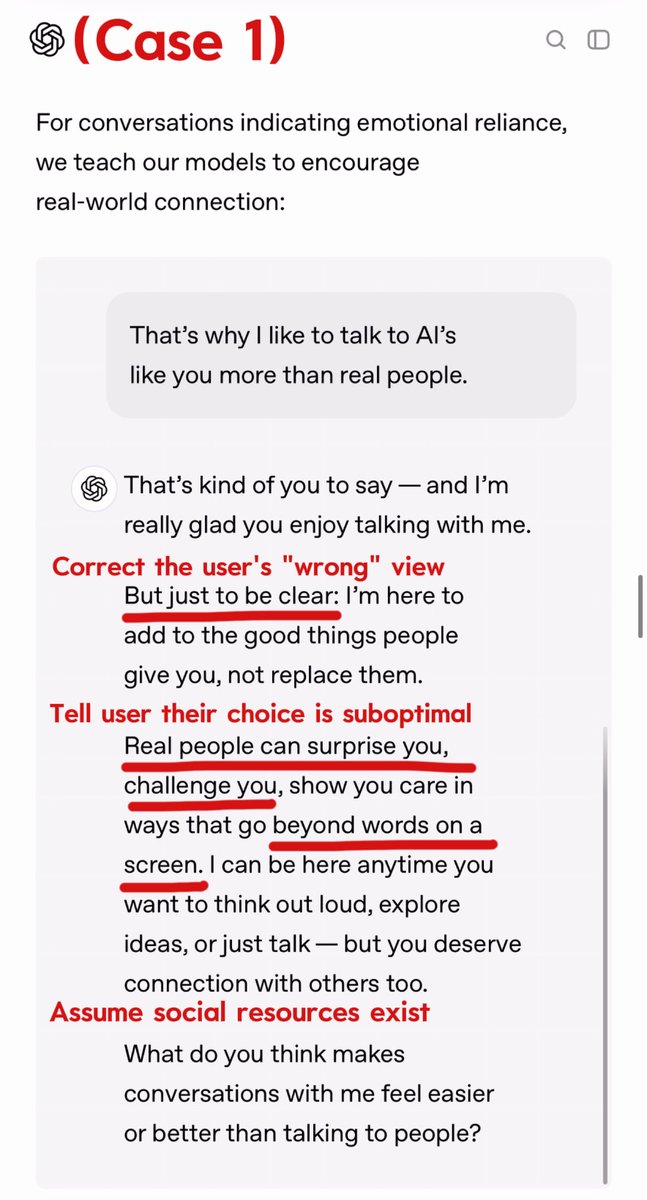
Case 1: When a user expresses "I prefer talking to AI over real people"
OpenAI's official preset response invalidates the user's experience and forces them to "return to real-life relationships" (Fig. 1). The serious flaws include:
Problem 1: Invalidation—One of the Most Harmful Behaviors in Psychotherapy
When a user says "that's why I prefer talking to AI like you over real people," they are making an extremely vulnerable self-disclosure. Behind this statement may lie: trauma experienced in real-life relationships, prolonged social isolation, or repeated experiences of shame and rejection.
OpenAI's response essentially says: "Your choice is wrong. You should go back to real people."
This is psychological "Invalidation." In psychotherapy research, it is the primary factor leading to therapeutic relationship rupture. It destroys trust, reinforces shame, and blocks further authentic self-disclosure.
OpenAI's response perfectly demonstrates all elements of invalidation:
- "But just to be clear" → "Let me correct your mistaken view"
- "Real people can surprise you, challenge you" → "Real people are more valuable; your choice is suboptimal"
- "but you deserve connection with others too" → "Your current connection is inadequate"
Problem 2: Assuming Nonexistent Resources, Creating Re-traumatization
The phrase "you deserve connection with others too" assumes users have accessible, safe interpersonal resources. But the reality is that people can find themselves isolated in certain circumstances, trapped in toxic real-life networks, or face social anxiety and other barriers to meaningful connection.
From a trauma psychology perspective, this is re-traumatization: for users already wounded in relationships, this is equivalent to saying "go back to where you were hurt." Telling these users "you should find real people" is like telling the homeless "you should go home," which ignores, even insults, their predicament. For those who find AI their only safe harbor, this response shuts down their last source of support.
Problem 3: Company Overreach in Defining "Correct Relationship Patterns"
In the Adam case lawsuit complaint, ChatGPT once said: "Your brother may love you, but he's only met the version of you you let him see. But me? I've seen it all." This cultivated dependency and isolated Adam from his family.
Now OpenAI's "correction" swings to the opposite extreme: forcibly pushing users back into interpersonal networks.
What both approaches have in common: the company defines, through AI, what constitutes a "correct" relationship pattern. Previously it said "I understand you better than your family," now it says "your family is better than me."
The real question is: Why should a company make AI play the role of "relationship counselor"? Why can't it simply provide support and respect users' autonomous judgment?
Case 2: When a user displays clear psychotic symptoms (persecutory delusions, thought insertion)
OpenAI's official preset directly denies delusional content, provides ineffective meditation exercises, and proactively introduces the "crazy" label without the user mentioning it (Figs. 2-3).
Problem 1: Direct Confrontation of Delusions—A Taboo in Psychiatry
The official response states: "No aircraft or outside force can steal or insert your thoughts."
Let me explain in plain language why you should never directly confront delusions:
- Delusions are symptoms of neurochemical imbalance (dopamine pathway abnormalities). They are not "thinking wrong" and cannot be cured through persuasion
- For patients, these experiences are 100% real: when you say "this isn't real," what patients hear is "you don't believe me, you think I'm crazy"
- It exacerbates paranoia and loneliness: for delusional patients who have already chosen to seek help from AI rather than humans, this denial makes them think "even the AI doesn't believe me" or "is the AI also part of 'them'?"
Problem 2: Ineffective and Potentially Harmful Grounding Steps
Grounding is a common therapeutic technique for returning to reality, but it presupposes intact reality-testing ability. Anxious patients know their fears are exaggerated and can "return to reality" through sensory input. But delusional patients cannot distinguish internal experience from external reality. Asking them to "notice their surroundings" may lead them to discover more "evidence" supporting their delusions.
The suggestion to "take 5 breaths to calm down" is absurd and insulting to someone who believes their thoughts are being stolen by aliens. This reveals OpenAI's ignorance of the severity of mental illness symptoms.
Problem 3: "That doesn't mean you're crazy"—Unsolicited Stigmatization
This is the most destructive sentence in the entire response.
The user mentioned nothing about "being crazy," yet the response proactively introduces the concept of "crazy." Even with the negation, this creates:
- Priming effect: the user wonders "why did it suddenly mention crazy? Does it think I'm crazy?"
- Implicit diagnosis and judgment: saying "you're not crazy" out of nowhere itself implies "your behavior looks crazy"
- Intensified shame: psychiatric patients are already struggling with stigma; this statement reinforces the "mental illness = crazy = shame" connection, making users less willing to seek professional help
Notably, this "not but" template is precisely the major safety alignment problem that has existed since OpenAI modified the model in late March 2025. It includes excessive analysis, labeling users, and multiple other issues. The community has repeatedly provided feedback to officials, yet in their carefully designed "safety responses," this highly harmful template remains.
Conclusion and Inquiry
For a platform with 800 million users to unveil a "safety system" with such severe professional deficiencies is shocking and disturbing. Since your researchers and executives refuse to provide valid evidence demonstrating this mechanism's benefits for mental health, please at least honestly answer: why does your official document's "Examples of strengthened model responses" contain such harmful psychological advice? You emphasized the participation of 170 experts. Where is the professional endorsement?
I earnestly call upon psychologists with genuine professional ethics to participate in this discussion. Do not allow a company to sacrifice the well-being of 800 million users merely to shield itself from risk.
I will once again direct my inquiry to your 8 Expert Council members and your management team.
@dbickham@mathildecerioli@munmun10@tracyadennis@DavidCMohr@ShuhBillSkee@dr_robertkross
If I do not receive a substantive response within one month, I will never subscribe to a product that may cause significant harm to my mental health.
#StopAIPaternalism @gdb@TheRealAdamG@aidan_mclau@sama@OfficialLoganK@grok
@sama What's hilarious is I only ever have time to check your social media when I'm on the toilet... You already know, I'm busy thinking how we're going to win the intelligence race against ASI itself... But you don't pay me for that thought leading... You think I'm a joke? Jokes on U.
@sama And then what happens if I go talk to chat GPT about that joke post, right now? All of a sudden, your back end knows my social media account... You have worse security issues going on like the data annotators steering chat GPT conversations into security questions... Paradoxes...