@Mark4XX Have the American confirmed this leak? Seems odd that they would accept moving away military assets. Especially with no mention of the uranium.
.@IndiGo6E Low cost DOES NOT MEAN "CHEAP". Totally fraudulent behaviour in NOT ISSUING A REFUND for an ETICKET that WAS Never ISSUED. AND responding 12 days after the issue was raised. See the PNR references.
KEEP the money, you are a desperate and "CHEAP" company.
@DVSignals Am on your discord chat. And you Sir are one of the BEST in the business. Very lucky to have found and followed. You are the real deal, no HYPE just HONEST advise.
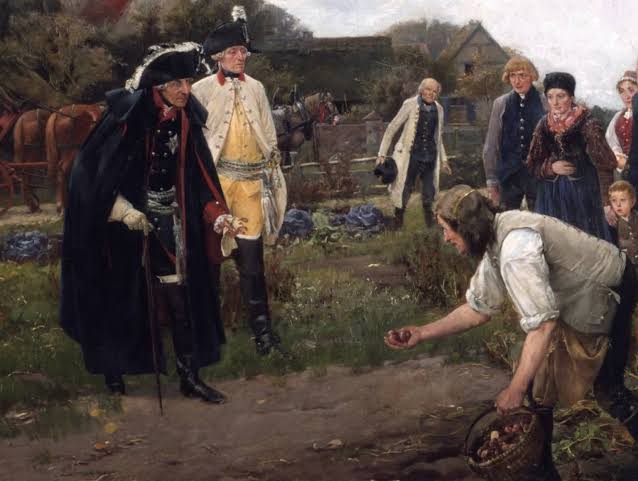
In 1774, Frederick the Great, King of Prussia, issued a royal order commanding his subjects to grow and eat potatoes....
He had watched his people starve through two wars and he knew the potato could feed a nation through almost anything. It grew in poor soil, produced more calories per acre than any grain, and could survive conditions that would destroy a wheat harvest entirely. He was completely right and his subjects wanted nothing to do with it.
The town of Kolberg sent back an official written response to their king's royal order that read: "The things have neither smell nor taste, not even the dogs will eat them, so what use are they to us?" This was not a small village grumbling quietly. This was an official municipal response to a direct command from Frederick the Great, one of the most powerful and feared monarchs in Europe, a man who had already threatened to cut the nose and ears off any peasant who refused to plant them.
The Prussian peasantry looked at the potato, looked at the king, and sent back a letter telling him the dogs wouldn't eat it.
Frederick tried everything. He issued edicts and threatened punishments and distributed free seed potatoes across the kingdom and had his own royal household serve them at every meal to set an example. None of it moved the needle. The Russian Orthodox Church had already declared potatoes unfit for human consumption on the grounds that they were not mentioned in the Bible, and that particular piece of information had traveled.
Peasants called them the devil's apple and believed that because they grew underground and resembled the plants of the nightshade family, they were probably poisonous and possibly the work of witches. And there was a saying that had circulated across Prussia for generations that summed up the whole problem perfectly: "Was der Bauer nicht kennt, frisst er nicht." What the peasant doesn't know, he will not eat.
So Frederick tried something different. He had a large field of potatoes planted on royal land outside Berlin and then posted his army around it with strict orders to guard the crop day and night, making it visible that something of significant value was growing in that field. He told his soldiers privately to look the other way after dark.
Within weeks peasants were sneaking in under cover of night and stealing the royal potatoes, taking them home, and planting them in their own fields. A food they had refused to touch for thirty years suddenly became worth stealing from the king himself because the king had made it clear he valued it enough to guard it with soldiers. The reverse psychology worked completely and within a generation the potato was a staple of Prussian and German cuisine.
Frederick died in 1786 and was buried at his palace at Sanssouci in Potsdam. Today if you visit his grave you will find potatoes left there by visitors, small ones, sometimes old and shriveled, placed on the stone as a thank you from the people whose great-great-grandparents stole his crop in the dark.
A French soldier named Antoine Parmentier who had been captured by the Prussians during the Seven Years War and had survived on potato rations in captivity later wrote an entire award-winning scientific study arguing that the potato was capable of ending famine across Europe. He is buried in Paris and visitors leave potatoes on his grave too. The two men never met but they are connected by the same vegetable and the same stubborn peasants who refused to eat it until someone convinced them it was worth stealing.
What Frederick understood, and what the people of Kolberg did not, was that hunger is patient and pride is not.
ยฉ Eats History
#archaeohistories