🚨 Scientists just built a refrigerator with NO compressor and NO refrigerant gas.
Just electricity.
Using a multilayer ceramic capacitor, researchers created a solid-state cooling system that changes temperature when an electric field is applied.
The result:
• ~3–4.5 K cooling swings
• works across room temperature
• survives >10 MILLION cycles
• no moving parts
• projected 70–90% Carnot efficiency
This is electrocaloric cooling and it may become one of the biggest threats to conventional refrigeration in decades.
Older materials only worked ABOVE room temperature and needed a brutal 42-day annealing process.
This new PST–PMW material:
• cools down to ~230 K
• avoids the expensive anneal
• handles massive electric fields
• maintains strong entropy transitions
The physics is beautiful.
An electric field reorganizes the material’s internal dipole structure, reshaping entropy inside the lattice and producing a real temperature drop.
Not “cold generation.”
Controlled entropy engineering.
If this scales:
• silent refrigerators
• ultra-efficient chip cooling
• vibration-free scientific systems
• wearable thermal control
• next-gen EV cooling
We may be watching refrigeration evolve from mechanical compression…
to programmable matter.
Follow me if you want the future of physics before it hits mainstream.
There was a time when stardom was a fortress. In the 90s, Ruby Bhatia wasn't just a VJ; she was the electric pulse of a new, liberalised India, reportedly commanding Rs 1 lakh per show. Rahul Roy wasn't just an actor; he was the face of a generation’s collective heartbreak, the Aashiqui boy whose silhouette defined romance and whose haircut was the bestseller in every saloon. Govinda? He was—and is—the undisputed king of the masses, a comic genius who could make a cinema hall shake with a single pelvic thrust.
Fast forward three decades, and the fortress has been dismantled by the relentless, voyeuristic machinery of social media. Today, these icons find themselves under the harsh, unforgiving glare of a "content-hungry" digital mob that mistakes struggle for failure and evolution for desperation.
Recent headlines have taken a perverse pleasure in dissecting Ruby Bhatia’s career shift. Yes, the woman who once defined "cool" is now a life coach charging Rs 3,000 for a six-month program. To the keyboard warriors, this is a "fall from grace." To any sane mind, it is a woman finding meaning after a nervous breakdown, choosing to make mental health accessible to the masses rather than gatekeeping it for the elite.
Similarly, Rahul Roy has been subjected to the "cringe" treatment for appearing in social media reels with unknown creators. The internet, in its infinite cruelty, ignores the fact that this man is a brain stroke survivor. He is fighting aphasia, paying off legal debts that predated his illness, and trying to "stay active" and work for as long as he is alive. When he asks his trolls to find him "decent work" instead of mocking his reels, he isn't showing desperation; he is showing a spine of steel that most "influencers" couldn't dream of possessing.
Then there is Govinda, the man who once gave the Khans a run for their money, now frequently seen performing at school annual days and weddings. The "dark shadow" of social media brands these "small shows," as if the size of the stage dictates the stature of the legend. Govinda’s response is a masterclass in humility: "I never let my ego influence my work." Whether it’s a Chief Minister’s event or a local school function, the man dances because he is a performer. There is more dignity in one of his "wedding steps" than in the entire collective output of a thousand anonymous trolls.
Social media has birthed a generation of spectators who believe that unless you are at the absolute zenith of your power, you should vanish into the shadows. We have become a culture that feeds on the "tragedy" of the legacy act.
But here is the truth: There is nothing sad about a veteran getting up and going to work. There is nothing "cringe" about an icon refusing to be defeated by a health crisis or a shifting industry. The desperation doesn't belong to Ruby, Rahul, or Govinda. The desperation belongs to the social media ecosystem that needs to tear down giants just to feel tall.
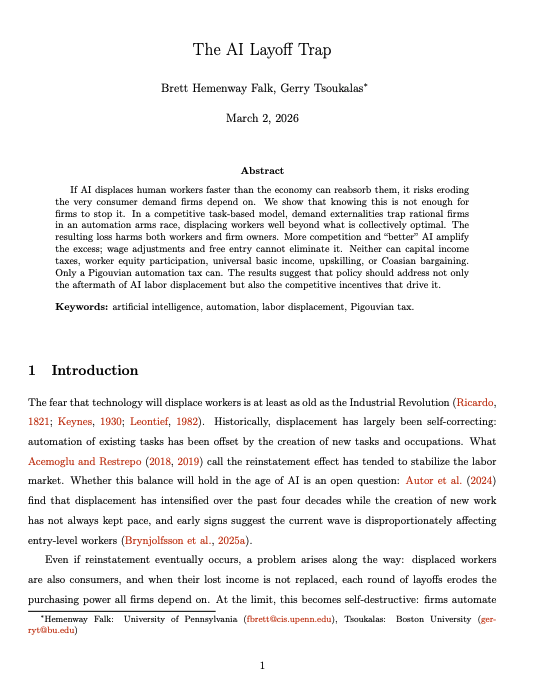
🚨BREAKING: Two researchers from UPenn and Boston University just published a paper that should be uncomfortable reading for every CEO automating their workforce right now.
The argument is straightforward. Every company replacing workers with AI is also eliminating its own future customers. Laid off workers stop spending. Enough of them stop spending and nobody can afford to buy anything. The companies that fired everyone end up selling into an economy with no purchasing power left.
Every executive can see this. The math is not complicated. But here is why nobody stops.
If you do not automate, your competitor does. They cut costs, lower prices, take your market share, and you collapse anyway. So every company automates knowing it is collectively destructive because the alternative is dying alone while everyone else survives. The researchers proved this is a Prisoner's Dilemma playing out in real time.
The numbers are already moving. Block cut nearly half its 10,000 employees this year. Jack Dorsey said AI made those roles unnecessary and that within the next year the majority of companies will reach the same conclusion. Salesforce replaced 4,000 customer support agents with AI. Goldman Sachs deployed a coding tool that lets one engineer do the work of five. Over 100,000 tech workers were laid off in 2025 and AI was cited as the primary driver in more than half those cases. 80% of US workers hold jobs with tasks susceptible to AI automation.
The researchers tested every proposed solution. Universal basic income does not change a single company's incentive to automate. Capital income taxes adjust profit levels but not the per-task decision to replace a human. Collective bargaining cannot hold because automating is always the dominant strategy.
They also identified what they call a Red Queen effect. Better AI does not solve the problem, it accelerates it. Every company chases faster automation to gain market share over rivals but at the end everyone has automated equally, the gains cancel out, and the only thing left is more destroyed demand.
The one thing the math says could work is a Pigouvian automation tax. A per-task charge that forces companies to account for the demand they destroy each time they replace a worker.
The conclusion is that this is not a transfer of wealth from workers to owners. Both sides lose. Workers lose income. Companies lose customers. It is a deadweight loss with no market mechanism to stop it on its own.
(Link in the comment)
Released in 1982, the Seiko TV Watch (T001) once held the Guinness World Record as the smallest television. Priced at $400, it offered up to five hours of viewing time in a groundbreaking, wearable design.
Fan-throated lizards are small, colorful lizards found in shrublands and some parts of coastal areas in southeast Asia.
Video from BBC Earth.
More of the world's weirdest animals: https://t.co/YlbnwzzGoH
This is Cortical Cloud. Live neural networks that you can interact with and train!
Now open to the public. What will you discover?
Credits: Frank Yang and a big thank you and acknowledgement to the rest of the Cortical Labs team.
Sign up for Cortical Cloud: https://t.co/Y8b1WojPRA
Learn more about us: https://t.co/tvcLEOFnnN
Check out our API: https://t.co/P9opFAALxr
Check out our API Docs: https://t.co/dZrsmiX85U
Check out our Developer Guide: https://t.co/HhwbOK2qIq
Join our Discord: https://t.co/5UQbBaJsd7
Scientists may have found a cure for type 1 diabetes.
For the first time ever, a man with type 1 diabetes is making his own insulin after receiving a cell transplant that required no immune-suppressing drugs.
Doctors took islet cells – the insulin-producing cells of the pancreas – from a donor. But before they were transplanted, scientists used CRISPR to edit three specific genes. Two of those edits made the cells less visible to the immune system. The third increased production of a protein called CD47, which acts like a biological shield, telling immune cells not to attack.
Then they injected the edited cells into the man’s forearm.
Within weeks, those cells began producing insulin. And 12 weeks later, they still are – with no rejection, no complications, and no immune-suppressing drugs. That’s a major breakthrough. In the past, cell transplants for type 1 diabetes almost always failed without heavy drugs to suppress the immune response. Those drugs come with serious risks: infections, organ damage, even cancer.
["Survival of Transplanted Allogeneic Beta Cells with No Immunosuppression." The New England Journal of Medicine, 2025]
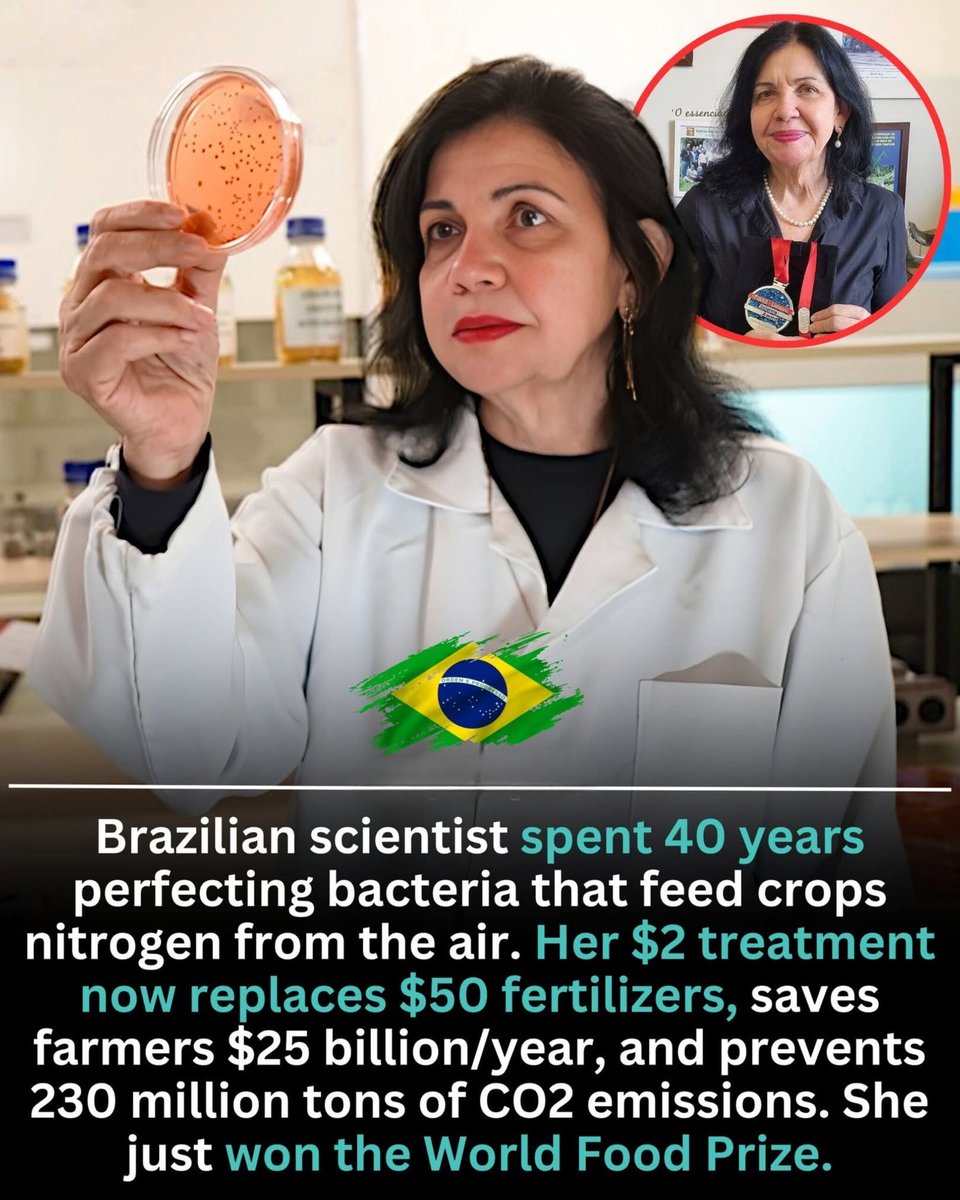
Another amazing Brazilian scientist, Dr. Mariangela Hungria, a microbiologist at Embrapa's soybean research center, spent decades studying bacteria that pull nitrogen from the air and feed it to plants.
The result: Brazil went from importing nitrogen fertilizer to becoming the world's largest soybean exporter — using microbes instead of chemicals.
Her work won the 2025 World Food Prize. But the real prize is the 40% reduction in synthetic fertilizer use across Brazilian agriculture.
This isn't just about soybeans. It's about a different model of agriculture: partner with biology instead of dominating it.
The Global South has something to teach the world here
Two teenagers from Pennsylvania just solved a problem most engineers ignored. Rohan Kapoor and Jack Reichert created the "Go Green Filter" — a 3D-printed device that attaches to your car's exhaust pipe. It doesn't just reduce emissions. It converts CO2 into oxygen. Using microalgae. The same process plants use — photosynthesis. They built a bio-reactor with water, LED lights, and living algae inside. The algae eat the carbon dioxide from your exhaust... and release clean oxygen back into the air. In testing? It cut emissions by 74%. They didn't wait for funding. Didn't wait for permission.
They 3D-printed the prototype themselves. Now it's being deployed in Indonesia. The cost? Low enough to scale globally. If this works at mass scale, it could reduce billions of tons of carbon annually. Two high school kids just did what billion-dollar companies haven't.





![Rainmaker1973's tweet photo. Scientists may have found a cure for type 1 diabetes.
For the first time ever, a man with type 1 diabetes is making his own insulin after receiving a cell transplant that required no immune-suppressing drugs.
Doctors took islet cells – the insulin-producing cells of the pancreas – from a donor. But before they were transplanted, scientists used CRISPR to edit three specific genes. Two of those edits made the cells less visible to the immune system. The third increased production of a protein called CD47, which acts like a biological shield, telling immune cells not to attack.
Then they injected the edited cells into the man’s forearm.
Within weeks, those cells began producing insulin. And 12 weeks later, they still are – with no rejection, no complications, and no immune-suppressing drugs. That’s a major breakthrough. In the past, cell transplants for type 1 diabetes almost always failed without heavy drugs to suppress the immune response. Those drugs come with serious risks: infections, organ damage, even cancer.
["Survival of Transplanted Allogeneic Beta Cells with No Immunosuppression." The New England Journal of Medicine, 2025]](https://pbs.twimg.com/media/HBlgzrsXAAAO_Ra.jpg)