If you are an athlete (strength, endurance, sports, idc) and aren’t doing some form of heat training, you are leaving (free) gains on the table.
Hot bath. Sauna. Mid-day run with layers. A few times per week.
Seriously.
It’ll improve your health too.
The best weekly exercise regimen for overall health is:
• 4–6 hours of aerobic exercise (2–4 lower intensity + 1 high-intensity)
• 2–3 strength training workouts (probably <2 hrs total)
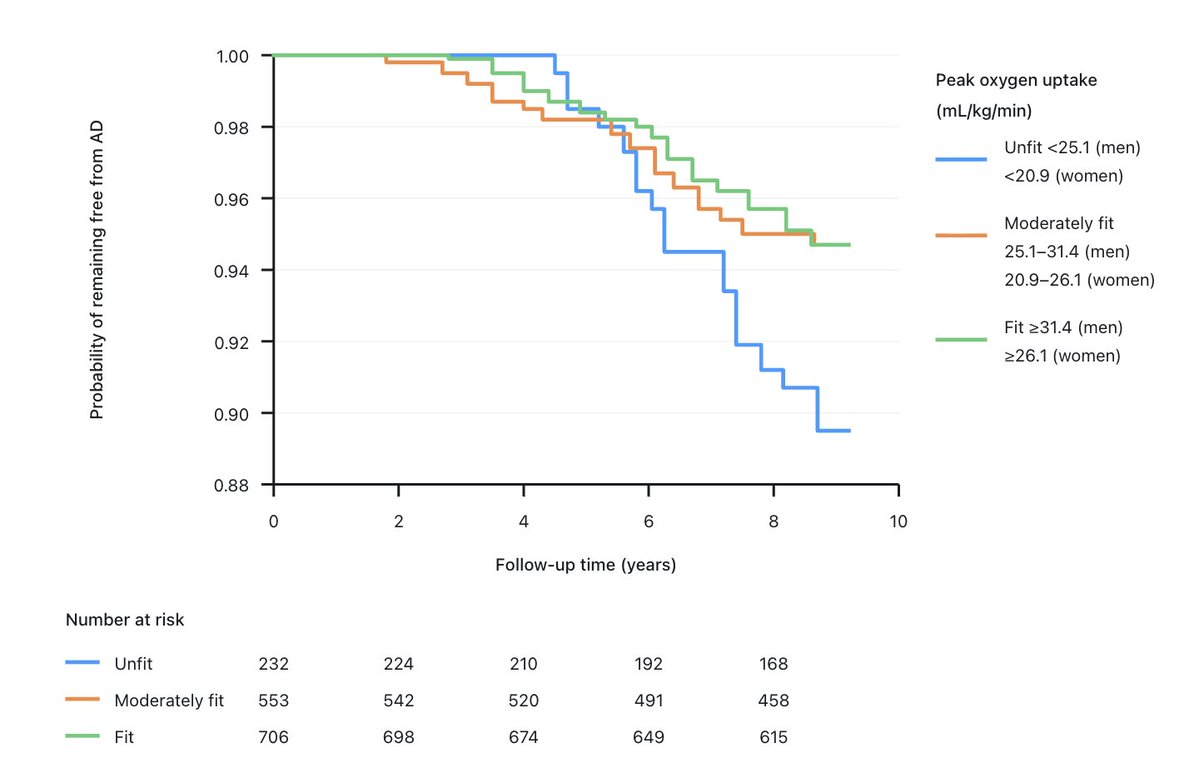
Higher aerobic fitness is associated with a lower Alzheimer's risk.
Moderately fit and fit adults had a 46% and 48% lower risk of developing Alzheimer’s, respectively, and every 1 mL/kg/min higher VO₂ peak was associated with a 4% lower risk.
Remaining above 80% of the sex-specific average VO₂ peak (25.1 for men and 20.9 for women) was associated with a substantially lower risk.
*Among adults aged 70-77
There is no secret.
Consistency over intensity.
Small wins instead of chasing heroic efforts.
Progress beats perfection.
Solid work. Repeated for a long time. That's it.
Happy Global Running Day.
The biggest thing running has ever taught me is how to be accountable to myself.
Nobody determines your success (or failure) in the sport as much as you do.
Just as in life...
What characteristics do the best performers have?
A few common traits I've noticed:
1. Don't get tired of the boring stuff
2. Masters of compartmentalization
3. Can flip the switch
4. Know how to lose well
5. Cultivate perspective
6. Delayed gratification
7. Drive from within
It's crazy how much junk health advice there is, when most of it comes down to simple things:
1. Exercise regularly
2. Sleep
3. Eat mostly real foods
4. Don't smoke
5. Have friends
6. Pursue something meaningful
7. Don't drink too much
8. Get off your phone
9. Spend time outside
Lift weights, get 8-10k steps a day, sleep 7-8 hours a night, spend time in nature, drink water, stretch daily & eat single ingredient nutrient dense foods.
Everything else is a distraction.
A few "boring" things I love:
- Going to bed early
- Waking up early
- Eating simple foods
- Saving money
- Moving my body
- Walking in silence
- Reading old books
- Avoiding drama
Boring is seriously underrated.
Think years, not days.
When legendary marathon runner Frank Shorter was asked about his training, he said: two hard workouts, a long run, and as much mileage as you can handle. Repeat for years.
The last part is the key. You want an exercise program that is sustainable.
What in the world did we just see!
The 2 hour marathon barrier has been broken. Three guys went under the old world record...
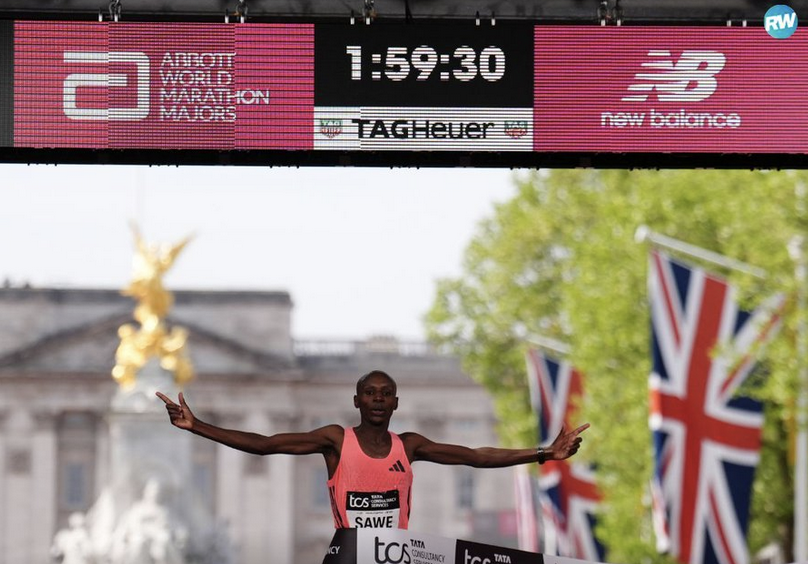
Sabastian Sawe just ran 1:59:30 with crazy negative splits, closing the last half in 59:01....faster than the American Record in the half.
One of the most mind blowing performances we've seen. How did we get here?
Every breakthrough is a mixture of belief and progress.
It takes folks daring to see what's possible, surrounding themselves with a quality team and doing the work to give themselves a shot.
You've got to bet on yourself in a big way.
When asked whether he believed he could run a sub-2-hour marathon before the race, Sawe answered with one word:
"Yes."
Let's get the obvious out of the way. Performance enhancing drugs are the legitimate question mark to every breakthrough.
So Sawe did as much as he could about taking that off the table.
He and his team asked to be tested all the time. His sponsor put up 50K to the Athlete Integrity Unit. The tests are run independently, no advance notice. Over a 2 month stretch, he went through 25 drug tests.
There's always a doubt. There has to be given what we know. Hopefully there's transparency in the results. But hats off to Sawe for addressing it:
"I want to prove that I am clean when I set foot at the start line."
But how'd we actually get here where two guys went sub 2 in the same race?
1. Shoe tech
We've had a revolution in shoe technology that boosts running economy.
For years shoe companies said their shoe would make you faster and was mostly marketing. Until 2016, when it actually did.
Initial research showed a 3-4% saving in economy, while subsequent work has shown it's highly variable.
Now, it's a matching game. Find the perfect shoe for your form and you can get a big boost.
Normally, it takes years of lots of miles and strength training to boost economy.
But now we get that instant boost that not only helps boost performance but often leaves us feeling less beat up in the later stages of the marathon.
So we get a little bit less hitting of the wall...
2. The fuel
For a long time, fueling was limited by biology. You can only take in and process so much.
Then in the 2000s, researchers found if we mixed sugars, we can boost intake because they're processed differently.
Then recently, Maurten found if you use a hydrxogel, you boost utilization without GI distress anymore.
We've gone from pushing 60g/hr to 120g/hr in a few decades.
Again...less bonking.
3. Depth
A few decades ago, you spent your career racing on the track and then once your speed started to fade a bit you went to the marathon.
Now, many skip right to the marathon. That's where the money is.
And with the economy boost from the shoes, you can make that jump quickly.
More depth of talent means more competitors in their prime pushing barriers.
4. Belief
Even with the shoes and tech, a few years ago sub 2 hours seemed a long way off, until Kipchoge pushed that barrier in a series of time trials.
Yes, they weren't official races and had contrived pacing. But it absolutely shifted everyone's thinking on what is possible.
A generation of runners saw Kipchoge go for it.
Our prediction of what is possible changed.
It's mind blowing how far we've come in such a short time.
What once seemed decades away, just got smashed twice in the same race.
Hats off to Sawe, especially for addressing the scourge of doping and showing folks what is possible with a lot of hard work, some crazy belief, and some fortuitous advances.
How should you Taper or Peak?
Why the research doesn't align with what actual elite runners do...the difference between tapering and sharpening, and so much more.
A new video deep dive on Youtube: @ SteveMagness
Link below:
If we really wanted to “Make America Healthy Again” we would shift our effort away from bullshit nutrition reform like removing artificial dyes and invest it in physical activity promotion.
Bring back recess. Incentivize exercise. Make movement accessible.