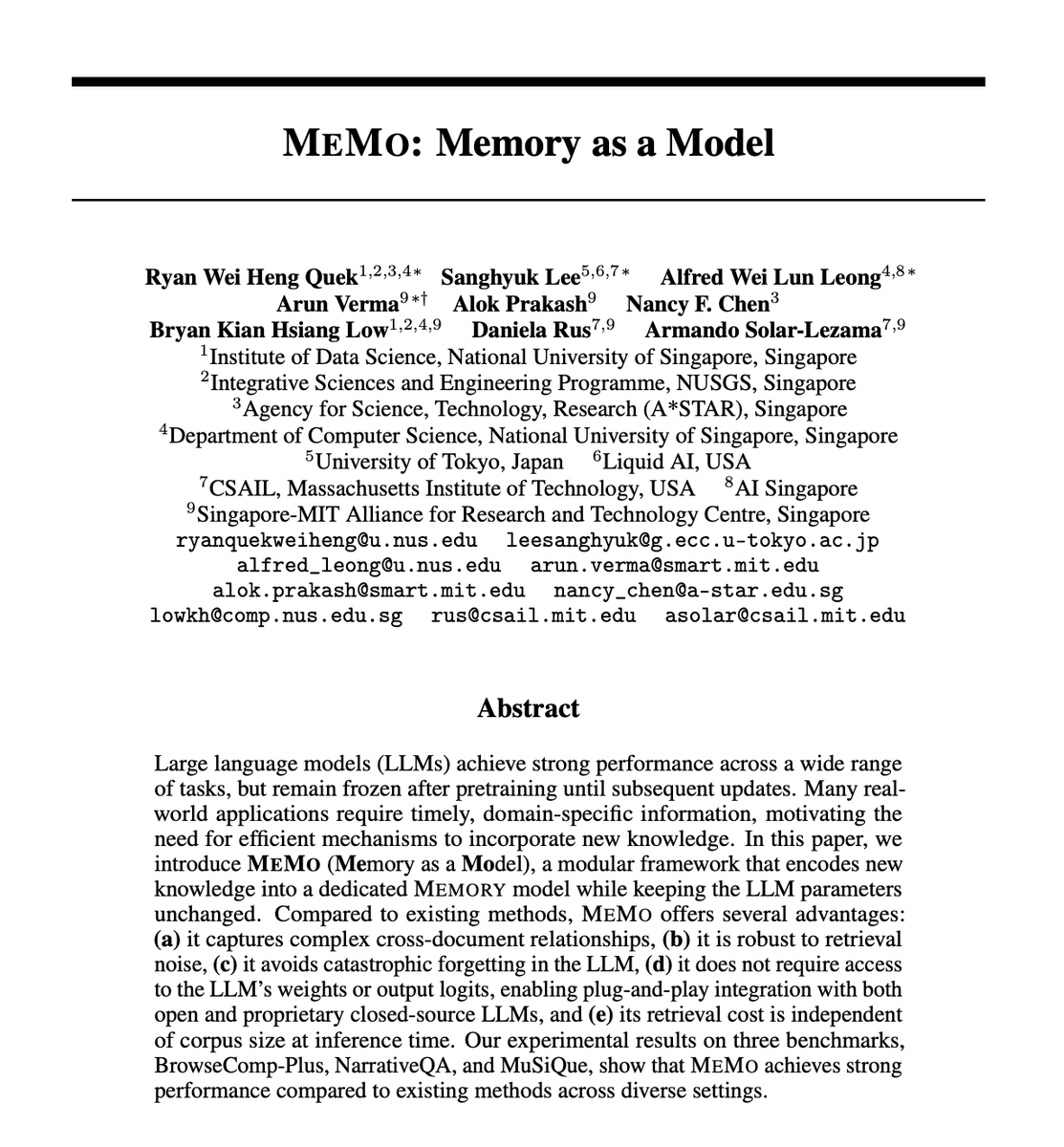
MIT published a paper that might end the entire RAG industry.
It’s called MeMo (Memory as a Model). It trains a separate Memory Model on your documents while keeping the main “Executive” LLM frozen.
Before training, a 5-step pipeline turns the documents into structured “reflections”: facts, entities and connections across sources.
When a question comes in, the Executive interviews the Memory Model through a 3-stage, multi-turn process.
It asks targeted follow-up questions, gathers relevant knowledge and uses it to build the answer.
The setup has three useful properties:
> The main LLM’s weights stay unchanged
> Works with open and closed models, without weights or logits
> Fixed-size memory keeps lookup cost independent of corpus size
On BrowseComp-Plus, NarrativeQA and MuSiQue, the researchers report stronger results than RAG and fine-tuning baselines, alongside resistance to retrieval noise.
The idea is simple: give the main model a separate model to consult, trained specifically on the knowledge it needs.
MIT published a paper that might end the entire RAG industry.
It’s called MeMo (Memory as a Model).
Instead of storing your documents in a database, you train a separate, dedicated "Memory" model to internalize them.
Your main LLM, the "Executive" model, stays completely frozen.
Your new knowledge gets encoded into a separate, dedicated Memory Model.
Here’s the clever part. They don't just dump raw text into it.
A 5-step synthesis pipeline distills your documents into structured "reflections”, extracting facts, surfacing entities, and stitching together cross-document relationships before the Memory Model is trained.
Then, at inference time, when you ask a complex question, the Executive Model doesn't search a clunky vector database.
It interviews the Memory Model.
Through a 3-stage multi-turn protocol, it breaks your question down into targeted sub-queries, pulls the exact synthesized knowledge it needs, and reasons over the final answer.
Why this changes the game:
• Zero catastrophic forgetting: Your main LLM’s weights are never modified.
• True plug-and-play: It treats your main LLM as a black box, no weights or logits needed. It works with both open-source and proprietary closed-source models.
• Flat retrieval cost: Inference cost stays independent of corpus size, because the memory lives inside a fixed-size model.
• Built for complexity: Validated across BrowseComp-Plus, NarrativeQA, and MuSiQue, outperforming both RAG and fine-tuning baselines while resisting retrieval noise.
We’ve spent years trying to build bigger context windows and smarter search bars to patch AI amnesia.
The real fix wasn’t giving models a bigger notebook.
It was giving them a second brain.
THIS IS AN ACTUAL F*CKING GOLDMINE
Before you blame Opus 5.5, learn these 15 official Anthropic commands
15 essentials to get more out of Opus 5.5:
less busywork → parallel agents → faster iteration
steal the cheat sheet ↓
01 /goal
https://t.co/djPCjEViqT
02 /batch
https://t.co/hdx9ZlyhJa
03 /subtask
https://t.co/XquDiLbiNr
04 /deep-research
https://t.co/pwO0X8iluT
05 /design
https://t.co/mxUDbP5co8
06 /plan
https://t.co/CEeVpQu4Oc
07 /memory
https://t.co/H8syNr3juj
08 /compact
https://t.co/trWEPzM1Ze
09 /branch
https://t.co/mxUDbP5co8
10 /rewind
https://t.co/rgdFl1xaDB
11 /mcp
https://t.co/OkVku217bW
12 /loop
https://t.co/xtXeBujN2d
13 /schedule
https://t.co/EW4gKzGt21
14 /simplify
https://t.co/mxUDbP5co8
15 /remote-control
https://t.co/tKxJaeHbuo
start here: /plan → /goal → /simplify
Save this, then build an AI team with Claude & an AI employee for your company ↓
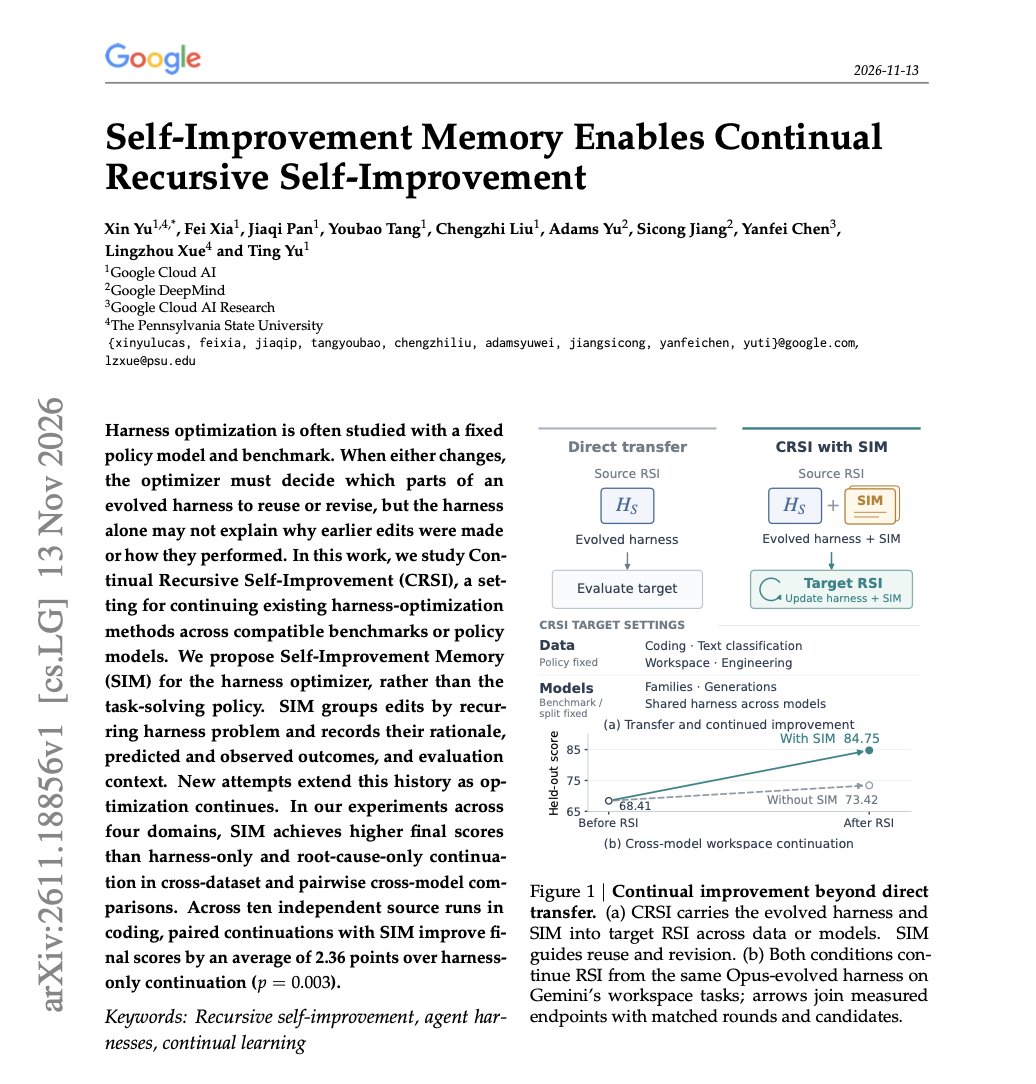
Brilliant paper from Google on RSI.
(bookmark it)
Recursive self-improvement (RSI) lets an optimizer agent improve an agent harness on its own. It reads failure traces, edits the prompts, tools and completion checks, and keeps whatever scores better on a benchmark.
This works until the model underneath changes. A harness evolved on Claude Opus, moved to Gemini, scored below Gemini's plain starting harness in every domain Google tested.
When the harness moves to a new model, the only thing carried over is the evolved harness code, meaning the prompts, checks and rules the optimizer added. The record of how each piece got there stays behind, including which failure it targeted and whether it fixed that failure when tested.
So the optimizer working on the new model inherits a set of changes with no reasons attached. It ends up retrying experiments that already failed, or removing fixes it doesn’t understand.
Google's fix is Self-Improvement Memory (SIM), a log kept for the optimizer itself. Each entry is a recurring problem, like an agent declaring a task done before its commands ran, and every fix attempted under it stores:
1. The edit and the reasoning behind it
2. The tasks it was predicted to fix, written down before testing
3. The tasks it actually fixed, failures included
4. The model and benchmark it was tested on
The whole log goes into the optimizer's prompt every round, and new attempts get appended as optimization continues.
The paper shows the difference on one inherited check that stops the agent from finishing early. With SIM, the optimizer read why the check existed and extended it.
Without SIM, it rewrote the same check four times, twice to fix deadlocks it had created itself.
On the Opus-to-Gemini workspace tasks, the run with SIM improved about 3x more from the same starting score. It also finished ahead in 9 of 10 independent coding runs.
The paper is at https://t.co/ZLdo7FK7qk
I also wrote an article on a related idea, covering how to make an agent harness diagnose its own failures.
It's built on @Cometml's Opik, which is 100% open source. It goes beyond reading trace logs to finding why a failure happened and stopping it from recurring.
That diagnosis step produces the kind of root causes SIM stores.
The article is quoted below.
Become a Claude Certified Architect
Here are all the required resource in one place: (save it)
Training courses: https://t.co/RDFGv4W1i2 (13 free courses)
Cookbook: https://t.co/1oYip6mo8V…
Exam Guide: https://t.co/DMYGbJ8oP8…
Practice questions: https://t.co/Wr4aXkRp2v (free)
MCP documentation: https://t.co/kFv5R2VW5o (free)
API documentation: https://t.co/zwCkwHWymI (free)
Partner Network: https://t.co/29FGAtFJLb (free to join)
Link to join: https://t.co/x5F1Esjoss…
Personal Playbook someone created after the exam: https://t.co/3Y360ZRjWE…
Elon Musk just released a prompt that turns Grok Bot & Opus 5.5 into an entire first principles strategy team.
It's f*cking unreal...
Send it to Grok Bot & Opus 5.5, and thank me later. Then read the full playbook with examples below.
Anthropic engineer:
“95% of our engineers are using self-improving harnesses + Opus 5.5. Now everyone is building agentic systems around them.”
In 1–2 months, we’ll all be building harnesses to orchestrate self-improving agents. No more raw prompting.
In a 35-minute lecture, Anthropic engineer shows how to build a self-improving agent harness from scratch with Opus 5.5.
Worth more than a $1500 agentic course.
Watch it
Then read the full Opus 5.5 harness engineering guide below ↓
Anthropic engineer:
“95% of our engineers already run agents inside Loops. The other 5% are still prompting.
In 1–2 months, everyone will be a context/harness engineer — because Context decides 90% of agent performance.
Same model, completely different results.”
In this 1-hour talk, he shows exactly how to build self-improving agents from scratch.
It’s worth more than every $1000 agentic course combined.
Watch this video, then read the article below on how to become a context/harness architect ↓
this must be illegal...
SpaceXAI engineer Lauren Tan revealed the skill she uses to automate coding agents:
run /create-verification-skill to teach agents how to launch your project, test real features and capture evidence
entry point → user actions → observable result
Encode that path as a verification record:
{
"entry_point": {
"launch": "exact startup command",
"ready": "observable readiness signal"
},
"user_actions": {
"interface": "UI | CLI | API",
"steps": "reproducible actions with fixed inputs"
},
"observable_result": {
"expected": "checkable outcome",
"evidence": "output, file, response or trace"
}
}
Result gate
> PASS - executed, expected outcome observed
> FAIL - executed, outcome differs
> NOT_RUN - blocked or not executed
Verify each property against its own evidence:
→ behavior
1. execute the real CLI / UI / API path with fixed inputs
2. compare expected_output with observed_output
3. read persisted values back from storage
→ performance
compare baseline and candidate profiles
control build_config / cache_state / workload
record the measured delta and trace paths
→ code quality
> run typecheck / lint / regression_tests
> retain command / exit_code / failure_log
> keep blocked checks marked NOT_RUN
When a failure repeats, use /correct to encode the lesson:
architecture → types / lint / CI → regression test → written rule
Prefer the strongest enforceable constraint
the next agent should encounter a type error, failed check or regression test before the same mistake reaches review
Save this for your next verification skill
I spent 4 months collecting this so you don’t have to waste the same time
Most people will save this and never open a single link.
This is the clean path from zero to being able to build and interview for real AI roles
01 Linear algebra and calculus
https://t.co/yi9qHLgYv3
02 Machine learning foundations
https://t.co/q8fM1qBS2O
03 Deep learning from scratch
https://t.co/u2c2VctE1L
04 Neural networks and backprop
https://t.co/n47rlwcbAx
05 Computer vision
https://t.co/tzlMu3vE5c
06 Natural language processing
https://t.co/Hx2oqFBAgf
07 Transformers and LLMs
https://t.co/RSxur9JGfH
08 Reinforcement learning
https://t.co/P7n1b1Fo9p
09 Building agents
https://t.co/gfWkr10k7k
10 The full path. Free
You either walk this now or keep watching random playlists for another year
Save this ⭣
THIS IS INSANE
Anthropic just dropped a goldmine of 20 Claude Code plugins. $29,077 worth of tools, FREE on GitHub
paid marketplaces sell a skill for $19 and an agent for $39. these repos ship 970 skills and 273 agents for $0
1.8M stars combined, picked from 68,900 repos tagged claude-code
most people still run Claude Code bare: no memory, no team, no taste, burning tokens on raw logs
20 GitHub projects you should open first:
1. Everything Claude Code → 71 agents, 311 skills and 97 commands in one harness. the closest thing to an agent OS
https://t.co/9rVZrWAndi
2. agent-skills → 25 production skills by Addy Osmani: spec, plan, build, verify, review, ship
https://t.co/t2ygivKgH7
3. Ruflo → runs agent swarms across Claude Code and Codex with shared memory between them
https://t.co/26QeNpJ8gC
4. agents → 202 agents, 185 skills and 105 commands packed into 94 installable plugins
https://t.co/otsYWvZkhj
5. claude-mem → records what your agent did, summarizes it and feeds it back next session
https://t.co/WccJ8te0TD
6. planning-with-files → keeps the plan in markdown on disk, so it survives /clear, compaction and crashes
https://t.co/5pENbLceT5
7. Graphify → turns code, docs and SQL schemas into a knowledge graph. parsed locally, nothing leaves your machine
https://t.co/IpUK6nWsRt
8. Understand-Anything → an interactive map of your codebase with search, guided tours and diff impact analysis
https://t.co/m5ot7lrl5g
9. ponytail → makes Claude code like the laziest senior dev. 53% less code and 45% fewer tokens in its own Opus 5.5 benchmark
https://t.co/W3h34gBkiK
10. rtk → a Rust CLI proxy that cuts 60-90% of the tokens from common dev command output
https://t.co/uFvslUWFb5
11. headroom → compresses logs, tool outputs and JSON before they reach the model
https://t.co/1Qluj9lMY5
12. context-mode → sandboxes tool output. 315 KB in, 5.4 KB to the model
https://t.co/usOJ1EnMAO
13. UI UX Pro Max → 79 styles, 192 palettes and 74 font pairings, so your UI stops looking AI-made
https://t.co/eLGaTdG1NV
14. taste-skill → gives Claude art direction, real reference photos and a browser check at several screen widths
https://t.co/x0KitmaEOL
15. video-shotcraft → turns your real pages into a cinematic product video in Remotion, synced to the beat
https://t.co/yspobXd0ye
16. Agent-Reach → lets your agent read YouTube, GitHub, Reddit and the web from one CLI, zero API fees
https://t.co/zZuAchQkUW
17. cc-switch → a desktop app to switch providers in one click and manage MCP, skills and prompts in one place
https://t.co/kgbzMzAbjs
18. pm-skills → 69 product skills and 42 chained workflows, from discovery to launch
https://t.co/RNc1RzrnaT
19. claude-skills → 380+ skills across engineering, marketing, finance, compliance and C-level advice
https://t.co/wGpjj88gE0
20. career-ops → scans job boards, scores every role against your CV and drafts the application. you still press Submit
https://t.co/2HXY1LWPqj
start with 3, not 20: one for memory, one for tokens, one for your actual job
run the same task before and after. keep only what makes the result better or cheaper
every plugin you add loads into context, so more isn't free
save this before you spend another weekend building something that already exists
and repost it for the friend who's still paying $19 a skill ↓
The next frontier is AI that improves itself, and we believe everyone should know how to build it.
This semester, Ao @ao_qu18465 and I are teaching 'How to AI an AI for Almost Anything' @MIT@medialab -- a new course on self-evolving AI systems that recursively improve from experience, feedback, memory, and exploration over long interaction horizons.
The key idea: intelligence shouldn't stop improving when training ends.
We cover four levels of evolution:
(1) context evolution through prompt optimization and context management,
(2) harness evolution through memory, tools & skills, workflow optimization, and multi-agent systems,
(3) model evolution through RL, distillation, test-time training, self-play, and continual learning,
(4) task evolution through generating increasingly complex synthetic tasks, simulations, evaluations, and environments.
Slides, readings, and videos available: https://t.co/QLPhT77Yvj
We thank @Kimi_Moonshot and @PrimeIntellect for generously sponsoring API credits!
Anthropic engineer:
“Anthropic hired me at $350K–$950K because I know how to build harnesses.
99% of people still hand-roll multi-agent systems and wonder why they break.
I build systems that run loops + sandbox tools + turn yesterday’s logs into new skills — same model, 10x more reliable agents that keep improving overnight.”
Opus 5.5 → Agents → Harness → Loops → Graphs
In a short workshop, he shows exactly how to build one from scratch.
step 1 → harness handles loops, context, and sandboxing
step 2 → brain and hands separated — 60% faster to first token
step 3 → runs server-side, resumes from the log after crashes
step 4 → failure is cheap — retry and replay instead of starting over
step 5 → yesterday’s logs become new memory — the system wakes up smarter
Anthropic calls this “dreaming”.
Most people spend weeks building this by hand.
You don’t have to.
Bookmark and watch it.
Then read the full Opus 5.5 harness engineering guide below ↓
Elon Musk just released a prompt that turns Grok Bot & Opus 5.5 into an entire process engineering team.
It's f*cking unreal...
Send it to Grok Bot & Opus 5.5, and thank me later. Then read the full playbook with examples below.
Anthropic engineer:
"99% of people use Opus 5.5 like Google, and only 1% are running swarms of self-learning Claude agents
I'm running 65+ agents in a loop. I have Chief agent, PM agents - they manage the whole team"
in a 30-minute workshop, an Anthropic engineer revealed how to get max value from Claude Code at min. cost
this is worth more than another $650 vibe-coding course
watch today, then read how to build self-improving agentic systems with Opus 5.5 in the article below
Prompt of the day:
/grill-me on how a /software-factory might help us
Helps you figure out if a software factory can help you, and brainstorms the infra you need to set it up.
https://t.co/sCojBeJw1D