$MIST
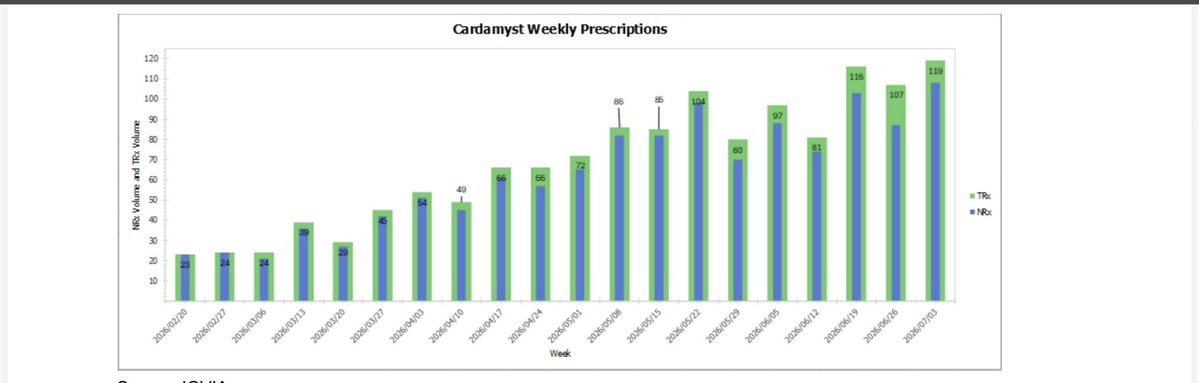
To have a credible path toward $6 per share during this launch cycle, I would want the rolling four-week TRx average to follow approximately this trajectory:
July: 125-140
August: 160-190
September: 220-270
October: 320-400
November: 450-575
December: 650-800
With no additional major payer unlocks other than ESI, I would want December closer to 800–1,000/week, because prescriptions would need to demonstrate exceptional demand despite restricted access.
With one of the two large commercial payers unlocked, approximately 650–800/week, still rising, could plausibly support $6.
With both major commercial payers unlocked, 500–650/week might initially excite the market, but the market would then expect a visible acceleration during the following one or two processing cycles.
Medicare access would be a future multiplier rather than something December prescriptions must already reflect.
I understand the frustration. Let’s review the facts:
1. Short selling isn’t entirely unfounded, there’s dilution risk, but the level of aggression is extreme.
2. TRx and NRx numbers are operationally bullish. The market is ignoring this because it expects those prescriptions to convert into revenue immediately. As investors trying to beat the market, we’re looking for those early signals before the broader market catches on.
3. The $1 level adds extra pressure; investors are nervous about a Nasdaq deficiency notice.
Right now, business evidence is improving faster than the share price. This can become an opportunity, but only if the next financial report confirms that rising TRx is turning into rising paid revenue, without destructive equity issuance. So, two things ultimately matter most:
1. TRx and NRx numbers
2. Net realized price per unit after rebates
@slim520rr@MLmeign1 The CEO is an expert in buyouts. The company will almost certainly be acquired. If they can make it through this six-month valley of death, the eventual buyout price will be enormous.
$MIST
I view the current valuation as a classic post-approval "valley of death" mispricing. Below, I detail the operational metrics required in the Q2 release to drive a re-rating above $2.00 (+65% upside) and unlock the institutional price target of $6.00+.
1. Top-Line Beat: Revenue > $2.0M vs. $1.1M Consensus
Wall Street consensus estimates for Q2 revenue stand at ~$1.10M (EPS: -$0.19). A top-line print clearing $2.0M–$2.5M+ would demonstrate a ~10x quarter-over-quarter trajectory relative to Q1's soft launch ($240k). This scale of top-line velocity is the single strongest indicator that physician uptake is accelerating past initial sampling.
2. Prescription & Prescriber Acceleration
Investors should evaluate cumulative filled scripts against the Q1 benchmark (~600 scripts for 560 patients). A update showing 2,500+ cumulative scripts would confirm organic momentum among electrophysiologists and cardiologists. Expansion of the unique prescriber base beyond ~400, coupled with evidence of multi-dose reordering by PSVT patients, validates product efficacy and sales force productivity across target accounts.
3. Managed Care Expansion (> 40% Commercial Lives Covered)
Following early placement on Express Scripts national formularies (>25% commercial coverage), new tier-1 PBM announcements (e.g., OptumRx, CVS Caremark) pushing total commercial coverage past 40%–50% would significantly reduce prior-authorization friction and out-of-pocket drop-off.
4. Balance Sheet Protection & Extended Runway Guidance
$MIST 's ~$184M cash balance provides runway into H2 2027. Reaffirming this timeline while demonstrating controlled SG&A expense post-launch will extinguish short-seller arguments regarding near-term equity dilution.
5. Pipeline Expansion (AFib-RVR Phase 3 Initiation)
Management updates confirming H2 2026 first-patient enrollment in the Phase 3 AFib-RVR trial reframe etripamil as a multi-indication asset, expanding the long-term addressable market beyond PSVT.
@stocksdd At 500 per week:
If TRx has risen from 120 to 500 in six months and is still accelerating, the market may price the future 1,000–2,000 weekly level before it arrives.
If 500 is the plateau after broad access and repeated physician engagement, then your critic is right.
$MIST
Comparing CARDAMYST to a primary care launch (like a statin or blood pressure pill) leads to unrealistic expectations. CARDAMYST is an acute, episodic specialty drug, which means:
1- Patients only use CARDAMYST when they experience a PSVT episode. A doctor won't write 20 scripts a week; they give it to select, symptomatic PSVT patients when they come in for their routine appointments.
2- A prescription written by a physician takes 14 to 30 days to go through hub intake, benefit verification, co-pay assistance, and home delivery. A script written in mid-May often doesn't show up as a filled TRx in IQVIA until mid-to-late June.
3- CARDAMYST represents a novel therapeutic class (a nasal spray for PSVT). Changing physician habits from IV drugs in an ER to a self-administered home treatment requires multiple educational touchpoints, not just a single sales call.
4- A small biotech cannot match the launch speed of a giant pharma, like Eli Lilly.
Moving from 23 scripts/week in February to 120 scripts/week in June represents a 5x acceleration. I still believe this is impressively solid. Reaching 120 scripts/week in early July via a lean sales force demonstrates genuine physician demand, proving the product is pulling itself through the market rather than relying on massive corporate spending.
@smallcapharma@MLmeign1 How is this "impressively solid"! Back in May didn't they say their sales force had already called > third of 10K prescribers. Back in March 30th express scripts(covers 105m lives) started covering..And in late June this is just doing 120Rx/week ?!? Pretty bad imo. NOT FI advice
@MLmeign1 By the way, another positive takeaway from the chart is the steady uptrend in refills over the past three weeks, a sign of growing recurring demand.
@MLmeign1 Very valuable information, thank you! I guess the figure should be around 1500 then.
In this case It confirms that a $2M Q2 revenue print is unlikely, and top-line results are more likely to land in the $0.8M to $1.2M range depending on gross-to-net realization recovery.
@alexpitti_stxs Until the big news drops, we have to read between the lines and pay attention to the small details to understand what management is up to.
Today, $MIST issued a press release about granting stock options to hire six new professionals. The key takeaways are:
1- This signals that, despite the depressed stock price, management is still executing their real-world strategy. They are likely either expanding the commercial sales support team, helping clinics navigate OptumRx prior authorization paperwork, or building the regulatory infrastructure required for the upcoming Phase 3 AFib-RVR trial in early 2027. It confirms the company is operating with the confidence of a $184 million cash runway. They are not packing up or winding down; they are adding talent to push through the 2026 “Valley of Death.”
2- Issuing 288,000 options against a base of roughly 124.5 million outstanding common shares represents a dilution of just 0.23%.
3- Recall that at the June 10 AGM, nearly 30% of the active voting base opposed the new 6.8 million share Equity Incentive Plan, and proxy advisors forced strict anti-recycling provisions onto the pool. By using the 2021 Inducement Plan (Nasdaq Listing Rule 5635(c)(4)), management hired six new professionals without touching the hard-won 6.8 million share bucket just approved by shareholders. They legally bypassed the standard shareholder-approved plan to preserve those precious shares for existing executives and top performers, while still managing to bring in new talent.
Overall, this is a solid, positive sign that the company’s internal machinery is actively scaling up for the 2027 plan year and the AFib-RVR pipeline.
$MIST
The Q2 quarter closed on June 30th. That means the entire second quarter was fought entirely in the mud of the initial launch friction, with Express Scripts being the only wide-open commercial channel. Q2 revenue will almost certainly print very low, exactly as the analysts expect.
However, the August earnings call becomes a massive psychological inflection point for a completely different reason. Institutional investors won't be looking at the trailing revenue spreadsheet; they will be listening for forward-looking forward guidance and structural commentary.
1- We will listen closely to the CEO's or COO's commentary regarding how effectively the 60-person sales force is helping cardiology clinics navigate the new OptumRx PA paperwork. If they state that clinics are successfully pushing scripts through the OptumRx gate, it proves the commercial pipeline is structurally functional, even if those July sales won't show up on a balance sheet until the Q3 report in November.
2- We will look at the relationship between total units shipped and net revenue. This will reveal the exact discount management had to give ESI. If the net price per box holds steady around our expected $700 range, it proves management is successfully defending the drug's profit margins and refusing to sign desperate, low-margin deals.
3- Any concrete confirmation of incoming regulatory milestone cash from China will provide a powerful psychological boost to the market. It reminds Wall Street that $MIST has an international, non-dilutive safety net protecting their $184 million treasury, meaning they can comfortably absorb a low-revenue summer without triggering shareholder dilution.
ANALYSIS OF THE JUNE 10 GENERAL ASSEMBLY $MIST
1- There was a lack of support for the "equity incentive plan", which is mechanically represented by a massive anomaly in the voting totals. There were 19,665,705 votes "For" management's compensation, but a staggering 6,990,920 votes "Against".
2- If you look deep into the actual text of the amended Equity Incentive Plan, management had to insert strict "shareholder-friendly" clauses to prevent institutional proxy advisors (like ISS and Glass Lewis) from telling funds to vote against the plan entirely.
2.1- The Recycling Block: They added a clause stating that after June 10 if a participant uses shares to pay their exercise price or tax withholding, those shares are permanently retired and cannot be recycled back into the plan for future use.
2.2- The Director Cap: They established a strict, hard cap preventing any Non-Employee Director from receiving more than $750,000 in equity compensation in a single year.
Management knew the shareholders were furious about the stock price. To guarantee they could secure the 6.8 million shares needed to pay their executives and sales force, they had to legally bind their own hands with these strict caps and anti-recycling provisions to appease institutional voters.
Because management possesses the cash runway into 2027, they survived this General Assembly. However, the 26% rebellion on their compensation proves that if they do not deliver a margin-protecting PBM deal with OptumRx or CVS Caremark by the end of the year, the 2027 General Assembly will likely feature activist investors actively attempting to replace the board.