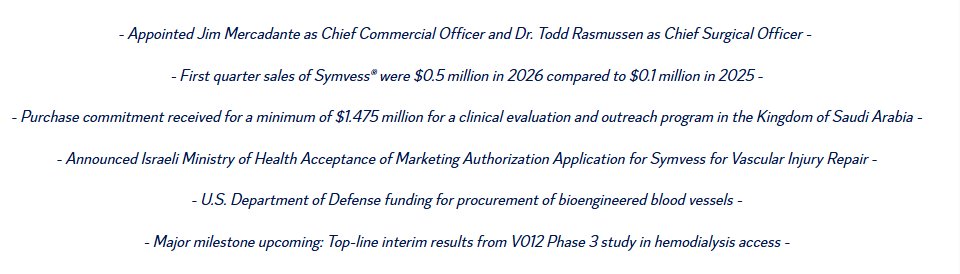
$HUMA was trading at -10% when I wrote this premarket, it's now up 15-18%, why? The market realized this Q was a huge derisking quarter for the company.
The signing of Dr. Todd Rasmussen as Chief Surgical Officer, who has deep ties with Mayo Clinic and DoD was the ultimate sign that the company was about to drop a bomb this Q.
Q4 25 / Feb 26 Management already hinted that $HUMA was working with the pentagon and DoD for the review of their Symvess. While funding was still unkown it was just a matter of time they released the inevitable news, DoD contract.
A contract with the DoD not only derisks the company from a default / bankrupcy.
If the DoD adopts Symvess as a standard of care, many Level 1 trauma centers will feel pressured to use Symvess, which in essence, will lead to higher sales and faster adoption.
After reading the Earnings Call transcript it looks like management has finally realized that they not only have to get Symvess to hospitals, they have to teach and convince surgeons how to and why Symvess is better than a conventional autologous graft.
With the new signings of Jim Mercadante as CCO and Dr. Todd Rasmussen as CSO I believe $HUMA is turning the business into where I believe is a first step to revenue growth.
While ultimately the biggest catalyst for the company will come with their Dialysis interim data readout next month, this Q was a huge derisking Q for the business and I believe bankrupcy risk has been left behind, albeit there will still be massive dilution going forward, but that pretty much granted from an early stage biotech company.
My estimate is that the DoD will finalize an initial purchase of around $5M by EOY26 with potential of going to 10s of millions as Symvess becomes SoC.
I believe the company is in a much better place than it was just a few months ago, and with a read out later next month, it's just a matter of time the company 2-3x overnight if the readout meets primary endopoints.
Wall Street haven’t figured $PENG role out yet.. when they do, it will explode.
Here’s everything you need to know and why $NVDA $AAOI $MU $SNDK will need to rely on them, at one point:
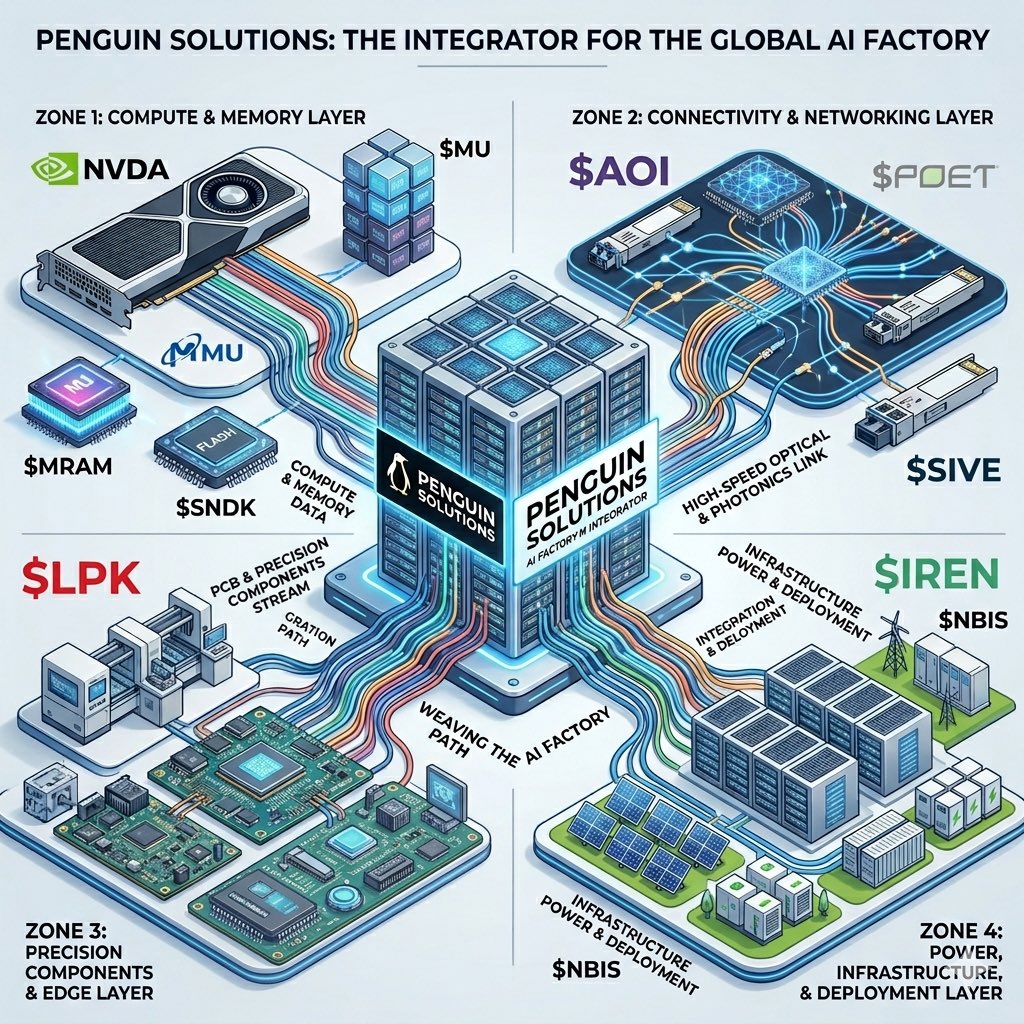
$PENG provides the *end-to-end architecture* required to make components work as a unified system.
They design, build, and manage "AI Factories" such as massive data centers optimized for AI training.
Their portfolio covers:
> Computing
> Memory
> Managed Services
They solve the "Memory Wall" (the bottleneck between the processor and data) by owning memory technology and system integration expertise.
And acts as the integrator layer, the "glue" that assembles raw components into a functioning supercomputer.
Penguin’s uniqueness lies at the intersection of Memory and HPC (High-Performance Computing). Most integrators focus only on the compute (GPUs), but Penguin understands that the "Memory Wall" (the speed gap between the processor and the data storage) is the BIGGEST bottleneck in AI. They are one of the few players that own the memory technology (through their SMART Modular brand) and the system-level integration expertise.
To give you an understanding of their position:
Tier 1: Component Providers (The Raw Materials)
$NVDA provides the Blackwell GPUs that serve as the engines of the factory.
$MU provides High-Bandwidth Memory (HBM), while $MRAM provides persistent memory for reliability.
$SNDK provides high-speed SSDs, and $P provides the all-flash arrays required to feed massive datasets to GPUs without lag.
$AAOI provides the "nervous system" through 800G and 1.6T optical transceivers that move data between GPUs.
$POET and $SIVE provide photonics to replace copper wires with light-speed links.
$LPK provides precision manufacturing for the circuit boards these components inhabit.
Tier 2: The Architect & Integrator (The Brain)
This is the center. Penguin takes the chips $NVDA, memory $MU, storage $P, and networking $AAOI and "weaves" them together.
They perform the "racking, stacking, and testing".
Tier 3: Infrastructure Operators
$NBIS & $IREN. These are the customers. They build the physical power, shells, and the AI cloud.
They rely on Penguin for the technical deployment and managed services to keep fleets running 24/7.
If the AI revolution is a gold mine, $NVDA and $MU are the pickaxes, $P and $AAOI are the conveyors and bins, $IREN and $NBIS are the ‘owners’, and $PENG Solutions is the engineering firm that builds and manages the entire operation.
-BP
NOT FINANCIAL ADVICE.
$RKLB is becoming the definition of non-stop execution.
- Signed its biggest launch deal yet, with a confidential customer booking 5 Neutron and 3 Electron launches
- Won a ~$30M contract from Anduril for 3 HASTE hypersonic test launches
- Announced a definitive agreement to acquire Motiv Space Systems, expanding deeper into space robotics, motion control systems, and precision spacecraft mechanisms
- Been selected, alongside Raytheon, to demonstrate advanced capabilities for the U.S. Space Force’s Space-Based Interceptor program
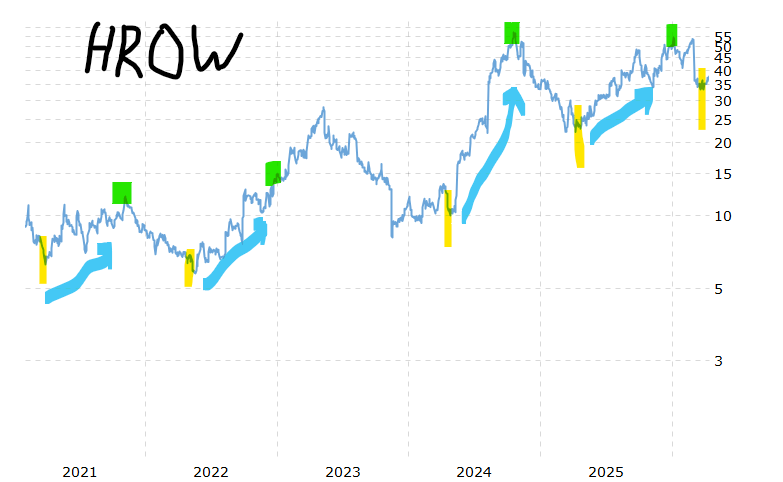
Reminder: seasonal business => seasonal $HROW share price 5 of last 6 years. Already happening again. Only 2023 different (bc acquisition & Iheezo J-code timing). Now is the buy time. You're welcome.
$USAR (May 1, 2026-daily chart update)
The volatility hole + red candle combo is my favorite signal — it has been highly accurate and has triggered a rally almost every time.
Momentum bars at $19.25 and $22.40 are acting as support for now. To gain stronger momentum, $USAR needs to close above the longer bars at $26.17 and $26.58.
Personalized AI medicine will likely be huge.
Nobody wants to die early.
Combining $HIMS to $TEM has immense potential.
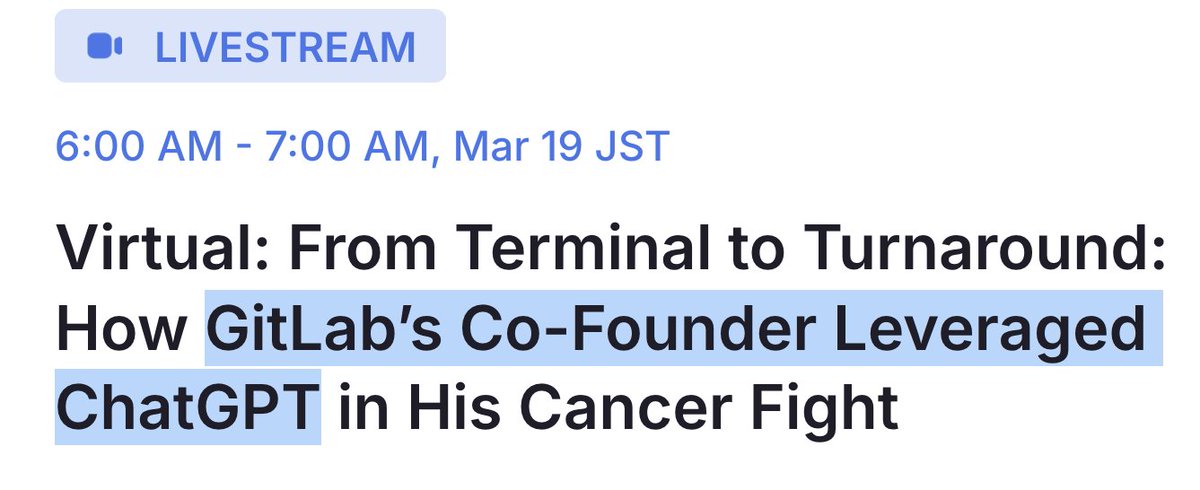
Here's just one example with Gitlab's CEO:
> In 2023, Sijbrandij was diagnosed with osteosarcoma
> In July 2024, he announced the cancer had returned, despite multiple treatments
> By late 2024, he had reached the absolute end of standard of care medical options.
> Rather than accepting death, Sijbrandij decided to treat his cancer the same way he built GitLab as an engineering problem
> He began feeding ChatGPT massive amounts of his personal medical data from scans, blood test results, and tissue sample data.
> ChatGPT and AI made novel targeted treatments after identifying mutations, then how to attack them
> From there, he applied for unapproved, experimental drug and received it
> The approach worked. Sijbrandij managed to stall and turn around a terminal prognosis with AI.
We've seen this success story with Gitlab's CEO ( $TEM was explicitly listed the partner he used for the bulk RNA sequencing of his tumor ).
As well as someone curing their own dog with AI recently.
The potential if you can combine $HIMS (DTC distribution network) and $TEM (Personalized sequencing and AI treatment) into a scalable product is massive (though extremely challenging).
The entire human population is the TAM.
And similar to the $AXTI InP situation with hyperscalers:
People will pay anything to not die (bottleneck). This is just a hint into where the future of healthcare is heading.
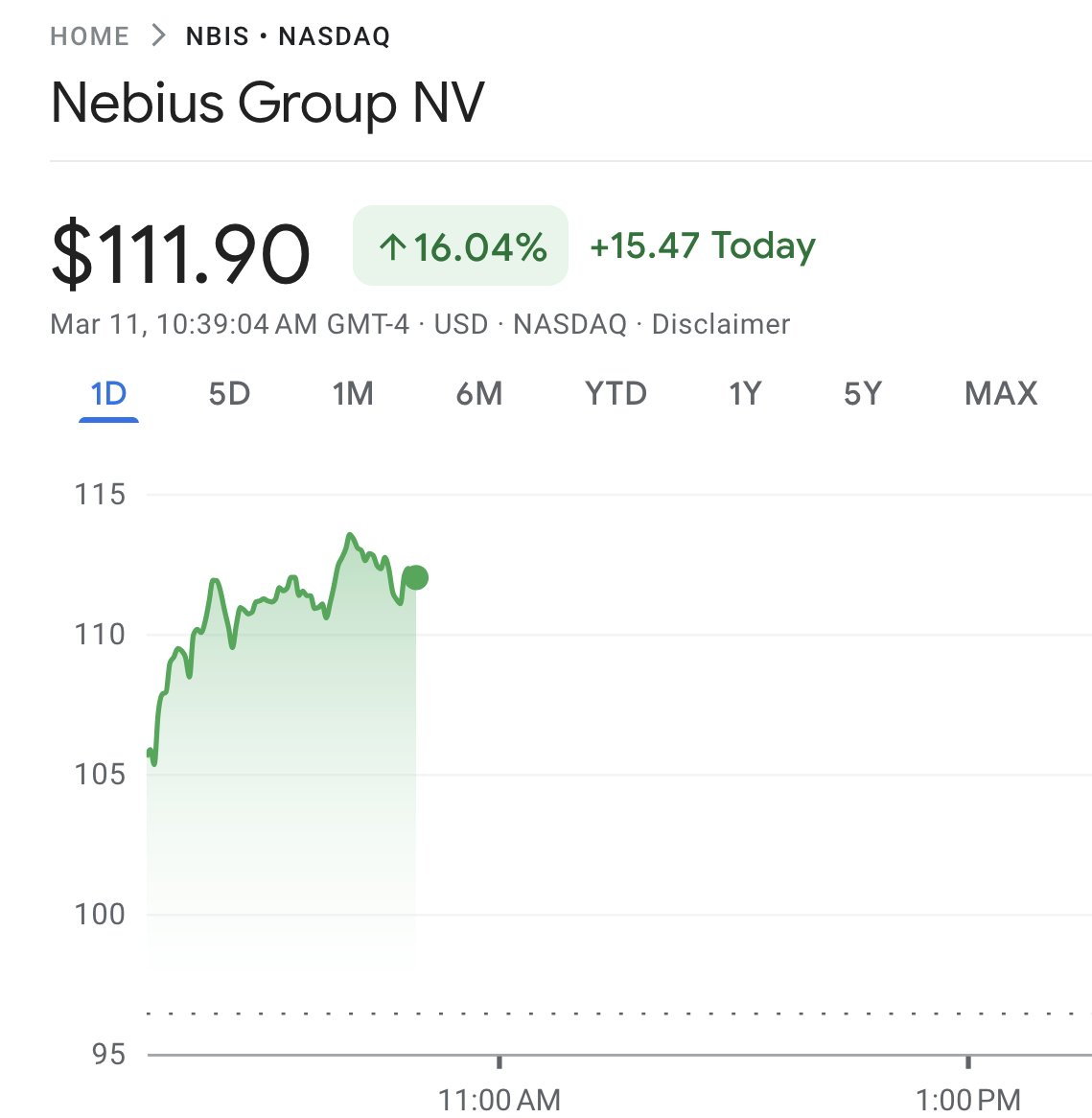
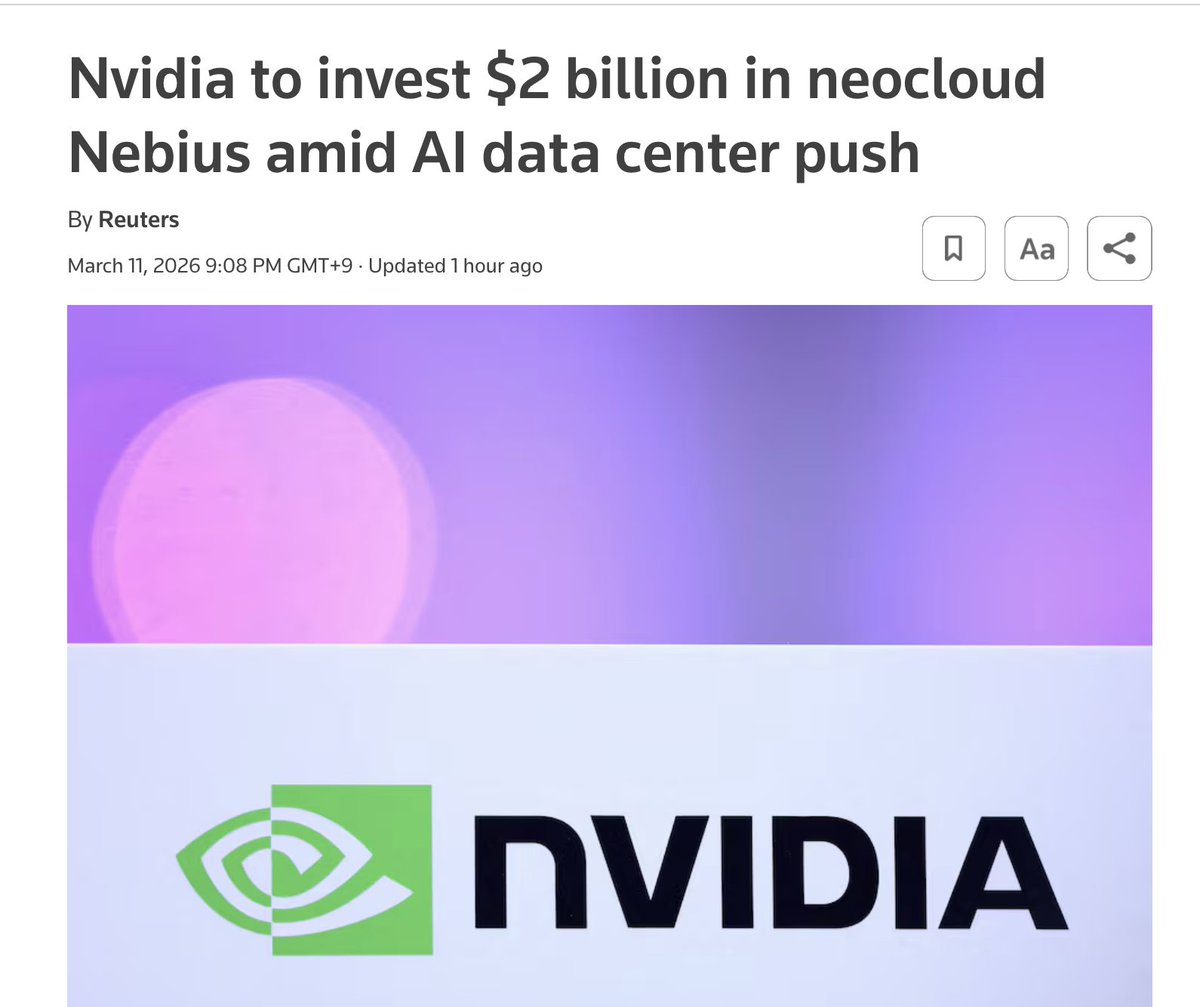
Just in: Nvidia has invested $2B into $NBIS.
I'm convinced Nebius is the next Amazon-level hyperscaler over time.
As they're 5 companies all growing sum-of-parts triple digits Y/Y:
- Nebius: $7-9B ARR from AI Cloud as the next AWS.
- Clickhouse: DB powering majority of fortune 500 companies, last valuation at $15B
- Avride: Robotaxi and FSD-4 level technology, now scaling up live with Uber.
- Toloka: Data Labeling platform, funded by Jeff Bezos and used by $AMZN
- TripleTen: Education platform, not as sexy as the rest, but still fast growing.
With sidequests from the widely used benchmarks like SWE-rebench.
Jensen's $NVDA investment into Nebius shares the same sentiment:
Nebius is at the forefront of AI and leading the wave to meet the growing demand for compute.