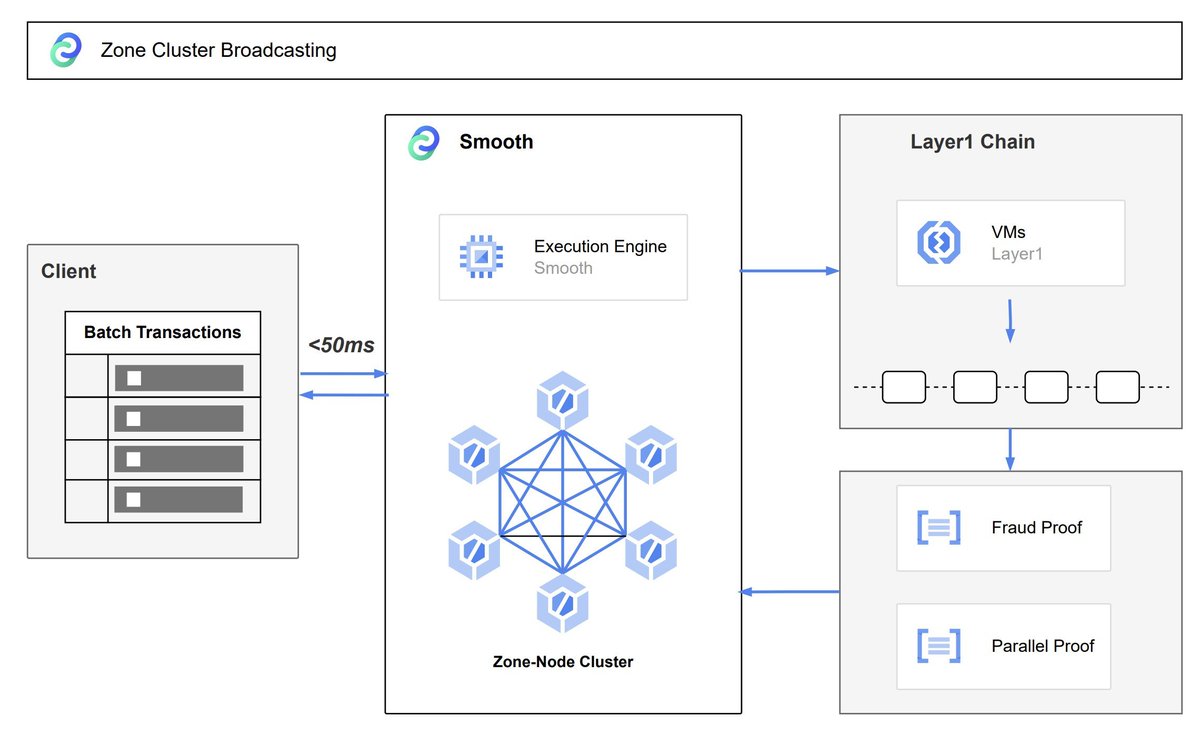
We are thrilled to announce that Adventure Gold DAO @GoldAdventure has officially partnered with Smooth Labs @smooth_org to jointly explore low-latency Layer 2 solutions.
https://t.co/YCcyZFztqI
Argot, a collective of developers who have been working on important Ethereum dev tools we know and love for many years, is in the process of becoming an independent org.
https://t.co/NQFooKNmCj
@sgoldfed Your technical work has been exemplary, and your achievements (still one of only two stage-1 EVM rollups, and huge amount of usage across diverse industries) show it.
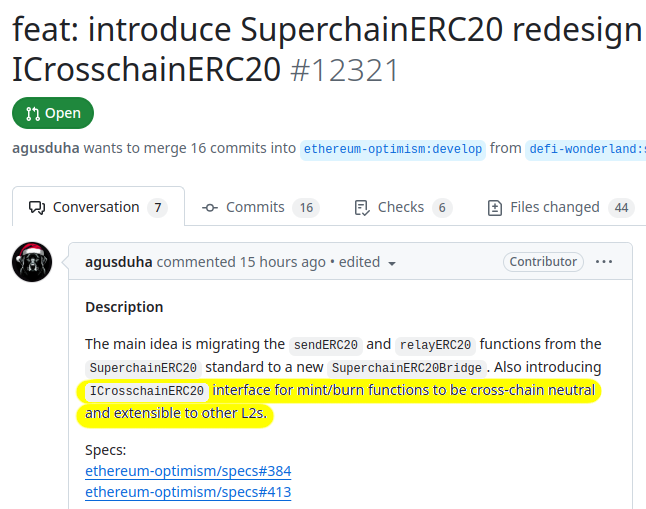
Seen on @Optimism github:
"Also introducing ICrosschainERC20 interface... to be cross-chain neutral and extensible to other L2s"
I think people are sleeping on just how much Ethereum infrastructure players really *are* willing to cooperate and build a unified Ethereum ecosystem
@VitalikButerin@optimizoor The on-chain integration of UI and CDN allows for fast data verification (possibly through hashing the frontend code) and provides more secure version control. At this point, a module for measuring latency can be added, which directs all user access to the nearest IPFS node.
💧
"Is this a shortcoming or a feature?" @ton_blockchain
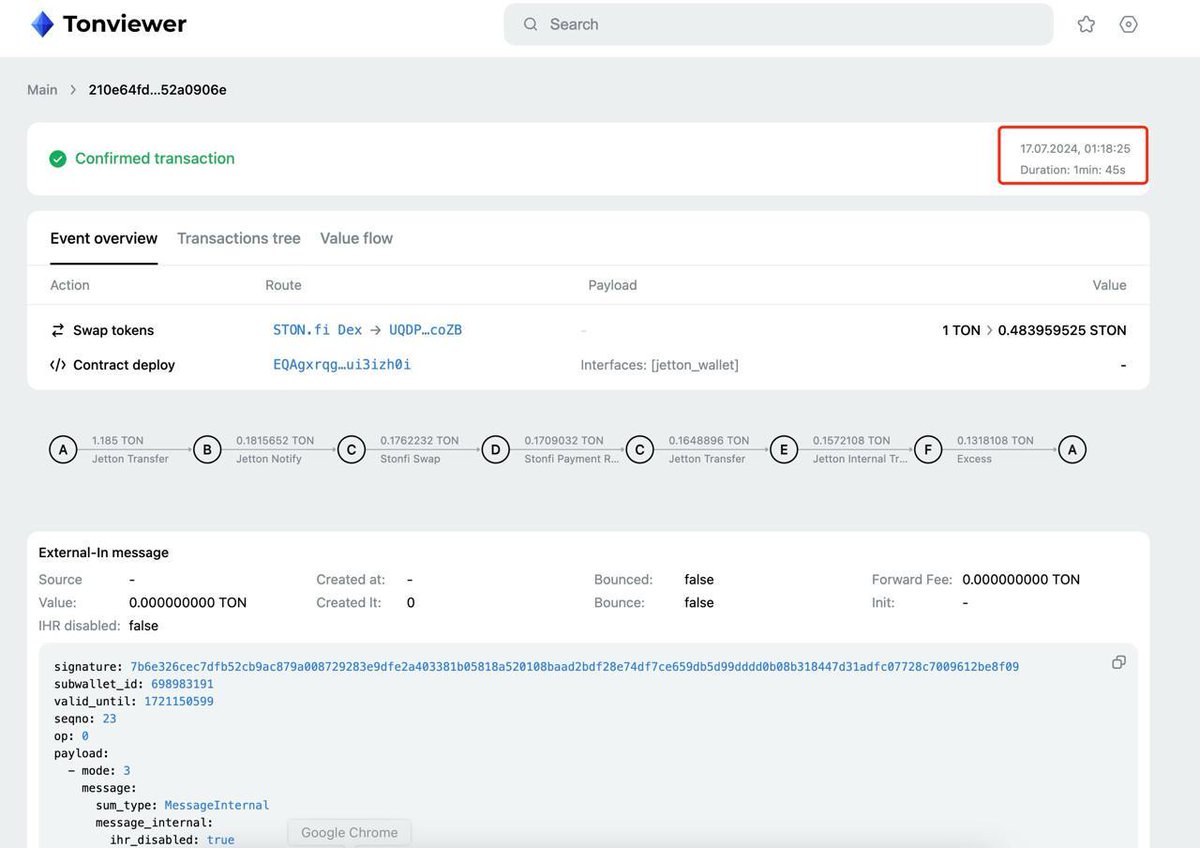
In simple terms, for EVM chains, which are synchronous blockchains, a single transaction can include multiple smart contract calls, and the next transaction doesn't start until the first one is finished. This means that with just one block confirmation, the transaction can be confirmed as completed.
However, in TON's asynchronous system, users cannot immediately obtain the response of the target smart contract within the same transaction because contract calls may take several blocks to process. The routing length between the block that initiates the transaction and the block that completes the transaction will affect the response time.
In the example above, the asynchronous communication of the swap message is the main reason for the time delay.
1/14
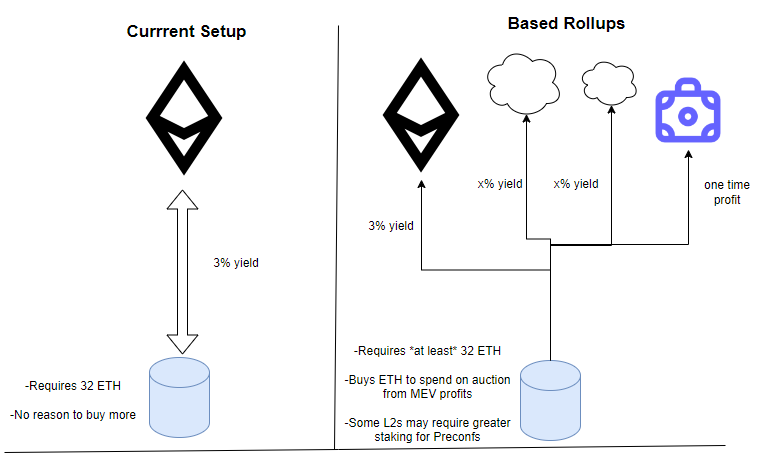
Based Rollups directly impact the monetization of ETH, by making a pretty fundamental change to incentive structures - which could easily 100x the long term demand for ETH.
Here's how that works:
🔵 Look into Compatibility and Scalability.
Implicit Dependencies
Developers do not need to explicitly define data dependencies; the system automatically manages and optimizes data flow and execution processes.
EVM Compatibility
Implemented as an extended Solidity running on unmodified EVMs.
Relay and Execution
By moving the execution flow instead of data to resolve data dependencies, the need for data transfer is reduced, optimizing execution efficiency.
Eventual Atomicity
Safely moves the execution flow between VMs, inspired by the Monoxide project. This ensures operation atomicity, even in a distributed environment, maintaining consistency and integrity.
Linear Scalability
Overhead remains constant regardless of the number of VMs. This means the system can seamlessly scale by adding more VMs without additional management or performance costs.
“The difference between a dream and a goal is a plan.”
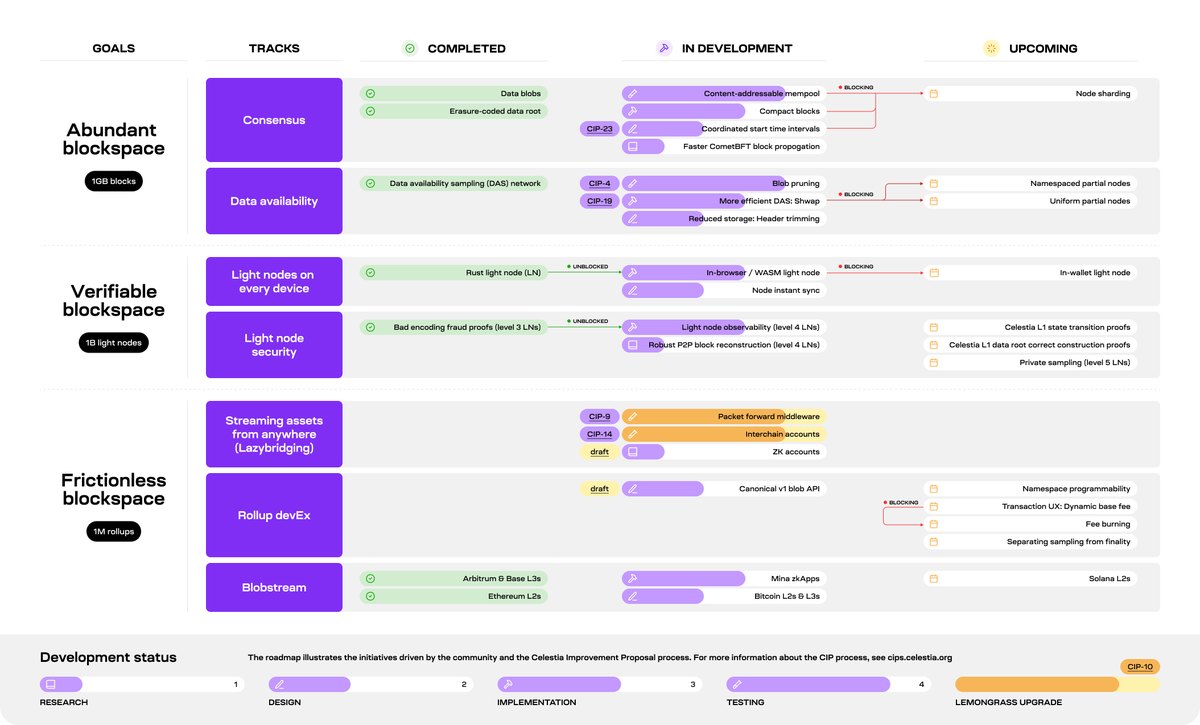
Celestia’s roadmap turns the vision of 1GB blocks, 1B light nodes, and 1M rollups from a dream into a tangible goal.
A goal that the community will be working towards relentlessly for years to come.
Here’s what you should know 👇
—
Celestia’s roadmap is organized around 3 core principles.
Scale: Celestia is laser focused on 1GB blocks
• We believe that removing the constraints of DA throughput will open new frontiers for what is possible to do onchain. We can scale up existing crypto apps like payments and DeFi, make altVM L2s like Eclipse that push execution performance beyond what’s possible on L1, and even deploy web2 apps or AI models onchain.
• Without execution or state, Celestia has the ability to scale far beyond high-performance monolithic chains. The goal is to be able to support many visa-scale and Solana-scale networks, all within one underlying protocol and security network.
Verifiability: light node security and distribution is key
• Blockchains are tools for trust-minimization. When users can’t verify the applications they are using and have to rely on an RPC to interact with the chain, trust-minimization goes down the drain. This is the state of most chains today.
• An entire track of the Celestia roadmap is dedicated to solving this problem by making light nodes as trust-minimized AND as accessible to users as possible. We will reduce hardware requirements, cut down sync times, and make the software easy to embed in wallets and UIs. This way anyone, anywhere can be a first class citizen of the network.
Frictionless devEX and UX: we must solve modular fragmentation
• The big question on everyone’s mind is how can we make devEx and UX for modular applications as seamless as their counterparts on monolithic chains. After all, developers and users are LAZY. The primary solutions to this problem exist outside of Celestia in the realm of chain abstraction, but features like ZK accounts can complement them to help solve fragmentation without adding state and execution to Celestia. More to come on this.
• And of course, Celestia will continue to provide offchain DA to the Ethereum ecosystem and look to expand support to the growing L2 ecosystems on Bitcoin, Solana and Mina via Blobstream.
See the roadmap blog post for more details 👉 https://t.co/XsofQNGhbg
—
How will we actually achieve all this?
The roadmap contains the specific engineering milestones required to reach these ambitious goals the community has set for itself. Some have already been shipped, others are coming soon in the Lemongrass upgrade, and others are somewhere in the pipeline from research, to design, to implementation and testing.
Learn more and get involved
If you're wondering what exactly each of these milestones like node sharding, shwap, or ZK accounts are, check out the glossary here 👉 https://t.co/hq9yX3wIgN
If you want to participate in Celestia’s development and get involved in the CIP process here’s how 👉 https://t.co/N3rlRy1yqG
A big THANK YOU to the community
This roadmap is the culmination of 10 months worth of core developer calls, community working groups, and 24 CIPs. Thank you to everyone who’s been part of these discussions.
Thank you to the 20 rollup teams who deployed on mainnet and to all the Celestia ecosystem projects who have taken the risk of building on the first modular DA layer and given valuable feedback. Your input has shaped Celestia into what it is today and what it will become.
Thank you to everyone out there running light nodes. Thanks for believing that we can make blockchains trust-minimized again.
Onward.
Lido on-chain delegation is finally available!
You can now select a candidate if you have any LDO sitting around.
We have a great roster of initial delegates; you can learn about their platforms below.
By delegating your LDO, you help
✅bring more diverse voices into the conversation
✅help hit quorums
✅strengthen the system against governance attacks.
Be a hero for the DAO; I'm also delegating mine!
🔵Latency is a crucial exception in the glue and coprocessor architecture. Even though glue typically prioritizes familiarity over efficiency, latency and data bandwidth remain essential. To improve latency, focus on optimizing data transmission paths and reducing unnecessary delays, such as network latency or storage access time. Additionally, introducing more efficient precompilation or specialized modules at the hardware and software levels, along with enhanced matrix computation techniques, can further reduce overall latency, boosting system responsiveness and performance.
@wolftivy I wonder what you would think about social mechanisms with built-in anti-correlation features:
https://t.co/uNHvO9SB6M
(Basically, try to explicitly distinguish "escaping propaganda" and "being propaganda", and boost the former in a neutral across-the-board way)
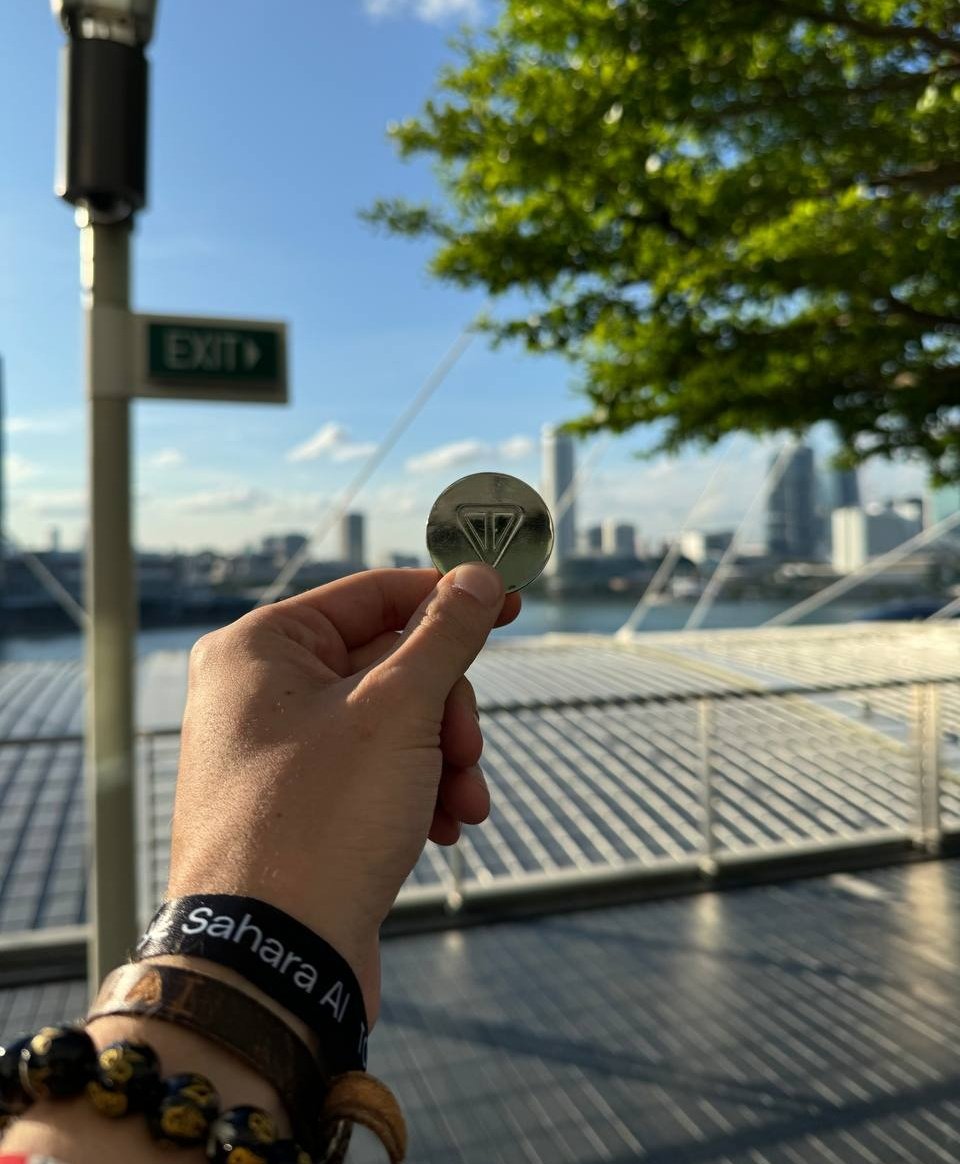
TON Blockchain Reaches 1 Billion Transactions 💎✊
#TON has hit a significant milestone, surpassing 1 billion transactions on its blockchain. Incredibly, half of this volume has occurred within the last three months.
https://t.co/wcHMLXhs0G
In April, @Picasso_Network launched the first Solana IBC connection, unifying the Solana ecosystem with the #interchain
Learn more about Solana IBC through the Interchain Jam Highlights, featuring @ComposableFDN, @jito, & @anza_xyz ⬇️
https://t.co/1nNSZcb7Zo
@VitalikButerin Perhaps the most appropriate method for airdrops is to distribute them in phases, similar to how institutions or teams do, and to consider utilizing the airdropped tokens after distribution, rather than having the airdrop conclude immediately at the project's launch.