Recently did an interview. We talked about our fund — how we select projects we truly want to build with, and how we help them grow by finding a tailored approach to development and scaling.
We also discussed the current market phase, strong narratives, and what many are overlooking.
Wrapped up with my personal takes and crypto predictions for 2026 👀🔮
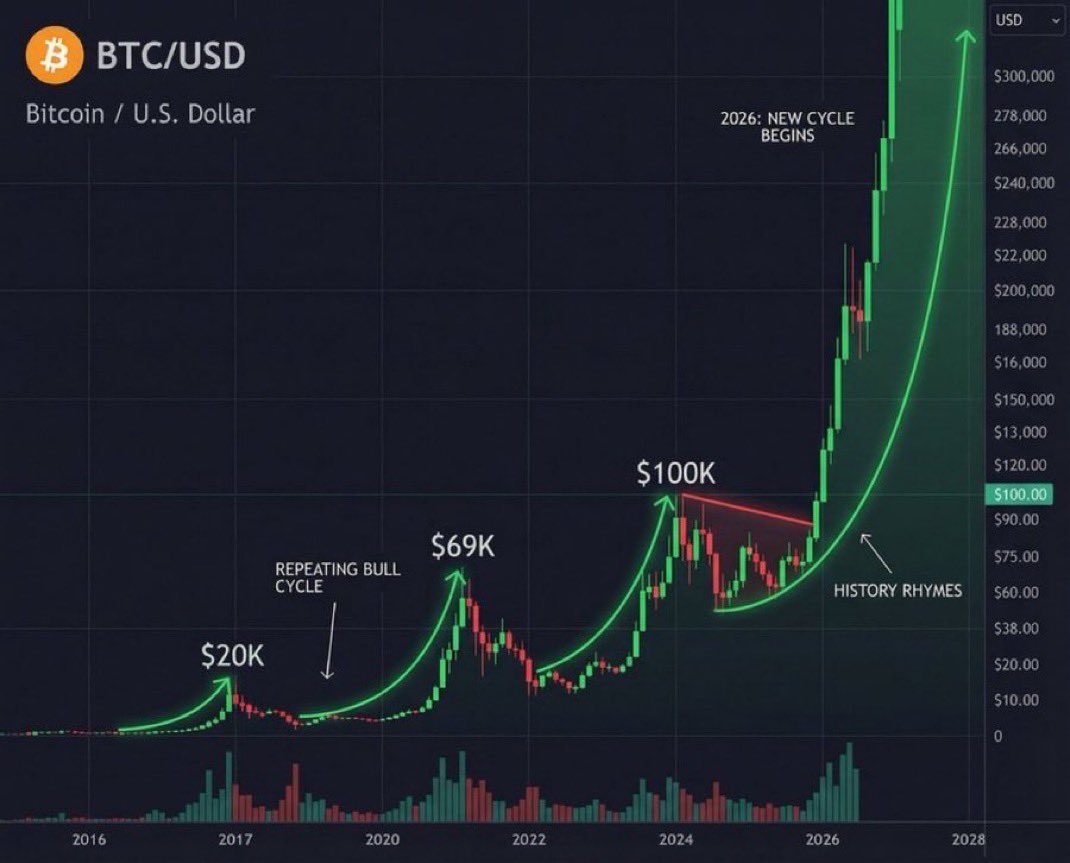
Bitcoin survived 3 years of positive "real" yields, the longest stretch in its existence.
As debasement begins to run hot once again, excess liquidity will flow into digital scarcity.
h/t @jvisserlabs
Claude really just helped a guy recover 5 btc after being locked out for 11 years cause he got stoned and forgot his passwprd
here’s the gist:
- he blanked on his password
- Tried many passwords, zero luck
- found an old mnemonic, only to realize it matched his previous password before he changed it
- assumed it was game over
- cycled through every trick he could find and even paid for recovery/reset nothing landed
- then he fed his entire dusty college laptop to Claude, and it surfaced a wallet file he’d totally forgotten existed
- the mnemonic cracked it instantly on the first attempt
crazy how the pasword was "lol420fuckthePOLICE!*:)"
you cannot make this up
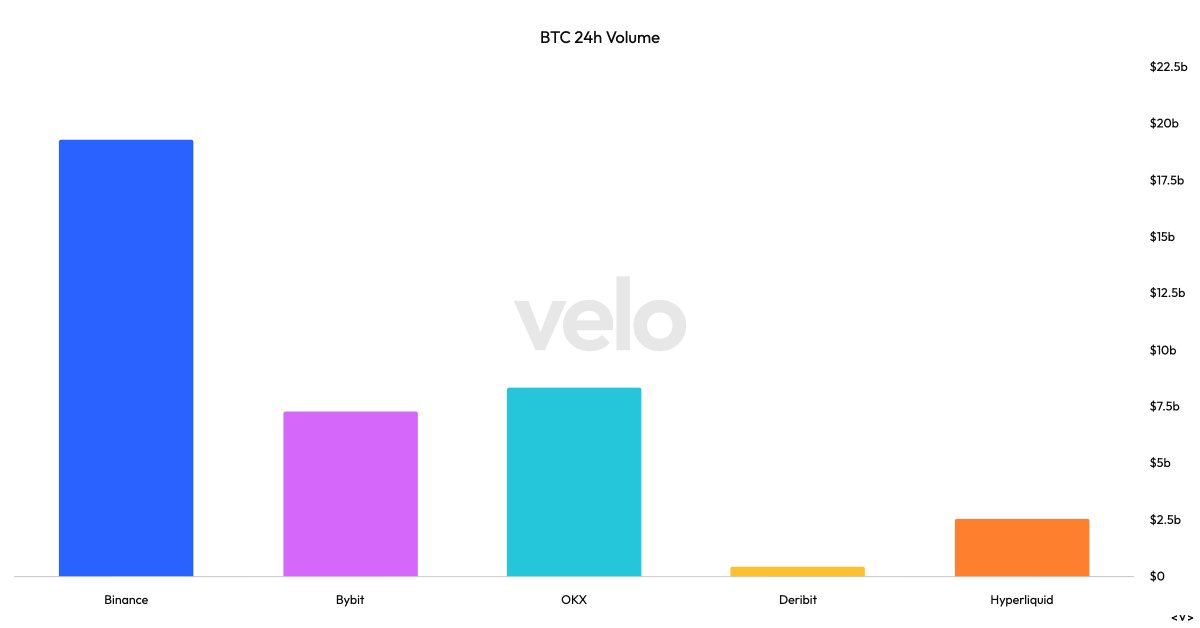
The owner of the S&P 500 index is licensing the world’s most tracked stock index for the launch of a derivative contract that trades around the clock on the crypto exchange Hyperliquid https://t.co/2naz9XWGoK
Just take the L. Coiners put on McDonald’s hats when btc is down. Their haters meanwhile just double down when btc is up. Poor sportsmanship, no fun. Self deprecation is sign of strength. TradFi lacks in this dept imo.
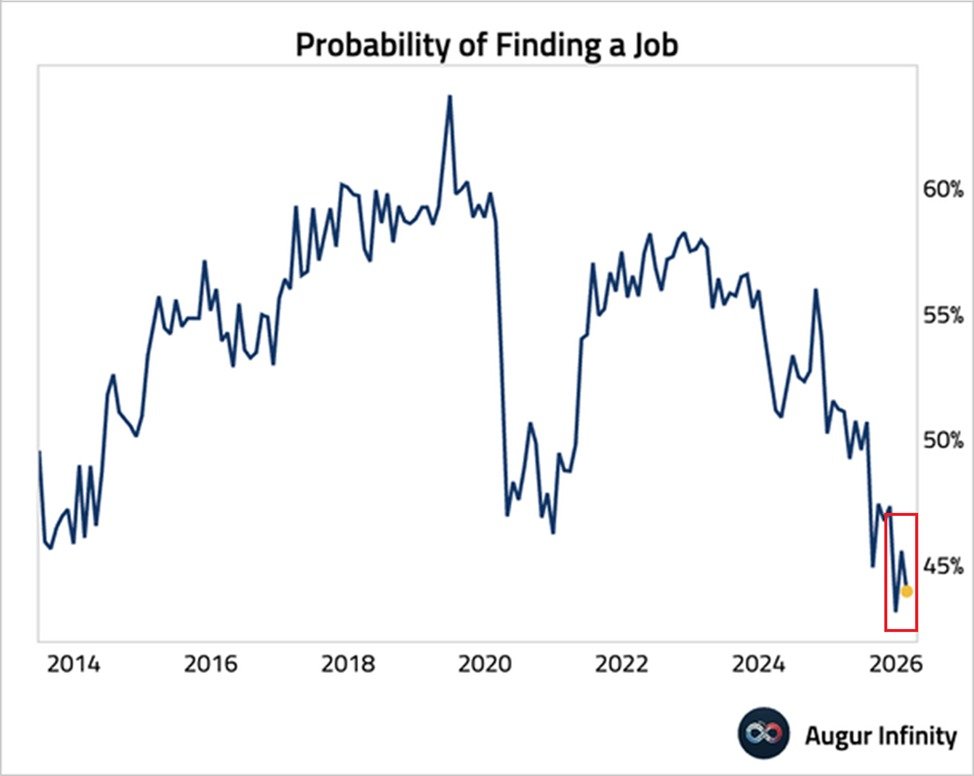
Americans are extremely worried about their jobs:
The perceived probability for households to find a new role within 3 months after a job loss is down to 44.0%, the 2nd-lowest on record.
This percentage has declined -12 points since October 2024.
To put this into context, the 2020 pandemic low was 46.2% while the 2013 bottom was 45.7%.
This comes as hiring activity remains at historically depressed levels.
The US hiring rate stands at 3.3%, the 2nd-lowest since the 2020 low and in-line with levels seen in the middle of the 2008 Financial Crisis.
Furthermore, employers announced plans to hire 18,061 people in January and February, down -56% from the same period in 2025.
US job market weakness is accelerating.
Revenue is the only thing that puts a floor under a token's price.
Everything else is just a story you tell yourself on the way down.
Most people filter by narrative. "AI coins." "RWA play." "L2 season."
But narratives don't give you a floor. When sentiment flips, there's nothing underneath the price. It's just vibes all the way down.
Revenue is different. If a protocol generates real fees, someone is willingly paying to use the product. That creates baseline demand that doesn't evaporate when CT gets bearish.
Pure speculation tokens? The bottom is wherever the last panic seller decides it is.
Revenue-generating protocols? Usage creates a floor. In choppy markets, floors are everything.
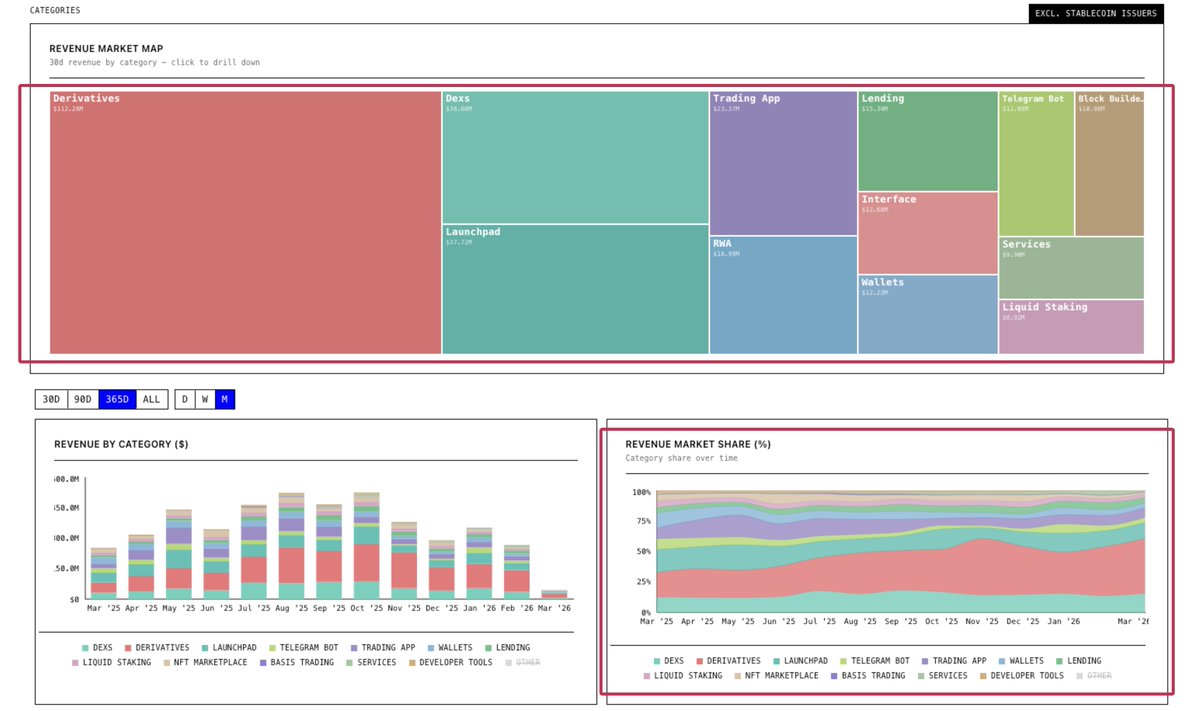
One tool I like is @sealaunch_'s revenue dashboard. There are revenue charts everywhere but I like how they lay it out visually.
Derivatives are dominating at $112M in the last 30 days. DEXs at $38M. Launchpads at $37M. Everything else is significantly smaller.
But the trend matters more than the snapshot. Total category revenue peaked mid-2025 (~$175M/month) and has been declining since. You want protocols that held their revenue through the drawdown, not the ones that spiked once.
Start with revenue. Work backward to TVL, users, and fees. Revenue is the hardest metric to fake. Everything else can be gamed.
Um...did the EF just roll out a way to drop Ethereum finality from 13 mins to...13 second??
Bullish if true.
Fast confirmation rule.
https://t.co/kY9cN8OSOz
Can we please come together as an industry and standardize how we measure adjusted transaction volume ?
USDC and USDT volumes look completely different depending on whether you check
@artemis@tokenterminal@AlliumLabs@DefiLlama or @stablepulse
We need consistent methodology here.
@Blockworks could help push this forward.
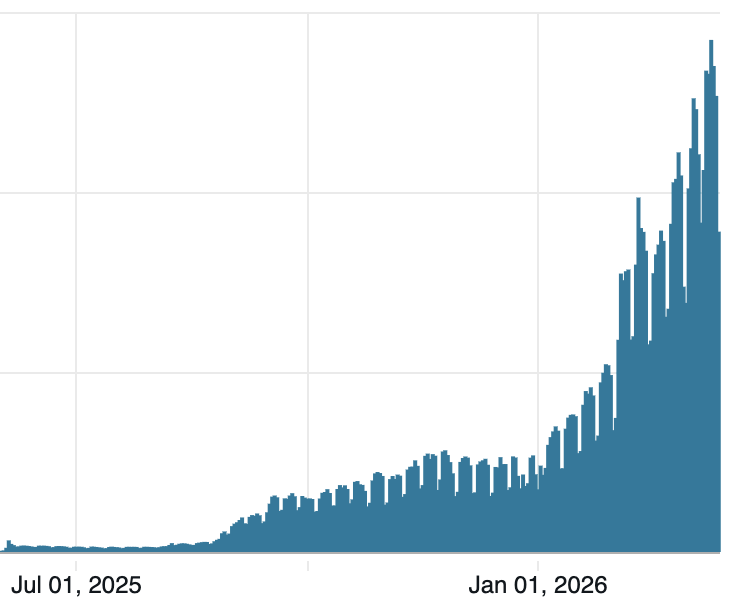
The Codex team are hardcore builders and it really comes through in what they create. No surprise all the hardcore builders I know have switched to Codex.
Usage of Codex is growing very fast:
This is 100% completely unsustainable as a society.
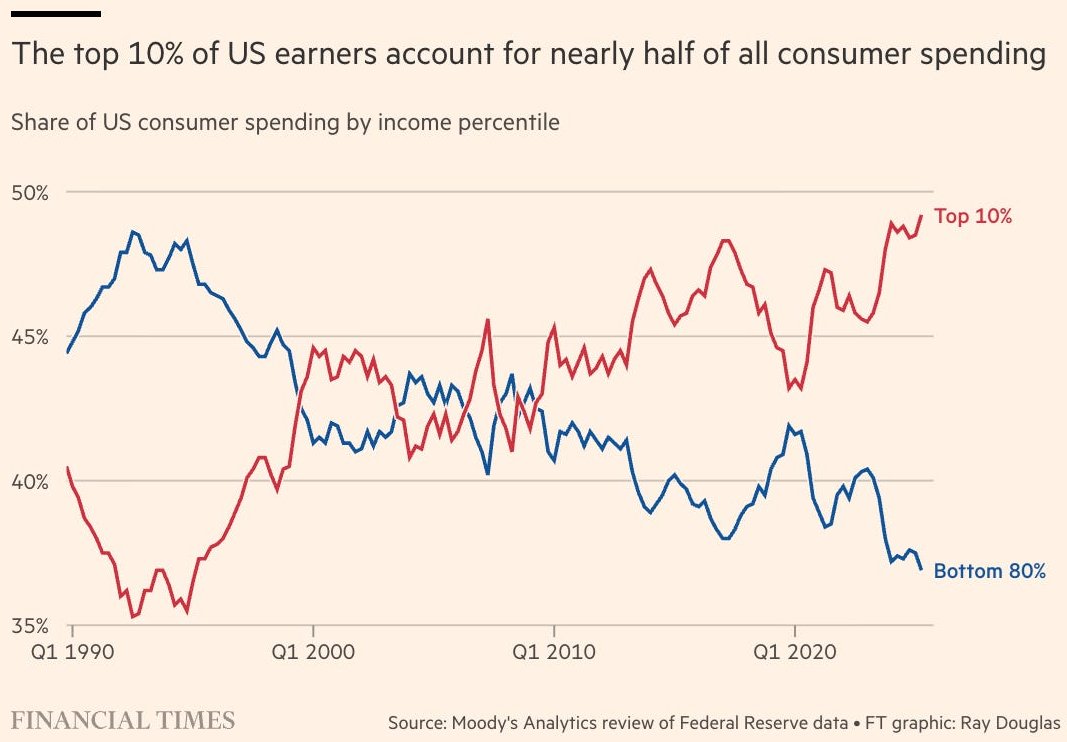
Nearly 50% of all consumer spending now comes from the top 10% of earners.
The bottom 80%?
Their share keeps falling.
This is why the economy can look strong in the data while millions of people feel like they're falling behind.
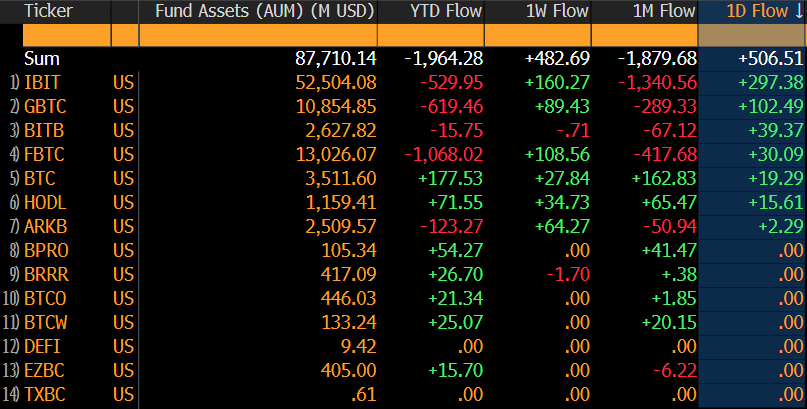
Half a bil into bitcoin ETFs yesterday, biggest day in a while, +$750m over past two days, right as obituaries were being published. They needed it too, like a hitter in a slump going yard. YTD is now under $2b in outflows. Unclear still tho if this is legit start to rebound or dead cat bounce.
A very important document. Let's walk through this one "goal" at a time. We'll start with fast slots and fast finality.
I expect that we'll reduce slot time in an incremental fashion, eg. I like the "sqrt(2) at a time" formula (12 -> 8 -> 6 -> 4 -> 3 -> 2, though the last two steps are more speculative and depend on heavy research). It is possible to go faster or slower here; but the high level is that we'll view the slot time as a parameter that we adjust down when we're confident it's safe to, similar to the blob target.
Fast slots are off in their own lane at the top of the roadmap, and do not really seem to connect to anything. This is because the rest of the roadmap is pretty independent of the slot time: we would need to do roughly the same things whether the slot time is 2 seconds or 32 seconds
There are a few intersection areas though. One is p2p improvements. @raulvk has recently been working on an optimized p2p layer for Ethereum, which uses erasure coding to greatly improve on the bandwidth/latency tradeoff frontier. Roughly speaking: in today's design, each node receives a full block body from several peers, and is able to accept and rebroadcast it as soon as it receives the first one. If the "width" (number of peers sending you the block) is low, then one bad peer can greatly delay when you receive the block. If width is high, there is a lot of unneeded data overhead. With erasure coding, you can choose a k-of-n setup, eg: split each block into 8 pieces so that with any 4 of them you can reconstruct the full block. This gives you much of the redundancy benefits of high width, without the overhead.
We have stats that show that this architecture can greatly reduce 95th percentile block propagation time, making shorter slots viable with no security tradeoffs (except increased protocol complexity, though here the performance-gain-to-lines-of-code ratio is quite favorable)
Another intersection area is the more complex slot structure that comes with ePBS, FOCIL, and the fast confirmation rule. These have important benefits, but they decrease the safe latency maximum from slot/3 to slot/5. There's ongoing research to try to pipeline things better to minimize losses (also note: the slot time is lower-bounded not just by slot latency, but also by the fixed-cost part of ZK prover latency), but there are some tradeoffs here.
One way we are exploring to compensate for this is to change to an architecture where only ~256-1024 randomly selected attesters sign on each slot. For a fork choice (non-finalizing) function, this is totally sufficient. The smaller number of signatures lets us remove the aggregation phase, shortening the slots.
Fast finality is more complex (the ultimate protocol is IMO simpler than status quo Gasper, but the change path is complex). Today, finality takes 16 minutes (12s slots * 32 slot epochs * 2.5 epochs) on average. The goal is to decouple slots and finality, so allow us to reason about both separately, and we are aiming to use a one-round-finality BFT algorithm (a Minimmit variant) to finalize. So endgame finality time might be eg. 6-16 sec.
Because this is a very invasive set of changes, the plan is to bundle the largest step in each change with a switch of the cryptography, notably to post-quantum hash-based signatures, and to a maximally STARK-friendly hash (there are three possible responses to the recent Poseidon2 attacks: (i) increase round count or introduce other countermeasures such as a Monolith layer, (ii) go back to Poseidon1, which is even more lindy than Poseidon2 and has not seen flaws, (iii) use BLAKE3 or other maximally-cheap "conventional" hash. All are being researched).
Additionally, there is a plan to introduce many of these changes piece-by-piece, eg. "1-epoch finality" means we adjust the current consensus to change from FFG-style finalization to Minimmit-style finalization.
One possible finality time trajectory is: 16 min (today) -> 10m40s (8s slots) -> 6m24s (one-epoch finality) -> 1m12s (8-slot epochs, 6s slots) -> 48s (4s slots) -> 16s (minimmit) -> 8s (minimmit with more aggressive parameters)
One interesting consequence of the incremental approach is that there is a pathway to making the slots quantum-resistant much sooner than making the finality quantum-resistant, so we may well quite quickly get to a regime where, if quantum computers suddenly appear, we lose the finality guarantee, but the chain keeps chugging along.
Summary: expect to see progressive decreases of both slot time and finality time, and expect to see these changes to be intertwined with a "ship of Theseus" style component-by-component replacement of Ethereum's slot structure and consensus with a cleaner, simpler, quantum-resistant, prover-friendly, end-to-end formally-verified alternative.
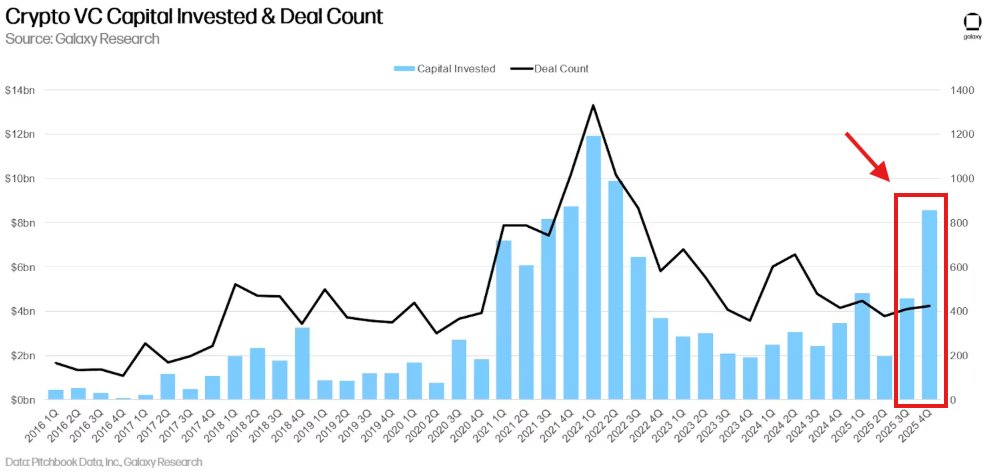
Wall Street is moving deeper into crypto:
Last week, Apollo struck a deal to support onchain lending markets for the first time in history.
The deal allows Apollo to acquire up to 90 million MORPHO tokens over 48 months.
Just days before that, BlackRock announced it is purchasing UNI tokens alongside its integration of its tokenized BUIDL fund onto Uniswap, where it will be traded by institutions.
On February 2nd, Jupiter, the world's leading onchain platform, struck a deal for a $35 million investment from ParaFi Capital, investing directly in the platform's JUP token.
Onchain institutional investment activity is heating up.
Bitcoin is sitting at $63k with the Fear & Greed index at 11.
That sounds like capitulation. But it isn’t. Not yet.
Yes, we’ve flushed leverage. Long liquidations. Funding negative. Open interest down.
ETFs bleeding for five straight weeks. That all happened.
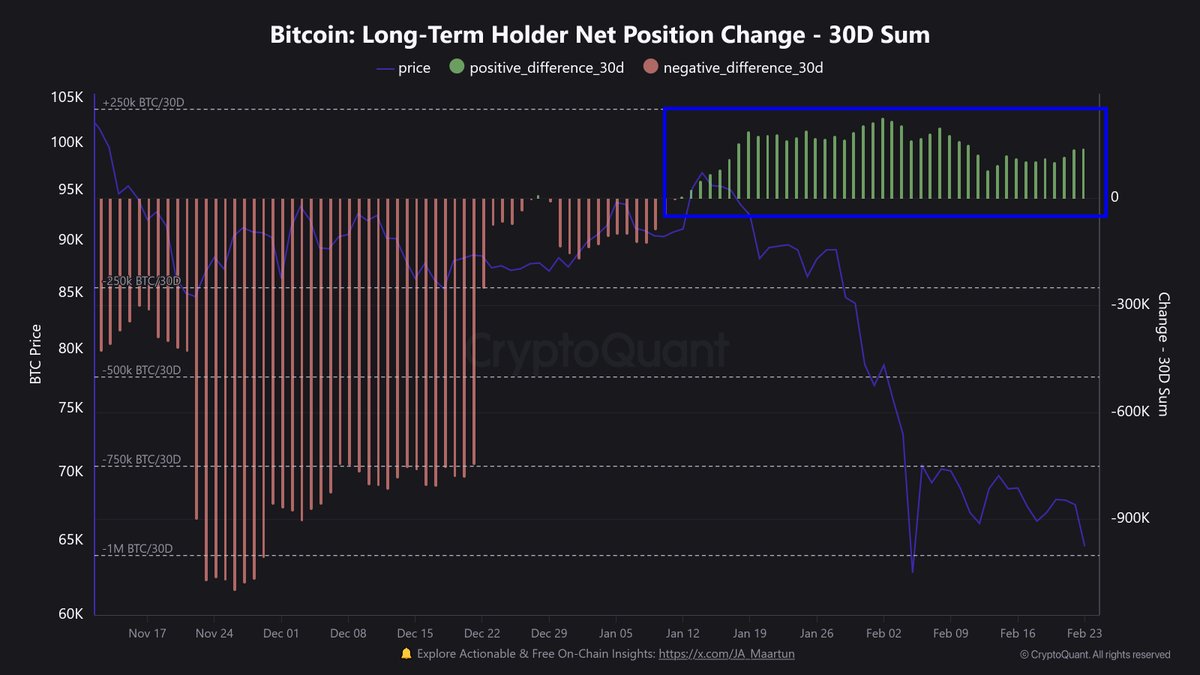
However, LTHs aren’t selling. Actually, the on-chain data is showing steady accumulation - not broad capitulation.
To me, this is feeling more like a positioning reset than a final bottom.
What’s different this time is the backdrop.
Crypto isn’t trading like crypto right now, but more like a high beta tech. AI is compressing growth multiples, tariffs are sticking, and the Fed seemingly can’t bail out risk assets.
When that growth gets repriced, Bitcoin gets repriced with it.
The $60k area matters because below that, you likely force real capitulation. Above it, you open the door to a squeeze if flows stabilize.
The bigger question isn’t whether we bounce, but whether this macro regime shift is temporary… or if crypto has to live through a longer rotation out of growth.
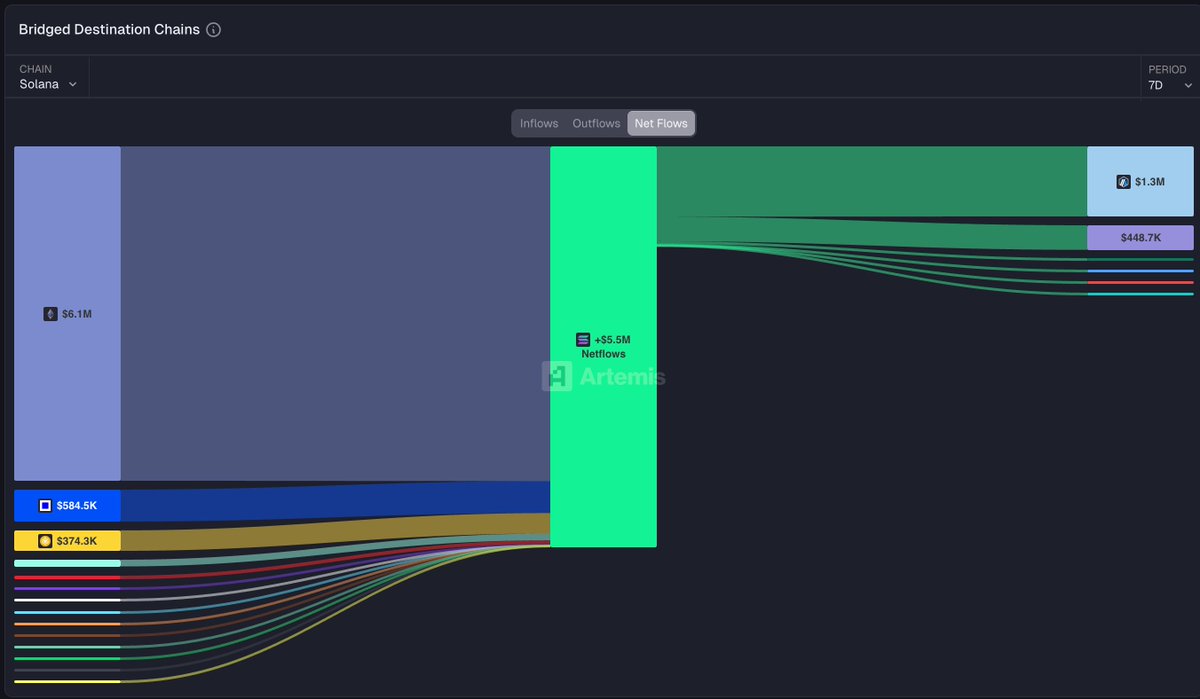
More capital keeps flowing into solana with over $5M bridged in this past week.
More of ethereum was channeled, funneling $6.1M of bridged liquidity into Solana.