Pleasure to write this News & Views on this elegant work from the Belousov lab, which engineers a chemigenetic bypass of mitochondrial pyruvate uptake. A truly creative advance that expands the experimental toolkit for studying mitochondrial metabolism.
https://t.co/tiHTOwjxj1
Excited to share our new publication in Nature Metabolism @NatMetabolism led by the fantastic @XingxiuPan, where we uncover an unexpected connection between reductive and oxidative stress. This study contains many exciting findings, and I will be highlighting different aspects of this work in a series of posts.
One of the central conclusions is that the NADPH/NADP+ ratio is a critically underappreciated parameter in mitochondrial dysfunction.
In this study we present SaNADK, a new xenotopic tool based on the S. aureus NAD kinase, which expands the cellular NADP(H) pool nearly six-fold! Most remarkably, together with the Peter Adams lab @AdamsBioAging, we found that increasing NADP(H) levels with SaNADK alone was sufficient to reverse age-associated hepatic transcriptomic signatures linked to metabolic dysfunction and inflammation as well as liver fibrosis highlighting the profound influence of NADP(H) metabolism on cellular aging.
We also uncovered an important aspect of mitochondrial bioenergetics. We found that NADH-driven reductive stress can cause excessive reduction of the coenzyme Q pool, creating a bottleneck for multiple coenzyme Q-dependent reactions. As a consequence, electron flow through CoQ-linked systems is impaired, including DHODH activity and de novo pyrimidine biosynthesis. These findings may help explain numerous observations in the literature that have long appeared counterintuitive, namely that mild mitochondrial complex I inhibition can sometimes be beneficial.
Here is the link to the study:
https://t.co/81x6P2gwHY
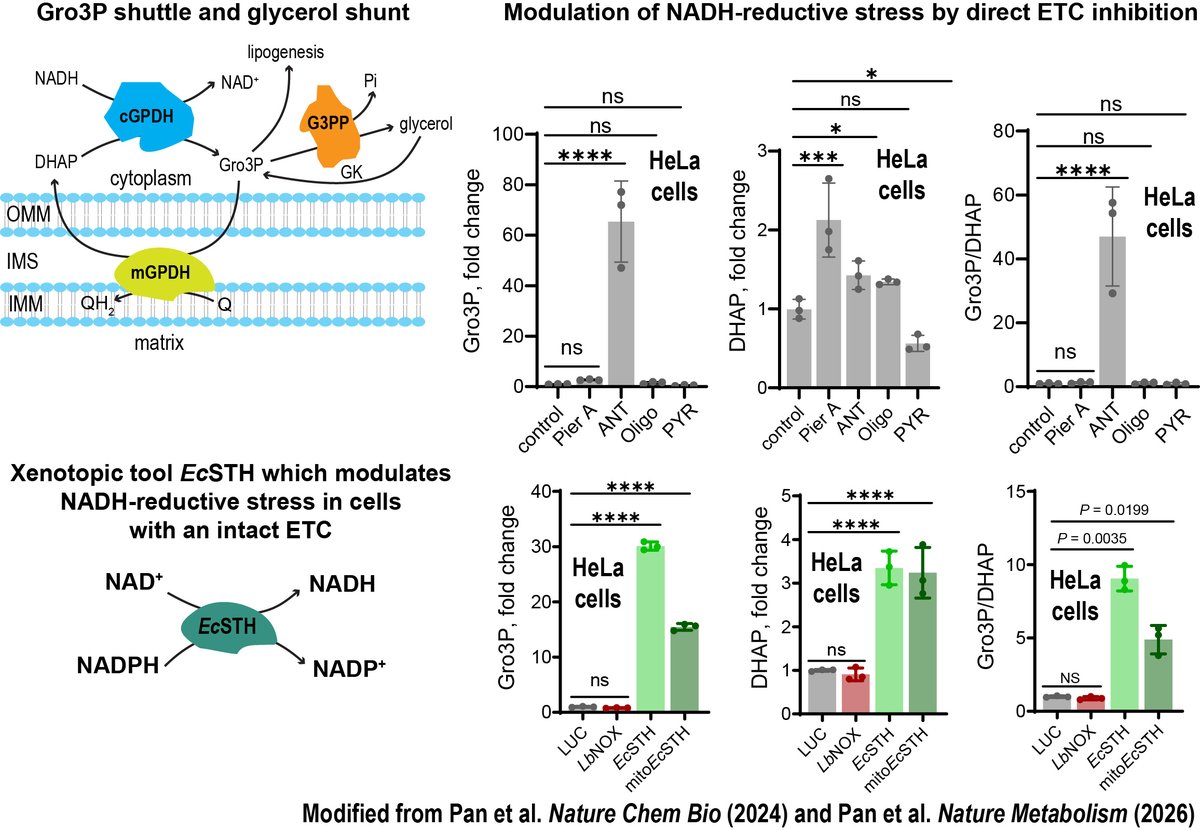
We started with our observation that one of the key features of NADH-reductive stress (elevated NADH/NAD+ ratio) is the accumulation of both dihydroxyacetone phosphate (DHAP) and glycerol-3-phosphate (Gro3P) (https://t.co/jziIANrFgS). This was expected, as DHAP and Gro3P are linked via the activity of the Gro3P shuttle, which allows reducing equivalents of NADH to be shuttled between the cytosol and mitochondria.
I am excited to share our newest paper, "A genetically encoded bifunctional enzyme mitigates redox imbalance and lipotoxicity," which is now live in @NatMetabolism! This study was led by outstanding members of my lab @XingxiuPan and @smunan1995, in close collaboration with the @hardikshah42 lab at @UCCancerCenter and the @russpgoodman lab at @MassGenBrigham. In this study we present a genetically encoded tool based on a bifunctional enzyme that can regenerate NAD⁺ while simultaneously executing an engineered glycerol shunt. We used this tool, which we call CrGPDH, to restore redox imbalance and modulate lipid metabolism in vitro and in a mouse hepatic steatosis model. 🧵
If you are in the San Diego area on March 27, 2026 you are cordially invited to attend our inaugural 2026 1st Annual Scintillon Innovator Forum. The main focus of this meeting is aging research. I will be presenting along with other fantastic speakers including Dr. Peter Adams @AdamsBioAging from Sanford Burnham Prebys and Dr. Hideyuki Okano, Scientific Advisory Board Member of @Scintillon, President of @ISSCR and Professor at @Keio_Univ. Registration is free, please read more about our meeting and RSVP here: https://t.co/YSXyqZT8TL
🌟 Day 1 | International Chemical Biology and Molecular Imaging Conference (iCBMIc-2025) 🌟
🗓️ November 7–9, 2025
🏛️ Organized by the Department of Chemistry, Shiv Nadar University, Delhi-NCR
The International Chemical Biology and Molecular Imaging Conference (iCBMIc-2025)
Hello,
My account @MunanSubrata has been hacked and is currently not under my control. Please do not interact, click any links, or respond to messages from that account.
I have already reported this to @Support and @Safety , and @X for immediate action.
My X account (@MunanSubrata) has been hacked. I am unable to log in or reset my password because the hacker has changed the email address and/or linked information. It is currently not under my control.