So Jimmy Kimmel can find his moral outrage when Scott Pelley loses a TV job, but Spencer Pratt losing his home is a joke. For people like Kimmel, suffering isn’t measured by the loss. It’s measured by the politics of the person suffering.
Milton Friedman's greatest regret.
The federal government discovered the perfect crime in 1943: make employers collect taxes before workers ever see their paychecks. You think you earn $60,000 per year, but you actually earn $75,000 and hand over $15,000 to politicians without ever touching it. The psychological difference is enormous.
Before payroll withholding, Americans wrote quarterly checks directly to the Treasury. Picture yourself sitting at your kitchen table, writing a $3,750 check to the IRS every three months. The pain was immediate and visceral. Politicians faced constant pressure to justify every dollar because citizens felt the extraction in real time.
Withholding transforms this concrete loss into an abstract accounting entry. Your employer becomes an unpaid tax collector, and you never experience the actual cost of government. Worse, most people celebrate their tax refunds as government generosity rather than recognizing them as interest-free loans they provided to politicians. The Treasury collects your money throughout the year, spends it immediately, then returns your own cash and receives gratitude.
This system enables the explosion in government spending you witness today. Defense contractors billing $640 for toilet seats, agricultural subsidies for corn syrup, and congressional salaries for 535 people who rarely show up to work. When taxation feels painless, voters stop demanding accountability for how their money gets spent.
Milton Friedman helped design withholding as a wartime emergency measure and later called it his greatest regret. Free market economists recognized that the psychological pain of direct taxation creates political pressure for fiscal restraint. The temporary always becomes permanent in government hands, and the emergency justification disappears while the extraction mechanism remains forever.
I bucked all advice from my friends (and resisted my conservative bias) and decided to fully trust the Times journalists.
As they left my home they asked that I not talk to any other outlets and I insisted then and repeatedly over the following weeks that I would keep my word and only share this story with them.
But then the weeks dragged on. They kept coming back to us saying the editors needed more. I needed to go on the record (okay). We need more screenshots (okay). I met every bench mark they set, eager to provide more sources or evidence as needed.
After the story went up I began to ask them … wait, where are the stories from the other women? Where are their accusations of sexual assault? Why am I the focus? Why are there 11 paragraphs dedicated to detailing my work history (more than has been published about Graham’s by far)?
Why does it say “nobody could corroborate” when I offered them sources that COULD corroborate?
Why did they include an out of context quote from a friend joking “do not call Graham” after I called off my wedding? (Because she knew I would never).
Where were the screenshots they’d said they would use? Or the mention that I’d supported local democrats and that most of my family (and husband) are liberal?
The editors said it was too much, they explained.
The Times also failed to include any mention that I DID confide in multiple friends through the years that Graham had been abusive — long before he was running for office. Those friends confirm they told the Times so.
It dawned on me that this really was a set up all along. The journalists I trusted who convinced me to share a story I never wanted to tell methodically delayed and twisted this into a gift to the Platner campaign. Violating the trust of his victims. Shattering the trust I placed in them with the most vulnerable story of my life.
And at the end of my call with them I reluctantly accepted their insistence that this was still a powerful story and that I had done a brave thing. And I thanked them for all the hard work they had put into it.
Still fawning after all these years.
Several Women Who Dated Graham Platner Recall ‘Unsettling’ Behavior
The Democratic candidate for Senate in Maine could be charming, women said in interviews, but some found his actions intimidating and disturbing.
https://t.co/WF7vdqbb7M
My wife mentioned a nice private school over dinner this week
She said the campus was beautiful
I asked what's the tuition
She said we should look at it as an investment in him not a cost
I made a note
She said don't make a note
I said I always make notes
She said this isn't a deal
I said everything is a deal
She closed her eyes
She said we'd discuss it Saturday
I agreed
Saturday 7:02am
She came downstairs in her Saturday robe
Coffee in hand
I had my cargo shorts on
The dining room had been cleared
The projector was on
The analyst was at the head of the table
Quarter zip on, three iced coffees, a legal pad, and two laptops
He had been there since 6:44am
I texted him at 11:14pm Friday
The text said dining room 6:45am bring the model
He sent a thumbs up
My wife stopped in the doorway
She said what is this
I said you said you wanted to discuss it
She said this is not a discussion
I did not respond
She sat down anyway
The analyst stood
He said good morning ma'am
She did not respond
He sat back down
A printed deck in front of each seat
A fourth copy in case
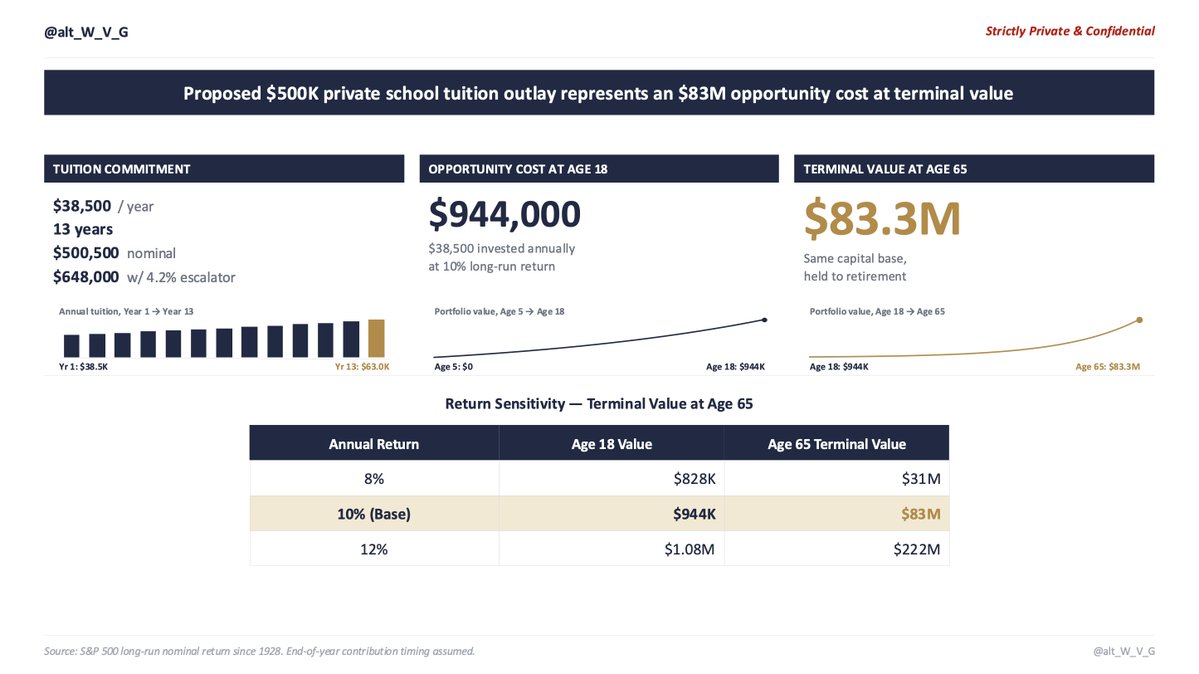
Slide 1 Tuition Schedule
$38,500 per year
Thirteen years
$500,500 nominal
Before escalators
The school has raised tuition 4.2% per year for a decade
With escalators $648,000
My wife said okay
I said I'm not done
Slide 2 Opportunity Cost
Even before escalators
$38,500 invested annually
10% nominal return
S&P long-run average since 1928
By his eighteenth birthday $944,000
My wife said we can afford it
I said I know that's not the slide
Slide 3 Terminal Value at Age 65
$83 million
She was quiet
The analyst slid the sensitivity tables across the table
8% return $31 million
10% return $83 million
12% return $222 million
She did not look
She said this isn't about money
I said it's always about money
She said no it isn't
I said then what is it about
She did not answer
She said you can't put a dollar value on his teachers his classmates his environment
I said I can the analyst already did slide 6
He flipped to slide 6
She did not look
She said the school is the best in the city
I said best is a feeling
She said it produces the best students
I said the students were already the best before they got there
She said our son deserves it
I said our son deserves $83 million
My son walked in
He is five
Dinosaur pajamas
He looked at the projector
He looked at the open deck on the table
He looked at slide 3
He said are we modeling pre-tax or after-tax
The analyst opened a new tab
My wife looked at the ceiling
He said what's the discount rate
The analyst set down his pen
She closed her eyes
He said is this the same return assumption from the 529 conversation
The analyst stopped typing
He looked at me
I did not say anything
She stood up
Sat back down
He said dad can I help
I said yes
He pulled up a chair
The analyst handed him a printout
He started reading
My wife watched him read
She watched him for a long time
She said his name
He looked up
She said do you like school
He said the work is too easy and the kids don't ask questions
She did not respond
She looked at the ceiling
She walked out of the room
The analyst started packing up
He said should I follow up Monday sir
I said no follow up needed
He'll be fine
Sent from my iPhone
This is probably a long shot, but if anybody happens to be in DC this weekend and plans on visiting Arlington, I would love to see a fresh photo of my husband’s grave in Section 60.
SSG Alan W. Shaw
Section 60, Grave 8451
B Co 1/12 Cav, 1st Cavalry Division
November 10, 1975 - February 9, 2007
There’s just something about knowing people still stop by, still say his name, still remember. 🇺🇸⭐🇺🇸
@ichitheewitch@IMAO_ According to the initial post, the industry in the 1920s was made up in a way that best picture winners were satisfying the rules. So there is nothing to do different, they were all ready doing it.