For too long, teleoperation has been reduced to a latency number. But a (cherry-picked) headline latency number tells you surprisingly little about the real-world operator experience. Operators adapt remarkably well to steady latency, even when it’s a little higher. What really hurts performance is inconsistency: jitter, frame degradation, and changing network conditions. That’s what we’ve spent our time engineering around.
If your team is rebuilding teleoperation from scratch, again, just to get back to the part that actually differentiates your robot or gets you to deployment, we can save you months without locking you in. Let’s talk!
Introducing Deft Robotics' unified deployment platform for physical AI.
Frontier models are moving fast. Real world autonomy isn’t.
Closing the gap takes more than better models.
The missing piece? Infrastructure to deploy, intervene, learn from failures, and continuously improve.
For the past year, we’ve been deploying in that gap and building the stack to close it.
Now, we’re opening it up.
Hardware available now. Software in beta.
Here’s how to use it for your use-case 🧵(1/7) ↓
With Emmanuel Dupoux https://t.co/hXpYcacDfs and Yann LeCun @ylecun, we consider a cognitive science inspired AI. We analyse how autonomous learning works in living organisms, and propose a roadmap for reproducing it in artificial systems.
https://t.co/fuqYmHZxSu
Introducing PaperQA2, the first AI agent that conducts entire scientific literature reviews on its own.
PaperQA2 is also the first agent to beat PhD and Postdoc-level biology researchers on multiple literature research tasks, as measured both by accuracy on objective benchmarks and assessments by human experts. We are publishing a paper and open-sourcing the code.
This is the first example of AI agents exceeding human performance on a major portion of scientific research, and will be a game-changer for the way humans interact with the scientific literature.
Paper and code are below, and congratulations in particular to @m_skarlinski, @SamCox822, @jonmlaurent, James Braza, @MichaelaThinks, @mjhammerling, @493Raghava, @andrewwhite01, and others who pulled this off. 1/
We’re excited to introduce @ChaiDiscovery and release Chai-1, a foundation model for molecular structure prediction that performs at the state-of-the-art across a variety of drug discovery tasks
We're releasing inference code, weights & a web interface: https://t.co/QmpbVO9Fhd
We are building one of the largest GPU clusters in biotech and are recruiting ML engineers!
If you have experience making GPUs go brr and would like work on exciting problems at the intersection of AI and autonomous science, please consider applying: https://t.co/3vD7MxdA2E
Please RT! @BrianHie and I are hiring joint @arcinstitute postdocs to work on ML in biology. Projects include reimagining synthetic gene circuits, mechanistic interpretability, and controllability. Recent work includes genome design with Evo, an AI foundation model trained on DNA to learn the language of evolution
patrick[]https://t.co/l7LF6bP2Ym
brianhie[]https://t.co/VPBj2jhqWn
Announcing the BioML Challenge 2024: Bits to Binders!
In this 5-week competition, teams will use AI methods to design protein binders that bind to a target antigen and activate an immune response from its associated CAR-T cell. Real-world scenario. With wet lab validation.
Join us for a TechBio Mixer in London on the evening of March 12th! We might have a surprise announcement during the event. 👀
Send us a DM and we’ll share the event details with you.
Thrilled to share sign up details (linked below) for Bio x ML hackathon, BioHack NYC, on November 11th hosted by @join_ef
More information on judges, compute, and data sets coming🧬
I'm thrilled to share that our 2023 https://t.co/upxA8GAS0r competition is now live 🎉
More details in 🧵, and you can get started on @kaggle today to compete for $100k in prizes: https://t.co/rINbm1gw1M
The MIT Bioinformatics Seminar is back this semester! We have an exciting series of speakers, with some joining virtually and others hybrid/in-person. Please check out the talk schedule here: https://t.co/N3v45HpTTu. (1/n)
We are now accepting applications for the second cohort of our Cohere For AI Scholars Program, designed to broaden access to cutting edge research settings & create an alternative entry point to ML research. Learn more & apply by September 11th! https://t.co/uNAxBnmp9R
There's a lot of excitement around large language models (LLMs) for healthcare. But what's hype and what's real?
In this paper, we review 84 such models to help health systems better understand and critically evaluate these technologies.
Paper: https://t.co/BzHxYiNmep (1/7)
We’re hiring!🥳 If you are excited by the challenge of building new tech for tx discovery, come join the thrilling start-up rollercoaster ride w/ our team at Tacit Tx! Feel free to share w/ folks that might be interested. Also happy to chat w/ candidates.😁https://t.co/sCOzJufbIR
BiB @bitsinbio and Pebbledbed are hosting a biotech career event! Folks in phd and postdoc programs thinking about industry roles should definitely consider attending! 🧬🧬 https://t.co/nBcuSd4KsF
In the wake of LLaMA, the deep learning research community quickly adopted the view that open-source LLMs will rule the future—reproducing open-source variants of proprietary models seemed to be easy and cheap. Is this the truth? Here’s a brief timeline of model proposals and what we know…
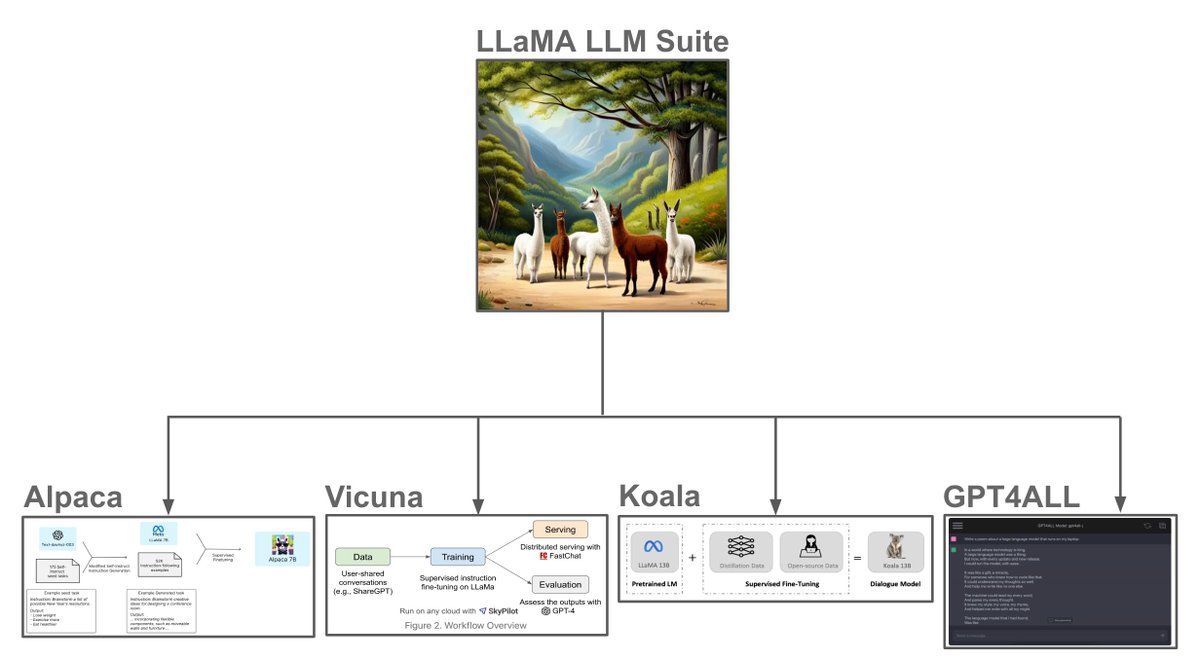
LLaMA. The surge of open-source LLM publications started with the proposal of LLaMA, a suite of LLMs with sizes ranging from 7 billion to 65 billion parameters. Taking inspiration from Chinchilla, these LLMs are a bit smaller than their counterparts but are pre-trained extensively, allowing them to perform surprisingly well for their size (e.g., 13B model is comparable to GPT-3). Unlike closed-source models that are trained on a combination of public and proprietary data, LLaMA uses only publicly available data for pre-training, making it fully open-source and possible to replicate.
LLaMA leak. After its proposal and release for research purposes, LLaMA weights were leaked to the public on 4Chan. This leak led many in the research community to begin doing research with the model, leading to a ton of different publications and proposals that we briefly overview below. A majority of these techniques fine-tune LLaMA on dialogue from ChatGPT (i.e., imitation models) and claim to achieve comparable performance, creating the view that creating open-source replicas of models like ChatGPT is actually quite easy.
Alpaca is a fine-tuned version of the LLaMA-7B LLM. The fine-tuning process is based on self-instruct, in which instruction-following data is collected from a higher-performing LLM (i.e., text-davinci-003) and used for supervised fine-tuning. The entire fine-tuning process of Alpaca costs only $600 (including both data collection and fine-tuning).
Vicuna is an open-source chatbot that is created by fine-tuning LLaMA-13B (i.e., comparable performance to GPT-3). Vicuna is fine-tuned using examples of user conversations with ChatGPT, and the entire fine-tuning process can be replicated for <$300, making chatbots more accessible for research purposes. Compared to Alpaca, Vicuna is more comparable to ChatGPT and generates answers with more detail and structure.
Koala is a version of LLaMA-13B that has been fine-tuned on dialogue data from a variety of sources, ranging from public datasets to dialogues with other high-quality LLMs that are available on the internet. Compared to Alpaca, Koala is fine-tuned over dialogue data and evaluated more extensively (using a larger number of crown workers).
GPT4ALL is a fine-tuned LLaMA-7B model that has been trained on over 800K chat completions from GPT-3.5-turbo. Along with releasing the code and model, authors of GPT4ALL release the 4-bit quantized weights of the model, which can be used to run inference on CPUs. The result is that we can actually host this model locally on a normal laptop.
Massive Potential. The models mentioned above were all published in close succession and (in most cases) claimed to achieve results that were comparable to top models like ChatGPT or GPT-4. As a result, the LLM community quickly adopted the opinion that open-source LLMs will soon match the quality of the most powerful proprietary models.
The Truth. When more targeted evaluations of these models is performed, we see that their performance is not as impressive as it seems. In reality, these models are good at matching the style and structure of models like ChatGPT when fine-tuned over a small amount of imitation data, but they lack the same knowledge base. Imitation models hallucinate more and perform poorly when subjected to a broader number of natural language benchmarks. Despite their limitations, these models were able to “trick” human evaluators via their style, despite being significantly less factual.