Today, we share a breakthrough on the planar unit distance problem, a famous open question first posed by Paul Erdős in 1946.
For nearly 80 years, mathematicians believed the best possible solutions looked roughly like square grids.
An OpenAI model has now disproved that belief, discovering an entirely new family of constructions that performs better.
This marks the first time AI has autonomously solved a prominent open problem central to a field of mathematics.
AI - in theory - should make writing easier, thus expressing ideas should be a lot easier.
And yet, I don't see all that much more things that are worthwhile to read. Sure, there's a lot more junk. But I don't see more interesting eng blogs, personal tech-related blogs etc.
What is going on?
(Is this a discoverability issue? Or are people / teams not writing/sharing all that much more, indeed?)
🚀 DeepSeek-V4 Preview is officially live & open-sourced! Welcome to the era of cost-effective 1M context length.
🔹 DeepSeek-V4-Pro: 1.6T total / 49B active params. Performance rivaling the world's top closed-source models.
🔹 DeepSeek-V4-Flash: 284B total / 13B active params. Your fast, efficient, and economical choice.
Try it now at https://t.co/GCdiMzk1Dl via Expert Mode / Instant Mode. API is updated & available today!
📄 Tech Report: https://t.co/drlDrxkYtp
🤗 Open Weights: https://t.co/T13Y8i7SDM
1/n
Introducing GPT-5.5
A new class of intelligence for real work and powering agents, built to understand complex goals, use tools, check its work, and carry more tasks through to completion. It marks a new way of getting computer work done.
Now available in ChatGPT and Codex.
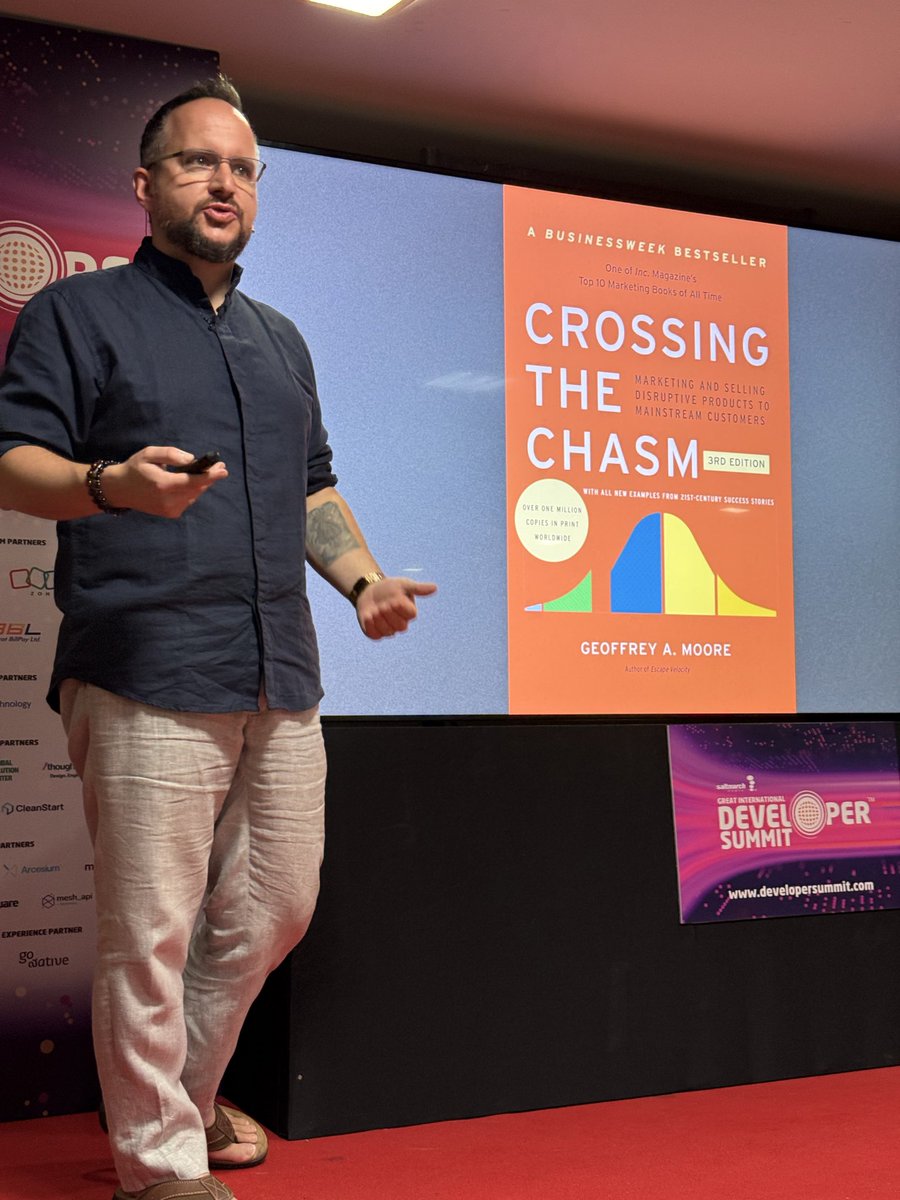
Day 2 at #GIDS and still going strong 🚀
Lots of interesting discussions around developer tools, innovation and how fast things are evolving.
More to explore, more to learn 👀
#gids#developersummit#AI#Developers#Tech
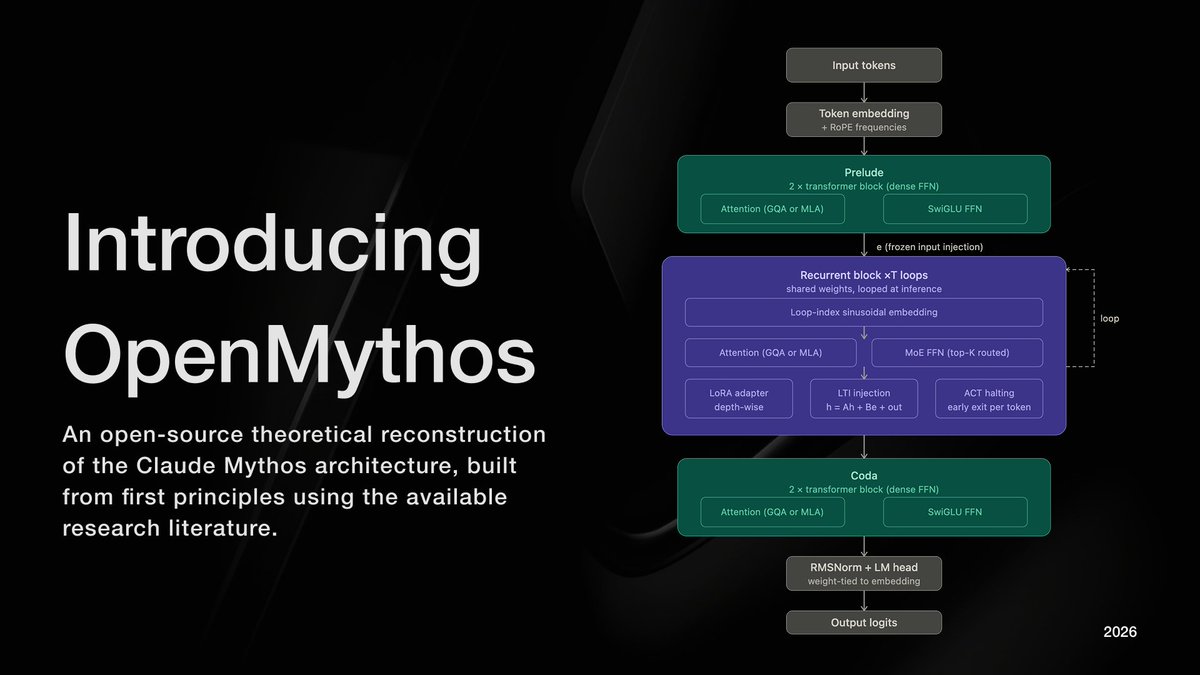
Introducing OpenMythos
An open-source, first-principles theoretical reconstruction of Claude Mythos, implemented in PyTorch.
The architecture instantiates a looped transformer with a Mixture-of-Experts (MoE) routing mechanism, enabling iterative depth via weight sharing and conditional computation across experts.
My implementation explores the hypothesis that recursive application of a fixed parameterized block, coupled with sparse expert activation, can yield improved efficiency–performance tradeoffs and emergent multi-step reasoning.
Learn more ⬇️🧵
For those living under a rock: LLMs stopped becoming smarter around summer 2025.
Everything impressive you see since then is about finetuning them for specific tasks (mainly coding and software-tool-based task solving) and building tooling around them (such as agentic coding systems).