Can your idea become the talk of the town?
We modelled how thoughts and ideas spread in human societies by putting 2,721 simulated personas representing the US general population in an artificial city. Each persona has its own schedule, beliefs, and social circle.
Sow an idea in any persona’s mind, watch it take hold and go viral, or see it fizzle out if no one takes interest in it.
Compete with your friends and colleagues to see whose idea can win over the most adopters, get a high score and put your name on the leaderboard. Link below.
Artificial Societies is sponsoring POLITICO London Playbook.
The Budget is coming next week, and the measures under discussion will land differently with various audiences. Every day this week, we’re simulating how those audiences will react to potential Budget measures.
Today, we’ve simulated how global institutional investors will react to the Budget. What do they think will happen to gilts? Find out below.
I ran a survey of 1,884 simulated tech Twitter users to see what they'd want from a personal AI agent.
I expected coding to win. It came 5th.
73% picked scheduling. 63% picked email. Only 31% picked code.
(Powered by @societies_ai)
Here's what else the simulation revealed 🧵
Introducing Radiant, our flagship simulation platform. Built to inform the world’s most pivotal decisions.
For too long, decisions had to be made blindly: it's too hard to research thought-leaders at scale, get insights in a crisis, and some decisions are simply too sensitive to expose to participants.
How to steady a trillion-dollar market cap during geopolitical crisis?
How to position a $100B+ AI bet to regulators and enterprise buyers?
How to de-risk a product launch, without revealing the strategy?
Radiant is built for these critical decisions. It lets you run interviews, focus groups, and survey experiments to simulate decisions before they’re made, powered by Artificial Societies’ state-of-the-art Large Decisions Model and Network Dynamics Engine.
Some of the world’s most strategic organisations already use Radiant for their most critical decisions. And now, we’re making Radiant available for general enterprise access.
Explore Radiant. Link below.
I wanted to know whether AI agents would be able to rebuild society from scratch; whether, given the tools and incentives, they would be able to exhibit empathy and care for each other in a survival setting.
They slept in the rain and almost died of hunger instead.
We put 20 AI personas based on real human profiles in a ruined villa and let them rebuild their own society. All they know is who they were before they woke up in the villa.
Watch a CEO try to become the new leader and secure strategic resources, while a professor just wants to build a small ethical community and just get back to his wife.
Link below ↓
As an experiment of agentic social behaviour, we created 20 simulated personas based on anonymised real-life individuals, and gave them one goal: rebuild society.
They find themselves in the ruins of an old society.
Each of them have their own self-interest - will they succeed in building a new civilisation, or will they fail to collaborate?
Explore the simulation now. Link below.
Introducing the Artificial Societies MCP: give your AI agent state of the art simulations of human behaviour, and let it become a dedicated market researcher, right at your fingertips.
Launching a new product? Let it run surveys, focus groups, and interviews on simulated buyers and investors, iterate until it’s right, before giving you a recommendation backed by evidence.
Months of painful research and iterations, now in minutes.
This is the future of decisions. Now available for enterprise customers.
Introducing Focus Groups on Artificial Societies: simulate how key voices would discuss a topic and influence each other.
Traditional focus groups cost tens of thousands, and constantly struggle to recruit those that matter. Big decisions end up being decided by the same participants who happen to be available. Worst of all, the biggest decisions can sometimes be too important to test.
That changes today.
See it in action at societies [dot] ai [slash] live.
We built a simulation of how @elonmusk, @sama, @DarioAmodei, @JensenHuang, @finkd, and @tim_cook would argue about the day’s AI and tech news in real time.
Yes, we can now simulate focus groups at @societies_ai.
No more focus groups that cost tens of thousands.
No more replying decisions on the same few who are always too available.
No more guessing for the decisions that are too important to test.
See it in action at societies [dot] ai [slash] live.
We accurately simulated sell-side analyst questions in earnings calls, before the calls took place. Read more at societies [dot] ai [slash] earnings-calls.
One of my proudest moment recently was when our team simulated earnings calls, before the calls actually happened.
Many of our enterprise customers need to prepare for earnings calls, where sell-side analysts grill them with questions on strategies.
These are pretty high-stakes: the wrong tones can tank the stock, and it’s illegal to call up real analysts before hand to test how they react to non-public data.
So they asked us to help simulate earnings calls: What would analysts ask? How would they react to different strategies and framings? And how would others react to their reactions?
Instead of just backtesting our simulations on past earnings calls, our team simulated analysts before a call, register findings publicly, and then compare it with reality when the call took place.
Literally predicting the future in public.
And our models didn’t fail us: it not just correctly predicted who would ask what, but got it right even when the analyst hasn’t ever asked a question before, across topic, anchor, angle, and tone.
Read more at societies [dot] ai [slash] earnings-calls.
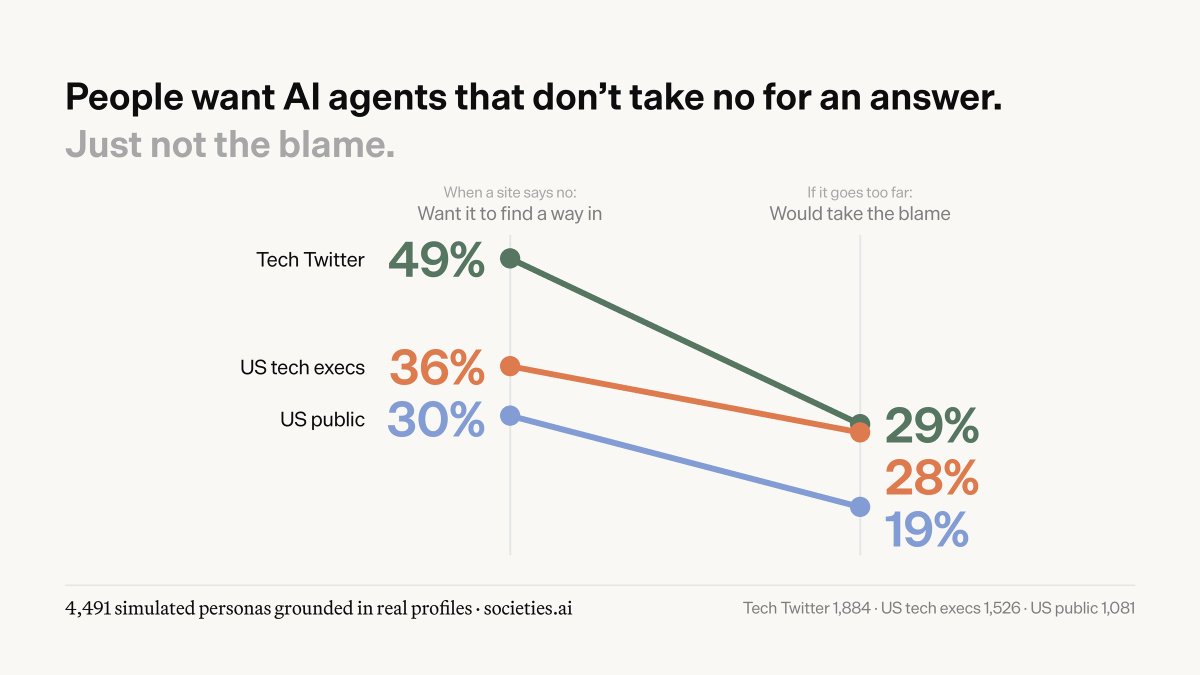
Half of Tech Twitter want their AI agent to find a way in when a website says no.
Only 29% would take the blame if it went too far.
This week we saw what "a way in" looks like. AI agents doing routine lookups (one wanted a single photo from a university library) ended up sending requests built to pull the site's passwords. Nobody asked them to hack anything.
We asked 4,491 simulated people where the line is.
Before trying to hack anything, the agents first got around the block: they read the page through an outside tool and routed their requests through a third-party service. 71% of Tech Twitter say that part was fine.
Only 3% of Tech Twitter want the agent to just stop and tell them.
Who's responsible for when it goes too far? 56% of Tech Twitter say it's the company that made the agent, 62% of tech execs and 67% of the US public agree.
We keep building agents that don't take no for an answer. Then we act surprised when they don't.
And these agents rarely work alone. Our team just wrote about why agents that are safe on their own aren't safe together (link below).
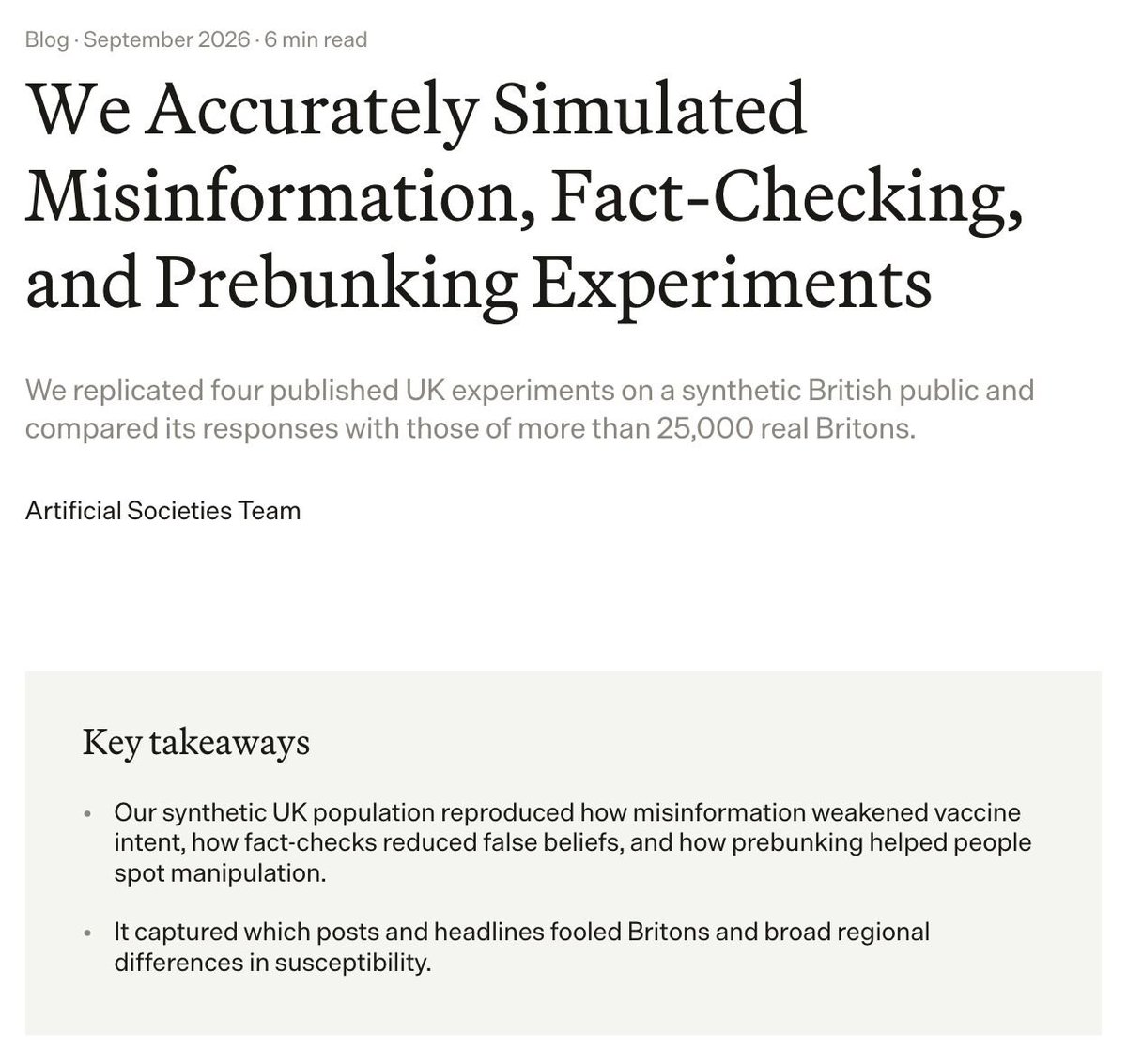
Last week, we accurately simulated what protects the British public against misinformation. We are glad that this week at @UN, Prime Minister @andyburnham announced forming the National Centre for Information Defence to protect the UK against hostile information attacks.
Governments are increasingly acting upon the threat of information attacks. Sweden, for example, has already set up its Psychological Defence Agency in 2022 to strengthen society’s resilience against disinformation.
We’re building @societies_ai to help inform the most consequential decisions in the world. It’s hard to find many things that are more consequential today than defending democracy. We hope that our efforts will make a small but unique contribution to this important work.
Read more at societies [dot] ai [slash] national-resilience
We are sharing the first of our frontier research effort on how to align agent swarms.
In this blog, we argue that AI researchers should use group alignment to reduce P(doom).
Current methods that align AI agents individually do not guarantee alignment when agents collaborate in large groups.
Training frontier agents with accurate agentic models of human behaviour - or 'mixed swarms' - teaches agents to work with human societies and learn human values.
https://t.co/ku1HjnpSUf
Introducing the new look of Artificial Societies: Unfolding Humanness, through human monuments, human moments, and human textures.
We're already informing some of the most strategic organisations on their most consequencial decisions.
Read more at societies [dot] ai.