New technologies often fail to scale for a boring reason:
the infrastructure was built for yesterday's technology.
Ships are becoming electric. Power generation is becoming mobile. Ports are electrifying.
Yet every new connection is still largely a project.
My question is simple:
What if we standardised the socket before choosing the plug?
I'm developing Energy Port Standard as the first real-world test of that idea.
This account documents the evidence — including evidence that proves the idea wrong.
@HopfJames The interesting part isn’t just the 1 MWe reactor.
It’s the design logic: make the generator transportable and modular enough to integrate into different maritime platforms.
Another plug becoming a product. The open question is whether the receiving side can become one too.
@ricci_nov@SecDuffy@USDOT@DOTMARAD Yep. The reactor wasn't the shortage. A ship with per‑port permits isn't in a market – it's trapped in one‑off sockets. Dock access = the receiving layer.
@HopfJames Ten years of reactor design, yet it all comes down to a one‑of‑a‑kind shore connection. Build the receiving end late, and 2036 is a pilot – not a market of floating energy supply.
@BPC_Bipartisan Load grows faster than the grid can receive. The real hidden socket: it means that the queue isn't a capacity problem – it's the missing standard interface to get in.
This case is the useful inversion of the usual technology story.
The ship is not the innovation here. The port is becoming ready for a class of compatible ships.
That is what infrastructure looks like when the socket starts becoming a product.
https://t.co/EqDPhj7f4K
@W_Nuclear_News@ProdigyCEnergy This is exactly the direction I keep seeing: the generator is becoming a repeatable product.
The next question is the receiving side. If each new site still needs a bespoke connection architecture, the plug can scale faster than the socket.
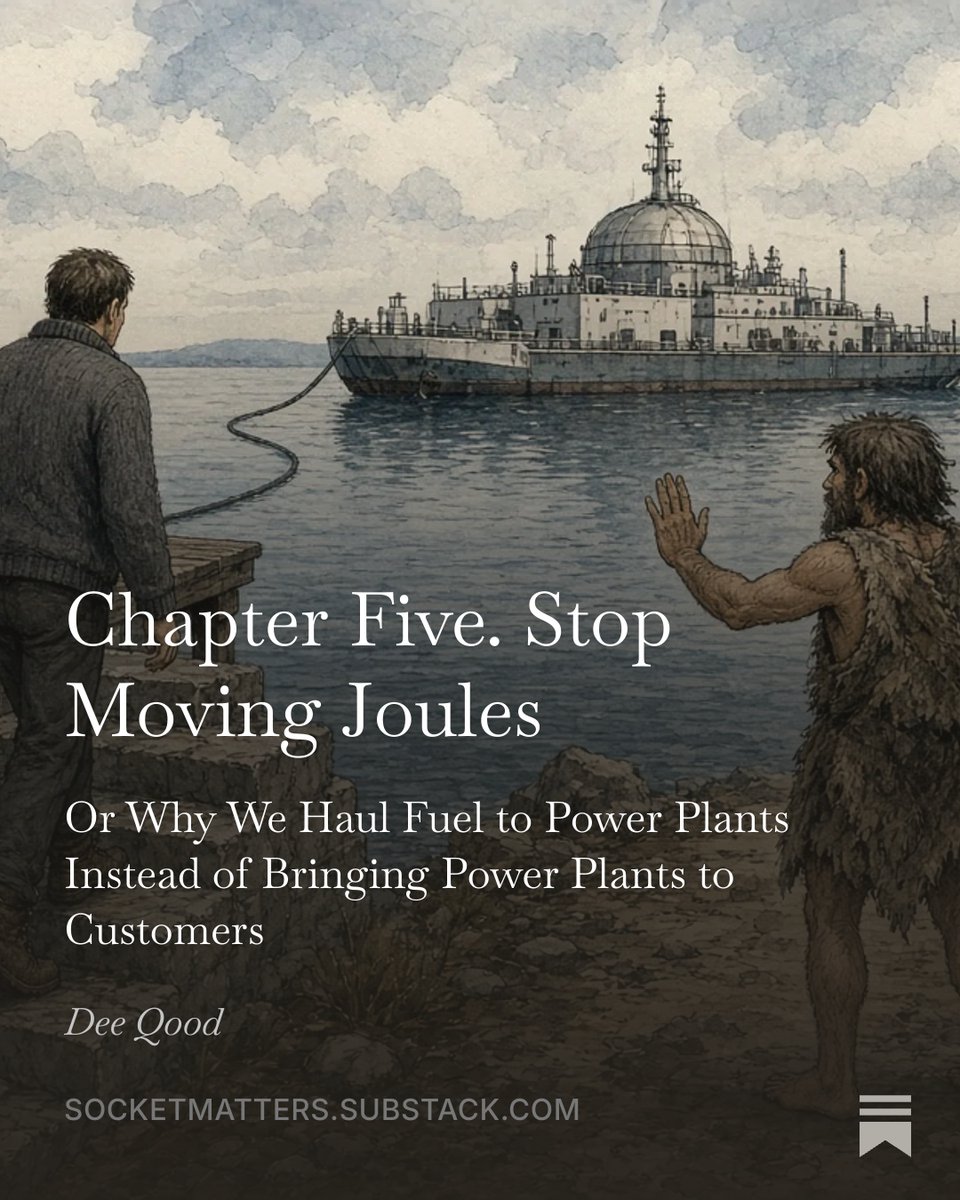
The new chapter of Socket Matters book is out: https://t.co/FG0gOtgIa5
There’s a Neanderthal, the swamp of deglobalisation, real estate that wastes our time, and a power plant acting like a replaceable cartridge.
And all because it’s time to stop moving joules and start delivering kilowatts.
@elonmusk But warming has two main causes that can be fixed here, on the planet: surface albedo + methane release from permafrost and waters of the Arctic seas. You are trying to create an umbrella, although you need to take off your fur coat.
4/ This issue still needs to sink in. But you can join my initiative to develop an open energy port standard today at https://t.co/umyQCLDJIR – so electricity makes sense (and cents) worldwide ⚡
3/ That's only half the problem. Grid capacity near ports is low, and port‑generated power costs more than shipboard diesel gensets. So ports can't sell it – case in point: Baltimore tried to charge 4× the ship's own cost per kWh.
3/ Yet again they're building the "plug" (reactor) but ignoring the "socket" (onshore infrastructure). Rosatom's neglect of this killed their floating sales. Learn from others' mistakes—or just read my book (links at profile) 😉
My takeaway from the Newcleo floating nuclear plant news 👇 https://t.co/9tS8MasRzt
1/ Russia has been presenting a turnkey solution for coastal power & desalination at every public event since 2020. Here's the proof from their slide—pipes on shore carry steam for distilled water. Meanwhile, France is just "starting to explore". You didn't invent anything new, but at least don't hide whose homework you copied 😉
2/ They have their own reactor manufacturer and certification partners—meaning they're building a sovereign in-house product. Clearly aiming for a market share with full tech control to compete. Smart move for a country in the nuclear club.