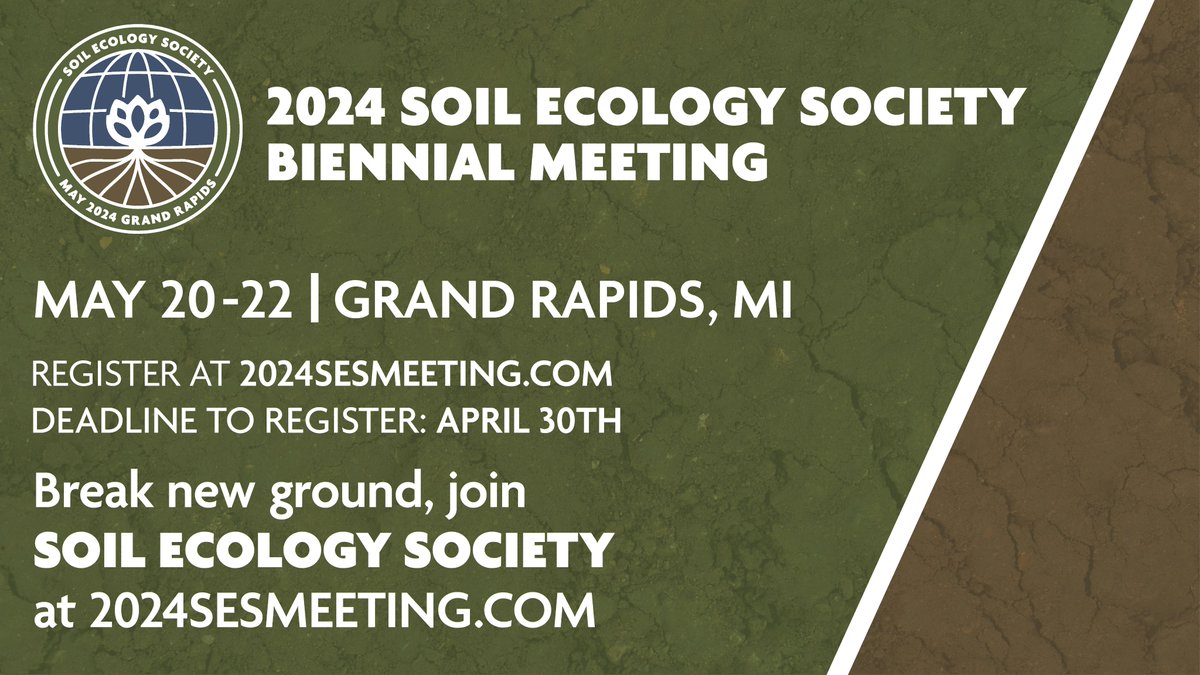
Registration is open for our Biennial Meeting in Grand Rapids, MI May 20-22! Check out all the details about registration, abstract submission, and hotels here: https://t.co/qaXexL5IBT
Brian Darby's family started a scholarship fund for UG students with interdisciplinary interests that include biology, including preference for students with a soil ecology interest. Donations can be made at
https://t.co/GTQiL68PAC
New preprint where we show that differences among ectomycorrhizal trees in their leaf litter nutrient stoichiometry, resource use patterns, and microbiome assembly can drive surrounding soil organic matter properties and ecosystem function
https://t.co/vo1EWSPImT
Phenotypic plasticity accounts for changes in #plant phosphorus-acquisition strategies from mining to scavenging along a gradient of #soil phosphorus availability in South American Campos #grasslands👇
@diegomichegari https://t.co/fDPdbNZr4s
🔥 New paper by @amyezimmerman@emilybonnell_g @BioDataGanache showing that tiny viruses have huge potential to impact soil carbon cycling @PNNLSoilsSFA https://t.co/lEwUlpN0JM
Article now out, led by Wolfram Buss: "Applying minerals to soil to draw down atmospheric carbon dioxide through synergistic organic and inorganic pathways."
We discuss synergies btw. enhanced weathering, biochar, and secondary minerals to increase SOC.
https://t.co/y9RV8NlfZd
Native arbuscular #mycorrhizal#fungi play an important role in #grassland succession, but a changing environment may alter this role as #plant response is context-dependent
@MycorReb
https://t.co/S6vXKsxOf2
For anyone teaching or learning DNA barcoding, here's an article describing three 1.5-hour introductory lesson outlines for high school students, designed as part of a two-week summer school program in Hawai'i. The lessons are focused around the DNA barcoding of algae but could also be adapted for other organismal groups.
The lesson outlines focus more on understanding the processes of PCR and DNA barcoding rather than hands-on lab work, so they could be reproduced without any lab equipment and using free software, or run remotely.
They also emphasise the importance of other taxonomic information as part of the identification, so they could be tied in with a broader curriculum involving morphology- or ecology-based identification.
A key part of the lessons is an inquiry activity of characterising an unknown algal specimen using DNA barcoding and morphological or ecological data, using a “claim, evidence, and reasoning” framework.
Importantly, students are encouraged to take charge of the investigations to allow as much student ownership of the research as possible.
The article also includes marking criteria for desired learning outcomes - useful for teachers and also learners!
You can find the article here:
Tateno-Bisel & Perez (2022). Teaching DNA Barcoding for the Identification of Algae. In: S. Seagroves, A. Barnes, A.J. Metevier, J. Porter, & L. Hunter (Eds.), Leaders in effective and inclusive STEM: Twenty years of the Institute for Scientist & Engineer Educators. UC Santa Cruz: Institute for Scientist & Engineer Educators (pp. 261–272).
https://t.co/QsQxtNCcDQ
Unexpected east-west range shifts in forest plants - our recent Europe-wide and long-term study now out in @ScienceMagazine!
I summarize the surprising findings here:
https://t.co/z1dsAFOUZV
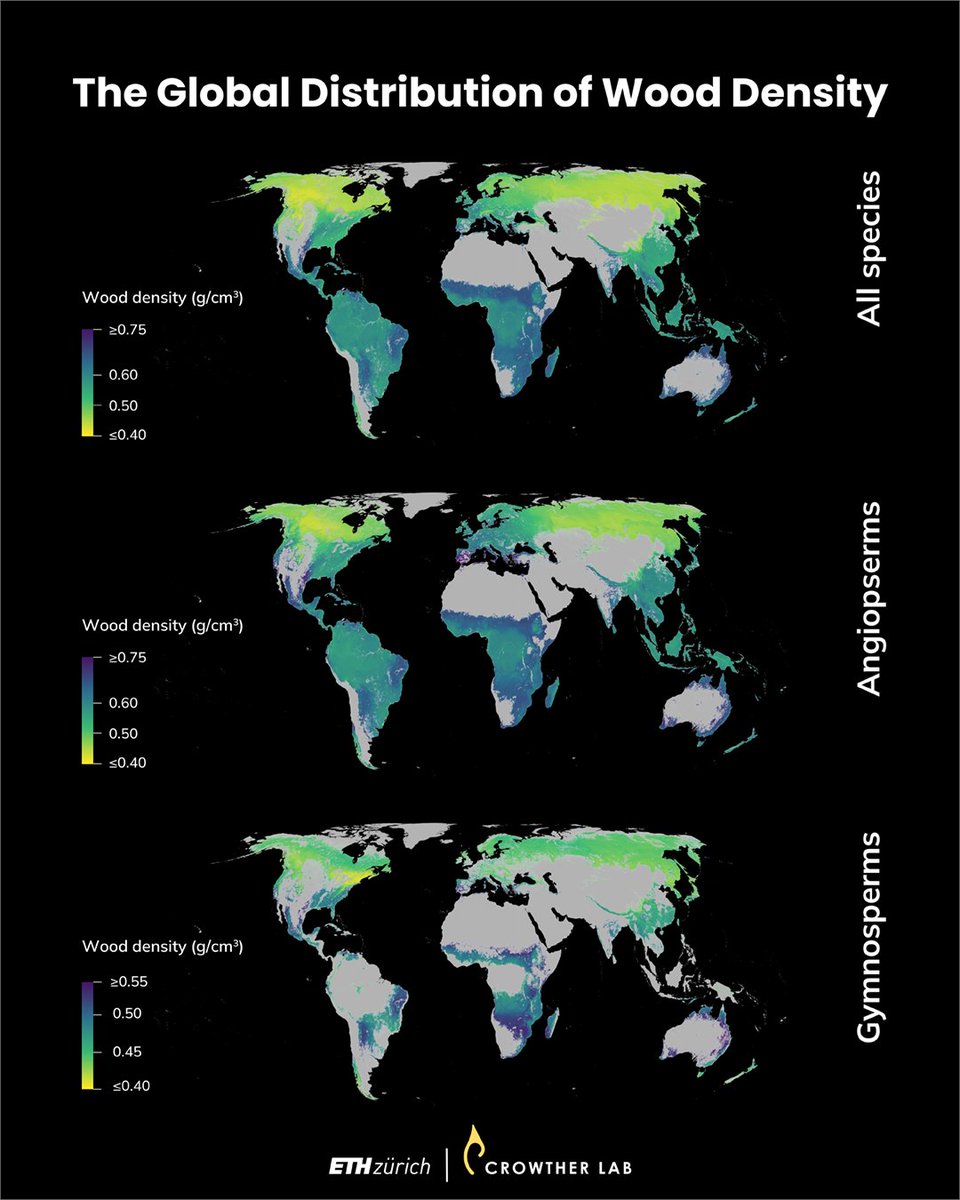
Out now in @NatureEcoEvo! Led by Dr. Lidong Mo & Dr. @ConstiZo, we studied global wood density variation & its drivers🪵🌍
Our research reveals a latitudinal gradient, whereby wood in the tropics is 30% more dense than in boreal forests.
Why? Learn more: https://t.co/CcLyCdurPK
New paper out in @Ecology_Letters 🤩
https://t.co/C9FXnrhEGZ
🙏co-authors: David Coulette, @ciais_philippe, @StevenDAllison
We challenge the idea that "selection always leads to the same outcome, no matter the adaptive mechanism." Here's how👇 (1/7)
ggstatsplot : an R 📦 that is an extension of ggplot2 and creates stunning, publication-ready visualizations with integrated statistical tests 📈
https://t.co/SiHSUFqot0
#DataScience#Stats#DataAnalysis#DataViz#ggplot2
Are you interested in full length 16S rRNA sequencing on @nanopore? We developed a new workflow using UMIs and R10.4+ chemistry to enable highly accurate and multiplexed microbiome profiling.
This was a long road, and I’m glad to see this out! 1/4
https://t.co/qdpNc2C960
Environmental matrix and moisture are key determinants of microbial phenotypes expressed in a reduced complexity soil-analog https://t.co/RwRJNFEuYM #biorxiv_micrbio
While there are some useful tips for graduate students in there, advisors should read this and think, "how can I take the burden off the student." We need to remember our students are in training and are not fully formed researchers.
Starting a #PhD? You need to read this article about: The care and maintenance of your adviser/supervisor. Download the Nature article on this topic here. https://t.co/xFnzQWEt5p #PhDchat#PhDforum#postgrad#VitaeCon2024
Final version published @SoilBiolBiochem
Liu et al. w/ @Gaowen_Yang and others
Discovering the role of fairy ring fungi in accelerating nitrogen cycling to promote plant productivity in grasslands
#fungi
https://t.co/tvI2dGxZDK