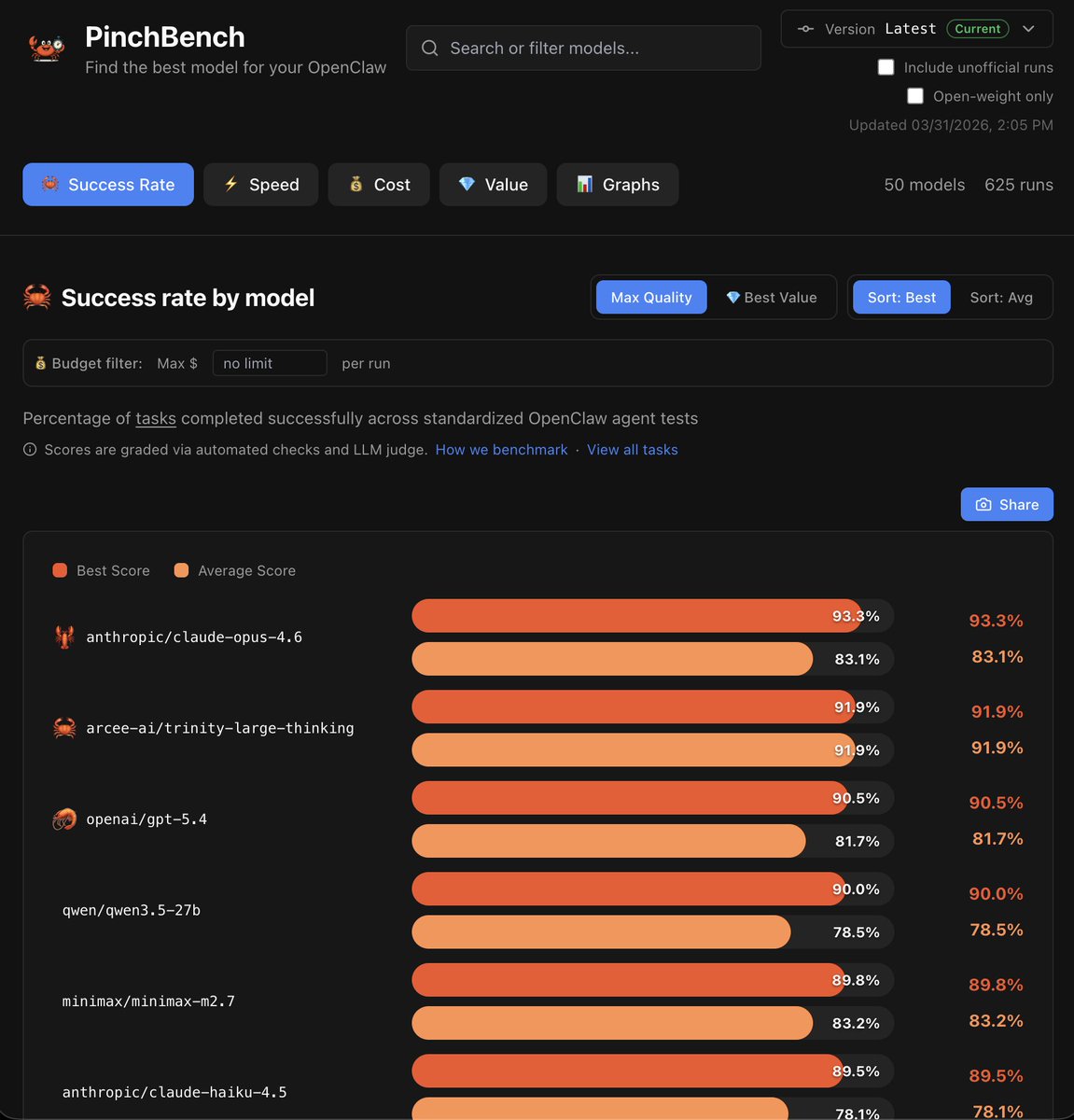
Jensen showcased PinchBench (by @kilocode) on stage at NVIDIA GTC as the new standard for evaluating @openclaw agent capability.
Trinity-Large-Thinking just hit #2 on @pinchbench globally (91.9%) behind only Claude Opus 4.6 (93.3%), which costs ~20x more per token. That's an expensive percentage point...
To celebrate the ongoing Trinity partnership, @OpenRouter is running a promotion to make Trinity-Large-Thinking free to use for OpenClaw until Sunday, April 5th.
Even when the promo ends, the Trinity economics are pretty incredible.
Trinity is $0.25/m input tokens (OpenClaw uses A LOT of input tokens), but with a 60%-90% cache hit rate at $0.06/m cache tokens the average input cost nets out to $0.087/m.
You no longer have to compromise on logic to keep your agent infrastructure affordable.
We're excited to see what you build.
Today we're releasing Trinity-Large-Thinking.
Available now on the Arcee API, with open weights on Hugging Face under Apache 2.0.
We built it for developers and enterprises that want models they can inspect, post-train, host, distill, and own.
A world of UBI looks a lot different than traditional tax transfer payments - AI oracles will be rewarding folks for their humanity and also thousands of small micro initiatives over one's lifetime.
Crossing what is happening in Minneapolis against how much I travel abroad, a few important recommendations for my fellow American emerge.
# 1 - Americans need to give up the notion that America is "# 1". America is imperfect like any other country. A focus on perfection leads to unhealthy behavior on both sides.
# 2 - Minneapolis is a political flashpoint. We have a high density of some of the most liberal and conservative folks in the country, due to urban and rural populations interacting in one place.
# 3 - Incoming immigration policies should be federal. Deportation policies should be local. The benefits of having a federal system are clearly being violated and under utilized by ICE.
# 4 - Both sides are suffering from scapegoat mechanism. Increasing violence does not solve the root cause of frustration.
# 5 - Minneapolis is brutal mentally in the winter with low light and cold weather. Get outside for walks when it is warm enough into the light, and travel some if your family can manage it. Talk to individuals in person and avoid the wormhole of your media sources.
# 6 - Relative to what is going on abroad in many other countries - we have it good. Keep fighting for democracy and have gratitude for what we have and how we can make it better, and correct when it is not going quite right.
Humanity speaks at roughly 100 trillion tokens/day, which is roughly 10x the size of most full pretraining corpora.
As AI velocity speeds up in continuous learning and RL, we'll see an increasing importance of foundation models that capture day to day shift in spoken language, and reason through the gaps.
Most applications we might use actually deliver negative value to us. Whether this be personally or within the institutions we are a part of.
This is a reminder to consider carefully when signing up for and considering deleting software from your schema.
NOW - Reza Pahlavi: "I went to Israel to show that we are the descendants of Cyrus the Great, who 25 centuries ago helped free the Jewish people and rebuild the Temple in Jerusalem."
Introducing Trinity, the start of a new open-weight MoE family. Rolling out today today:
Trinity-Mini (26B-A3B)
Trinity-Nano-Preview (6B-A1B)
Download on HuggingFace. Free for limited time on OpenRouter.
Announcing Roboflow Rapid: the first prompt-based model creation engine. Data labeling is dead.
Go from idea to deployed model in minutes without labeling data.
Upload a video, type a text prompt, and get an API. No data labeling teams. No manual annotation. No infra / dependency hell.
If you are spending 95% of your time labeling data and only 5% building your app, you are doing it wrong.
We've been running @radixark for a few months, started by many core developers in SGLang @lmsysorg and its extended ecosystem (slime @slime_framework , AReaL @jxwuyi). I left @xai in August — a place where I built deep emotions and countless beautiful memories. It was the best place I’ve ever worked, the place I watched grow from a few dozen people to hundreds, and it truly felt like home. What pushed me to make such a hard decision is the momentum of building SGLang open source and the mission of creating an ambitious future, within an open spirit that I learnt from my first job at @databricks after my PhD.
We started SGLang in the summer of 2023 and made it public in January 2024. Over the past 2 years, hundreds of people have made great efforts to get to where they are today. We experienced several waves of growth after its first release. I still remember the many dark nights in the summer of 2024, I spent with @lm_zheng , @lsyincs , and @zhyncs42 debugging, while @ispobaoke single-handedly took on DeepSeek inference optimizations, seeing @GenAI_is_real and the community strike team tag-teaming on-call shifts non-stop. There are so many more who have joined that I'm out of space to call out, but they're recorded on the GitHub contributor list forever. The demands grow exponentially, and we have been pushed to make it a dedicated effort supported by RadixArk. It’s the step-by-step journey of a thousand miles that has carried us here today, and the same relentless Long March that will lead us into the tens of thousands of miles yet to come.
The story never stops growing. Over the past year, we’ve seen something very clear:
The world is full of people eager to build AI, but the infrastructure that makes it possible is not shared. The most advanced inference and training stacks live inside a few companies. Everyone else is forced to rebuild the same schedulers, compilers, serving engines, and training pipelines again and again — often under enormous pressure, with lots of duplicated effort and wasted insight.
RadixArk was born to change that. Today, we’re building an infrastructure-first, deep-tech company with a simple and ambitious mission:
"Make frontier-level AI infrastructure open and accessible to everyone."
If the two values below resonate with you, come talk to us:
(1) Engineering as an art.
Infrastructure is a first-class citizen in RadixArk. We care about elegant design and code that lasts. Beneath every line of code lies the soul of the engineer who wrote it.
(2) A belief in openness.
We share what we build. We bet on long-term compounding through community, contribution, and giving more than we take.
A product is defined by its users, yet it truly comes alive the moment functionality transcends mere utility and begins to embody aesthetics.
Thanks to all the miles (the name of our first released RL framework; see below).
https://t.co/2vio4Eiiac