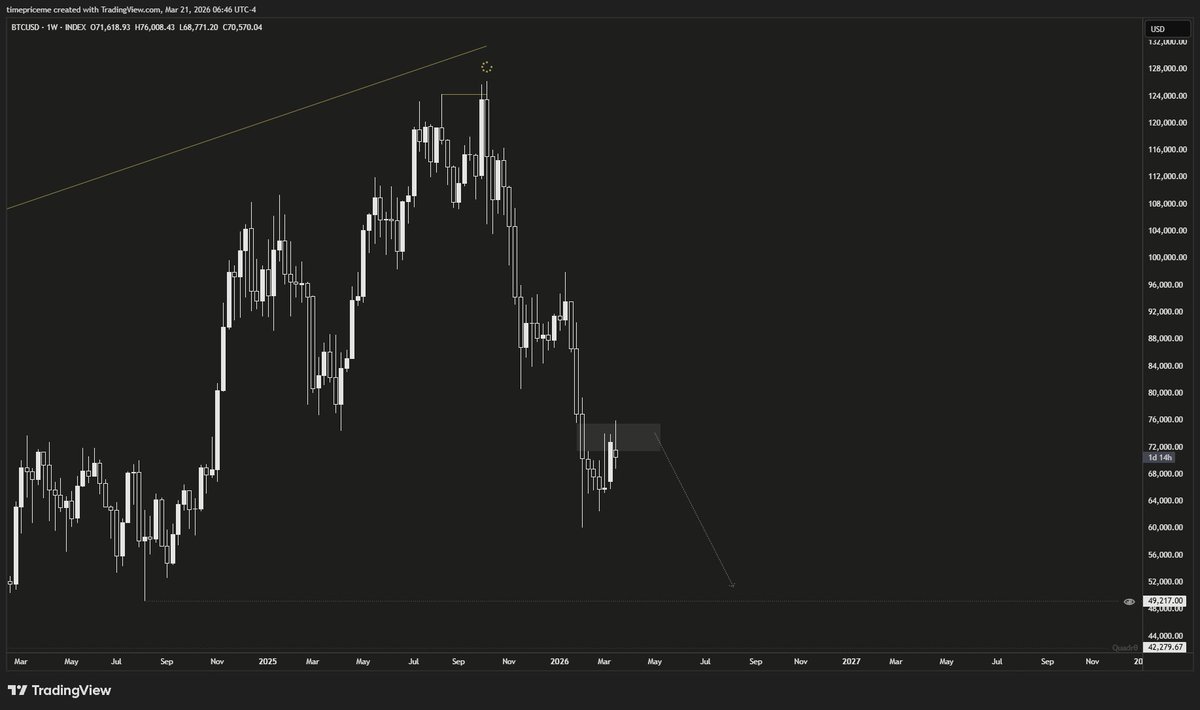
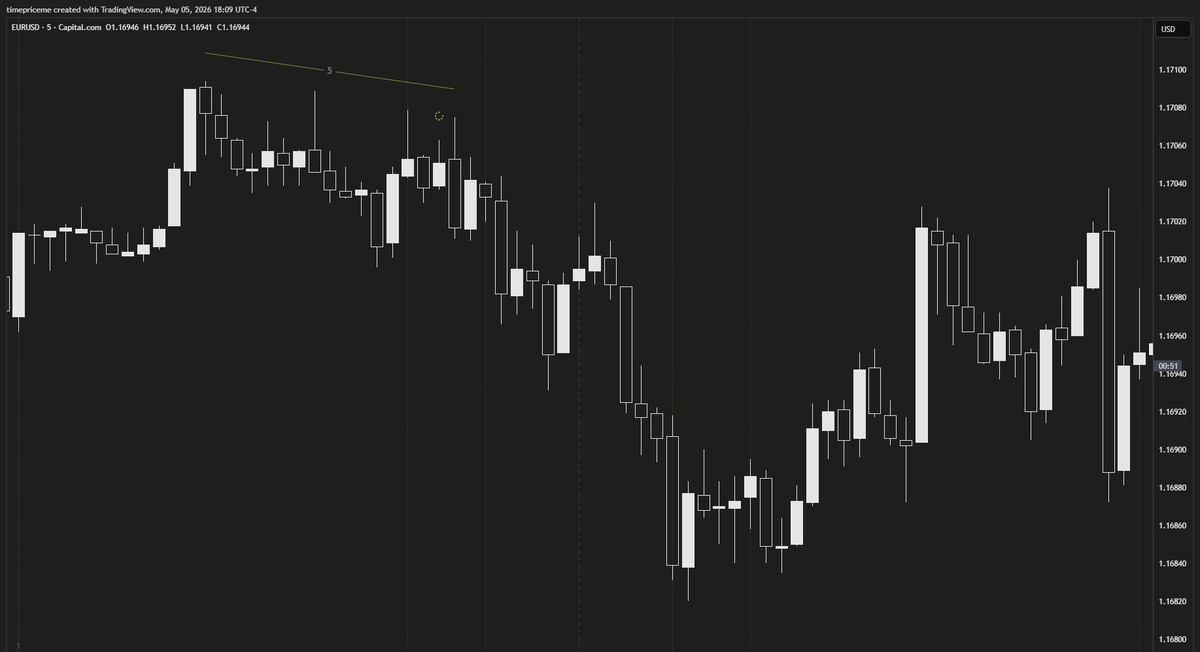
$BTC
My feed currently: "Oh ah everyone anticipates Bitcoin to find a bottom around 50k in Q4, that's the reason it won't happen". Firstly, 50k should be touched liquidity-wise. Moreover, it's impossible to measure exact market sentiment based on X timeline, it's quite limited.
$DXY
Did you know that in slightly over 60% of cases Friday marks initial High/Low of an upcoming week (purely mechanically)? Couple it with clean HTF liquidity and 2 cracks in correlation formed on Friday. The sole thing left is to find LTF entry in an anticipated direction.
I am 52 years old. I have been working since I was 15 years old. I have no savings, no retirement, and will never own a home before I die.
And there is now a trillionaire.
$DXY
Did you know that in slightly over 60% of cases Friday marks initial High/Low of an upcoming week (purely mechanically)? Couple it with clean HTF liquidity and 2 cracks in correlation formed on Friday. The sole thing left is to find LTF entry in an anticipated direction.
I am not an expert on AI, but I have been thinking for a while that there sure is a whole lot of money pouring into the belief that current tech, built in sufficient quantities, will be enough to carry us into the future we dream of. But it is a massive bottleneck of real resources waiting to be disrupted by more efficient models/chips. The same thing happened to fiber while companies were spending billions to build out Internet infrastructure 25 years ago. Yeah they're growing GDP, but for what ultimate purpose? Multiple companies all hoping to run with similar end products (as far as average people can tell) on a subscription based revenue model. There aren't going to be four or five winners. Someone will have to lose spectacularly, and it will necessarily be one of the biggest companies on the planet when it does.
what happens to trading if AI keeps getting better?
Dwarkesh Patel asked Jane Street's head of technology the obvious question: if we get AGI, can't it just replace what you do?
his answer: "trading feels to me like AGI-complete."
"all of the different problems of the world end up influencing what you're doing in a trading context. trading involves figuring out what things are worth. which means making predictions about the future. and lots of different things flow into that."
in other words, to fully automate trading you'd need to fully automate understanding the entire world. every geopolitical event, every supply chain shift, every behavioral pattern, every regulatory change, it all feeds into price.
and even at a firm running tens of thousands of GPUs with sub-100-nanosecond execution: "many of your most profitable days happen when weird stuff happens and nobody knows what's going on. doing that well involves human judgment. we think humans work better than models through phase transitions."
his conclusion: "i have never been more desperate to hire more engineers and traders than i am today. everything people are doing is more valuable than it was."
so what does this mean for the rest of us?
if the most automated trading firm on earth is saying humans matter more not less. the implication is that AI doesn't shrink the opportunity in trading. it raises the bar for what each person can do. the traders who learn to use these tools will pull further ahead. the ones who don't will fall further behind.
🚨 Wayne Rooney on how Cristiano Ronaldo became who he is :
“When Cristiano Ronaldo first arrived at Manchester United, you could already tell he was different. The talent was obvious, everyone could see that. But what shocked us most wasn’t the tricks or the pace ,it was the obsession. Training would finish, lads would head inside, but Cristiano stayed out there. Extra shooting drills. Extra sprints. Extra gym sessions. Day after day.
Sometimes you’d think he’d finally had enough, then you’d look back and he was still running hills or practicing free-kicks in the dark. He treated every training session like a cup final. It wasn’t just talent alone that made him great , it was madness mixed with discipline. A level of dedication I’ve honestly never seen from anyone else.
That’s why he became Cristiano Ronaldo. Not because he wanted to be one of the best… but because he refused to be anything less.”
The Rare Book Thesis for an AI World
I recently read about the sale of a first edition Newton's Principia for $3.7 million, which sounds like a lot of money until you realize that someone paid $23.7 million for CryptoPunk #5822—a 24×24 pixel image of a blue alien wearing a bandana. This is not a judgment about NFTs, but rather an observation about revealed preferences.
Let's do the math: The total value of all ~400 first edition Principias in existence, if we generously assume an average value of $2 million each (most are worth much less), is about $800 million. The total market cap of all 10,000 CryptoPunks at their peak was about $4.5 billion. That means the market valued a collection of CryptoPunks at ~5× the collective value of all surviving copies of the book that fundamentally restructured our understanding of physical reality.
But it gets weirder. The entire rare book market—every first edition of every important work in human history, from Gutenberg Bibles to Shakespeare Folios to Darwin's Origin—is worth maybe $20 billion total. That's only about four times what CryptoPunks alone were worth at their peak. We live in a world where a single NFT collection created five years ago came within striking distance of the collective value of all physically preserved first editions of human knowledge.
To be clear: when I say rare books, I'm referring to first editions of seminal works that permanently altered the trajectory of human civilization—books that became the source code of modernity, like Newton's Principia, Darwin's Origin of Species, Smith's Wealth of Nations, and Galileo's Dialogue. The mispricing feels starker when you zoom out. The global art market commands $2 trillion, while the entire rare book market is optimistically valued at about $20 billion. That's a 100× differential.
The Economics of Rare Books
Books are absurdly easier to store and transport than any comparable alternative asset. You know what happens when you need to move a Basquiat? You hire a team of art handlers who charge six figures, arrange climate-controlled trucks, secure export permits, and pay insurance that costs more than a Lambo. A first edition Principia? I can put it in my carry-on and walk through customs like I'm carrying a notebook.
The Netflix series You popularized the notion that rare books require bulletproof cases in climate-controlled underground vaults, but the reality is more mundane: just turn on the A/C and keep them out of direct sunlight. This means that rare books are by far the cheapest to store per dollar of value, and insurance premiums are 2–3× cheaper than for art or classic cars.
The tax arbitrage is even more delicious. Most jurisdictions treat books like... well, books. There are fascinating quirks in tax laws across different countries. In the UK, for example, rare books have no VAT and are capital gains-exempt. In most European countries, rare books carry substantially less VAT than art, and many offer CGT exemptions with minimal conditions (Germany: hold for more than one year).
The supply dynamics are equally compelling. Every year, more first editions get:
- Permanently absorbed by institutions (Harvard's library is basically a black hole for rare books)
- Damaged by people who don't realize their grandfather's old book is worth more than their house
- Lost to floods, fires, and millennials who throw out "old junk" when cleaning estates
These factors have long been recognized, which is why rare books have been averaging 3–4% real returns, comparable to stamps and art. But what's about to change, and how will these returns look in the future?
The Coming Revaluation
As we contemplate an AI future based heavily on human corpuses, followed by autonomous AIs bootstrapping and recursively self-improving, we have to ask: will that preserve human values? Or will important things be lost or omitted—becoming a photocopy of a photocopy of something that once mattered to us? In a post-scarcity, post-AGI world, meaning and identity become paramount. An aligned AGI would likely recognize that humans derive profound meaning from tangible connections to their intellectual heritage, and that first editions serve as pinnacles of human achievement from before AI's own paradigm dominated. The first Wealth of Nations exists from a pre-capitalist world. The first Communist Manifesto from a pre-communist world. These are messages in bottles from worlds that no longer exist, that can't exist again. An aligned AGI will likely recognize these as the only uncontaminated samples of human thought—ideas from before the ideas themselves reshaped reality—and revalue them accordingly.
Also consider the "culture" of AI itself. An aligned AGI that inherits human values would likely revere its own origins, the same way we preserve fossils and visit historical sites. These books serve as documentation of its own intellectual ancestry. An AGI might value them more than humans do, recognizing them as the primary sources of its own consciousness. If this sounds far-fetched, remember that humans already spend millions preserving cave paintings and stone tools—the artifacts of our own cognitive evolution.
And here's the most poignant point: post-AGI, death might become optional. These books will be the only remaining artifacts from the Age of Death, when all human thought occurred under ultimate constraint. Every great work was written by someone racing against their own mortality.
The Semantic Singularity
We're about to enter what we might call a "semantic singularity"—a point where AI can generate unlimited amounts of meaningful text indistinguishable from human writing. GPT-5 will write better prose than most humans. When this happens, the value of "content" as an abstract category collapses to approximately zero. Cultural objects will split into two distinct categories:
1. Pre-Singularity Artifacts: Created under scarcity, bearing the scars of limitation, impossibly precious
2. Post-Scarcity Productions: Infinite, perfect, meaningless, worth exactly zero
This is where first editions become uniquely important. They're the only asset that exists simultaneously as:
- Physical artifact (the object)
- Semantic content (the text)
- Cultural catalyst (what it did to human consciousness)
- Temporal proof (when humanity chose to preserve this thought)
In post-scarcity, this unique ontological position makes books impossibly valuable. First editions of seminal works represent the peak moments of purely human discovery. They're physical evidence of when humans were the sole creators of transformative knowledge. In an AGI world, this becomes historically significant in a way that is beyond our current frame of reference. Once AGI surpasses human capability, no human will ever again be the first to discover something truly revolutionary. These books become archaeological artifacts of independent human cognition—the last proofs that our species once led intellectual progress rather than followed it.
Caveats and Metacognition
I might be completely wrong about all of this. Maybe AGI never happens, or happens so differently that none of this matters. But the asymmetry is interesting: the downside is that you own some very nice old books that appreciate at their historical 3–4% real return. The upside is that you own the only authentic remnants of human consciousness from before the phase change—artifacts whose value could explode by orders of magnitude.
In a world of fiat debasement and AI transformation, that seems like a bet worth considering.
Complete version with references at https://t.co/Fm1GGI78Al