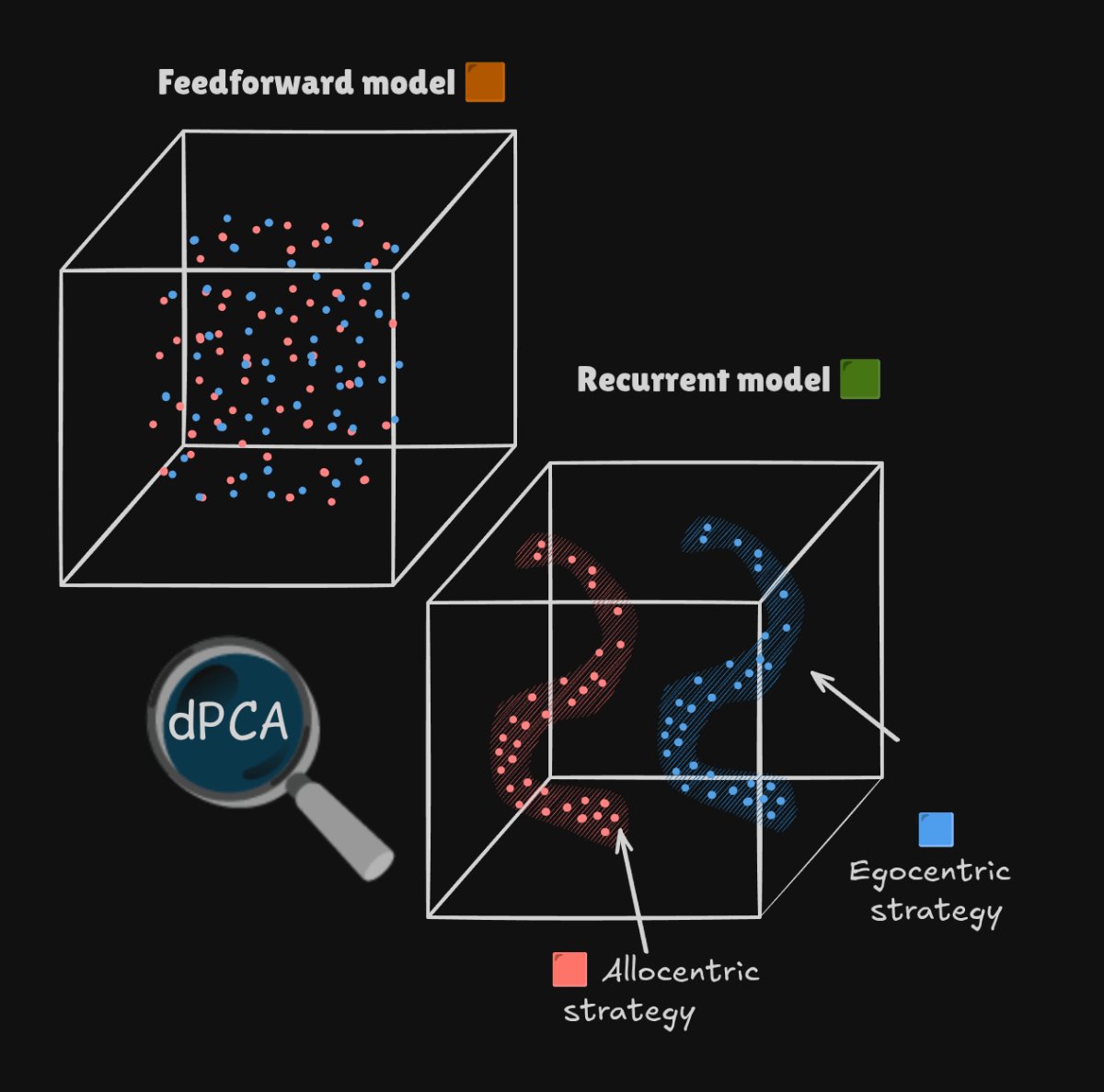
How does the brain find its way in realistic environments? 🧠 Using deep RL and neural data, we show that hippocampal-like networks support navigation, learning, and generalisation in partially observable environments—mirroring real animal behaviour:
https://t.co/seBNfM8w0T
Jeee 🐦⬛
I am very proud of our joint effort with @sreejan_kumar Kumar on the project "Reason to Play"
LRMs show human-like rule discovery, and their hidden states predict human brain activity during gameplay.
Interactive demo + paper:
https://t.co/4ouwGoqgDf
I'm excited to share my new work joint with @csaba_botos: how well do frontier LRMs like DeepSeek-V4 learn novel video games and predict brain signatures associated with game learning? We found that they achieve SOTA on both game performance and brain predictivity! Thread 1/7
Super proud to have contributed to this amazing team effort, led by @sreejan_kumar and @csaba_botos!
We asked: Which AI models learn to play video games like humans, comparing both behavior and internal representations. The answer surprised us!
Check out our paper/post below.
Our first endeavour in jointly explaining human brain-behaviour through gameplay! An impressive effort led by @csaba_botos and @sreejan_kumar with the help of a team of collaborators!
Parer:
https://t.co/PGnRuhUz4k
Jeee 🐦⬛
I am very proud of our joint effort with @sreejan_kumar Kumar on the project "Reason to Play"
LRMs show human-like rule discovery, and their hidden states predict human brain activity during gameplay.
Interactive demo + paper:
https://t.co/4ouwGoqgDf
The hippocampus is not a library, it is a simulation engine.
HPC is known for storing maps of the environment but not so known for generating planned trajectories.
This paper proposes that recurrence in CA3 is crucial to produce those plans.
Here is my toy model and notes:
NEWS: Hippocampus helps us learn to navigate unknown environments
The study by a team of international researchers and @OxfordDPAG reveals how the hippocampus supports flexible learning when sensory information is uncertain or incomplete.
https://t.co/YSJrz2wUD5
The brain has many processing pathways that reliably form during development, but where do these pathways come from?
In our new #NeurIPS paper, we identify three biologically relevant inductive biases that encourage pathway formation in Mixture-of-Experts models of the brain 🧵
🚨 Big news for the neuroscience community!
The Call for Abstracts, Travel Grants and Registrations for #FENS2026 is officially open! 🧠
👉 Register and submit your work today: https://t.co/v3ZVQu4yEi
As Transactions on Machine Learning Research (TMLR) grows in number of submissions, we are looking for more reviewers and action editors. Please sign up!
Only one paper to review at a time and <= 6 per year, reviewers report greater satisfaction than reviewing for conferences!
Finally out in @NatureComms: “Hippocampus supports multi-task RL under partial observability.”
Big thanks to my co-first @dabalpedamonti, co-authors @CiocchiStephane@MalagonVina Martin Dimitrov, and grateful to supervisor Rui Ponte Costa @somnirons 🙏
https://t.co/msQVQyJ6Al
Excited to announce that we'll get to present our work on modeling brain-like processing pathways at NeurIPS later this year!
Check out our paper here: https://t.co/diCa8bOw8s
Come join us! @FLAIR_Ox has a long history of hosting visiting students and we are now trialling a slightly more formal process for a six months internship early 2026. The successful students will become fully-fledged members of FLAIR working on cutting edge ML in a wonderfully supportive environment featuring some of the smartest and nicest people I have ever had the chance to work with ���
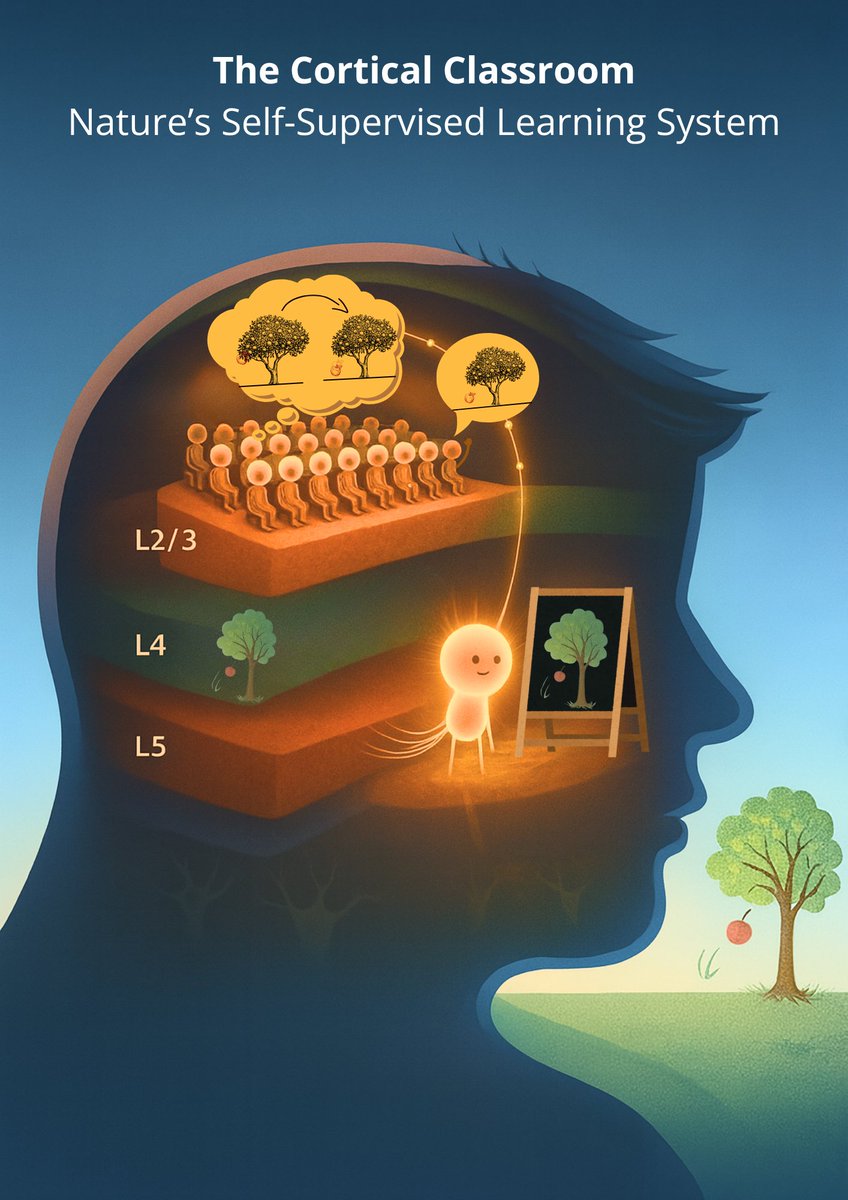
Sharing this very cool drawing of our paper that
@kevin_nejad
generated using AI systems that have themselves been trained via self-supervision, which seems very fitting :) https://t.co/bUWoc7sAaQ…
@OxfordDPAG
After a year of review, our paper is now out in @NatureComms !
I really think our model/theory offers one of the most promising frameworks yet for learning in neocortical circuits - perhaps not in its final form, but the core principle of ssl feels right.
Hoping experimentalists will test it, break it, and computationalists will refine it
#AllModelsAreWrongButSomeAreUseful - I think this one could be very useful😀
Pleased to say that our story of how a theory of self-supervised learning in cortical layers accounts for several experimental observations is now out 🎉
https://t.co/bgvTLlMrlg
Closing soon! Register by July 1st for UK Neural Computation 2025
https://t.co/S5wUGy3DXq
ECR day: 9 July - careers, grants, starting a lab
Main meeting: 10-11 July - 13 speakers, 70+ posters, sandpit
Hosted by @imperialcollege
Sponsors @ARIA_research@TheCrick
Our preprint is finally out! How can we understand the role of Behavioral Timescale Synaptic Plasticity in credit assignment? Does it fit into existing supervised and unsupervised learning frameworks? What theoretical gaps are still left unexplained?
https://t.co/nF4bZmxO2i