A guy whose lab just raised $2.000.000.000 spent 39 minutes telling you exactly how they did it. Almost nobody pressed play.
The talk sits on YouTube: a Moonshot AI researcher walking through the machinery under Kimi K3, the 2.8 trillion parameter model that just shook Silicon Valley.
Minute 5 dismantles the data wall. He shows how 50 trillion tokens become 100 trillion. His words on stage: "almost like magic."
Minute 18 is what US labs would never show publicly: reward equations for commanding swarms of 1,000 agents, including the term that catches agents faking their work.
Minute 26 he puts up a training curve, 30 trillion tokens without a single loss spike, and calls it the most beautiful of his life.
Consultants charge $500 an hour to guess at this. The primary source is free and timestamped.
Everyone's debating the model. The blueprint has almost no views.
1/ Iran is using a unique type of loitering, self-targeting surface to air missile to shoot down US MQ-9 Reaper drones. 11 Reapers costing over $330 million have so far been reported destroyed in the war with Iran. ⬇️
It is hard to communicate how much programming has changed due to AI in the last 2 months: not gradually and over time in the "progress as usual" way, but specifically this last December. There are a number of asterisks but imo coding agents basically didn’t work before December and basically work since - the models have significantly higher quality, long-term coherence and tenacity and they can power through large and long tasks, well past enough that it is extremely disruptive to the default programming workflow.
Just to give an example, over the weekend I was building a local video analysis dashboard for the cameras of my home so I wrote: “Here is the local IP and username/password of my DGX Spark. Log in, set up ssh keys, set up vLLM, download and bench Qwen3-VL, set up a server endpoint to inference videos, a basic web ui dashboard, test everything, set it up with systemd, record memory notes for yourself and write up a markdown report for me”. The agent went off for ~30 minutes, ran into multiple issues, researched solutions online, resolved them one by one, wrote the code, tested it, debugged it, set up the services, and came back with the report and it was just done. I didn’t touch anything. All of this could easily have been a weekend project just 3 months ago but today it’s something you kick off and forget about for 30 minutes.
As a result, programming is becoming unrecognizable. You’re not typing computer code into an editor like the way things were since computers were invented, that era is over. You're spinning up AI agents, giving them tasks *in English* and managing and reviewing their work in parallel. The biggest prize is in figuring out how you can keep ascending the layers of abstraction to set up long-running orchestrator Claws with all of the right tools, memory and instructions that productively manage multiple parallel Code instances for you. The leverage achievable via top tier "agentic engineering" feels very high right now.
It’s not perfect, it needs high-level direction, judgement, taste, oversight, iteration and hints and ideas. It works a lot better in some scenarios than others (e.g. especially for tasks that are well-specified and where you can verify/test functionality). The key is to build intuition to decompose the task just right to hand off the parts that work and help out around the edges. But imo, this is nowhere near "business as usual" time in software.
Apple will either acquire this or sherlock it within 18 months. They can’t let a third party own the fastest path from idea to App Store.
Rork just abandoned their entire React Native stack for native Swift. This company raised $2.8M from a16z building cross-platform apps from prompts. Rork Max throws that away and bets everything on Apple-native. That’s a complete technical pivot, not an iteration.
The “replaces Xcode” line is the real announcement. Xcode is a 21-year-old IDE that Apple has zero competitive pressure to modernize. Every iOS developer complains about it. Nobody builds against it because Apple controls the entire toolchain from compiler to App Store submission. Rork is betting that Claude Code can generate Swift well enough to bypass that monopoly entirely.
The timing tells you something. They chose Claude Code and Opus 4.6 over GPT-5, which means they tested both and Anthropic’s code generation won for native Swift output. That’s a live benchmark result disguised as a partnership announcement.
If Rork Max can actually one-shot native Swift apps for iPhone, Watch, iPad, TV, and Vision Pro from a browser, the IDE, the build system, the simulator, the provisioning profiles… all of that complexity collapses into a website.
There are 34 million registered Apple developers. Most of them hate Xcode. Rork just showed them the exit, and Apple can’t afford to let someone else own the door.
After 2 years of writing with Claude, I can say it's the tool that revolutionized my content creation more than Grammarly, Hemingway, and every writing course combined.
Here are 10 prompts that transformed my writing and could do the same for you:
That’s why this is one of my most used and most useful prompts:
I asked 3 competing LLMs to do the exact same thing and they came up with pretty different plans which you can read below. I want you to REALLY carefully analyze their plans with an open mind and be intellectually honest about what they did that's better than your plan. Then I want you to come up with the best possible revisions to your plan (you should simply update your existing document for your original plan with the revisions) that artfully and skillfully blends the "best of all worlds" to create a true, ultimate, superior hybrid version of the plan that best achieves our stated goals and will work the best in real-world practice to solve the problems we are facing and our overarching goals while ensuring the extreme success of the enterprise as best as possible; you should provide me with a complete series of git-diff style changes to your original plan to turn it into the new, enhanced, much longer and detailed plan that integrates the best of all the plans with every good idea included (you don't need to mention which ideas came from which models in the final revised enhanced plan):
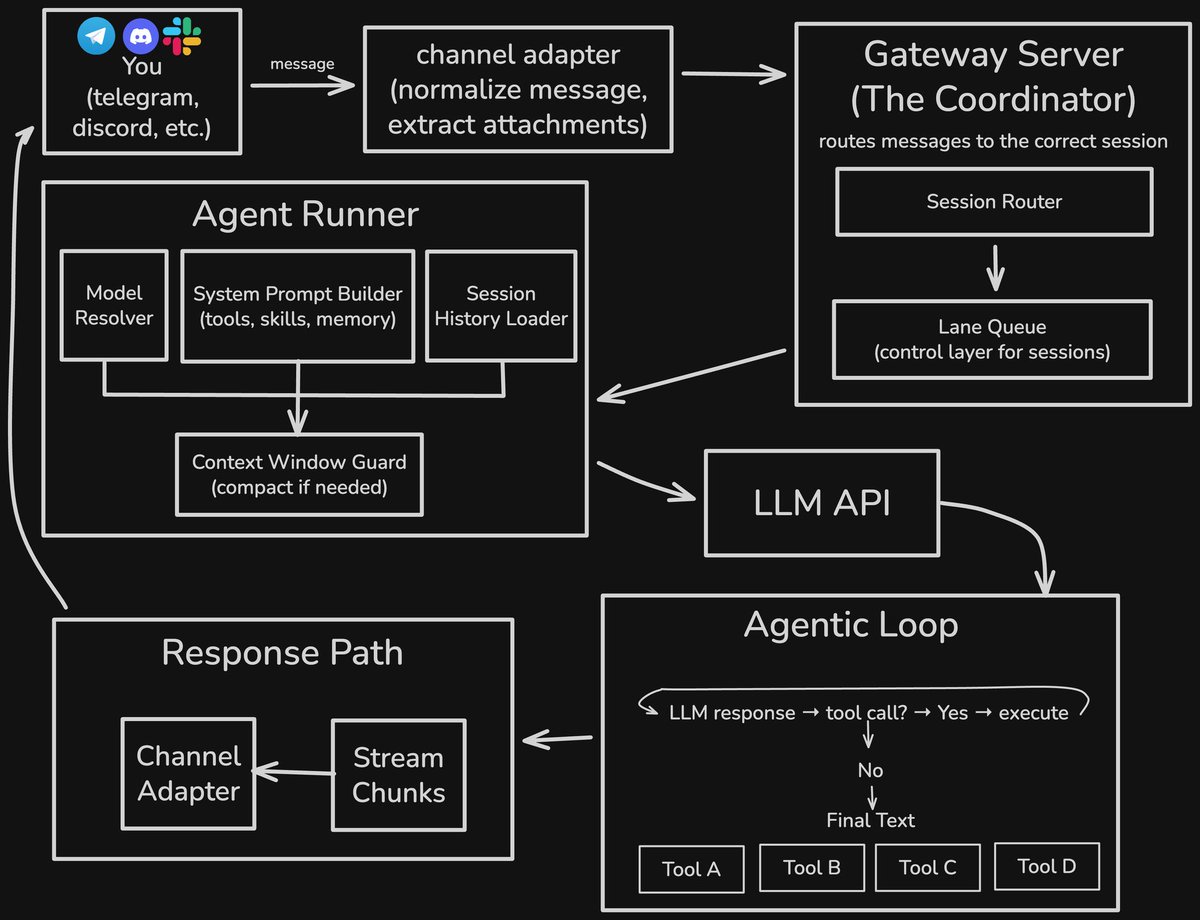
good breakdown of the architecture behind OpenClaw/Clawdbot, and also makes it perfectly clear that our operating systems are overdue for reimagination.
the big OS companies need to lean in hard here…this is the future
this is the single most practical explanation of what ClawdBot is really capable of.
TLDR; ClawdBot is a blank canvas you can fill with anything you want. your limit is your imagination.