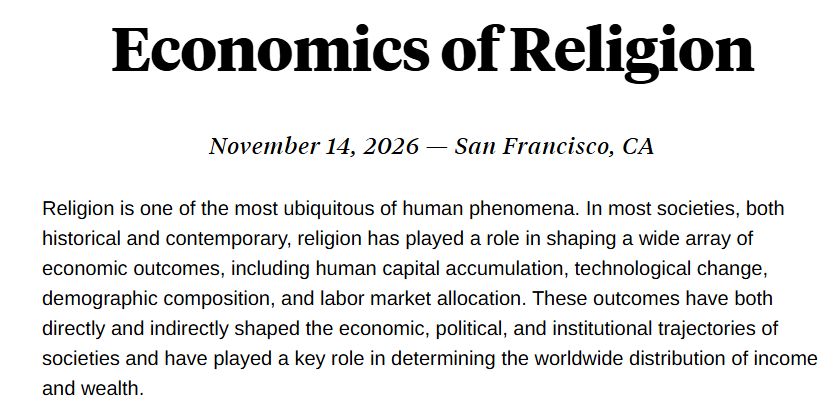
Open call for papers, Economics of Religion. Conference to be held in San Francisco, CA on November 14, 2026. Submit papers by 11:59pm EDT on September 1, 2026. More information: https://t.co/xULRC7z8qp
Excited to reveal the cover of my forthcoming book, Muslim Capitalism: A Political and Legal History of Colonial Bombay. Coming soon from Cambridge University Press. Looking forward to sharing more about the project soon!
@CambridgeUP
@mehdirhasan Sadly you don't know economics. His business is worth 1 trillion. It's the value of stock: if he started selling even 10% of it, markets may devalue them such that he loses 90% of that immediately. His literal standard of living is comparable to billionaires.
This looks like a must-read!
"Macro: The Economic Models That Shape Our World" by Greg Kaplan (available in November).
"In clear and engaging prose, Chicago economist Greg Kaplan demystifies how our everyday behavior, including how we spend and save, connects to the biggest questions in fiscal and monetary policy. Tracing the evolution of modern macroeconomics from Keynes to today, he guides readers through the models that are often used to explain our economy, uncovers their flaws, and reveals what cutting-edge research tells us about managing the economy in good times and bad. The journey culminates in HANK, a macroeconomic model co-created by Kaplan that is more consistent with reality. Macro offers a timely, new framework for understanding and shaping economics in the real world."
https://t.co/IxOWTajiak
Forthcoming in AEJ: Applied Economics: "Who Knows? Information Access and Endogenous Network Formation" by Laura Derksen and Pedro CL Souza. https://t.co/QLDzWrDjPr
Will the Fed learn the right lessons from the Fed Framework Review?
@BryanPCutsinger, @PIrelandEcon, and @WilliamJLuther discuss with @DavidBeckworth the big takeaways from the 2025 Fed Framework Review, the flip flopping of FIT to FAIT and back to FIT, the biggest lessons from the 2020 Fed Framework Review, the case for NGDP Targeting at the Fed, hope for future reviews, and much more.
https://t.co/o5jMauvHea
Six months ago, I made a passing comment on an AI panel about LLMs being dumber than a 2-year-old toddler.
https://t.co/IxTPbveTjE
Today, I turned this thought into a formal experiment, and tested 17 state-of-the-art closed and open models against a simple "theory-of-mind test."
Most models failed, including Opus 4.8.
For those interested, here are my slides from yesterday's Cowles Lecture at the Econometric Society Meetings @YaleCowles@econometricsoc
https://t.co/HilQnlxMEG
Thanks so much for listening and for the great discussion and comments!
If you're interested in adopting our PhD macro textbook https://t.co/OUdVXhDUZn for the coming school year, I just wanted to let you know that slides for all Part I and II chapters are here https://t.co/uRy52xPjs7. I plan to make progress on Part III chapters during the summer.
Nassim Taleb just laid out the single most important rule in fat-tail statistics:
"work with alpha, not the mean"
The mean is not a valid variable for power-law distributions.
The estimator of alpha, however, is beautifully Gaussian - and that's your way in.
Free talk. No paywalls.
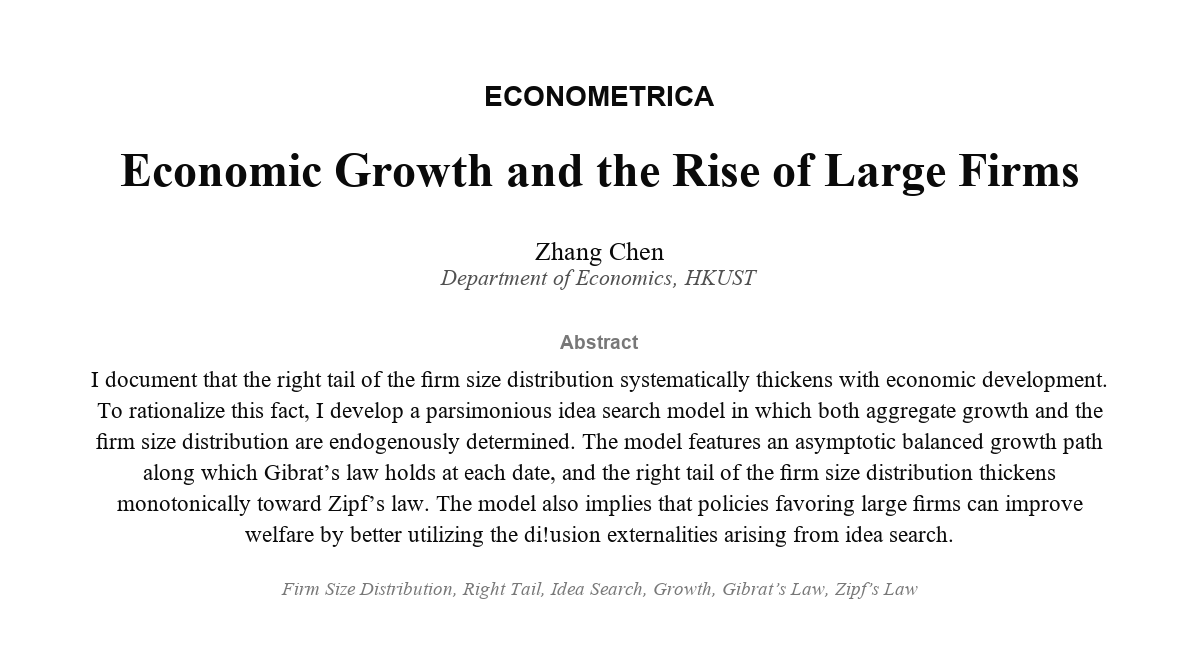
Why do richer economies have more very large firms? This paper shows that the upper tail of the firm size distribution thickens as economies grow. A model of idea search explains why, showing how growth itself can produce rising concentration.
https://t.co/ocOxbeV3Ww
Thought-provoking (and probably controversial) food for thought!
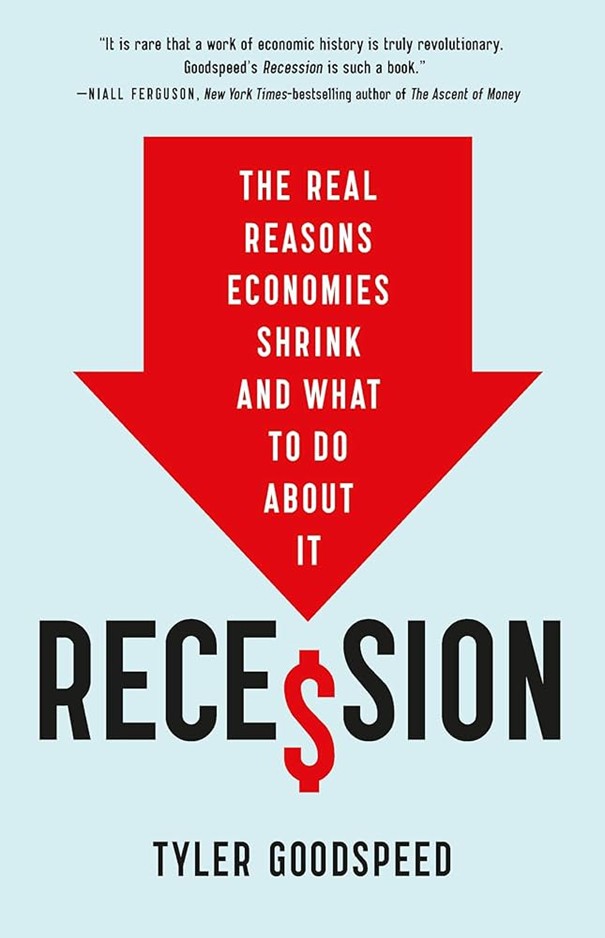
"Recession: The Real Reasons Economies Shrink and What to Do About It" by Tyler Goodspeed.
"What causes a recession? Do recessions end on their own, or do they require external intervention? Does a recession in one country mean the rest of the world will follow? Are we in a recession now? Economic expert Tyler Goodspeed answers these questions and many more in Recession, a groundbreaking new analysis of economic contractions over the last four centuries."
https://t.co/mJBHqls8HA
This podcast about the book is worth listening to!
"Tyler Goodspeed on Challenging the Way Economists Look at Recessions" (Macro Musings podcast hosted by David Beckworth)
"The core thesis of the book is that recessions are not inherently cyclical phenomena. We tend to think of economic expansions as possessing some fundamental flaw, some error, some excess, to which economic recession is that inevitable, even necessary remedy. In reality, there is simply nothing in the height, the speed, the duration, or the composition of an economic expansion that can really explain anything about the depth, speed, duration, composition, or even probability of the subsequent recession."
https://t.co/uL0JQZ2bwC
Super interesting!
"Contingent Expectations: Uncertainty, Risk, and Economic Behavior in Historical Perspective" by Alexander Nützenadel and Jochen Streb (Princeton University Press).
"Nützenadel and Streb show how economic actors developed new forecasting methods in response to rising uncertainty brought on by the Industrial Revolution, the expansion of global trade, financial market integration, and environmental crises. Tracing the evolution of economic theories on expectations, they find that when growing market volatility made forecasting more complex, economic agents often adapted with remarkable flexibility to changing circumstances."
https://t.co/w5NFIiJmLB
🎙️ Tomorrow: First Calvo Lecture with Iván Werning (MIT), introduced by Sebastián Galiani
“On Inflation: A Look From Above, Backwards and Forwards”
📅 May 22
⏰ 12 PM EDT
💻 Zoom, no registration
🔗 https://t.co/hsWLaZdifN
Really cool!
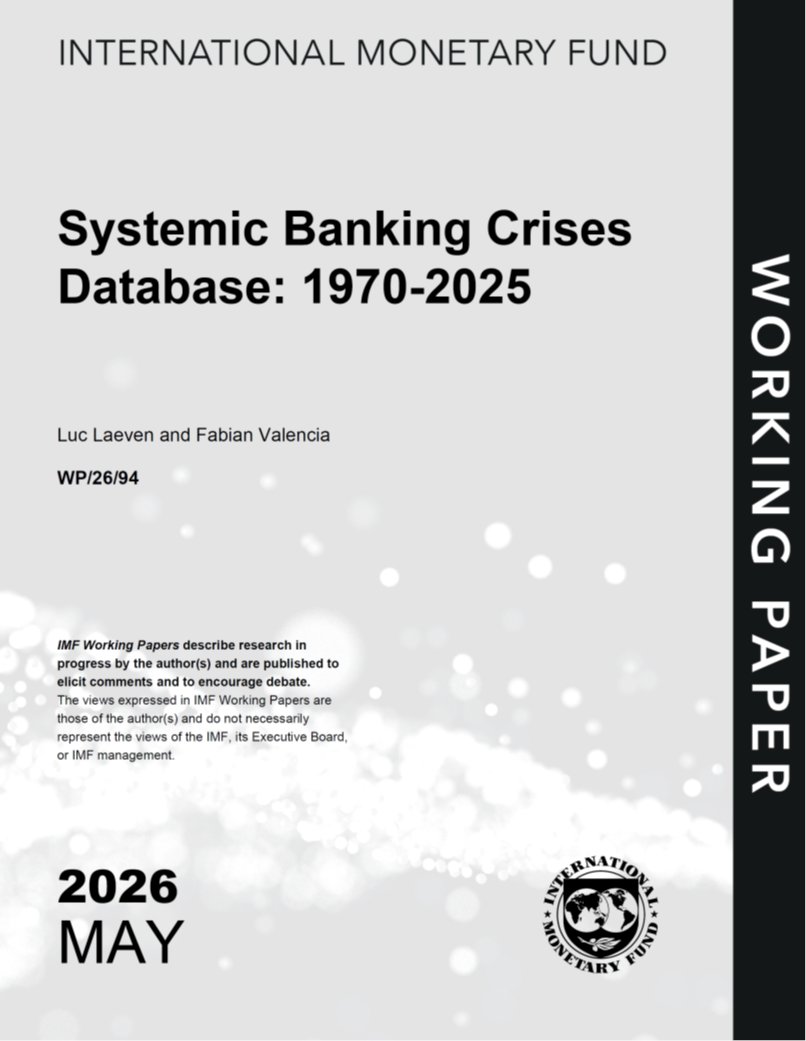
"Systemic Banking Crises Database: 1970-2025" by Luc Laeven and Fabian Valencia.
"This paper presents an updated version of the Laeven and Valencia (2013, 2020) database on systemic banking crises, extending the coverage through 2025. The update incorporates new episodes, while maintaining the definition established in previous editions, which emphasizes both significant signs of financial distress and substantial policy interventions. The update integrates textual tools to screen potential candidates that are then further scrutinized to confirm if our definition is met. The database includes information on banking crises episodes during 1970-2025, including starting dates, policy responses, fiscal costs, and output losses. It offers a comprehensive tool for assessing cross-country vulnerabilities and policies to resolve banking crises."
https://t.co/4nSydVP6lF
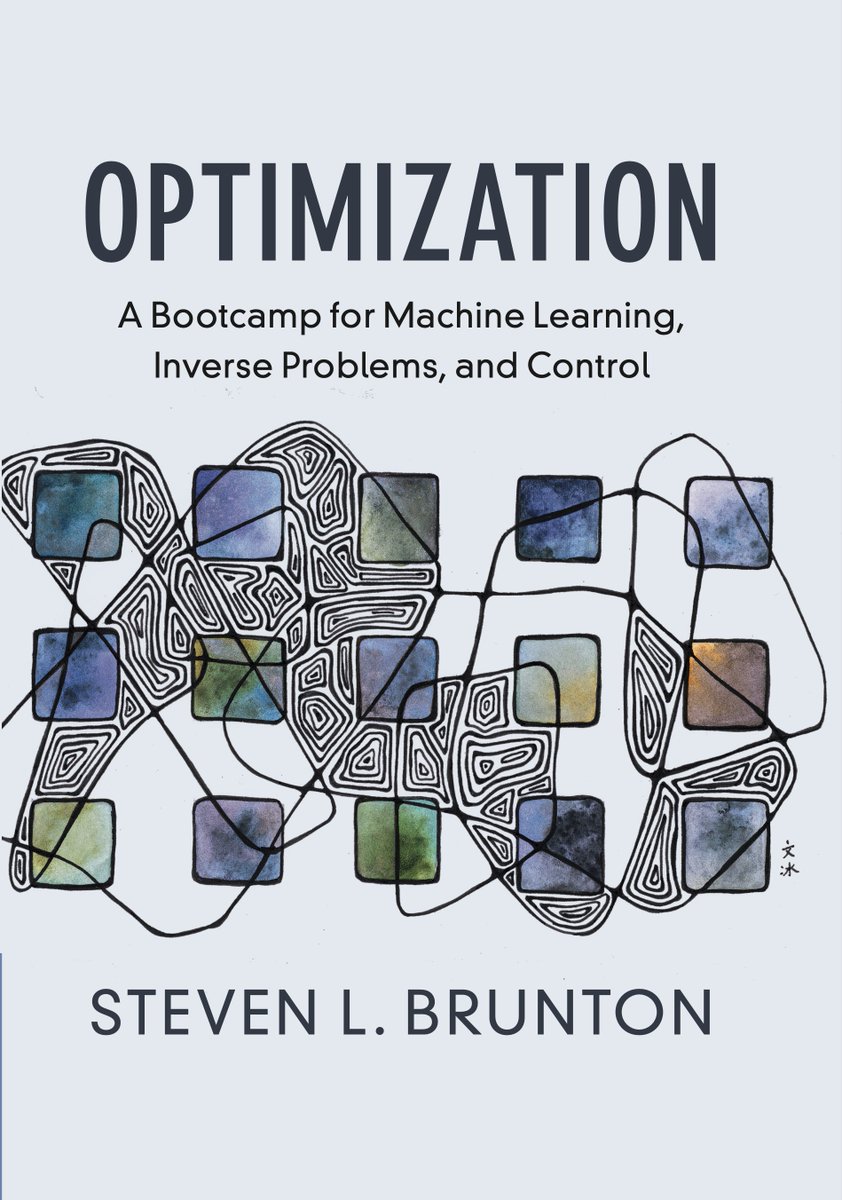
I Wrote a New Book!!!
Optimization: A Bootcamp for Machine Learning, Inverse Problems, and Control
Pre-Order Now (July 31)
https://t.co/EoDMFapUUf
Coming Soon:
* Free PDF on website
* YouTube Videos for entire book
* Python code on GitHub