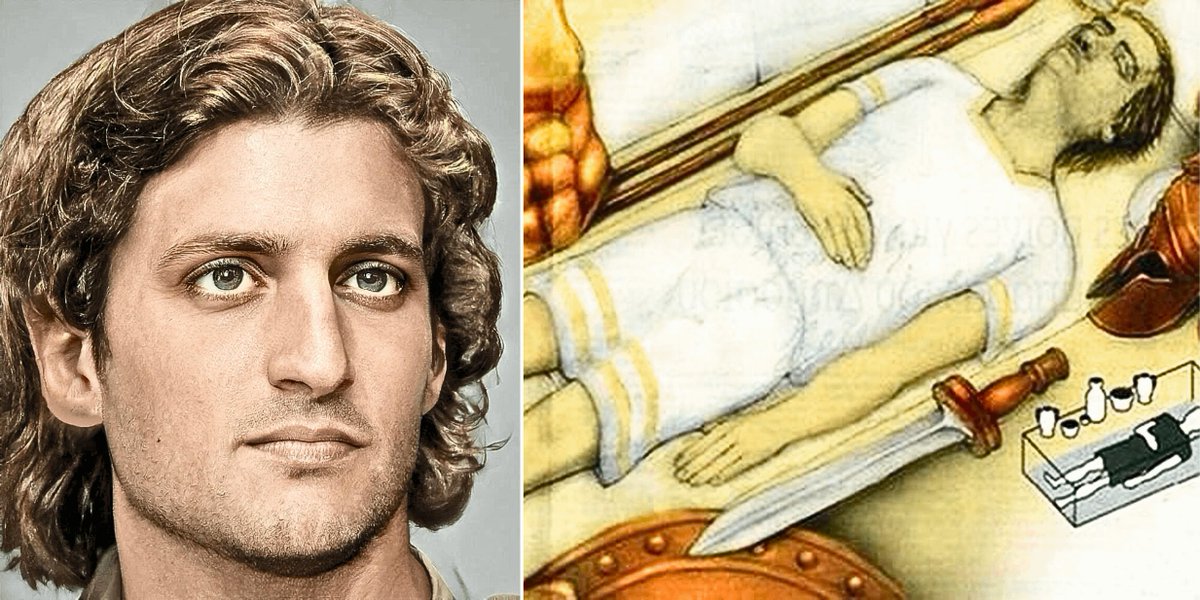
In June 323 BC, Alexander the Great fell ill in Babylon after a night of heavy drinking, suffering from a sudden onset of severe fever, joint pain, and progressive paralysis.
Over eleven days, his condition deteriorated until he lost the ability to speak and was ultimately pronounced dead at age 32. Ancient accounts record that despite hot summer conditions, his body showed no signs of decomposition for six days following his death.
Witnesses and followers interpreted this apparent lack of decay as proof of his divinity, solidifying the myth that Alexander was a living god whose mortal remains were immune to corruption.
Modern medical scholars propose that Alexander suffered from Guillain-Barré Syndrome (GBS), an autoimmune neurological disorder often triggered by a gastrointestinal infection like Campylobacter jejuni. GBS causes ascending paralysis, gradually stripping the body of muscle control while leaving cognitive function intact.
As the paralysis reached his diaphragm, his breathing would have become so shallow and faint that ancient physicians could not detect a heartbeat or pulse.
Because body temperature regulation would have also failed, his metabolic rate plummeted, significantly delaying visible decomposition. Consequently, Alexander was likely declared dead while still conscious, making it probable that he died of suffocation or was prepared for burial while technically still alive.
Beyond his death, the post-mortem fate of Alexander’s remains sparked an extraordinary series of geopolitical clashes and historical mysteries. After his passing, a two-year effort produced a magnificent, gold-laden rolling funerary temple meant to transport his body back to Macedonia; however, his general Ptolemy I hijacked the procession in Syria, stealing the corpse to legitimize his own rule over Egypt. Alexander’s body was initially entombed in Memphis before being moved to a grand mausoleum in Alexandria, known as the Soma, where it became an ancient tourist attraction visited by Roman figures like Julius Caesar and Augustus, the latter of whom accidentally broke off part of the mummy's nose while leaning in to kiss it. Over the centuries, the golden sarcophagus was melted down for currency during dynastic wars and replaced with glass or alabaster. By the late fourth century CE, amidst Christian riots and political upheaval in Alexandria, all historical mentions of the tomb abruptly ceased. Today, despite over 140 official archaeological expeditions, the exact location of Alexander's body remains completely unknown, giving rise to fringe historical theories that his remains were either hidden, destroyed, or misidentified in 828 CE as Saint Mark and smuggled to Venice.
#archaeohistories
A hard lesson from administering my late mother's estate: read the fine print on life rights before your parents sign one.
For those unfamiliar: a life right is a popular retirement-village model in South Africa. You don't buy the property. You pay a large lump sum (often R2m+) for the right to occupy a unit for the rest of your life. The operator retains ownership and the title.
When the holder dies, here is what nobody really explains up front.
1. The operator takes a fixed chunk regardless of how long you lived there. Typical contracts deduct around 40 percent of a notional "Listing Consideration" as the operator's effective fee, amortised over five years. If your loved one lives in the unit for two years, three years, or even just under five, that 40 percent disappears anyway. My mother paid R2 million in 2021. Five years later, the estate stands to receive less than half of it back.
2. The estate keeps paying levies after death. Indefinitely. The contract terminates automatically when the holder dies. But you, as the estate, remain liable for the full monthly levy, rates, and consumption charges until the operator finds a new buyer. There is no deadline. No reasonable-time obligation written in. We are six weeks past hand-over and the invoices keep arriving.
3. The estate cannot use, let, or even allow family to enter the unit. The right to occupy was "personal in nature." It died with the holder. The estate cannot put a tenant in, cannot let it on Airbnb, cannot even allow family to stay there without the operator's written consent. Every mitigation lever sits with the operator at their sole discretion.
4. The operator has zero incentive to re-sell quickly. They hold your capital interest-free until a buyer is found. They earn the levy every month you wait. They earn a remarketing fee on re-sale. The longer they take, the better for them. The worse for you.
5. The contract usually contains a CPA exemption-by-design. Most of these schemes acknowledge the Consumer Protection Act on paper, then carve themselves into clauses that allow exactly the kind of one-sided continuation of obligations the CPA was meant to police. Sections 48 and 52 of the CPA, and the Constitutional Court line on fairness in contract (Barkhuizen, Beadica), give real grounds to push back. But you have to know to push.
If you or a family member is considering a life right, please:
- Read the full agreement including every annexure, not just the marketing brochure.
- Model the worst case: holder dies within 3 to 5 years of taking occupation.
- Calculate the estate's expected net return, including post-death levy bleed if re-sale takes 6 to 12 months.
- Get independent legal advice before signing. Not advice from the village's referred attorneys.
- Ask explicitly: what is the operator's contractual obligation to re-sell within a reasonable time? If the answer is "none," walk away.
There are genuinely good retirement villages and well-structured life rights out there. But the structural risk to the estate is rarely disclosed up front.
If you've been through this and want to compare notes, please reach out.
“Sorry, I couldn’t make your wedding, Eric. I didn’t want to go.”
“Dad, I’m Barron.”
“Nobody gives a shit about your pronouns, Eric. You should really take a cognitive test, you’re mixing up your own name.”
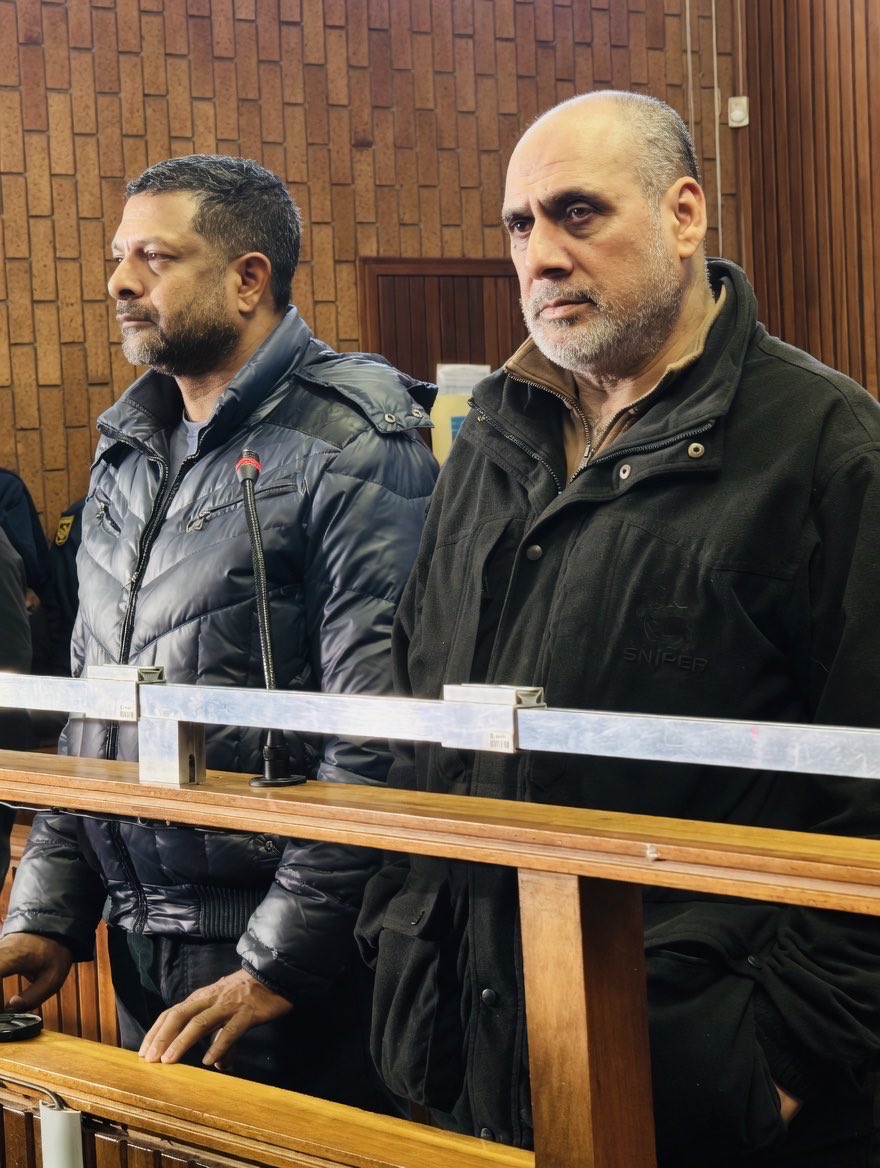
IN THE DOCK: What a devastating image for South Africa!
Yet another two senior police generals in the dock, accused of criminal conduct.
The very people meant to uphold the law are increasingly the ones accused of breaking it.
Oh, and if you forgot their (top) ranks, let me remind you…
Major-General Feroz Khan: Head of Counter-Intelligence in SAPS Crime Intelligence.
Major-General Ebrahim Ahmed Kadwa: Gauteng Provincial Head of the Hawks.
Makes this even more of a travesty!
⛈️"The storm – a visual storm has just hit!
France, Belgium, and Sweden join forces in this musical-visual masterpiece. Gener8ion collaborates with rapper Yung Lean, directed by Romain Gavras and choreographed by Damien Jalet… creating a music video that's taking the internet by storm.
Mesmerizing synchronized choreography, powerful visuals, and addictive sound.
Are you ready to be swept away by the storm?
🔥Let's go!"
"As Jad lay collapsed in an alley, the soldiers created a cordon around him and blocked two Palestinian ambulances from reaching him. According to video footage and eyewitness testimony, the soldiers then stood around for 45 minutes while he bled from one or more gunshot wounds."
I first crossed swords with Nic Georgiou in 2011. The final sequestration of his estate this week may at last hold hope for some compensation for a few of the victims involved in this saga
Georgiou estate finally sequestrated - Moneyweb https://t.co/AMvYXSVUoy
This is not a peace plan. It is a proposal that weakens Ukraine and divides America from Europe, preparing the way for a larger war in the future. In the meantime, it benefits unnamed Russian and American investors, at the expense of everyone else.
https://t.co/bLuBqKRrAd
WFP Statement | #Gaza
On the morning of 20 July, a 25 truck WFP convoy carrying vital food assistance crossed the Zikim border point destined for starving communities in northern Gaza.
Shortly after passing the final checkpoint beyond the Zikim crossing point into Gaza, the convoy encountered large crowds of civilians anxiously waiting to access desperately needed food supplies.
As the convoy approached, the surrounding crowd came under fire from Israeli tanks, snipers and other gunfire.
We are deeply concerned and saddened by this tragic incident resulting in the loss of countless lives. Many more suffered life-threatening injuries. These people were simply trying to access food to feed themselves and their families on the brink of starvation. This terrible incident underscores the increasingly dangerous conditions under which humanitarian operations are forced to be conducted in Gaza.
Today’s violent incident comes despite assurances from Israeli authorities that humanitarian operational conditions would improve; including that armed forces will not be present nor engage at any stage along humanitarian convoy routes.
There should never, ever, be armed groups near or on our aid convoys, as reiterated on many occasions to all parties to the conflict. Shootings near humanitarian missions, convoys and food distributions must stop immediately. Any violence involving civilians seeking humanitarian aid is completely unacceptable.
We stand firmly by our principles of operating with independence, impartiality and neutrality. It is one of the many reasons why communities trust us.
The World Food Programme continues to call for the protection of all civilians and aid workers delivering life-saving assistance. WFP teams accompanying convoys should not have to risk their own lives in the effort to save others. Without these fundamental conditions in place, we cannot continue providing life-saving support across the Gaza strip.
Gaza’s hunger crisis has reached new levels of desperation. People are dying from lack of humanitarian assistance. Malnutrition is surging with 90,000 women and children in urgent need of treatment. Nearly one person in three is not eating for days. Food aid is the only way for most people to access any food – as the cost of a one-kilogram bag of flour has surged to over USD100 in local markets.
Only a massive scale-up in food aid distributions can stabilize this spiraling situation, calm anxieties and rebuild the trust within communities that more food is coming.
An agreed ceasefire is long overdue. All hostages should be released, and humanitarians should be able to reach the civilian population in Gaza with critical food supplies in a consistent, predictable, orderly and safe manner -- wherever they are across the Gaza Strip.
WFP is ready. We have food supplies nearby, experienced teams on the ground, and proven systems in place to respond at scale. We did it before and we can do it again.
We urgently call on the international community and all parties to advocate for, and facilitate, the delivery of life-saving food aid to starving populations inside Gaza – safely, securely, wherever families are, and without obstruction.
[READ]
“RISE Mzansi remains committed to the GNU, but notes that the rules of engagement need to be strengthened, codified and agreed to by all signatories to the Statement of Intent (SoI). All GNU partners, especially those in the executive need to sing from the same hymn sheet on executive matters. The petty insults, contradictions and media leaks are not helpful, and do not show the kind of leadership that South Africans seek,”
- RISE Mzansi
Read here ▶️ https://t.co/iq0twXkJFY
#RISEInParliament
#RISEWhereYouAre