“Government's view of the economy could be summed up in a few short phrases : If it moves, tax it. If it keeps moving, regulate it. And if it stops moving, subsidise it.”
Ronald Reagan
@aparanjape@PMCPune@navalMH No one screws infra like Pune does, for example metro doesn’t connects airport and shuttle supposed to connect metro to airport stops nowhere near metro station 😃
Your brain is wired to quit at the exact moment you're about to break through.
Most people think they quit because they lack discipline or motivation. They blame their willpower. They assume successful people have some genetic advantage or superior mental toughness.
The real reason runs much deeper.
Neuroscientists at UC San Diego studied brain scans of people learning complex motor skills over several months. They discovered something counterintuitive: during the weeks when learners felt most frustrated and considered quitting, their brains were undergoing the most dramatic structural changes. New neural pathways were forming at accelerated rates. Myelin sheathing around neurons was thickening rapidly. The very period that felt like stagnation was actually when the most profound rewiring was happening.
The participants had no conscious awareness of this transformation. Subjectively, they felt stuck. Objectively, their brains were rebuilding themselves.
Your nervous system interprets sustained incompetence as a survival threat. When you attempt something new and fail repeatedly, ancient circuits fire that once kept your ancestors alive by making them avoid dangerous situations. The same neural pathways that prevented early humans from repeatedly approaching predators now prevent modern humans from repeatedly approaching challenges.
Competence feels safe. Incompetence feels like death.
Every time you miss the shot, fumble the presentation, or write garbage, your amygdala sends distress signals. Your brain floods with cortisol. Your body creates the same physiological experience it would create if you were being chased by something that wanted to kill you. After days or weeks of this neurochemical assault, quitting feels like escape from genuine danger.
But what the UC San Diego researchers revealed changes everything about how we should interpret that discomfort. The biochemical chaos you feel during extended periods of failure is actually evidence that deep learning is occurring. Your brain consumes massive amounts of energy to build new neural architecture. The exhaustion, frustration, and sense of being overwhelmed are byproducts of construction, not signs of inadequacy.
People who master difficult skills have accidentally discovered something profound: they've learned to interpret the discomfort of incompetence as evidence they're in exactly the right place. They've trained themselves to recognize the specific feeling of neural restructuring and chase it instead of avoiding it.
The shift is so subtle most people never notice it happening. But once it clicks, the entire relationship with difficulty inverts.
Watch someone who genuinely enjoys the learning process. They don't celebrate successes the way normal people do. They celebrate failures that teach them something. They get excited by obstacles that reveal gaps in their understanding. They treat confusion as information, not as evidence they should quit.
They've rewired their internal reward system to crave precisely the experiences most people avoid.
What makes this psychological rewiring possible is understanding that competence emerges from chaos, not from clarity. Your first attempts will be embarrassingly bad because your brain is literally constructing the neural infrastructure required for skill. The timeline for moving from "terrible" to "decent" is always longer than you expect because biological change operates on its own schedule.
Most people never reach competence because they interpret the gap between where they are and where they want to be as evidence they're not cut out for it. They quit during the exact window when their brain is doing the rewiring that would eventually make them good.
The secret is learning to love that window. The period that feels like failure is actually the period when your brain is working hardest on your behalf. The discomfort you're avoiding is the discomfort of becoming someone new.
Strange election rules we have.
A one-time transfer of cash, rum, biryani, whatever for a vote from party funds is illegal.
But a monthly transfer of cash from government funds is a legitimate election promise.
P/B ratio has historically been a more reliable and stable valuation metric for predicting future returns compared to alternatives such as P/E or EV/EBITDA. I had demonstrated this through correlation analysis in an earlier investor memo.
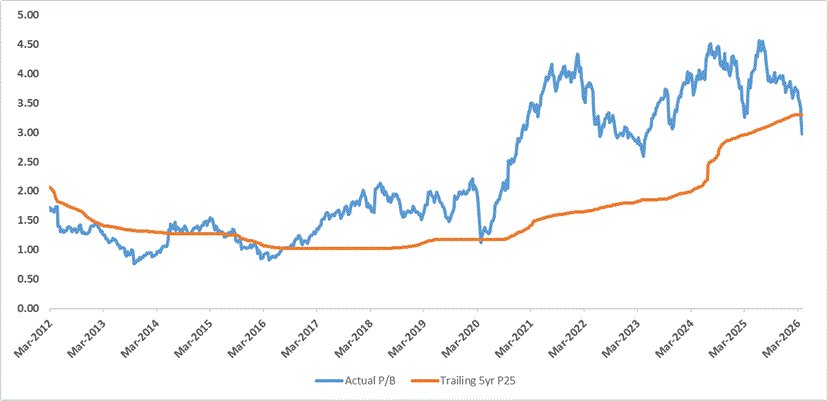
The chart below tracks the P/B ratio (blue line) of the Nifty Smallcap 100 Index against the 25th percentile of its trailing 5-year P/B range (orange line). In simple terms, when the blue line falls below the orange line, the current valuation is in the lowest quartile of the past five years.
Since P/B is broadly proportional to ROE, the structural improvement in index ROE—from ~8–12% in the previous decade to ~15% currently—has led to a gradual upward shift in the orange line over time.
Notably, for the first time since the COVID crash, the current P/B has moved below this 25th percentile threshold. Historically, similar instances—during the 2011–2013 downturn, Q1 2016 correction, and the COVID crash—have been followed by strong returns over the subsequent 1–3 years.
This does not imply that markets have bottomed, nor does it guarantee short-term gains. In an event-driven environment, especially with geopolitical risks such as an escalation in war, markets could decline further by 10–20%.
However, what can be said with a reasonably high degree of confidence is that forward-looking returns over a 1–3 year horizon from such valuation levels have historically been better than average.
Generally IPO’s are anathema for value investors, but in down markets selective IPOs with forced sellers can be attractive place to evaluate.
Other place is recently IPOed stocks with bombed prices with early participants patience running thin.
Of course caveats apply.
Many times big driver of profitability of company is changing industry dynamics for example changing no of competitors, regulatory changes, value migration to other industries keeping eye on this and getting directionally right helps to form early view of future profitability.
🚨 JUST IN: A migratory bird just shattered world records — flying 8,425 miles (13,560 km) NON-STOP across the Pacific without landing once.
The bar-tailed godwit doesn’t stop to eat, drink, or sleep during its migration across the Pacific Ocean. Its journey from Alaska to Australia takes roughly 11 days of continuous flight, covering over 13,000 kilometers through storms, headwinds, and open ocean with zero land beneath it the entire time.
Before departure, it does something almost surgical to its own body. It shrinks its digestive organs down to almost nothing, converting the stomach, intestines, and liver into raw fuel. The bird essentially eats its own gut to make room for fat reserves that will power its wings for nearly two weeks straight.
The brain doesn’t fully sleep either. Half of it stays active while the other half rests, alternating in shifts mid-flight at altitude over the open Pacific. The godwit is simultaneously unconscious and navigating with magnetic field sensitivity that no human instrument in the 18th century could replicate.
What makes this genuinely staggering beyond the physical record is the navigational precision involved. The bird leaves Alaska and arrives in New Zealand with accuracy that would embarrass early GPS systems. It reads Earth’s magnetic field, atmospheric pressure gradients, star positions, and potentially quantum-level compass mechanisms inside its eye that literally let it see magnetic field lines overlaid on its visual field.
Evolution spent millions of years building an aerospace navigation system inside a 300 gram animal.
We spend billions engineering machines that do what this bird does on instinct, fat reserves, and half a sleeping brain.
The longest recorded non-stop flight by a commercial aircraft is around 20 hours.
This bird does 11 days.
Without a runway.
Stanley Druckenmiller, who has relied heavily on technical analysis during his career, recently said:
“I can unequivocally tell you that technical analysis is about 20% as effective today as it was 30 years ago, because no one was using it. But when everybody’s using it, it doesn’t work anymore because you don’t have a unique thing to act against.”
If even Druckenmiller says this, it reinforces a simple idea:
What really matters is buying great companies and avoiding overpaying for them.
As Peter Lynch used to say, in the long run the price of a stock will follow the company’s economic results — regardless of the “drawings” on a chart.
“If charts could really predict the future, technical analysts would all be billionaires.”
Technical analysis is more of a distraction than anything else.
The real edge isn’t drawing lines.
It’s understanding businesses.
@aparanjape Appa's canteen was small and would hardly accomodate 10/12 people and one needed to wait outside for his turn...
....but khichadi kakdi was absolutly wow and lipsmacking.
Tried new place once due to namesake and nastolgia...but taste is nowhere comparable.