Mia Khalifa had 400 Instagram followers.
Three days later she had 200,000.
Not from a song. Not from a dance. From one scene she warned the studio not to shoot.
She’s Catholic, from a Lebanese family. The studio wanted her in a hijab. She looked the producers in the eye and said, word for word: “You motherfuckers are going to get me killed.”
She thought she was half-joking.
The day after the video dropped, it stopped being a joke.
CNN. Fox. Newsweek. USA Today. Trending everywhere. Banned in countries including Egypt and Afghanistan. Her family disowned her. ISIS sent a photoshopped image of her being beheaded with the message “You’ll be next.” Someone posted a Google Maps screenshot of her apartment. Her Instagram was hacked and used to push their propaganda. She moved into a hotel.
Six months later she had roughly 2 million followers and she had already quit.
The entire run paid her about $12,000. No residuals. The studio still owns the footage and still makes money from it. A decade later she is still trying to outlive the name.
Fame usually comes with money. Hers came with death threats and a permanent label she never controlled.
The studio got a scene that keeps paying. She got a story she can’t escape.
Did anyone win here except the studio?
Lily Phillips went viral in 2024 after sleeping with 100 men in one day. Millions watched the footage, debated the men, the cameras, and what happened afterward. She became one of the most talked-about names online.
This is a fictional scenario with a different ending.
What if one of the participants didn’t care about the documentary or the attention? What if he only wanted access to her money?
No smashed laptop. No stolen bank card. No physical theft of any kind. Just one malicious wallet approval.
While Lily was occupied and the cameras kept rolling, he got dressed, opened her wallet, and signed the transactions. $1.2 million moved in three transfers. Different assets, all routed to a single controlled account.
Crypto doesn’t ask who you trusted or what was happening in the room. It only checks whether the authorization is valid. Once the funds pass through multiple wallets, getting them back is a completely different and usually impossible problem.
The real risk isn’t how fast the money can move. It’s how little effort it takes to start the process.
What would you be more afraid of: that someone would steal your phone, or that you'd be tricked into having sex?
Elsa Jean's uncle found her first scene before she ever told her family. He left a comment under it.
That awkward moment isn't what made her money.
In the clip below she tells the story the way most people would describe a slightly chaotic first week at a new job. She tried to keep the whole career a secret. It didn't last long.
"They found out, but I was already moved out. I lived by myself. By the time, I was already on my own. My mom couldn't really say anything."
To this day her family still doesn't talk about the work. Not the studio years. Not what came after.
And what came after is the actual story.
Most girls in that industry lasted months. She lasted years, then walked away from mainstream studios.
Not from the work. From the middlemen.
She went all in on her own page. Her prices. Her schedule. Her audience. No more waiting for someone else to book her or take a cut.
She says it put her in the top 1% of creators by earnings.
Then she launched her own podcast, HeartBreakers.
Then digital membership passes.
"I created my own website and everything to sell them."
The studios made her famous.
Ownership made her rich.
A scene pays once.
An audience pays every month.
Lana Rhoades was the most searched performer on Pornhub in 2019.
345 million views.
She had already quit two years earlier.
Pay: as little as $1,200 per scene.
When she left, she says she had about $100,000 in the bank.
The videos stayed online. They still are.
She says if she could, she would delete every single one.
“A lot of the videos I have no rights under.”
Then she switched to platforms where she owns the content.
Same face. Same audience. Same internet.
She says she’s now a multi-millionaire.
The only thing that changed: who owns the files.
Her old work still makes money for other people.
Her new work makes money for her.
Was the problem the industry, or a contract a 19-year-old signed before anyone explained what “forever” actually means?
Holly Madison was one of the women in Hugh Hefner's bed twice a week at the Playboy Mansion. Every girlfriend took her turn, two minutes each, porn on giant screens, the others pretending to be busy while they waited. She says nobody wanted to be there and everyone just tried to get it over with. And Hefner handed out Quaaludes at clubs, telling her he had "a whole team" in case a girl overdosed.
In the video below, she finally explains how the Playboy Mansion really worked.
She moved in at 22. A girl from Oregon who thought it would be a fun year or two during college. She stayed 7 years.
Hefner barely had to do anything to find girls. They came from clubs, Playmate castings and parties. And in every group, she says, there was a "recruiter." Have another drink. Take this. Want to come upstairs?
There was no drink limit. Everyone got wasted.
She once asked him what would happen if a girl from a club had already taken something and he gave her a Quaalude on top. He admitted it was a concern. Then he kept handing them out.
Every woman who lived in the house long-term was one of his girlfriends. Every Wednesday and Friday after the club, it was the group night. "Your turn." Two minutes. Next girl.
It only stopped when "The Girls Next Door" started filming. Hefner was so high off the show and his new relevance that he no longer needed what she calls compulsive sex nights to feel wanted.
Then there were the rules. A 9 p.m. curfew. She couldn't visit her family for a week, even after years. She saw one girl leave for a few days and come back to find all her belongings packed in boxes outside the back gate.
He played the girls against each other so no one could ever team up against him. Girls listened at bedroom doors. She called the house cult-like.
She tried IVF with him. It didn't work. That was the moment she started thinking about leaving.
In front of everyone at dinner, he called her stupid. When she rolled her eyes once at work, he screamed a slur at her.
When she finally broke up with him, he left his will on her side of the bed so she could see what she'd get if she stayed. He printed out every tabloid story saying her career would be over without him.
She left anyway. She wrote a bestselling book about it. Hefner died in 2017 at 91.
The fantasy everyone envied had a schedule, a curfew and a two-minute timer.
Some lessons are written in other people's mistakes. Watch it once. Remember it forever.
Mia Khalifa was one of the most searched names on the biggest adult site on earth.
Over a billion views on her videos.
Her cut: $12,000.
She was 21. Three months. About 12 scenes at roughly $1,000 each. She quit in early 2015.
The videos never stopped. Millions in revenue for the companies. Her share of ongoing profits: zero.
She doesn’t own the videos, the photos, or even the domain with her own name on it. Her team tried to buy the rights back. No deal.
The studio later said she was paid $178,000 and filmed more scenes. She says most of that was for a separate social-media job.
Two versions. They can’t both be true. Either way, the clips are still running.
In her words: “It makes me feel like I lost all right to my privacy.”
She signed the contract.
Does the internet own her face forever - or should anyone be able to take it back?
Sophie Rain has shown ~$100M+ in OnlyFans gross. High-profile people with real money online are constant targets.
A recent case shows how little it takes: a user lost thousands after three days on open hotel Wi-Fi. No phishing link. No leaked seed phrase. Just a fake approval prompt that looked normal while he was on a legitimate site.
Here’s the usual play:
→ Attacker joins the same local network (hotel, Airbnb, café, or a compromised router).
→ Injects or sits in the middle of traffic.
→ You open your wallet or exchange as usual.
→ A “reconnect,” “verify,” or approval request appears.
→ You sign once. Funds move later (or immediately).
On-chain there is no undo.
How to stay uncooked:
→ Never touch a wallet or exchange on public/shared Wi-Fi. Use a hotspot or VPN.
→ Keep serious size on a hardware wallet.
→ Read every signature on the device before confirming—especially permissions and unlimited approvals.
→ Lock down your own router (change defaults, disable remote access).
Your bag is only as safe as the network you open it on.
Save this before the next trip.
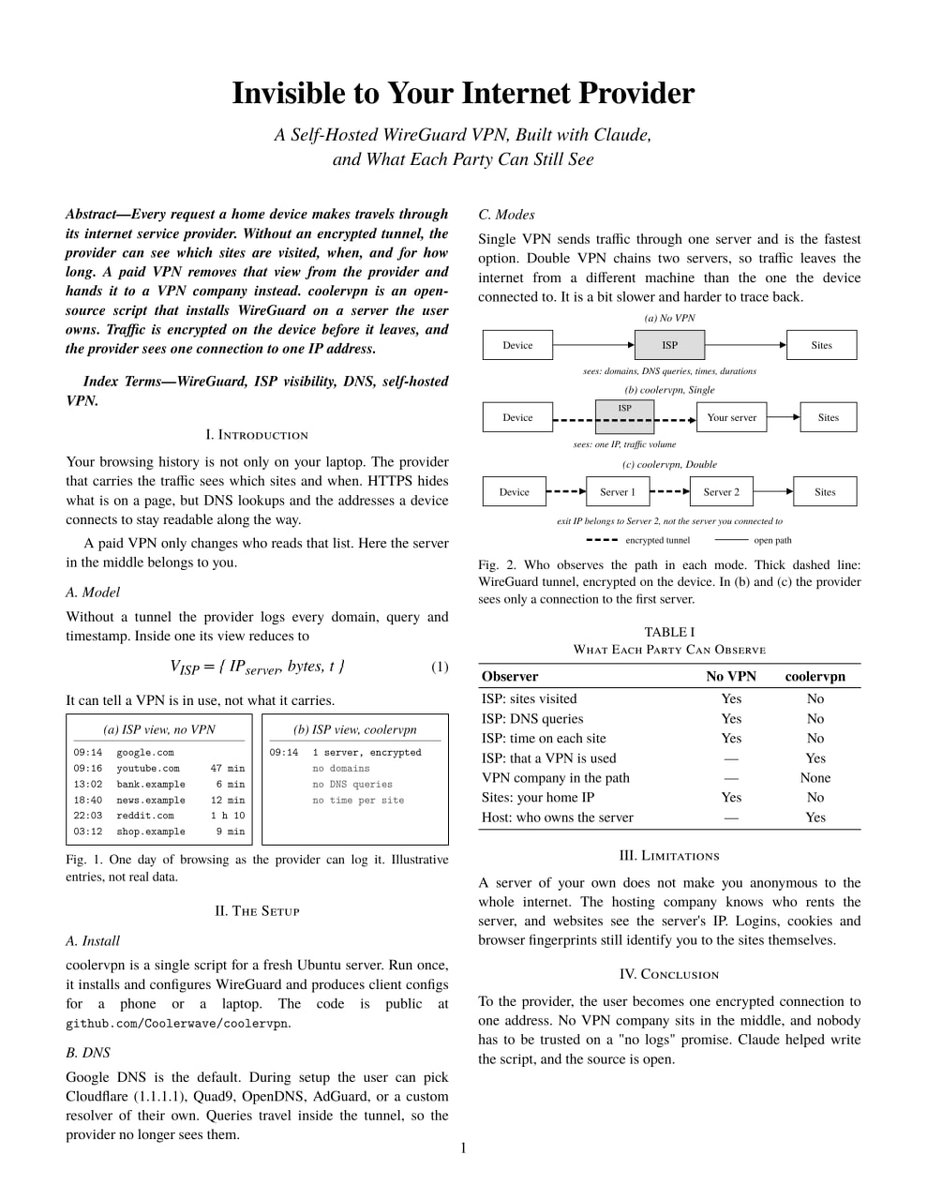
YOUR INTERNET PROVIDER HAS A LIST OF EVERY SITE YOU OPENED THIS WEEK. WITH TIMESTAMPS.
I built a VPN with Claude that makes you invisible to them.
With coolervpn your traffic is encrypted before it leaves your device. Your provider only sees that you're connected to one server. Which sites you open and how long you stay there stays hidden from them.
Paid VPNs do the same, except the VPN company sees your traffic instead. I wanted the server to belong to me.
What it is
coolervpn is a script for a fresh Ubuntu server. You run it once, and it installs and configures WireGuard, a fast modern VPN protocol. Then you connect your phone or laptop, and your traffic goes through your own server.
Google DNS is the default, but you can pick any DNS you want during setup: Cloudflare (1.1.1.1), Quad9, OpenDNS, AdGuard, or your own custom server.
Two modes
Single VPN sends your traffic through one server. It's the simplest and fastest option.
Double VPN sends it through two servers in a row, so your traffic exits from a different machine than the one you connected to. It's a bit slower, and it's harder to trace back to you.
What it doesn't do
Your own server won't make you anonymous to the whole internet. The hosting company knows the server is yours, and websites see the server's IP. What you get is no VPN company in the middle of your traffic, and no need to take anyone's word on "no logs."
Why Claude
I didn't build this alone. Claude helped me write the script and explained what every part of it does. The code is open source, so anyone can read every line before running it.
🚨BREAKING NEWS : Windows never deleted your "deleted" photos.
Claude Code found mine in a cache file on my PC. Some of them were years old.
I asked it one thing: find thumbnails of images that no longer exist on disk. It went straight to a folder I had never opened:
%LOCALAPPDATA%\Microsoft\Windows\Explorer
Inside: thumbcache_96.db, thumbcache_256.db, thumbcache_1280.db
what was still in there:
→ screenshots I deleted seconds after taking them
→ photos from 2022 that are gone from every folder
→ files I already emptied from the Recycle Bin
→ dozens of entries marked "deleted, still cached"
how it works:
→ every time File Explorer shows a preview, Windows saves a small copy to that cache
→ deleting the photo removes the file, not the copy
→ the 1280 file keeps previews big enough to see exactly what was on them
→ the cache only gets cleared if you clear it
the fix, 1 minute:
→ Win + R, type cleanmgr, Enter
→ pick drive C:
→ tick only "Thumbnails", then Delete Files
→ to stop it for good: File Explorer Options → View → "Always show icons, never thumbnails"
the prompt I ran is in the reply. it only reads, nothing gets deleted or uploaded.
follow @X1Kafadzhy for Claude Code checks like this
THIS CABLE CHARGES YOUR PHONE. BUT PLUG IT INTO YOUR LAPTOP AND IT COULD START TYPING COMMANDS WITHOUT YOU.
same plastic. same logo. charges like any other cable. you’d never look at it twice.
inside there’s a chip smaller than a fingernail. plug it in and your laptop thinks a keyboard just connected. then it types on its own. opens a terminal, runs commands, closes it before you look up.
some versions go further and log your keystrokes. passwords included.
this isn’t sci-fi. it’s called the O.МG cable, and it’s sold to security testers right now.
will someone target you with one? honestly, probably not.
but the trick behind it is everywhere:
→ your laptop trusts anything that says “i’m a keyboard”
→ public chargers and “free” cables are a blind spot
→ nobody checks what a cable actually is
simple habits:
→ use your own cable. always
→ “trust this computer?” at a public charger = tap no
→ a cheap usb data blocker for public ports
borrowed a cable or found one in the office? i made a prompt that has claude code check it in 2 minutes.
it’s in the first reply.