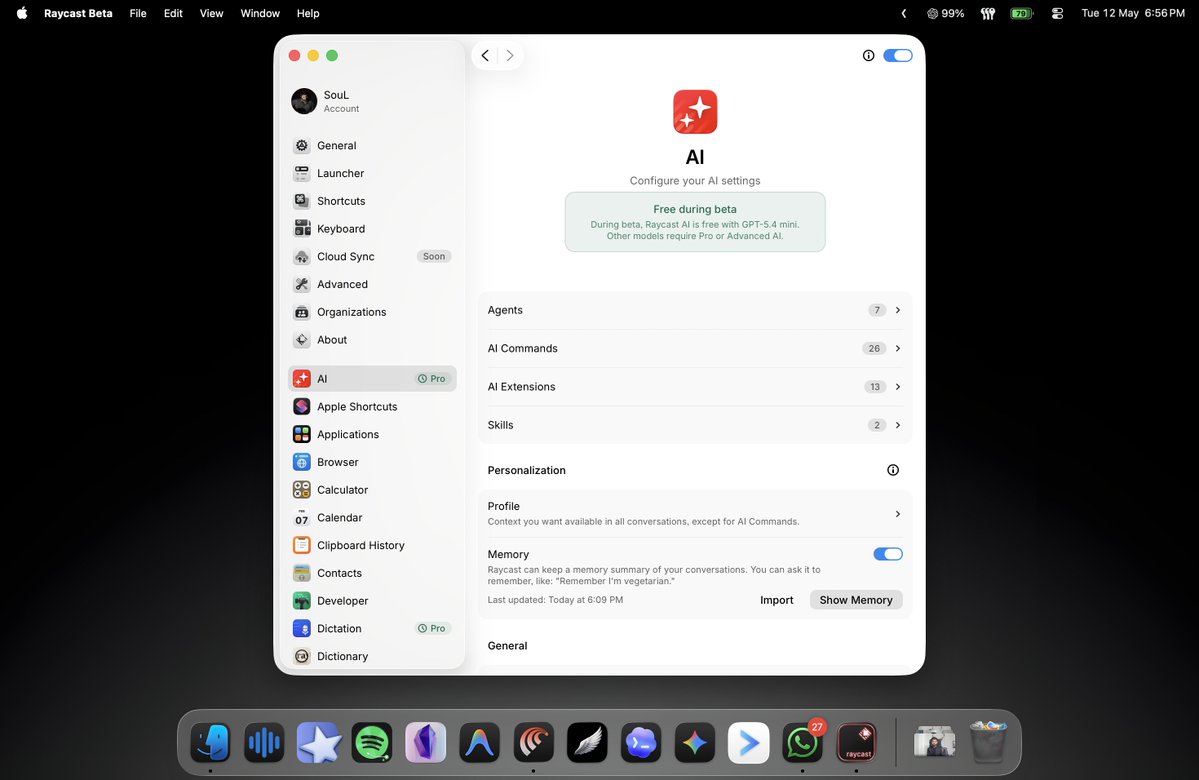
@peduarte I've been using Raycast AI even more than Codex, especially after the 2.0 update introduced memory. It is incredibly underrated. Yes, I would really like an inbuilt browser.
@emanueledpt Antigravity CLI? I have purchased Google AI Pro, and it has been useless for quite a few months, so it would be nice if you would add antigravity CLI support as well.
A feature request for Raycast AI: the ability to store chats in projects or folders for better organization. It would be helpful if these chats could share memory within their respective folders or be easily managed within organized folders. @peduarte@thomaspaulmann
Thank you for Raycast v2! 🎉 @raycast@peduarte@thomaspaulmann
Quick take: Raycast is the best app ever made. I have never been more excited about an app than this one.
Google Official Skills just dropped.
13 skills released already — built around the Agent Skills standard and compatible with Claude Code, Gemini CLI, Cursor, Copilot, and more.
Feels like the beginning of a real shared ecosystem for AI agents.
https://t.co/GVvPsqO0KC
Thank you for Raycast v2! 🎉 @raycast@peduarte@thomaspaulmann
Quick take: Raycast is the best app ever made. I have never been more excited about an app than this one.
Fireside chat at Sequoia Ascent 2026 from a ~week ago. Some highlights:
The first theme I tried to push on is that LLMs are about a lot more than just speeding up what existed before (e.g. coding). Three examples of new horizons:
1. menugen: an app that can be fully engulfed by LLMs, with no classical code needed: input an image, output an image and an LLM can natively do the thing.
2. install .md skills instead of install .sh scripts. Why create a complex Software 1.0 bash script for e.g. installing a piece of software if you can write the installation out in words and say "just show this to your LLM". The LLM is an advanced interpreter of English and can intelligently target installation to your setup, debug everything inline, etc.
3. LLM knowledge bases as an example of something that was *impossible* with classical code because it's computation over unstructured data (knowledge) from arbitrary sources and in arbitrary formats, including simply text articles etc.
I pushed on these because in every new paradigm change, the obvious things are always in the realm of speeding up or somehow improving what existed, but here we have examples of functionality that either suddenly perhaps shouldn't even exist (1,2), or was fundamentally not possible before (3).
The second (ongoing) theme is trying to explain the pattern of jaggedness in LLMs. How it can be true that a single artifact will simultaneously 1) coherently refactor a 100,000-line code base *and* 2) tell you to walk to the car wash to wash your car. I previously wrote about the source of this as having to do with verifiability of a domain, here I expand on this as having to also do with economics because revenue/TAM dictates what the frontier labs choose to package into training data distributions during RL. You're either in the data distribution (on the rails of the RL circuits) and flying or you're off-roading in the jungle with a machete, in relative terms. Still not 100% satisfied with this, but it's an ongoing struggle to build an accurate model of LLM capabilities if you wish to practically take advantage of their power while avoiding their pitfalls, which brings me to...
Last theme is the agent-native economy. The decomposition of products and services into sensors, actuators and logic (split up across all of 1.0/2.0/3.0 computing paradigms), how we can make information maximally legible to LLMs, some words on the quickly emerging agentic engineering and its skill set, related hiring practices, etc., possibly even hints/dreams of fully neural computing handling the vast majority of computation with some help from (classical) CPU coprocessors.