There is a rule in Florence that has not been broken in over five hundred years: nothing in the city may be built taller than a dome finished in 1436.
The dome belongs to the cathedral of Santa Maria del Fiore, and it is the work of Filippo Brunelleschi.
When you look at a photograph of Florence and notice that its skyline seems strangely, impossibly intact, you are not imagining it...
The city has protected that view, by custom and by law, since the Renaissance. To this day, no building in Florence is permitted to rise higher than the cupola.
What it guards is one of the most astonishing structures ever built. When Brunelleschi began in 1420, no one in Europe knew how to raise a dome that wide. The technology had been lost with the Romans. The cathedral had stood for decades with a hole in its roof, because the span was considered impossible to cover, and the city had essentially gambled that someone would one day work out how.
Brunelleschi built it without the wooden scaffolding everyone assumed was necessary, laying over four million bricks in a self-supporting double shell, one dome inside another, in a herringbone pattern that let each ring hold itself up as it rose.
Six centuries later, it remains the largest masonry dome in the world. Nothing built since, in brick and stone, has surpassed it.
The Italian director Franco Zeffirelli, who was born in Florence, once explained what that means to him. "When I feel depression creeping in," he said, "I return to Florence to gaze at Brunelleschi's dome. If human genius was able to achieve something so great, then I too can and must try to create, to act, to live."
That is what a skyline can be when a city decides that beauty is worth protecting...
I write a weekly newsletter for over 50,000 people who love rediscovering the beauty of the past. You can join us for free at the link below, and if you'd like to support my work, a paid subscription is what makes it possible:
https://t.co/hgJUdR0jlx
Thanks for reading.
Mirror to Heaven.
Rome’s Hidden Miracle
The ceiling of Sant’Ignazio di Loyola isn’t curved…
It’s completely flat. Andrea Pozzo’s 17th-century trompe-l’œil masterpiece tricks your eyes into seeing infinity.
Pure magic.
More people need to know that ancient Roman engineering was so precise, their aqueducts still produce clear water to this very day - 2,000 years later.
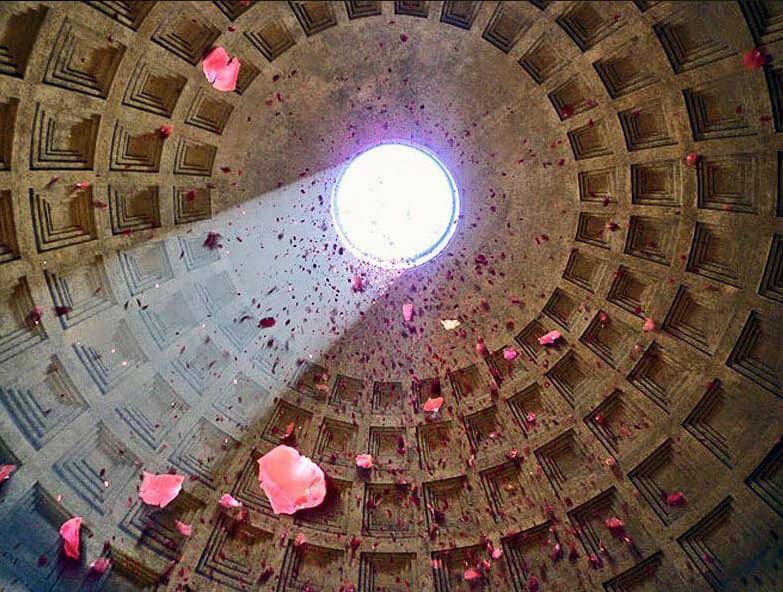
Durant les festivités de la #Pentecôte à #Rome se déroule le traditionnel lancer de pétales de rose du haut de l'oculus du #Panthéon. Cela symbolise la descente de l'esprit saint sur les apôtres pour les chrétiens. Photos @pantheon_roma et TheRomanPost.
The Colosseum had a retractable roof, operated by a crew of sailors, almost 2000 years before any modern stadium.
It was called the velarium: an enormous awning of canvas and rope that could be drawn across the open top of the arena to shade fifty thousand spectators from the Roman sun.
It was so large and so complex that ordinary labourers could not manage it. The Romans brought in sailors from the imperial fleet, men who spent their lives handling rigging and sail, and stationed them at the top of the structure to extend and retract the canvas as the day moved.
A building that has stood, roofless to our eyes, for centuries was in fact designed to be covered.
That is the pattern with the Colosseum: almost everything about it was way more advanced than it looks today...
Construction began around 72 AD under the emperor Vespasian. Once completed, it was the largest amphitheater in the Roman world: an elliptical structure of stone, concrete, and travertine, 189 meters long, rising as high as a modern fifteen story building. It could hold around 50,000 people and the staircases allowed that entire crowd to enter and leave with a speed that modern stadium designers still study.
Beneath the arena floor lay the hypogeum, a hidden labyrinth of tunnels, cells, and machinery. Animals and gladiators waited there in the dark. Numerous trap doors opened in the wooden floor above them, and through hidden lifts and ramps a lion, a leopard, or an armed man could rise into the daylight as if from nowhere, in front of tens of thousands of people.
The Romans knew that they had built something that would outlast them so completely that the Colosseum became, for the people who came after, a measure of the world's own endurance. In the 8th century, an epigram attributed to the Venerable Bede offered a prophecy that has never lost its allure:
"As long as the Colosseum stands, so shall Rome; when the Colosseum falls, Rome shall fall; when Rome falls, so falls the world."
If you enjoyed this, I write a weekly newsletter read by over 50,000 people who love rediscovering the beauty of the past. You can join us here:
https://t.co/hgJUdR0Rb5
If you'd like to support my work, a paid subscription is what makes it possible.
Today at noon thousands of red rose petals will flutter down through the oculus of the Pantheon in Rome. This spectacular tradition is held each year on the feast of Pentecost.