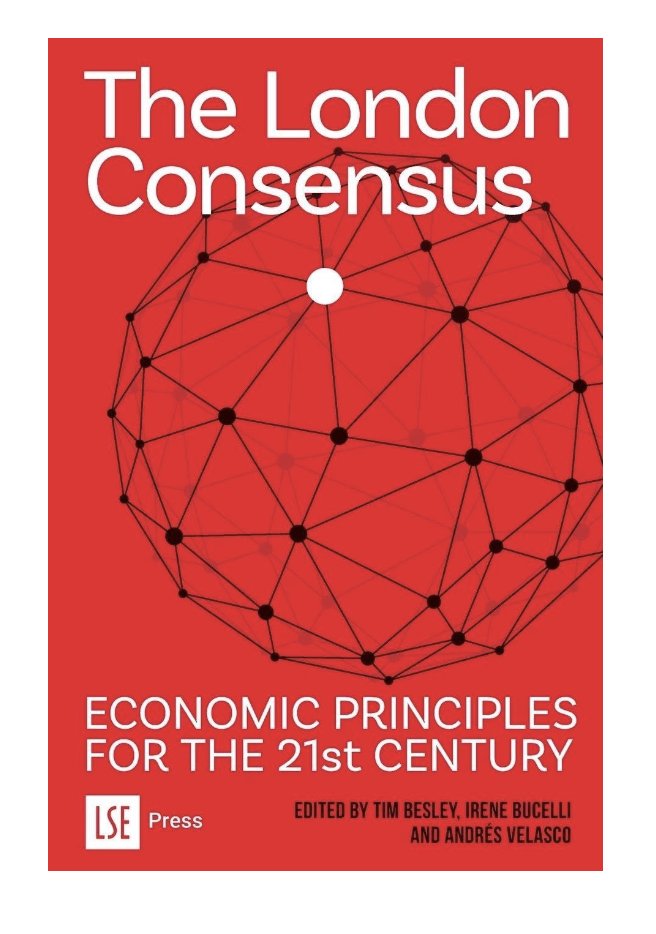
Beyond the Washington Consensus
This book offers a great synthesis of new thinking about the economy. It covers issues such as innovation and productivity, trade, macro policy, the labor market, social policy, the environment & state capacity
Open Access https://t.co/7ghFSSexai
here’s my convo with @balajis
we talk about what ambitious talent should do
and where ambitious talent should go
a few notes/takeaways:
- a second passport > a first home
- it’s easier to build Netflix than reform Blockbuster
- rising cities to explore if u can (Dubai, Singapore, Warsaw, Bangalore, Ho Chi Minh City, & Shenzhen)
Our pipeline at 8090 is full of CEOs going through this rude awakening.
As usual, CIOs and CTOs spend money and adopt a set of capabilities with no real sense of ROI. Most of this is slop. Most of it is sold by the incumbent Software Industrial Complex.
Because most CFOs and CEOs aren’t technical, they go along for the ride and report it back to their Boards that “We’re on it.”
Over time, most of this effort turns out to be wasted, most of the new products don’t work and people scramble to find 10%+ productivity improvements to justify ongoing spend.
In contrast, we’ve helped many of those same orgs see 50%+ improvements across their entire team by moving to Software Factory.
It is exactly what you think it is. A regimented process where humans and agents/bots work elegantly together to make and ship code. Everything is measured.
THERE IS NO HIDING. Killer engineers, Eng Managers and CTOs love it.
As Boards and CEOs demand more accountability, Software Factories are the proper response for using AI but doing so cost effectively with strict reporting on ROIC.
https://t.co/fkfTXgcI8c
@_alphashark_@kenklippenstein Perhaps it’s the hunger to create a better tomorrow for themselves. In India where I come from education is the primary pathway to affluence.
Watching @balajis operate as CTO at Coinbase taught me something profound about corporate power.
Most executives are climbers who optimize for influence and empire-building. They hoard social capital to entrench themselves, hire bigger teams, spin up more projects, and own bigger budgets. The more they're responsible for, the more credible their bid for the next rung in the org chart.
Balaji was different. He became CTO through the Earn acquisition, and he knew he wouldn't stay long. So instead of empire-building, he used his accumulated social capital as a knife to stab underperforming teams—the ones everyone knew were useless but no one bothered to go after.
Most executives won't crusade against other executives. It's politically pointless. Doesn't earn you anything to get a peer fired. But Balaji was singularly offended by incompetence and wielded his power to exterminate entire teams. This developed him a reputation for being a menace. So many people at Coinbase at that time would complain about Balaji as impossible to work with. Even to outsiders like me, it was obvious how much people feared Balaji up and down the organization.
But this is truly one of Balaji's superpowers: he is both tireless and always willing to simply say what he sees. It sounds simple, but it's incredibly rare. It requires an unnatural tolerance for pain and a willingness not to shy away from conflict. From the perspective of a CEO, you're constantly looking at your organization through the fog of war. People like Balaji are invaluable because their honesty cuts through that fog.
People who develop this reputation—consistently calling out what everyone knows but won't say—eventually become the most powerful people in an organization.
(Watch the clip by @brian_armstrong for context 👇)
If you're trying to understand India's economy, here's perhaps the most important question you can ask, how much are Indians consuming? Behind all the economic jargon, it's just money changing hands again and again. Everyday spending makes up 60% of our economy.🧵👇
@MyHaldirams just ordered a chilli paneer bowl at your outlet in Agra. Both the rice and the gravy came premixed. Shouldn’t that be left to the customer’s sense of proportion ? Wasn’t a good dish at all ..
#WATCH | Lucknow, UP | Addressing the students at IIM Lucknow, Adani Group Chairman Gautam Adani says, "When I first announced my intention to build a port, most people thought that I had lost my mind...When I presented the idea, some of the bankers laughed and how do you expect us to finance a land that is underwater?... Mudra had no access, no industry, no precedent...Maps will only take you where someone has already been, but to build something truly new, you need a compass that points to the possibilities..."
(Source: CBC Adani Group Communications)
By now, I hope it is clear to all of India's educated elite that we must build up our capabilities here. The mindset "we can buy whatever we lack" or its much deeper axiomatic version "money can buy everything" won't work in this new era. For one, money cannot buy national security nor sovereignty nor resilience. We cannot stand up to bullies if we don't build ourselves up.
More broadly, educated Indians must reexamine our fundamental belief systems. As one example, why are we paying so much for a degree from abroad (and here I am not referring to the low cost medical education in Vietnam - we must examine why medical education is so costly in India!)
Second, should we still value English as the _medium of instruction_? We should learn English _as a language_ but does it make sense to make it the medium for teaching mathematics or history or technology or medicine? English as the medium of instruction is a status symbol from our colonial past. Should that be our future as well?
Why I repeatedly come back to this question is because language has separated us into two classes and that division has only grown worse. English as a status symbol is a bigger barrier today than caste. I know how deeply it is holding back our rural youth.
The solution "government schools offer English medium to everyone" does not work and has never worked. Instead I propose that all our children - rich and poor - must be educated in our own languages as it happens in countries big and small and as it happens in all of the nations of EU.
Yes that means that every kid in Bengaluru must study in Kannada (not just learn Kannada!) and in Chennai must study in Tamil. Countries like the Netherlands with a quarter of the population of Tamil Nadu make it mandatory to learn in Dutch only after a year of enrolling in school there. Children do learn quickly.
So before you react emotionally to my suggestion "how dare you suggest my English fluent children study in Tamil or Kannada medium" ask yourself if that has served our nation well. Are we bringing up our children to have no pride or attachment towards India, particularly the vast majority of our people who do not speak English? Are we not alienating our own children from our roots?
Please don't bring up "IT jobs". We build sophisticated tools like compilers and the team mostly speaks Tamil. We never made it a requirement to be fluent in English and our engineers learn enough English to read English documentation, just as engineers in Japan and China and Korea and Germany all do.
And we do have a lot of non-Tamil speaking engineers too and since they choose to live in Tamil Nadu they learn enough Tamil to work with colleagues. This is what Indians learn to do when we migrate to, say, Germany. It is not the big deal we often make it out to be.
So we must stop making excuses. It starts with our mental attitudes towards our nation and our fellow citizens.
NEW ESSAY: "Dispatches from India"
A year ago I was living in New Delhi, India 🇮🇳. I traveled across 10 states and 30 cities+villages writing for The Economist, including a cover story on the economy
Since then I’ve been chewing on how to capture what I learned
It still surprises me how few resources go into understanding India given it has 1.4bn people (will peak in 2060), is growing at 7%, and could be as large as US/China in my lifetime
My 7-part reflections below
Contents:
1.Decentralisation-why I’ve become more bullish about Indian democracy
2. Illegibility-the hilarious way I learned about black money in politics
3. Revolutions-Modi, Trump, and igniting a social media mob
4. Technology-how Bangalore and Silicon Valley are converging
5. Growth-why India is not an Asian Tiger but could still become the world's biggest economy
6. Culture-my favourite cities, traveling to villages, and book/content recommendations
Bonus: what it was like writing for The Economist! 1/
Which tasks are going to take longest for AI to do?
4 categories:
1. The data poor
The internet has trillions of words, so AI got p good at writing.
But there's no equivalent database of 3D movement, and it's expensive to gather, so robots still struggle.