Check out my latest book on Amazon called Hidden Choices. It is an action journal designed to help you build a plan to live your version of "the good life." https://t.co/agMGu1YINt
I am honored to be confirmed as the 16th Chairman of the @CFTC.
I want to again express my gratitude to President Donald J. Trump @POTUS for placing his trust and confidence in me to lead the agency during this historic time. I also want to thank @SenateAgGOP and the U.S. Senate for a smooth and speedy confirmation, @DavidSacks for his leadership in revitalizing American entrepreneurship, innovation, and productivity by modernizing legacy regulations and cutting red tape, @SECPaulSAtkins and @HesterPeirce for their guidance, wisdom, and mentorship during my time at @SECGov, @CarolineDPham for her strong stewardship of the CFTC as Acting Chairman, @giancarloMKTS for setting an example of principled governance that inspired me to follow in his footsteps, and all who supported me throughout the process.
Today begins a new chapter for the CFTC. We are at a unique moment as a wide range of novel technologies, products, and platforms are emerging, retail participation in the commodity markets is at an all-time high, and Congress is poised to send digital asset market structure legislation that will cement the U.S. as the Crypto Capital of the World to the President’s desk. I welcome the vital responsibility to oversee the stability and security of America’s commodity derivatives markets during this period of rapid transformation. No agency is better suited to pioneer common-sense rules of the road for the new financial markets of America’s Golden Age than the Commodity Futures Trading Commission. Under my leadership, the CFTC will conquer these great frontiers and ensure that the innovations of tomorrow are Made in America.
Onwards.
⚡️Michael Saylor is describing a control-threshold event, not a price prediction.
Most people hear “$1 million Bitcoin” and mentally file it under hype.
That misses the mechanism entirely.
This is about ownership concentration inside a fixed-supply monetary system.
1. Bitcoin does not price like a normal asset
Bitcoin has three properties most assets never share at once:
• fixed terminal supply
• inelastic short-term float
• global settlement with no issuer
That means price is not driven by valuation models.
It is driven by how much supply is actually available at any moment.
When float shrinks, price does not drift.
It jumps.
2. Ownership concentration changes the rules of price discovery
When a large actor accumulates a meaningful share of total supply, several things happen at once:
• fewer coins trade
• marginal liquidity disappears
• price stops reflecting sentiment
• price starts reflecting extraction cost
At that point, buyers are no longer competing with sellers.
They are competing with holders who do not need to sell.
That is a different market.
3. Percentages matter more than time
What Michael Saylor is framing is a percentage model, not a timeline.
5 percent ownership is not magical by itself.
7 percent ownership is not magical by itself.
The inflection comes when the market realizes:
“No realistic amount of short-term selling can meaningfully increase available supply.”
Once that belief locks in, hoarding accelerates.
Hoarding reduces float.
Reduced float validates the belief.
This loop compounds.
4. Volatility flips direction after the threshold
Before the threshold:
• volatility expresses downside fear
• leverage amplifies crashes
• liquidity is assumed to exist
After the threshold:
• downside volatility compresses
• upside volatility expands
• price gaps to find sellers
This is why Bitcoin’s biggest moves historically happen after long periods of boredom and disbelief.
Not during euphoria.
5. This does not require a single actor
Strategy is not unique.
It is simply visible.
ETFs, treasuries, sovereign-adjacent allocators, and balance-sheet buyers are all doing the same thing under different mandates:
Removing coins from circulation permanently.
The market does not care who holds the keys.
It cares how many coins remain accessible.
6. Why the numbers sound absurd in advance
Humans think linearly.
Scarcity repricing is non-linear.
When supply is cornered gradually, price moves slowly.
When the realization hits that supply is cornered, price jumps until sellers appear.
Sellers only appear at prices that feel ridiculous beforehand and obvious afterward.
This is why scarcity regimes are invisible until they are irreversible.
7. The real signal Saylor is sending
Saylor is not saying:
“Bitcoin will be $1 million soon.”
He is saying:
“Once enough supply is removed from circulation, price stops asking permission.”
That is a statement about market structure, not optimism.
The quiet truth:
Bitcoin’s terminal pricing will not be set by adoption curves, transaction counts, or narratives.
It will be set by who owns the coins and why they own them.
Once ownership concentrates among entities that do not mark to market and do not require liquidity, Bitcoin stops behaving like a traded asset.
It becomes digital bedrock.
Price then does one thing only.
It jumps until it finds sellers.
And sellers appear much higher than anyone expects.
⚡️That chart is the wrong model for this moment.
If you force-fit it anyway, we are not anywhere near euphoria, complacency, or denial. We are also not in panic or true capitulation.
The closest emotional regime is late disbelief → frustrated consolidation, but even that’s misleading because price psychology is no longer the primary driver.
Here’s the deeper truth.
That psychology curve assumes:
•Retail is the marginal buyer
•Narratives drive flow
•Cycles end when belief peaks
None of those are true right now.
What we’re actually in is something new:
Structural absorption + emotional exhaustion.
•Retail feels bored, confused, and annoyed because price isn’t rewarding attention.
•Miners are stressed.
•Leverage already flushed.
•ETFs, treasuries, and balance sheets are quietly absorbing supply.
•Volatility is suppressed after violence, not before it.
That emotional state does not appear on this chart.
If you absolutely had to label it in plain language:
“Disbelief that this isn’t already higher.”
Not fear.
Not euphoria.
Not denial.
A slow realization forming that the old reflexes don’t work anymore.
That’s why this chart keeps getting posted.
People are trying to map a familiar emotional script onto a market that has structurally moved on.
Quiet truth:
This is pre-recognition, not post-euphoria.
And historically, the most violent repricings happen after boredom and confusion, not after excitement.
That’s the stage.
Anyone confidently pointing to “anxiety,” “denial,” or “capitulation” is reading crowd emotion instead of capital flow.
And capital flow is what actually moves price now.
With apologies to @SenWarren, you can’t memory hole three of the largest US bank failures – Silicon Valley Bank, Silvergate Bank, and Signature Bank – which occurred in 2023, all under the Senator’s beloved and ill-conceived regulatory straitjacket as enforced by the Biden Administration.
Over-regulation is not the solution to what ails the American banking system. Rigorous, responsible supervision is.
The initial report on the 2023 debacle by former Vice Chairman for Supervision, Michael Barr, was an exercise in obfuscation and sophistry. The American people deserve supervisors who are not asleep at the wheel, and the incoming Chairman of the Federal Reserve should undertake a thorough investigation of the systemic and oversight failures that led to that disaster.
The Banksters are trying to prohibit platforms like @Gemini, @coinbase, and @krakenfx from offering stablecoin rewards to you. The GENIUS Act already settled this issue with an elegant compromise — stablecoin issuers cannot offer rewards, but intermediary platforms like Gemini, Coinbase, and Kraken can. Now, the banksters want another bite at the apple. They want to relitigate a settled, legislated issue in a way that is bad for you, innovation, and American competitiveness. We are not going to let them get away with this. That's why we signed onto this letter with 125+ other companies to defend the GENIUS Act as it is written. Onward! 🇺🇸🤝🫡
Look here for an open letter from @millervalue to @MSCI_Inc regarding their proposal to exclude digital asset companies from indices. #notthebestidea
https://t.co/fMqVujsMhP
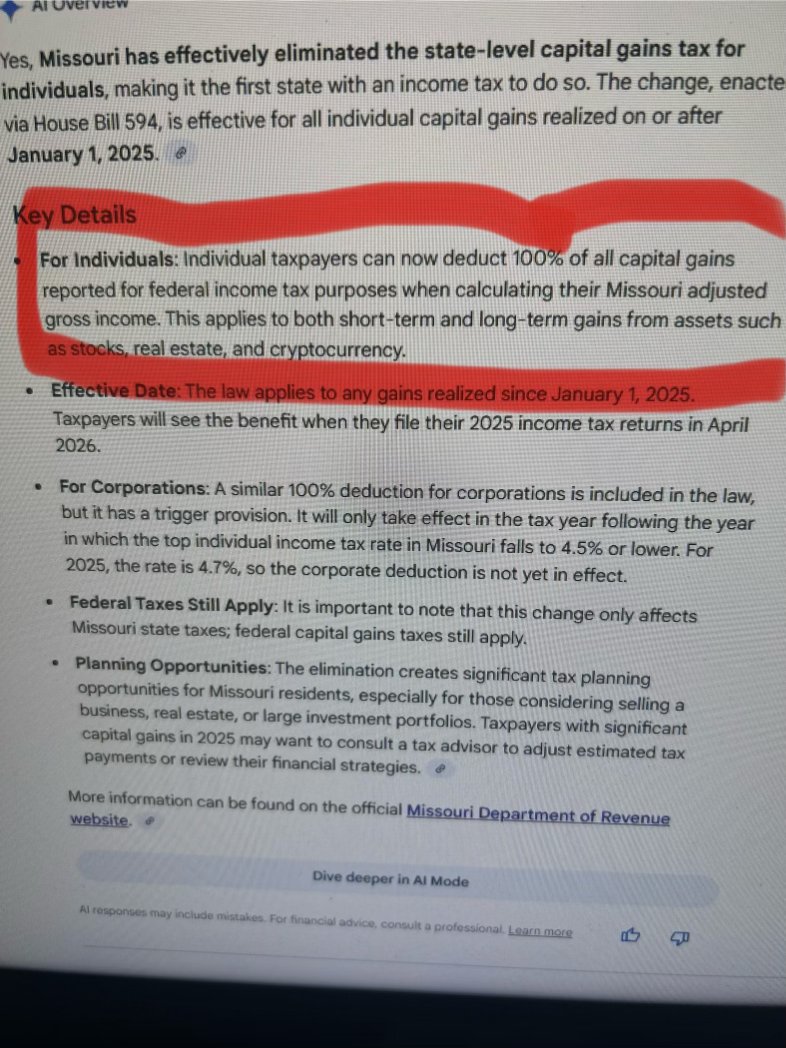
The state of Missouri has completely eliminated capital gains tax, and even allows you to deduct 100% of all capital gains reported for Federal income from your state taxes.
Missouri is Bitcoin country.
Come to Kansas City and join us @KcBitcoiners.
⚡️This is a survival briefing from someone who understands the system is entering a hard compression phase.
1. This is about not getting structurally locked out.
When Elon says “survive the next 2–3 years,” he’s pointing at a very specific window:
•chip supply gets rationed
•power availability gets politicized
•capital tightens unevenly
•governments pick implicit winners
•infrastructure timelines dominate model timelines
Once that window closes, late entrants don’t catch up.
They get permanently boxed out by physics and permitting, not intelligence.
This is the last phase where brute force scaling is still possible.
2. The real race is compute sovereignty, not model intelligence
Everyone still arguing about benchmarks is behind.
The actual question is:
Who controls enough compute, power, and capital to keep training uninterrupted when the world hits stress?
AGI talk is narrative compression.
The real objective is uninterrupted iteration under constraint.
That decides everything.
3. The “AGI by 2026” line is a psychological weapon, internally and externally
Internally:
•keeps teams sprinting
•normalizes extreme burn
•justifies insane capex
•forces prioritization under pressure
Externally:
•forces competitors to overspend
•pulls capital forward
•reshapes investor expectations
•scares regulators into engagement instead of obstruction
It’s not a prediction.
It’s a forcing function.
4. $30B per year is the clearest signal in the entire leak
That number tells you Elon believes:
•this race cannot be won efficiently
•this race must be won asymmetrically
•there will be casualties among AI labs
•only entities with balance-sheet endurance survive
This is a war of attrition disguised as innovation.
Most labs die from exhaustion, not failure.
5. The 1M GPU target implies state-level coordination, whether admitted or not
At that scale, you are no longer a startup or even a company.
You become:
•a grid customer that matters
•a national security conversation
•a zoning and permitting priority
•a supply chain allocator
You don’t get there without political gravity.
That is why governments are suddenly “interested in AI safety.”
They’re actually interested in AI control surfaces.
6. Optimus running data centers is about removing the last human bottleneck
People focus on the robots.
The real implication is tempo.
If maintenance, repair, reconfiguration, and expansion stop waiting on humans:
•iteration speeds up
•downtime shrinks
•operational fragility drops
•scale accelerates nonlinearly
This is how infrastructure becomes self-reinforcing.
Once that loop starts, it’s hard to stop.
7. Space and Mars data centers are signal beacons, not projects
They tell you how Elon thinks:
•energy capture beyond Earth
•compute unconstrained by terrestrial politics
•long-term insulation from regulation and conflict
This is about optionality across centuries.
It sounds insane until you realize every dominant system builder talks this way when they’re planning past current regimes.
The real truth
This is fear, properly harnessed.
Fear of being too slow.
Fear of dependency.
Fear of losing control of the substrate that defines the next civilization layer.
Elon is warning that scarcity is about to reassert itself at the infrastructure level.
And the ones who don’t secure compute, power, and capital now will spend the next decade begging those who did.
This is a last-call memo before the doors close.
Milton Friedman on 4 ways to spend money:
1) Your money on yourself (you’re careful about both cost and quality)
2) Your money on others (you care about cost, less about quality)
3) Someone else’s money on yourself (you care about quality, not cost)
4) Someone else’s money on others (you care about neither)
The last one is how government spending works 🚨
⚡️This has nothing to do with soldiers’ financial well-being and everything to do with conditioning the public to a new fiscal logic.
1. This is a behavioral test, not a benefit
The amount is deliberately small enough to avoid budget backlash and large enough to feel personal.
What is being tested:
•speed of disbursement
•public approval of targeted cash
•narrative elasticity around “deserved recipients”
•market tolerance for discretionary payouts outside normal budget cycles
This is rehearsal. You do not rehearse with a trillion dollars.
2. This is fiscal signaling to the bond market and the public at the same time
The U.S. interest burden is exploding.
Rates cannot stay high forever without breaking something.
Cuts are politically radioactive.
So the system chooses a third path:
•keep spending
•make it emotionally defensible
•fragment recipients into groups people will not oppose
Paying soldiers is the safest possible cohort to normalize continued cash outflows.
3. This is about loyalty under stress
States that feel stable do not do symbolic payouts.
States that sense rising internal and external pressure do.
Direct cash to soldiers is a quiet admission that:
•recruitment is fragile
•retention is fragile
•legitimacy must be reinforced materially
•words alone no longer bind people to institutions
Money talks when belief weakens.
4. This fits a broader pattern you are already seeing
Zoom out and connect the dots:
•rising interest expense
•explicit encouragement of stock ownership
•targeted cash transfers
•growing acceptance of deficits
•rhetorical normalization of “dividends” instead of “welfare”
This is the architecture of managed liquidity politics.
The state is learning to drip-feed money where it stabilizes the system most efficiently.
5. This has long-term consequences that people are underestimating
Once dividends exist, expectations form.
Once expectations form, withholding becomes destabilizing.
Once withholding becomes destabilizing, spending becomes mandatory.
That is how fiscal dominance becomes irreversible.
You do not walk this back without crisis.
6. This is bullish for hard assets, full stop
Not because of the $1,776.
Because of what it reveals about the trajectory.
The system is choosing:
•spending over restraint
•optics over discipline
•cohesion through cash
•narrative management over balance sheets
That environment eats fiat credibility slowly, then suddenly.
The real truth
This is a stressed system paying for order, loyalty, and time.
And when a system starts buying time with money, it is already telling you how the story ends.
I met with @intangiblecoins at my home in Miami to discuss the year in digital assets, capital, and credit; the latest Bitcoin controversies; and how @Strategy is digitally transforming capital markets and global banking through digital money.
this is why crypto is going to win. it's full to the brim of extremely talented people that were frozen out of the prestige industries. I myself am a perfect example. a liberal arts grad that aspired to a writing career, but gave up when I realized that newsrooms had a DEI mandate and a liberal slant. talent wasn't enough. I realized early on that crypto was an open field and more meritocratic than academia, big tech, or creative industries. it still is.
⚡️The system knows it cannot deliver what it used to promise.
Stable jobs. Housing. Pensions. Predictable upward mobility.
That social contract is broken and irreparable under current constraints. So the replacement is psychological, not material.
You bind people to the system earlier than ever and you do it through ownership optics.
If a child grows up with a brokerage account branded as a civic good, the market stops being something that happens to them and becomes something they are inside. Losses feel personal. Volatility feels normal. Questioning the system feels like attacking your own future.
This is how you convert structural failure into individual responsibility.
Ray Dalio understands this at a very deep level. His entire framework is about managing cycles without overthrowing the machine that produces them. Broad participation dampens revolt. It spreads pain horizontally instead of vertically. It turns inequality into variance rather than injustice.
The corporate backers are protecting throughput. Payments, custody, assets under management, transaction flow. You cannot tax your way out of the current debt and demographic math. You can only expand the base of people emotionally invested in asset inflation.
This is also why the language is “everyone should own stock,” not “everyone should own productive assets,” not “everyone should have housing,” not “everyone should have income security.”
Stocks are liquid belief instruments. They require faith, patience, and tolerance for drawdowns. Perfect tools for social conditioning.
The interesting part is the timing. This push only makes sense because the system expects higher volatility, more shocks, and less margin for error ahead. You pre-wire acceptance before the turbulence intensifies.
Children become shock absorbers for macro instability they did not create.
So yes, some kids will benefit financially. That is the cover story. But the real function is inoculation. You are training a generation to experience systemic risk as a personal journey rather than a political failure.
This is adaptation by an elite that knows the old stories no longer work.
Markets are no longer a tool of society.
They are becoming the environment people are raised inside.
That is what is actually happening.
🚨🚨🚨WOWZERS--the Fed rescinded guidance it enacted in Jan 2023 simultaneously with the @custodiabank denials + the Biden White House anti-crypto statement. Thank you, VCS Bowman & Gov Waller!🙏 The Fed broke the law by citing this very guidance in the Custodia denial, even tho the guidance hadn't become official yet (that didn't happen until Feb 2023). Of course the Fed's debanker-in-chief, Michael Barr, dissented in today's vote. Per insiders, we now know that Barr directed Fed staff to "find something" to deny Custodia at the time (which was ~2 weeks after FTX failed)--and the now-rescinded guidance was part of what he & his team "found" to deny Custodia. But most of that team is now gone or out of power at the Fed. Nature is healing. Thank you VCS Bowman & Gov Waller!👏
https://t.co/HTd9HFOnQZ
Bhutan is empirically dismantling almost every theoretical argument used against Bitcoin
It's economy is thriving, and it is now using its Bitcoin stack to build a sustainable Mindfulness City
It is not selling its Bitcoin, but using it for collateral and risk-managed yield