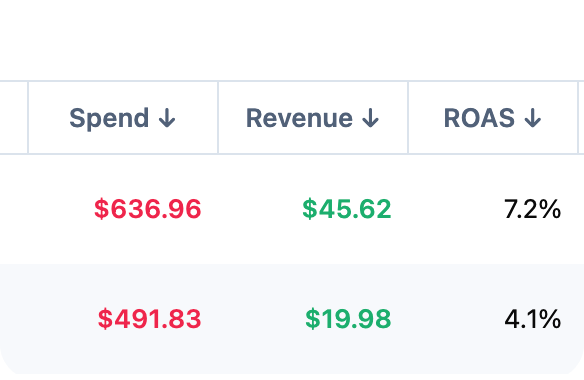
Yesterday I made a plugin to check keyword-level revenue in Apple Ads dashboard ease.
I spend so much time on asa's dashboard, so finally I don't need to check revenue in other platform or by guess.
This is genuinely encouraging. We usually only see the success after the curve turns upward, not the years when almost nothing seems to work. “88% of my projects failed” makes the $2.8M far more meaningful. The real lesson is to keep building, learning, and staying in the game long enough to catch the right wave.
Even the World’s Most Famous Indie Hackers Grow Slowly—Until They Don’t
One of the best-known indie hackers marc recently shared his July 2026 revenue: nearly $100,000, at roughly an 85% margin.
But the most interesting part is not the $100K. It is where the money comes from.
The seven older products he built before the ChatGPT era now generate only around $1,400 a month combined. Products launched in 2023 contribute roughly $14,000. Most of the revenue comes from a handful of products launched in 2024 and 2025.
This is a useful reminder that indie hacking rarely follows a smooth growth curve.
Marc spent years launching products with relatively modest results. According to his own revenue timeline, he made $9K in 2018, $31K in 2019, $18K in 2020, $15K in 2021, and only $10K in all of 2022. Then he made $263K in 2023 and $1.2M in 2024.
The breakthrough did not come from every product gradually becoming more successful. It came when years of accumulated product skills, distribution experience, and personal brand were finally concentrated into a few breakout products.
There is another lesson here: audience size, reputation, and business revenue are not the same thing. A developer can be widely followed while most of their individual products still make very little. And even for a top indie hacker, the majority of revenue may come from only a few winners.
We usually discover people after the curve has already turned upward. What we rarely see is the long period before the breakthrough—the years of products making tens, hundreds, or a few thousand dollars.
Success makes the journey look inevitable in retrospect. The revenue history shows that it was anything but. @marclou
I find this genuinely encouraging.
Not because it proves that persistence guarantees success—it doesn’t. But because it shows that years of seemingly small results may still be compounding beneath the surface.
The goal is not to keep forcing the same product forever. It is to keep building, learning, improving distribution, and staying in the game long enough for those capabilities to converge on the right opportunity.
Sometimes the breakthrough is not the reward for one product. It is the delayed return on everything you built before it.
Apple Ads, meet ChatGPT — the first plugin that runs Apple Search Ads in ChatGPT with your real revenue.
Stop flying blind. Just ask:
"Which keywords are wasting money?"
"What should I scale?"
Lily Apple Ads reads your keyword-level ROAS, preps the changes, you approve. Optimized for paying users, not installs.
Try it here:
https://t.co/10heAUJMNG
Best Apple Ads managers don’t think in API endpoints.
They think in launches, countries, budgets, CPA targets, creative variants, and payback periods.
The CLI should speak that language.
That’s exactly the philosophy behind Lily's Apple Ads CLI.
Instead of exposing raw API objects, I’re building a workflow that feels like how Apple Ads teams actually operate in their daily work.
Less API.
More marketing.
Introducing Apple Ads CLI by Lily:
https://t.co/MLOGrtVi1I
#AppleAds #BuildInPublic #CLI #IndieHackers #applesearchads
Apple Search Ads optimization in 2026:
Open Apple Ads
Export CSV
Open RevenueCat
Compare everything manually
Repeat tomorrow 🤦
There had to be a better way.
So we built one dashboard that connects spend and revenue together.
https://t.co/eM4lWwJdBy