TOMORROW:
My *Exclusive* conversations with @SpaceX President & COO @Gwynne_Shotwell
In the ONLY “traditional media” interviews the company is doing for $SPCX’s history-making IPO.
We will bring you content ALL DAY 🚀
@CNBCMorningCall@CNBC@Nasdaq@Harri8t
Ambitious is what we do at NASA.
Artemis III will be unlike anything we’ve ever undertaken. A multi-launch campaign bringing together the most powerful rockets in the world to test rendezvous, docking, and interoperability across multiple systems close to Earth before we return astronauts to the lunar surface.
This is how we get into the rhythm of the missions that follow. You give NASA and our industry partners a year, we’ll get the job done.
There has been a lot of hand wringing on the appropriate valuation of SpaceX. Some large institutions believe SpaceX can only be valued at half what the market seems to be willing to pay for it. Others are claiming it has 15X appreciation ahead of it.
Almost all of this difference of opinion comes down to how comfortable you are modeling beyond 2030 and what valuation method you use.
2030 valuation using a traditional Gordan DCF produces a very different result than a 2040 EV/EBITDA Multiple. Both have pros and cons. Most analysts don’t really discuss this and lead with a headline number.
We are very comfortable modeling out to 2040, as large portions of what SpaceX is proposing is real world infrastructure, which provides modelable physics constraints to anchor against.
The analysis we released today explores this in-depth, its open to the public all the way through IPO. I highly encourage you check it out prior to then.
https://t.co/McShCl78uo
We’ve run 5,000 monte carlo runs across 500 variables (real number, even though it sounds fake) and three valuation methods.
This video is of a 3D cloud chart showing every simulation outcome expected in valuation output across two of the most impactful variables to the model when using an EV/EBITDA multiple from 2026 to 2040.
The horizontal axis is the steepness of the orbital data center demand S-curve.
The vertical axis is the rate at which chip compute efficiency becomes cheaper.
Each of the 5,000 dots is one simulated future; green dots are the ones where SpaceX's 2040 value clears the $1.77T IPO line, over time.
Under EV/EBITDA valuation through 2040, 96% of our simulated futures clear the expected IPO price once the bell rings Friday.
We aren’t publishing this publicly to tell investors what the stock is worth, we’re publishing this to help investors understand the world of outcomes, what the fundamentals suggest through 2040, and what frankly most analysis simply won’t share.
SpaceX is a generational company working on long term infrastructure harnessing a domain no one has been able to tap in so far: space.
It deserves doing the work as an investor. because this in not financial advice.
The cleanest way to hold SpaceX is a bond stapled to a call option (AI-Compute); Starlink is the bond, the near term SatCom annuity that funds the next flywheel.
Understand the world of outcomes and take your position accordingly.
Comparables and P/E won't take you far enough.
Behind every milestone is a team that shows up for the hardest problems in space and defense. As we approach our one-year IPO anniversary, it's the people who made our achievements possible. This is what accelerating the advantage looks like.
$VOYG #MissionReady #AcceleratingtheAdvantage
Vast and @esa, on behalf of the Czech Republic, have signed an agreement for a private astronaut mission to the International Space Station in partnership with @NASA. @astro_ales is slated to serve as mission pilot & is expected to become the first Czech astronaut to visit the station. @SpaceX’s Falcon 9 will launch Dragon and the crew to the @Space_Station no earlier than 2027 🇨🇿 https://t.co/Wpm4qIEdDc
The Terran R program entered a new phase in May as stage 2 rolled out of Long Beach and began its journey to NASA Stennis.
🏗️ Build: Completed stage 2 integration while advancing thrust structure, interstage, and stage 1 qualification hardware.
🔥 Test: Aeon V second stage engine completed its qualification campaign, hitting key service life, duration, and start milestones for flight one.
🌴Launch: Water tower reached its final height at 305 feet; lightning protection system erection continued
End-to-end communications testing is well underway for Blue Ghost Mission 2. This testing confirms our Elytra orbiter can link with Blue Ghost on the Moon’s far side and act as a backup communications relay for @NASA's LuSEE-Night - enabling up to two years of surface operations where there’s no direct line of sight to Earth. https://t.co/sslH27Q4e3
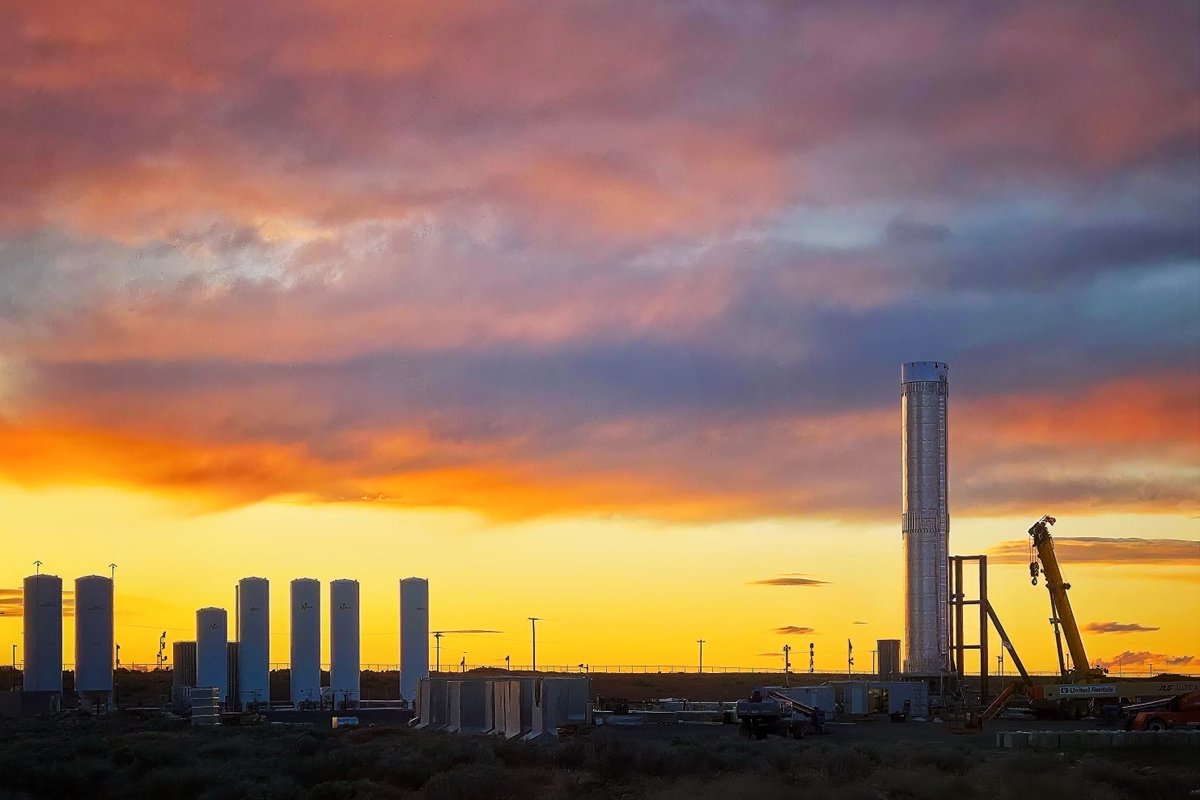
The sun has set on our Stage 1 structure's time in Moses Lake, but it will soon rise over our launch site in Cape Canaveral.
No one said the road to launch was easy, but it sure is a pretty ride. 🚀🌅
Read our blog to learn more about the proto-qualification campaign: https://t.co/TFKfrM2n2B
Our astronaut Luca Parmitano is assigned as pilot of NASA’s #ArtemisIII mission.
With Europe powering Orion with the European Service Module, this mission will test the critical operations preparing for humankind's return to the Moon.
A strong step forward for ESA–NASA partnership.
🔗https://t.co/MJpn0ftcpr
📸 NASA
NASA on Tuesday announced the four astronauts who will fly to space as soon as next year to test out moon landers built by SpaceX and Blue Origin.
The upcoming Artemis III mission is slated to fly as early as 2027 https://t.co/1J8YkGFDJ1