“But wristbands can still be used to track HRV trends even if they aren’t 100% accurate”.
This assumes that the error is fairly constant across the range of values (e.g. it consistently underestimates values by 10 ms whether RMSSD was 20 or 120 ms). If this were the case, then these could be used to track trends.
Unfortunately, studies show that error is highly inconsistent across the range of RMSSD values.
In some cases, error increases as RMSSD increases, with the error occurring in either direction. This means that the true RMSSD might be substantially higher OR lower than it appears on the app. You won’t know in which direction it is off.
In other cases, there is overestimation at low values and massive underestimation at high values. This means your true low values will appear higher (e.g. 15 ms true value appears as 30 ms) and your true high values will appear lower (90 ms true value appears as 60 ms).
This is unacceptable for tracking changes and quantifying daily variation (CV) with longitudinal monitoring, and for rank ordering individuals cross-sectionally (lowest to highest HRV).
Note that many previous validation studies did not test for these types of bias (though it can be seen in figures), leading to overly optimistic conclusions about device accuracy.
It’s concerning enough that people are using these recreationally and being misled.
It’s much worse that these are increasingly being used for conducting research.
Total sleep time is often regarded as the most accurate wearable sleep metric.
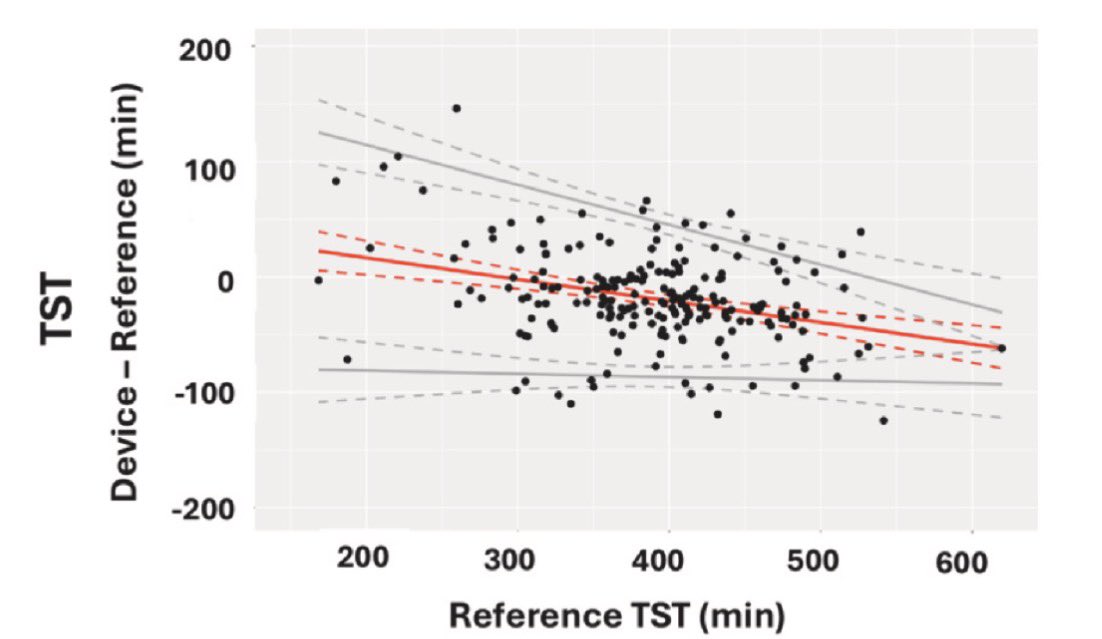
New Oura study shows it’s still not that accurate, and as with HRV, the error varies across the range of values, making simple corrections difficult.
Oura overestimates TST when EEG-measured sleep is short and underestimates it when EEG-measured sleep is long. Individual-level error is large.
Still not a research tool.
I love these simple historical studies.
Natural experiment during World War II on coal miners showing that rationing calories reduces coal output per day. What's interesting is the time lag - you can maintain output when underfed for a bit, but with longer term consequences.
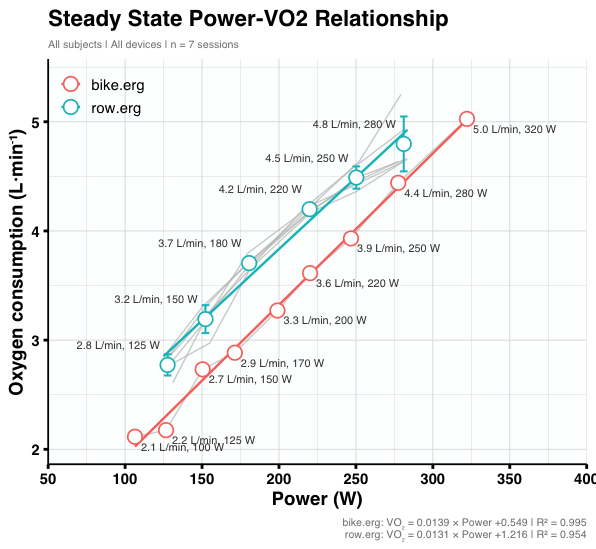
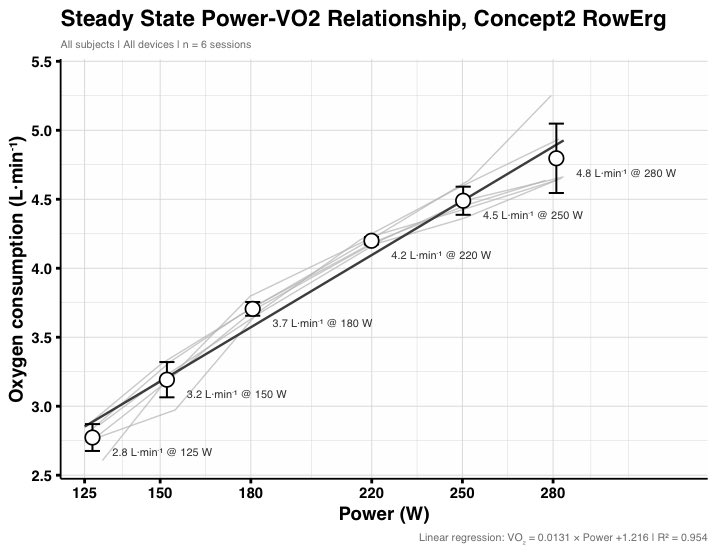
Rowing is very energetically costly. Much higher submaximal VO2 at a given power vs the bike (data on myself).
What's interesting is that even at maximal effort there's still a bias for higher VO2 at a given power (data on >200 tests I ran). Subtle but definitely there.
Only 120 pages in, but really fascinating book so far. Hard to believe how much regularity/predictability there is across diverse systems from plants to companies that all follow similar scaling principles.
@Brady_H Probably equivalent to a 4:40-4:45 on the track lol but a good starting point. Trying to delay the inevitable speed decline as long as possible. Only thing that sucks is it’s hard to find competitive 1 mile races for people of intermediate ability 😂
These aren’t the highest rates of fat oxidation ever measured in a human - elite racewalkers who adapted to a keto diet for 6 days or 3.5 weeks showed higher rates - some at 2 g/min. But they raced at a slower speed when asked to perform in a real life race. You can’t outrun the stoichiometry of fuel production. Carbs produce more ATP per litre of oxygen than fat.
One perk of my current job is usually having a COSMED K5 on hand. With a bike and rower at home I’m collecting a ton of data on myself to determine biological variability of VO2 and technical error of our devices. Excited to build this out more over the next few weeks.
Love this race! Big improvement from last year with still some room to improve. Not that I'm running to win anything, but it's crazy that running nearly 3 min faster than last year only bumped me up 10 places. Now shifting focus to the mile/5k for the spring and summer.
I have historically worn cheap running shoes until the last year or so. Since I haven't been through the gamut of all the high profile kicks, take this with a grain of salt, but the Adidas evo SL has to arguably be the best shoe on the market. Especially the newer woven version.