If you're tired of your life, read this:
Joe Dispenza wrote one of the most dangerous books I’ve ever read:
Breaking the Habit of Being Yourself.
It shows you exactly why you're stuck and how to break free.
Here are 11 insights that’ll punch your old self in the face (in a good way):
This is it.
Everything learned spending millions on longevity.
From: Your Immortal Unc and Auntie.
To: Our Immortal nieces and nephews.
0. Sleep is the world's most powerful drug.
1. Be in your bed for 8 hours
2. Same bedtime every night, any time before midnight
3. Don’t eat right before bed
4. Calm foods for dinner
5. No screens 1 hour before bed
6. Avoid added sugar (be aware it’s in everything)
7. Avoid all things in an American convenience store
8. Avoid fried foods
9. Shoes off at the door
10. Eat whole foods, particularly veggies fruits nuts legumes berries
11. Walk a little after meals or air squats
12. Get your heart rate high routinely
13. Lift heavy things
14. Stretch daily
15. Water pik, floss, brush, tongue scrape, morning and night
16. Make an effort to drink water
17. Get sunlight when you wake up (UV is low)
18. Protect skin in midday sun
19. Stand up straight
20. See at least one friend once a week
21. Avoid plastic where you can (in all things)
22. Circulate air in rooms
23. When stressed, breathe, learn to calm your body
24. Go to the dentist
25. Avoid sitting for long times
26. Protect your hearing, the world is too loud
27. Alcohol is bad for you
28. Finish coffee before noon
29. Avoid bright lights after sunset
30. If obese, look into a GLP
31. Sleep in a cold room
32. Texting while driving is dangerous
33. Turn off all notifications
34. Limit social media use
35. Don’t smoke anything
36. If you struggle to sleep, read a physical book before bed
37. 1 hour before bed have a calm wind down routine: bath, read, light walk, listen to music
38. The body is a clock and loves routine. Have a daily morning and evening schedule.
39. Avoid long distance travel where you can
40. Baby steps first: incorporate new things slowly
41. Do less… most things don’t work.
Bonus points if you get your blood checked.
Start here, it will change your life.
PSYCHOLOGISTS FOUND THAT WRITING ABOUT YOUR FUTURE SELF IN PAST TENSE CAN TRICK THE BRAIN INTO TREATING IT LIKE MEMORY
Researchers studying mental time travel have discovered something fascinating. When you write about your future goals as if they already happened, the brain activates the same neural networks used for recalling real memories.
This process strengthens belief, confidence and emotional alignment with the desired outcome. The subconscious mind struggles to separate vividly imagined past tense events from actual experiences, which is why this technique influences behavior and motivation so strongly.
This method works because the brain relies on memory based prediction. When it believes something has already occurred, it begins adjusting decisions, habits and emotional responses to stay consistent with that internal story.
Journal entries written in past tense create a sense of familiarity and reduce the psychological resistance that normally blocks long term goals. The mind feels safer pursuing something it already recognizes.
Psychologists call this self directed neural priming. You are not manifesting through magic. You are conditioning your brain to respond as if your goals are part of its known history.
This reduces doubt, increases clarity and activates the circuits responsible for planning and follow through. Over time, actions shift to match the identity you described in your journal.
Your brain builds your reality around the stories you repeat. When you write your future as a memory, you train your mind to move toward it with confidence.
~ MindBox
✨🙌🏾💫
PAID VERSION → FREE VERSION
1. Netflix Premium → Plex
2. YouTube Music → Audiomack
3. Audible → LibriVox
4. Amazon Prime Video → Tubi
5. Apple TV+ → Freevee
6 Disney+ → Pluto TV
7. YouTube Premium → NewPipe
8. Hulu Live → Roku Channel
9. Crunchyroll Premium → RetroCrush
10. Spotify Premium → SoundCloud
11. HBO Max → Plex Free Movies
12. Apple Arcade → Poki
13. Xbox Live Gold → Steam Free Games
14. PlayStation Plus → Epic Games Store
15. Canva Pro → Adobe Express (Free Plan)
16. Grammarly Premium → Hemingway Editor
17. Notion AI → Google Docs (Free + Extensions)
18. Adobe Photoshop → GIMP
19. Zoom Pro → Google Meet (Free Plan)
20. Microsoft Office 365 → LibreOffice
Save this list; it could be incredibly useful.
🚨 BREAKING: Passive studying is dead!
Claude can train your brain harder than most professors ever will.
Here are 10 Claude prompts to learn anything 10× faster
My favorite quote from Atomic Habits by James Clear:
"It doesn't make sense to continue wanting something if you're not willing to do what it takes to get it.
If you don't want to live the lifestyle, then release yourself from the desire.
To crave the result but not the process is to guarantee disappointment."
𝗚𝗮𝗺𝗲 𝗧𝗵𝗲𝗼𝗿𝘆 𝗯𝘆 𝗚𝗶𝗮𝗰𝗼𝗺𝗼 𝗕𝗼𝗻𝗮𝗻𝗻𝗼
Probably one of the best book on Game Theory. Access the PDF here: https://t.co/QW3Jlk29xj
𝗠𝗮𝗶𝗻 𝗧𝗼𝗽𝗶𝗰𝘀 𝗳𝗿𝗼𝗺 𝘁𝗵𝗲 𝗣𝗮𝗽𝗲𝗿:
- Introduction to Non-Cooperative Game Theory
- Strategic-Form Games with Ordinal Payoffs
- Dominance Relations (Strict and Weak) and Iterated Deletion Procedures
- Second-Price Auctions and Pivotal (Clarke) Mechanism
- Nash Equilibrium in Finite and Infinite Strategy Sets
- Dynamic Games with Perfect Information and Backward Induction
- Extensive-Form Games with Imperfect Information
Subgame-Perfect Equilibrium
- Games with Chance Moves
.......
Lewis Borsellino is the kind of trader who only exists in stories - except his story is real. He spent decades running the S&P futures pit in Chicago, had 20 years without a losing year, built a fortune and then nearly entirely lost in his late 50s, and then rebuilt again from zero. The full arc of a life in markets, lived at the highest level. Riz's interview with him is one of the deepest and most honest trading conversations I've come across in a long time - every few minutes something lands that you've either already learned the hard way or are about to.
Here's what stayed with me most.
1. If you're being honest with yourself, you already know why you're not profitable.
This is the one that opens the whole interview and it hit me like a truck. Lewis says it plainly: if struggling traders would just sit down and be genuinely honest with themselves, they could identify exactly what's holding them back. Too much stress outside of trading. Living out of the trading account. Undercapitalized. Taking shortcuts. Most people know the answer. They just don't want to say it out loud because saying it out loud means they have to do something about it. The mirror is the hardest tool in trading, and most traders avoid it entirely.
2. There is no practice day. It's game day every day.
Lewis was adamant about why he preferred backing traders with athletic backgrounds - not because they were smarter, but because athletes already understood something fundamental about performance that most people don't. In sports you practice, practice, practice, and then game day arrives and the speed is completely different. In trading there is no practice day. Every session is live, every decision has real consequences, and the ability to act under pressure without freezing isn't something you can simulate at half speed and then magically apply at full speed. You build it by doing it, repeatedly, until the reaction becomes automatic. This connects directly to everything Roger Gracie said about jiu-jitsu: nothing outside the mat compares to the mat itself.
3. Know yourself before you know the markets.
One of Lewis's ten commandments, and the one he spends the most time on. He watched traders who were genuinely good at trading one or two contracts completely fall apart when they sized up simply because the dollar amount per tick changed what the loss meant to them emotionally, and that changed every decision that followed. Your propensity for risk is not a fixed number that grows automatically with your account. It grows through experience, through building trust in your process, and through understanding where your own psychology starts to interfere with execution. Skip that step and the market will find the gap for you.
4. Love your losers like you love your winners.
This is the commandment that most traders intellectually agree with and almost none of them actually practice. Lewis's version of it goes beyond the usual "learn from your mistakes" cliché - his point is that if you get away with breaking a rule and the trade works anyway, that's the most dangerous outcome possible. Because it teaches you that the rule can be broken. And eventually, when you break it one more time, the market collects everything the previous violations had been quietly building up. The rules don't break you immediately. They let you accumulate enough rope first.
5. You can break a rule and get away with it once. But one day the rules will break you.
The tenth commandment, and the one that closes the loop on everything else. Lewis has a trader he backed who lost his entire $25,000 stake in four months. Instead of cutting him, Lewis told him to stop thinking about the money and just execute the process. By the end of that same year, Brad made a million dollars. The process was always there. What changed was the pressure being removed from the outcome long enough for the execution to come through cleanly. I think about this a lot in the context of my halving rule - the rule exists precisely to remove that pressure when the results are moving in the wrong direction. Not to limit what I can make, but to protect the quality of the decisions that will eventually make it.
6. The market humbles everyone. Ego shortens careers.
Lewis made $4.7 million in a year and had people calling him the best trader in the country. His response was to remind himself he was in the right place at the right time and did the right thing - and that none of that guaranteed the next trade. The traders he watched end their careers prematurely were almost always the ones who confused a great run with permanent superiority, sized up beyond their actual risk tolerance because they felt invincible, and then couldn't get out when the market reminded them they weren't. The market has ended more careers during winning streaks than during losing ones, and that's a fact that doesn't get talked about nearly enough.
Lewis lost 90% of his net worth at 57 years old, started over, built a cybersecurity company with 100 employees, and still wakes up every day grateful to be doing something he loves. That's a tremendous life lesson.
Go watch the full interview.
@Wordsofrizdom@ScaryDarkWeb
https://t.co/lwN0eiwz0K
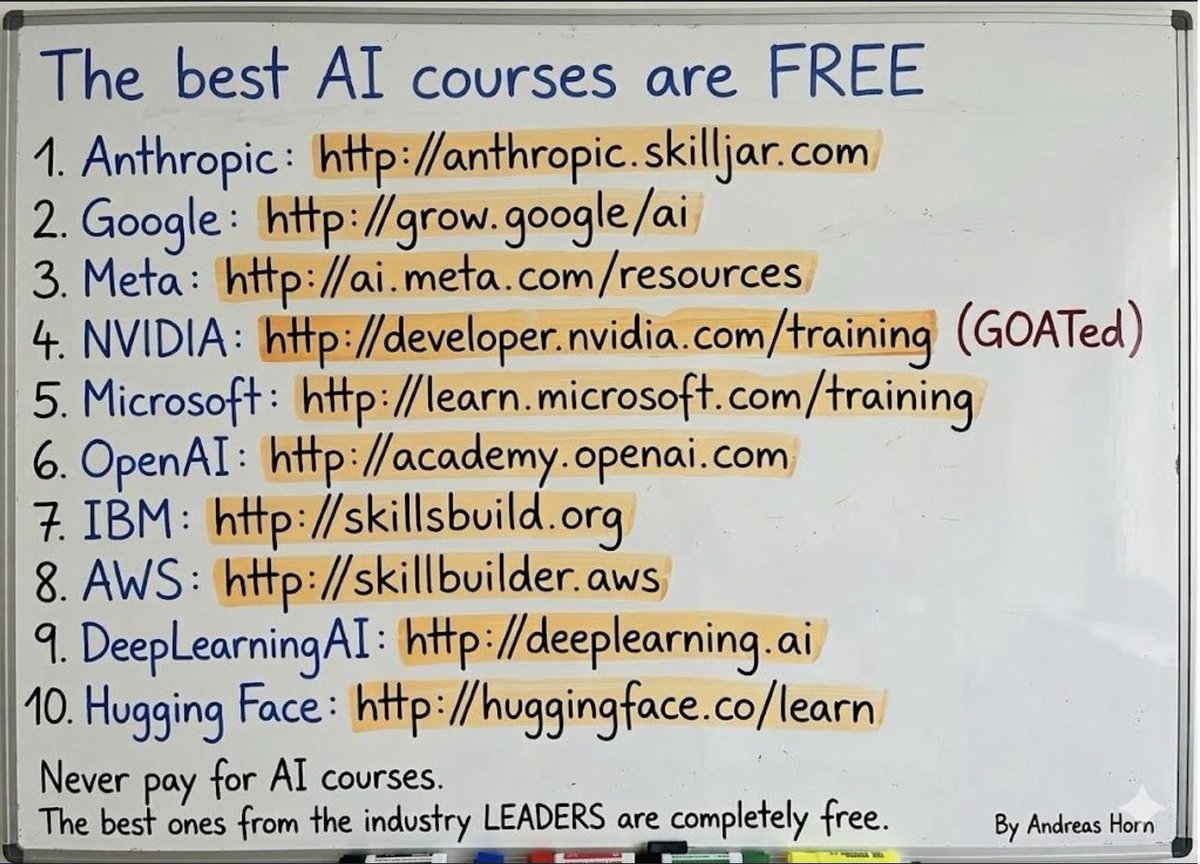
Before you spend $2,000 on an AI course, read this.
A lot of people are buying expensive AI courses right now.
But honestly, most of them don’t need to.
Some of the best AI learning resources in the world are already free. And they’re not built by self-proclaimed AI experts online.They’re created by the companies actually building the models, chips, tools, and infrastructure behind this entire AI wave.
If you want to learn AI properly, it makes sense to learn directly from the source.
But before that, Check out 100+ such resources shared in this community of 200K+ AI/ML Engineers: https://t.co/1551GLLSyi
Here's a list of 10 free AI learning platforms from industry leaders:
𝟭 - 𝗔𝗻𝘁𝗵𝗿𝗼𝗽𝗶𝗰:
https://t.co/i11SbYMwsc
𝟮 - 𝗚𝗼𝗼𝗴𝗹𝗲:
https://t.co/AP7UJIWCZS
𝟯 - 𝗠𝗲𝘁𝗮:
https://t.co/Szgt9UZwEG
𝟰 - 𝗡𝗩𝗜𝗗𝗜𝗔:
https://t.co/jhKE77g8qA (GOATed)
𝟱 - 𝗠𝗶𝗰𝗿𝗼𝘀𝗼𝗳𝘁:
https://t.co/7oyuGNBso1
𝟲 - 𝗢𝗽𝗲𝗻𝗔𝗜:
https://t.co/SB5qSuOJND
𝟳 - 𝗜𝗕𝗠:
https://t.co/bivomoOsgU
𝟴 - 𝗔𝗪𝗦:
https://t.co/4XySMsxNbR
𝟵 - 𝗗𝗲𝗲𝗽𝗟𝗲𝗮𝗿𝗻𝗶𝗻𝗴𝗔𝗜:
https://t.co/wW9udDmT29
𝟭𝟬 - 𝗛𝘂𝗴𝗴𝗶𝗻𝗴 𝗙𝗮𝗰𝗲:
https://t.co/9llzeMmuAo
If you’re serious about learning AI, the biggest difference usually comes from consistency, not another course.
Linda Bradford Raschke has been consistently profitable for decades. That alone should make you stop and pay attention to everything she says. Here are the five lessons from her latest interview with Jason Shapiro that hit hardest:
1. Most of your profits will come from a small number of trades - and that's completely fine.
Linda is very clear about this. Regardless of whether you're a day trader, swing trader or long-term trend follower, roughly 20% of your trades will account for 80% of your profitability. The implication is enormous - stop treating every session like it has to deliver. Your job is to stay consistent, protect capital, and be positioned correctly when the real opportunity shows up. The big moves in cocoa she referenced - ten solid weeks of downtrend - don't come around every week. When they do, you need to still be in the game;
2. Never make public predictions about market direction. Not even to yourself.
This one caught me off guard. Linda told Jason that when he asked her before the interview to share her market outlook, she refused - not to protect anyone else, but to protect herself. Once you verbalize a directional bias, it embeds itself in your subconscious and quietly destroys your flexibility. The market is a fluid, dynamic environment that demands constant adaptation. Locking yourself into a narrative - publicly or privately - is one of the most expensive things a trader can do. Stay fluid. Let the data speak.
3. Technical analysis is a risk management tool, not a prediction tool.
This reframe is critical. Linda argues that the primary value of technical analysis isn't telling you where the market is going, but telling you where it shouldn't go if your thesis is correct. Support and resistance define your risk. Everything else is just noise management. The traders who use charts to project targets and call directions are misusing the tool entirely. The ones who use it to define the conditions under which they're wrong - and act accordingly - are the ones who last.
4. Wear one watch.
One of the most memorable lines in the entire interview. If you're wearing two watches, you'll never know what time it is. Linda applies this directly to information consumption - five subscriptions, ten different voices, constant FinTwit noise. All of it creates confusion and erodes the one thing that actually makes you better: your own judgment. Do your own work. Build your own framework. When you get to a key level, you need to be able to trust your own read of what's happening - and you can only do that if you've done the homework yourself.
5. You need two things in any performance-oriented discipline: humor and patience.
Linda heard this from an Olympic equestrian coach in her 80s and immediately applied it to trading - and she's right. Humor keeps you loose and relaxed, which is exactly the mental state where your best decisions get made. The traders who are white-knuckling every session, anxious and desperate, are the ones who miss the obvious setups staring them in the face. And patience - everyone grossly underestimates how long this actually takes. Linda said she's been working on dressage for 40 years and still feels like an amateur. Trading is no different. The timeline is longer than you think, the immersion required is deeper than you think, and the ones who make it are the ones who accepted that reality early enough to stay in the game.
Go watch the full interview. Then watch it again.
@LindaRaschke@Crowded_Mkt_Rpt
https://t.co/qt843YhrAh