@GeorgeToskov96@BullTheoryio I don't think isa are open to corporations. Plus 20k limit wouldn't help big players .it's a good thing itll promote uk stock market more and stop folks hoarding cash
@wheazyjoe@BullTheoryio No mate, it's only cash put in and not invested into market. It's to promote uk s&s and reduce the cash hoarded . It won't affect cash from sales of stocks
STRC down to $82.6 today. Here's my read:
1. Strategy is fine. If everything stays as is, they can pay STRC dividends for 32 years. If BTC appreciates at ~2% CAGR, they can pay dividends indefinitely.
2. Why the sell-off? This appears to be a liquidation cascade.
Over the last 6 months, the narrative became that STRC volatility was reducing, and price began to spend all its time in $99-100 range.
This invites leverage. If you expect the price to always be north of $95, you can take on 20x leverage with your portfolio to buy more STRC and dramatically increase the yield on your portfolio.
This works great, until it doesn't.
STRC is designed as a free-market asset. When attention shifted to SATA and STRC price flagged, it may have raised the attention of opportunistic short-selling hedge funds.
By shorting aggressively, they could push the price down and start triggering margin calls and liquidations from folks who aggressively levered up their STRC positions.
The price action today is a clear liquidation cascade, rapidly pushing prices lower, in turn triggering additional liquidations.
3.
What happens now? The market will heal itself.
Opportunistic hedge funds will recognize that this is a firesale and the fundamentals are unchanged for STRC and step in as buyers. Shorts will close, becoming buyers. Individuals are getting a tremendous entry price for long-term holding STRC shares.
Buyers at this level will get ~13.7% effective yield. If STRC trades back to $100 and they sell, they get an easy +18% return.
4.
What will Strategy do?
Strategy will likely increase the dividend rate on June 30 - maybe to 11.75% but possibly to 12%. Buyers at the current price level then would get 14.2% effective yield from that point forward.
Strategy may also step in to buy STRC shares back. They could do this by issuing new shares of MSTR (currently at 1.14 mNAV) or by taking on traditional debt and deploying those funds to buy discounted STRC shares on the market.
If/when STRC trades back to $100, Strategy could then re-issue those STRC shares. The ~$15 delta per share could be used to buy BTC as pure accretion to MSTR holders, with no net change to amplification.
No doubt that Saylor has already at least considered this, and it wouldn't surprise me if they're currently doing this.
5.
In summary...
The market is freaked out that this depeg is like Terra/Luna... but this is not an asset like that. Strategy's balance sheet determines whether STRC continues to receive dividend payments... and Strategy's balance sheet is completely unchanged.
This is a leverage wipeout.
From this, the market will learn that Digital Credit is mostly very low volatility. But because it is a free market asset, the longer that a Digital Credit instrument trades within a tight range to par... the more leverage will inevitably pile up as people get greedy.
And that creates the conditions for a leverage wipeout depeg. Following that, the instrument will make its way back to par value as the market heals itself and recognizes that the dividend payments will continue uninterrupted because the issuer's balance sheet is unaffected.
The earnings call for @strategy explicitly stated a shift in Strategy and it could be awesome.
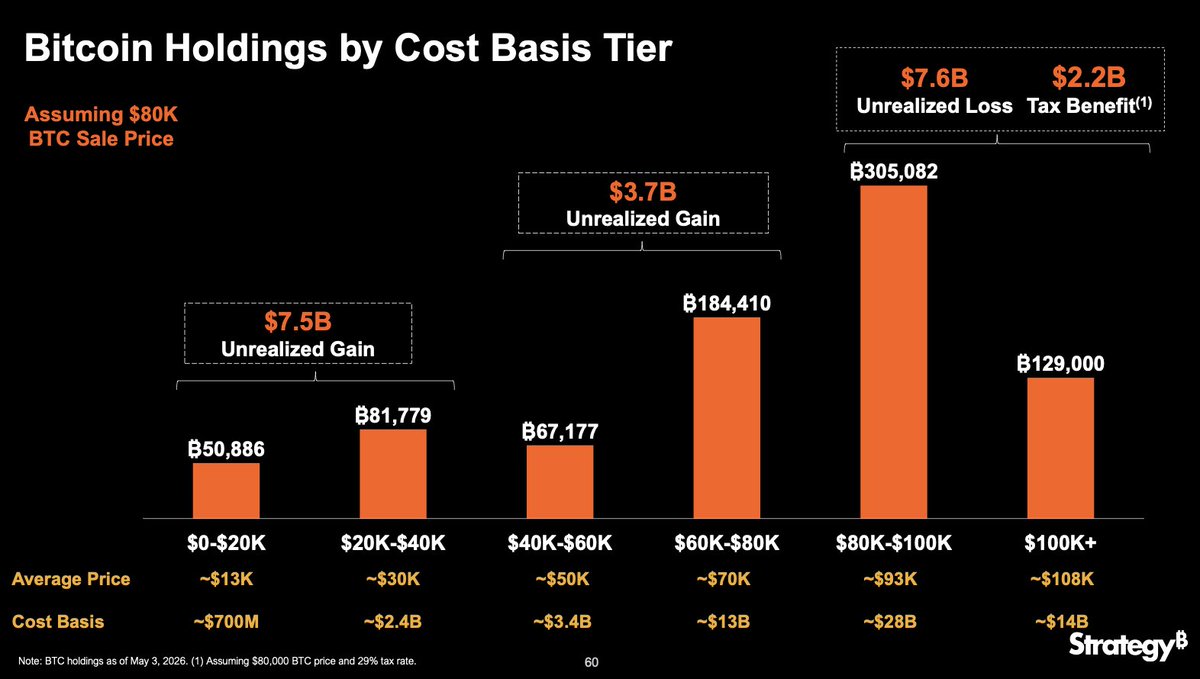
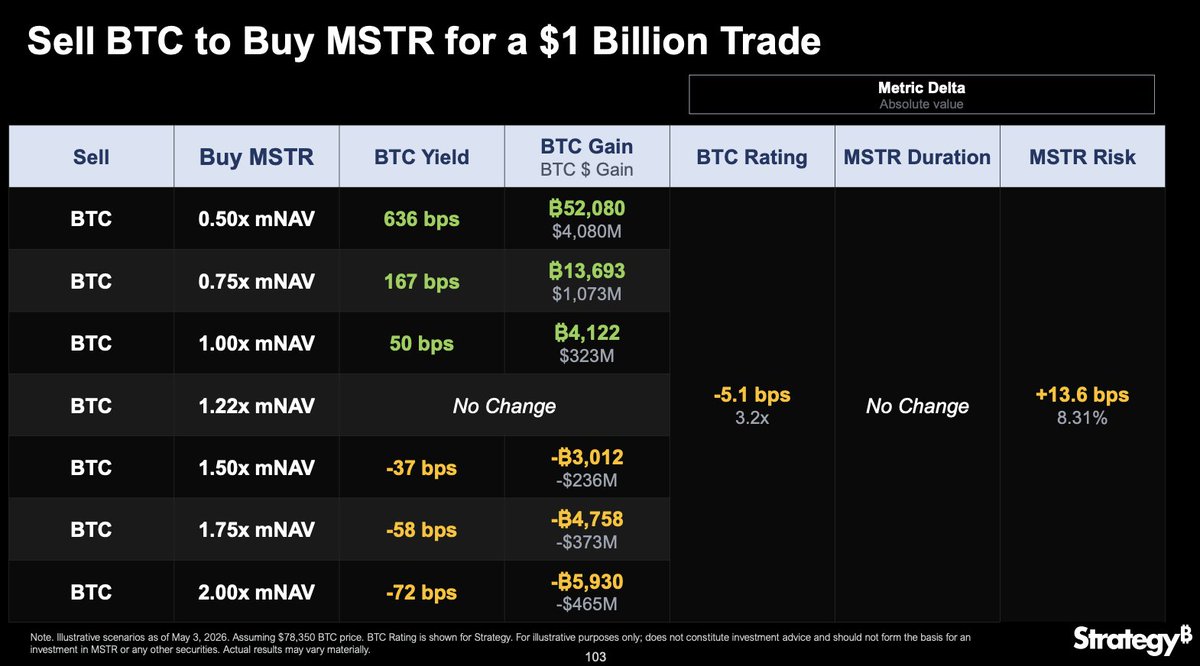
TL;DR -> Sell High Cost Bitcoin, Book Taxable Loss, Use $4B to buy back $MSTR and Converts, boost share price and mNAV, crush shorts.
GAAP volatility ≠ taxable event
Realized BTC sales = taxable event
Previously, Strategy could show huge GAAP gains/losses from fair-value accounting without necessarily triggering CAMT because unrealized appreciation alone does not create taxable income in the same way as realized gains from selling BTC.
Now, if they sell high-cost-basis BTC first (FIFO/HIFO strategy matters), they can intentionally realize losses.
Sell 50,000 BTC at ~$80K = ~$4B proceeds
If average basis was ~$100K+, they realize roughly ~$1B+ actual capital loss
That realized loss becomes economically valuable because it can:
Offset realized gains elsewhere
Reduce future CAMT exposure
Create tax assets / shield future taxable income
Free up billions in liquidity without increasing leverage
Then the important second step:
They can redeploy the cash into higher BPS-accretive actions.
Buy back undervalued MSTR (if mNAV low)
Retire low-conversion-price converts
Fund dividends / USD reserves
Reduce float and future dilution
So the realized loss itself is not “good” because EPS changes. EPS alone doesn’t mechanically help the stock.
The value comes from:
converting high-cost BTC into liquidity + tax assets + denominator reduction.
That is the shift. $MSTR $STRC
BTC is no longer treated as untouchable inventory. It’s becoming an actively managed capital allocation asset optimized around Bitcoin per share, float control, taxes, and capital structure.