@HarrisonSchust1@unclebobmartin@Lenovo Not judging, or complaining, just curious. Why did you call and not type in your situation to Claude or ChatGPT? From your post you were surprised, so you presumably didn't know Lenovo had an AI on the other end. For my side, I think I might call next time, to see if AI answers!
@kilwiining@staylorish And yet the same Scot Gov economists and ministers who would administer and run Indy Scotland are unable to find these huge cash flows. Why are they hiding them?
@esrtweet Do you think "defund the police" means no police? I thought was a slogan short-hand for "reallocate some money from the militarized police". Are people really that dumb to want to have no cops?
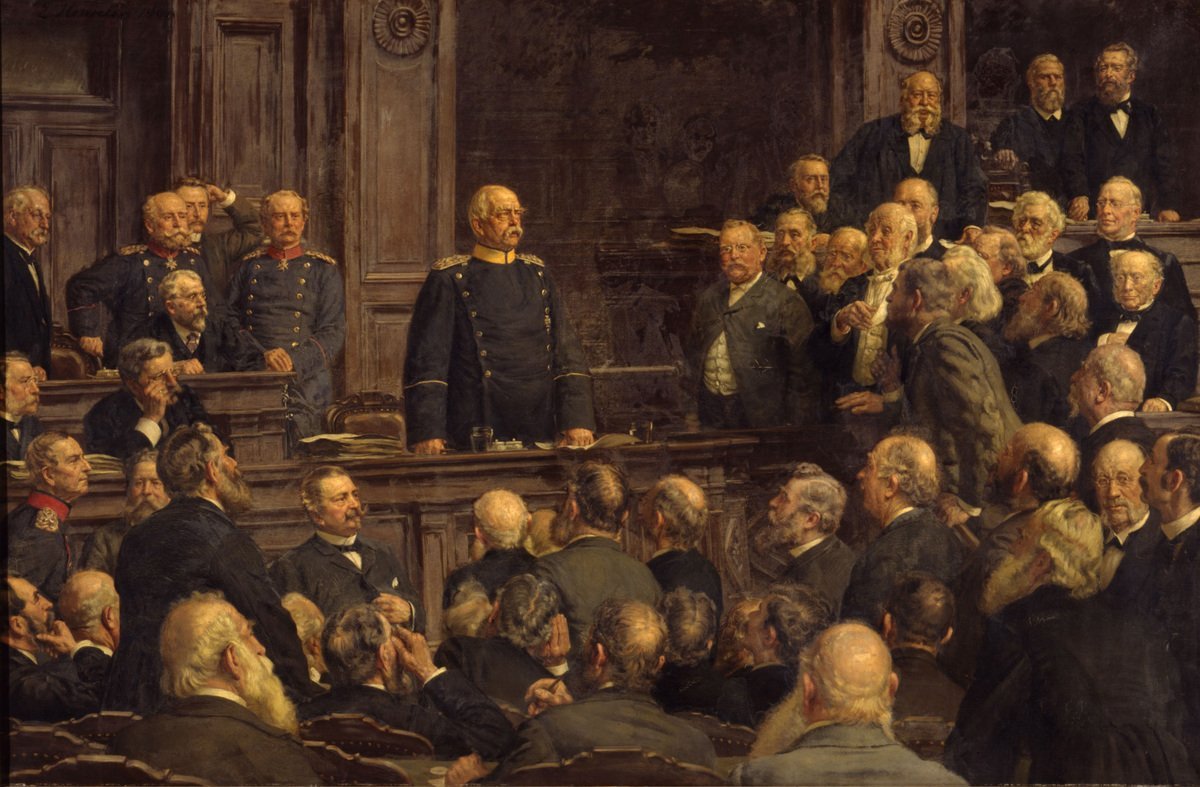
This reminds me of this quote from Otto von Bismarck: "Gentlemen, if you contest the right of conquest, you cannot have read the history of your own country."
Modern people are uncomfortable with the concept of Right of Conquest because it became essentially prohibited after 1945 to invoke it in any conflict, since the UN and the international order don't allow wars of conquests in terms of one country annexing territories of another country by force anymore.
However even the creators of these modern post-1945 ideas never intended to question age old borders which were a result of some conquest centuries ago, when the Right of Conquest was effectively the norm, as Bismarck points out in this quote.
Let me explain what the historical principle in international law and political practice known as Right of Conquest actually was. It did not mean recognizing that some country has the right to go on any war of conquest they want, but that a conquest could be seen as legitimate if the victorious party was able to establish effective control over the territory and the defeated were no longer able to resist or reclaim the territory. Historically, this would be seen as establishing a new legal reality, leading to formal treaties that confirmed the transfer. Such treaties were seen as valid and countries could claim legal right to territories by the virtue of having conquered them in the past.
So even if these conquests resulted out of wars of aggression which would be seen as illegal, the result of the conquest could still be legally affirmed out of pragmatism and "might makes right" (Macht geht vor Recht) principle, a catchphrase specifically describing Otto von Bismarck's Realpolitik and a reality for most of history. In this context the Right of Conquest would be invoked.
This was simply a pragmatic reality in the age where global empires and emerging nation states were regularly going at war with each other and territories switched hands all the time. In this context, the Right of Conquest was actually the only way to ensure peace, because if losing states would not want to accept defeat and transfer of their territories to the winner, peace treaties would be impossible to sign, and therefore leading to perpetual wars all over the world.
However the Right of Conquest became essentially banned in 1945 by UN charters. Modern international relations and conflicts were to be guided by the concept of ex iniuria ius non oritur ("a right does not arise from a wrong"), which asserts that if a war was waged illegally, anything that was gained through such war could not be legally recognized as legitimate anymore. And since all wars of aggression are effectively seen as illegal today, countries could no longer invoke Right of Conquest in international law for any new transfers of land.
The reason why a "ban" of such historically accepted concept like Right of Conquest was made possible is because of the establishment of international order that was actually able to enforce it. All the major post-1945 powers like USA and Soviet Union essentially agreed to it. For example when these countries waged wars and invaded other lands, they did not attempt to annex those lands and claim their territories but instead installed a favorable regime. The post-1945 order turned wars of conquest into regime change wars. The 1945 borders were practically meant to be frozen, to preserve world peace and provide stability, since such order at least in theory discourages countries to invade another, knowing that their territorial gains would never be legally recognized.
So even though the modern 1945 international order banned the Right of Conquest to be invoked in future conflicts, it was never meant to question historic conquests that happened before that. Quite the opposite, because the 1945 borders were meant to be frozen. The modern international order is literally based on the idea that you affirm all the historic conquests that happened before it came into being as legitimate.
But now you often see people who want to project the modern international legal order and morality into earlier times in history, and treat historic conquests as illegitimate, as if the post-1945 international laws existed in 15th century. This is just a result of complete ignorance of these people and/or their inability or dishonesty to form a coherent worldview. It's always completely selective too. For example if you think that Ceuta isn't Spanish because it was gained through some military conquest centuries ago, Morocco literally shouldn't exist as a country by the same logic. Or, to quote Bismarck again, "you cannot have read the history of your own country."
@antonerable You can't say its untrue any more than someone can say its true.
Tell us why you think its untrue. The person who suggested it fully detailed his analysis behind his theory including a number of caveats.
The floor is yours.