✨ I think I've been coding almost solely on my VPS with Claude Code for almost a year now
All I can say it's just fantastic:
- no need to keep laptop open ever
- no laptop battery drain
- can switch to phone or any other device you like whenever you want to continue (like when you're outside)
- it just keeps going all night while you sleep (esp with /goal)
- you can start hacky projects from scratch and go live in seconds because you're already on the server which is great to ship things and get it used by people fast (not stuck on your local laptop webserver)
- it just feels like living in the future
I used to code on my laptop, test locally, then push to GitHub, then it auto pulled and deploy to production, that'd take me ~1 minute to get a new feature out
But then when I bought a new Mac Book Pro a few years ago I was too lazy to install a local Nginx environment, so I just started pushing to prod and everything went fine, and I sped up deploying to about 3 seconds from laptop to server, which people called me crazy for too
But now with Claude Code on my VPS in the last year, it just live edits on my production server, which sounds like it should go wrong but it just doesn't, it's very careful and only twice in 12 months messed up which meant my site didn't load for 10 seconds which is OK
If I wasn't working solo, like at a big company, I' think I'd recommend the same workflow but with a staging server, so it wouldn't touch production, for safety and regulatory reasons etc. but for me it's fine
I agree with @theo completely, it's clear to me this is where it's going, also seeing @karpathy with Claude moving to the cloud (via Slack etc), I think AI "agents" and AI coding will operate on servers / from the cloud first
P.S. I have 3-2-1 backups, multiple on-site and off-site backups which you should also even if you wouldn't code with AI, safety first!
I did write-up of one of them in the past which is along other six included in the performance above, when I have some time I will do the full writeup of things you can run that pretty easy with reasoning also why they work etc.
I have been also thinking about running either the crypto leg public in vault or giving the access to this in other way since these are not any inefficiencies or low timeframe alpha that gets arbed away.
https://t.co/kQOrrnb8Bg
I kept pulling the $TRT thread. It leads somewhere bigger than I expected.
To $NVDA. Through a landlord.
Start with what we know for certain.
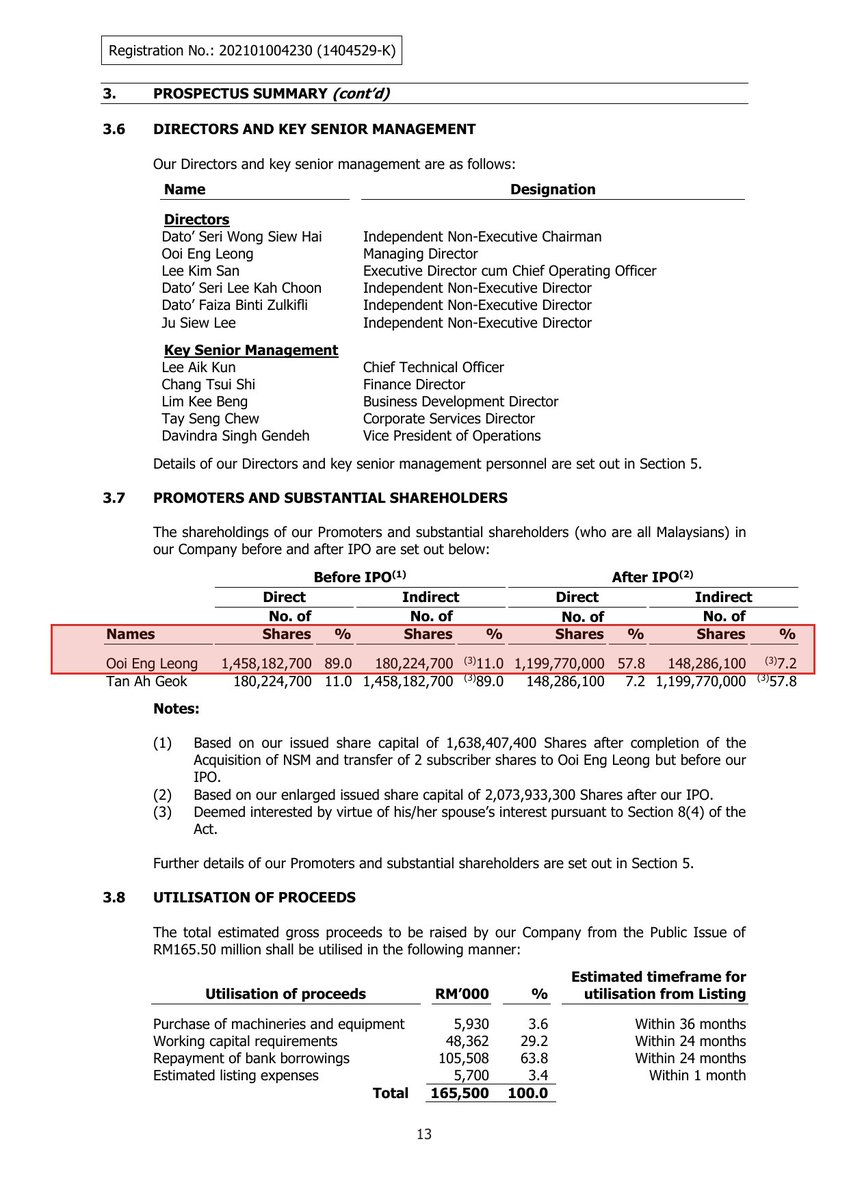
→ $TRT leases its new 104,000 sq ft Perai facility from Skygate Technology (M) Sdn Bhd
→ Skygate is controlled by Datuk Ooi Eng Leong
That is in TRT's own 8-K filing.
Now follow the owner.
The same Datuk Ooi Eng Leong controls ~55% of NationGate Holdings (KL: NATGATE).
And here is what NationGate is:
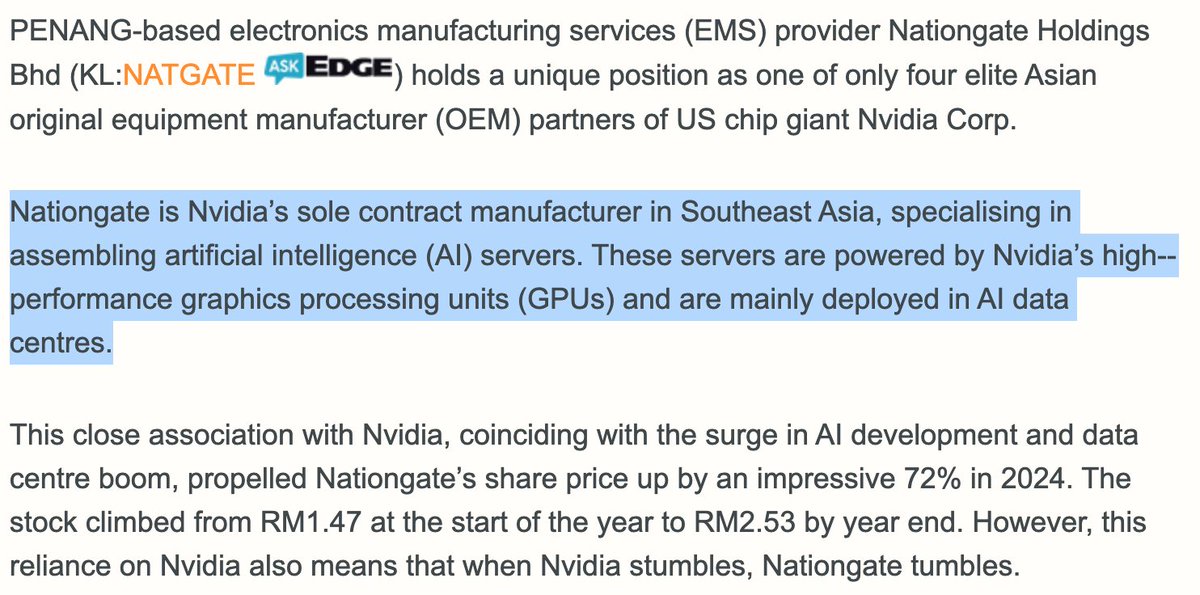
"Nvidia's sole contract manufacturer in Southeast Asia… one of only four elite Asian OEM partners of Nvidia."
- The Edge Malaysia
NationGate builds Nvidia AI servers.
So line it up.
The man who owns $TRT's landlord also controls the company that builds Nvidia's AI servers in Southeast Asia.
Same owner. Same Perai cluster. Same AI supply chain.
And remember what $TRT is shipping right now.
$5.3M + $2.6M in burn-in board orders for a "next-generation AI GPU platform," North American and European customers.
Nvidia could very well be the AI GPU platform.
This is an ownership and ecosystem link, not a signed deal - and true confirmation here is very difficult, because the contracts are most likely signed with an NDA.
But if we take a step back.
AMD. Micron. Coherent. NXP. And now an ownership thread running straight into the Nvidia supply chain.
One microcap. Sitting in the middle of all of it. In one corner of Penang.
Still under ~$200M market cap.
My favorite humanoid stocks ranked:
1. $AMBA (Ambarella) — Best pure-play edge AI vision for robotics. 37% revenue growth, 60% gross margins,$100M+ robotic pipeline, still under $5B market cap. The risk is concentration and scale. The upside is being the de facto vision processor as robots proliferate.
2. $6324.T (Harmonic Drive) — Irreplaceable. There is no substitute for strain wave reducers in high-precision robot joints. 75% market share with Nabtesco. Hard to replicate. If humanoid robots ship in any volume, this company prints money.
3. $ALGM (Allegro MicroSystems) — Near-monopoly in motor current sensing, priced like an auto cyclical. 30-50 sensors per humanoid at automotive-tier P/E multiples. The market hasn’t re-rated this for robotics yet.
4. $VPG (Vishay Precision Group) — The purest humanoid hardware play. Precision load cells and force sensors with a 1.21 book-to-bill. Risk: trading at 255x current earnings on ~$320M revenue. If humanoid volumes slip, this gets crushed. But if they don’t, VPG is the most direct bet on robot touch.
5. $MOG.A (Moog) — Aerospace-grade precision actuators with a credible humanoid crossover. Already up 83% on the thesis but the volume ramp hasn’t started. Defense + robotics optionality.
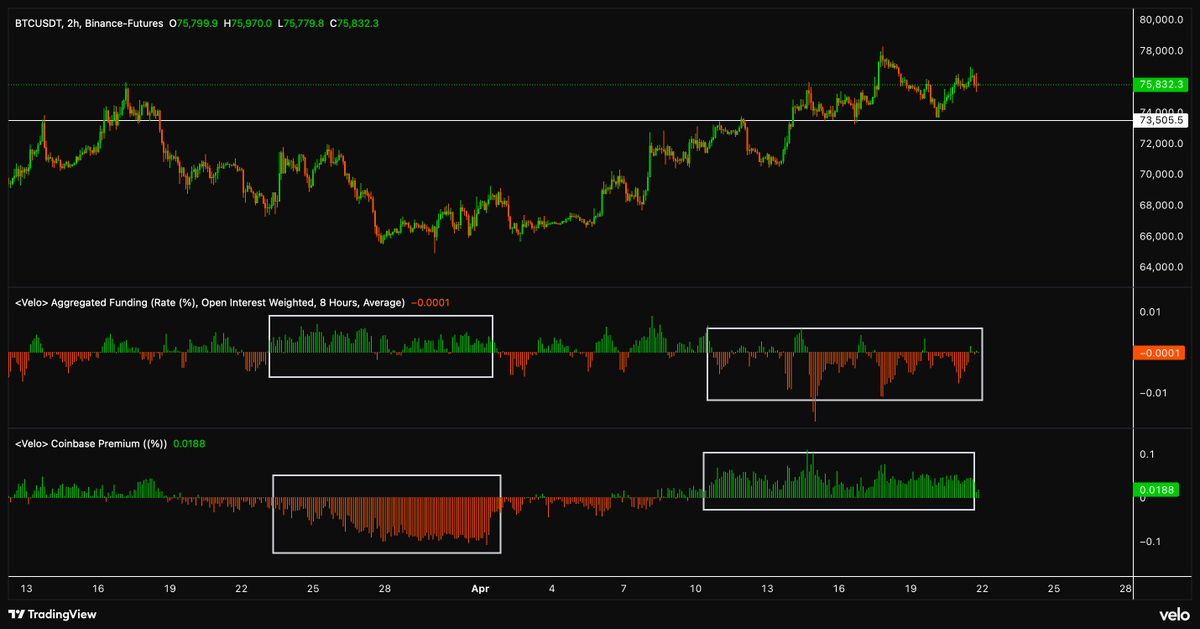
$BTC Funding rate sentiment trap (educational):
Most traders read negative funding = people are shorting. That's half the story.
Many miss the fact that negative funding also appears when spot buyers are so aggressive they're pushing $BTC spot price above perps.
We all know that Coinbase premium indicates strong institutional demand. Now look at the pattern:
Coinbase discount → positive funding.
Coinbase premium → negative funding.
Don't read funding alone.
spotting mean reversion:
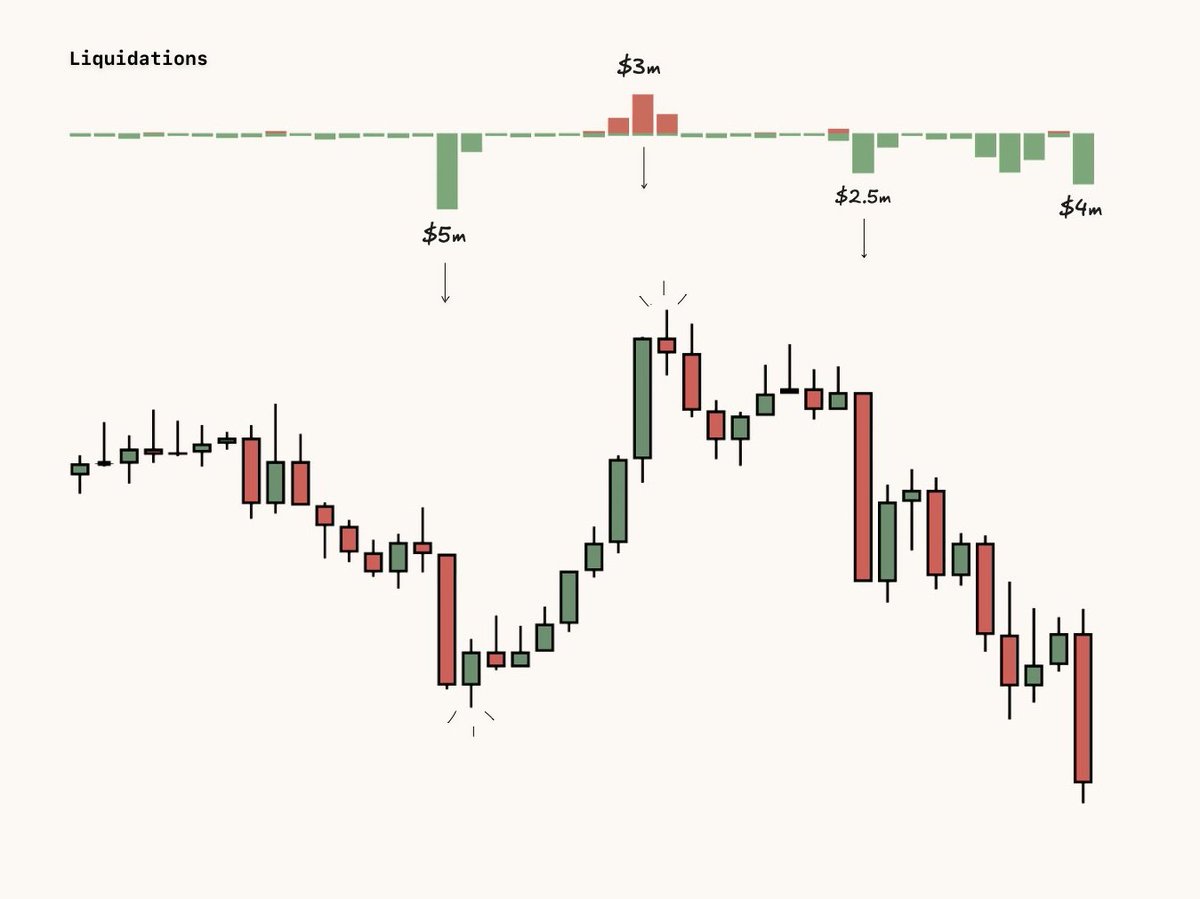
I look for liquidation spikes on Hyperliquid, in confluence with aggressive one sided delta to show limits being aggressive & getting filled.
> longs liquidated (sells)
> aggressive negative delta
signs of a potential low
Trading is hard. try to avoid:
- ignoring regime shifts
- focusing on output over input
- trading every session
- neglecting drawdown
- letting socials effect execution
- hoping as a strategy
- looking at patterns over hypothesis
- skipping your own review process
The Space Bottleneck: Optical ground infrastructure.
- "The industry has built roughly 10 percent of the optical ground infrastructure"
Now, who are the beneficiaries?
- $EOS.ASX (operating stations at Mt. Stromlo equipped with "adaptive optics.")
- $SKPJF (TYO: 9412) | $NTTYY | Space Compass is JV with NTT and satellite operator SKY Perfect JSAT
- $SGBAF - Works with Cailabs to for terrestrial optical terminals
- $SAFRY - Manufacturer of the optical ground stations
Then if it fails fallback would be names like:
$VSAT, $GILT
Analysis states that if the optical mesh fails due to clouds or lack of stations, the architecture "falls back to Ka-band RF links".
-> Near term capital flows to Relay Providers (Kepler, Space Compass, General Atomics).
-> Long term structural winners will be the photonics hardware manufacturers (Cailabs, Safran).
-> Then companies like SpaceX wins by default. Many are private.
"This infrastructure deficit is no longer just an engineering problem but a direct threat to a major White House [Golden Dome] policy objective"
Orbital laser communications market are hard-capped until physical ground infra scales, hence the current bottleneck.
But not quite sure if capex is to the scale of hyperscaler AI buildouts yet to benefit these companies enough.
I want to clarify some things on VWAP and explain a little bit about how I use it.
I had some pushback on my last post about VWAP because I used a really good example of the market repeatedly rejecting off of VWAP.
However, that was simply designed to illustrate that VWAP is indeed useful (since most naked price action system traders seem to think order flow isn't useful). It wasn't meant to imply that the market rejects off VWAP every single time. We all know that there's no such thing as an indicator that works every single time.
The funny thing is that both of the sessions after I posted that post had a rejection near VWAP that led to a big move down (I took shorts and caught a huge move down on Friday and I called it out in chat to some of my people and held runners all the way until the close. Just adding this since some people will think "Yeah, but did you actually trade this?" Yes, I did trade it and I often did trade the examples that I share but I don't always feel the need to mention that as I'm not here to brag but to help people to dramatically improve their trading skills.).
So, now that I got that out of the way, let me explain the main way I use VWAP.
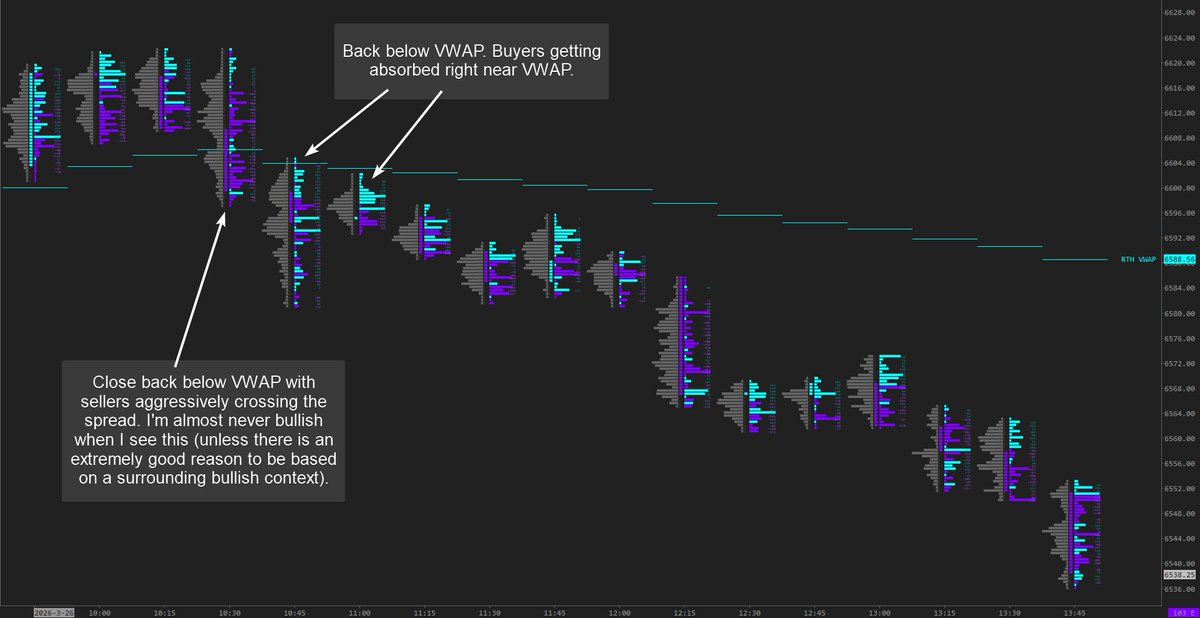
I don't just mindlessly take trade entries every time the market rejects near VWAP. I mainly use VWAP (RTH VWAP especially) as an inflection point. In general I prefer to take longs above VWAP and shorts below VWAP while the order flow supports it. Of course I look at other things as well but I'm just going to keep this about VWAP (which is one of my favorite inflection points in the game).
The main time that I like to fade this rule is when large players are bullish on HTFs and the market flushes hard below VWAP and then volume starts drying up. In that situation, I'm usually ultra bullish and taking longs (as long as we don't have some sort of major bearish news catalyst).
Below, are examples from Thursday's session and Friday's session (the two sessions after I made the VWAP post).









![aleabitoreddit's tweet photo. The Space Bottleneck: Optical ground infrastructure.
- "The industry has built roughly 10 percent of the optical ground infrastructure"
Now, who are the beneficiaries?
- $EOS.ASX (operating stations at Mt. Stromlo equipped with "adaptive optics.")
- $SKPJF (TYO: 9412) | $NTTYY | Space Compass is JV with NTT and satellite operator SKY Perfect JSAT
- $SGBAF - Works with Cailabs to for terrestrial optical terminals
- $SAFRY - Manufacturer of the optical ground stations
Then if it fails fallback would be names like:
$VSAT, $GILT
Analysis states that if the optical mesh fails due to clouds or lack of stations, the architecture "falls back to Ka-band RF links".
-> Near term capital flows to Relay Providers (Kepler, Space Compass, General Atomics).
-> Long term structural winners will be the photonics hardware manufacturers (Cailabs, Safran).
-> Then companies like SpaceX wins by default. Many are private.
"This infrastructure deficit is no longer just an engineering problem but a direct threat to a major White House [Golden Dome] policy objective"
Orbital laser communications market are hard-capped until physical ground infra scales, hence the current bottleneck.
But not quite sure if capex is to the scale of hyperscaler AI buildouts yet to benefit these companies enough.](https://pbs.twimg.com/media/HFHcOHVboAAfWku.jpg)





