A major milestone in strengthening Uganda’s industrial power infrastructure. UETCL has received three 80MVA transformers destined for the Kabalega Substation at the Hoima Industrial Park.
These critical assets will enhance power reliability and capacity to support strategic national investments in the Albertine region.
Once installed, the transformers will provide the backbone of the electrical infrastructure required to power the @EACOP_, petrochemical industries, and other industrial installations, further advancing Uganda’s journey towards industrialisation, energy security, and economic transformation.
The most brutal part is not that China is using AI to sort garbage.
It is that China has pushed waste management so far that the old problem has reversed.
China used to worry about having too much garbage to process.
Now some waste-to-energy plants are facing the opposite problem:
not enough garbage.
Previously sealed landfills may even have to be reopened, not because China failed, but because waste has become fuel, feedstock, data, and part of an industrial recycling loop.
This is what China does best.
It takes the ugliest, dirtiest, most ignored corner of urban life — garbage — and turns it into engineering, automation, energy recovery, environmental governance, and industrial optimization.
Even trash gets absorbed into the machine.
In many countries, garbage is where governance collapses.
In China, even garbage becomes a system.
ON THIS DAY in 1983, St. Lucie Nuclear Power Plant Unit 2 first connected to the grid.
It was built 20 feet ABOVE sea level to protect against flooding and extreme weather, now powering over 1 million homes in south Florida. 🌊
China is rapidly expanding its battery storage industry, betting that the future of clean energy belongs not only to those who generate power, but also to those who can store it for homes, factories and entire electricity grids.
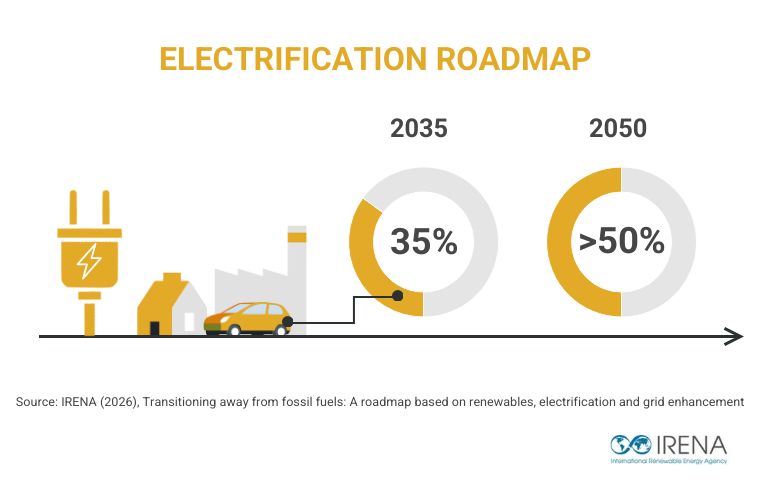
⚡Electrification is a no-regret option for the #energytransition. A concrete end-use electrification target of "35 by 35" can deliver benefits far beyond emissions reductions; it strengthens #energysecurity, resilience, competitiveness & boosts economic growth while reducing dependence on fossil fuels. Check out @IRENA’s latest data ➡️ https://t.co/VwEAp3JKfG
#COP31
Gas is losing market share across much of the world, as renewables increasingly meet new demand.
In Europe, Latin America and much of Asia, gas is no longer the primary route to power sector growth.
https://t.co/Whwn0pU9ae
@UTDTrey There's a reason they're ranked 8 in the world. Only 7 countries in the whole world are better. Not only African countries. Show African positivity not negativity.
Global energy spending is on track to reach $3.4 trillion in 2026
Around $2.2 trillion of this is set to go to grids, storage, low-emissions fuels, nuclear, renewables, efficiency & electrification
And about $1.2 trillion goes to oil, natural gas & coal: https://t.co/eTdSo1G5rS
Chile isn't just focusing on #EV growth. It's also building one of the world's largest renewable energy projects, bolstering #VRE growth.
Oasis de Atacama combines 2 GW of solar with 11 GWh of battery storage, enough to shift vast amounts of daytime solar into evening peak. #SWB
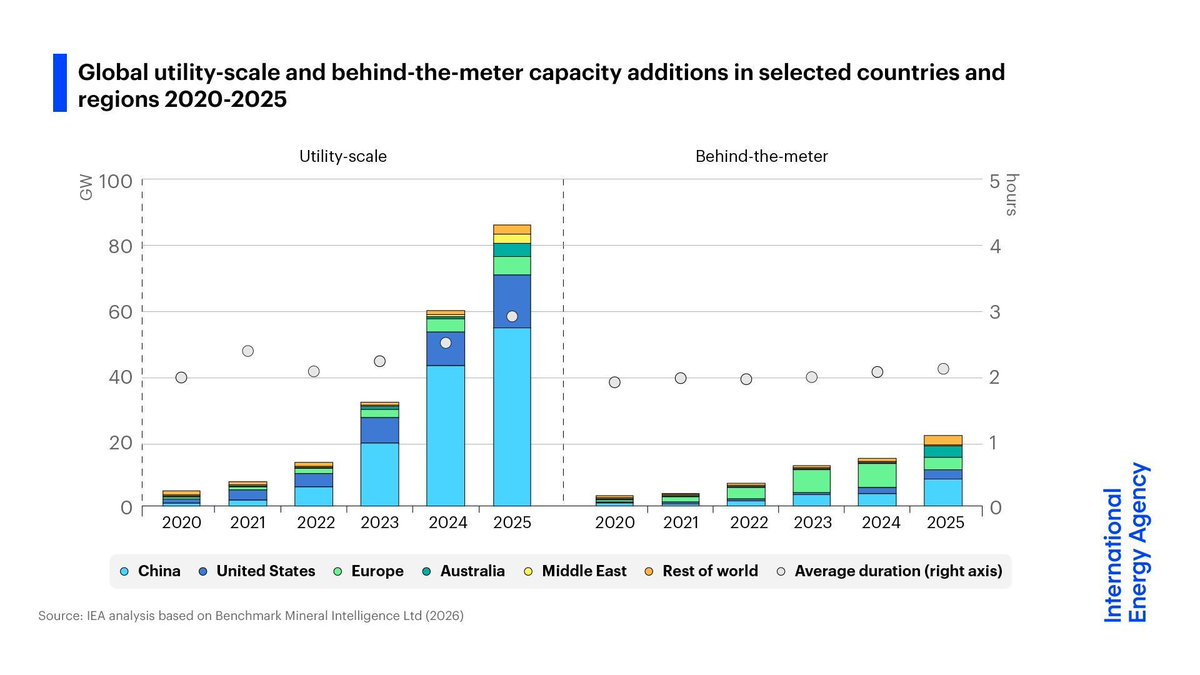
Battery storage is growing at record speed, with 2025 additions 40% higher than in 2024
From balancing grids to shifting solar power across the day, storage is emerging as a versatile tool for modern day power systems around the world
The full analysis: https://t.co/KoR561QiKH
Simplified First Law of Thermodynamics: Energy cannot be created or destroyed, but only transformed.
For wind systems; Kinetic energy from moving wind rotates rotor blades, -------> Mechanical energy in the rotor blades rotates the shaft connected to the generator -----> shaft rotation in generator creates and emf leading to electrical energy.
Clean, zero emissions, sustainable
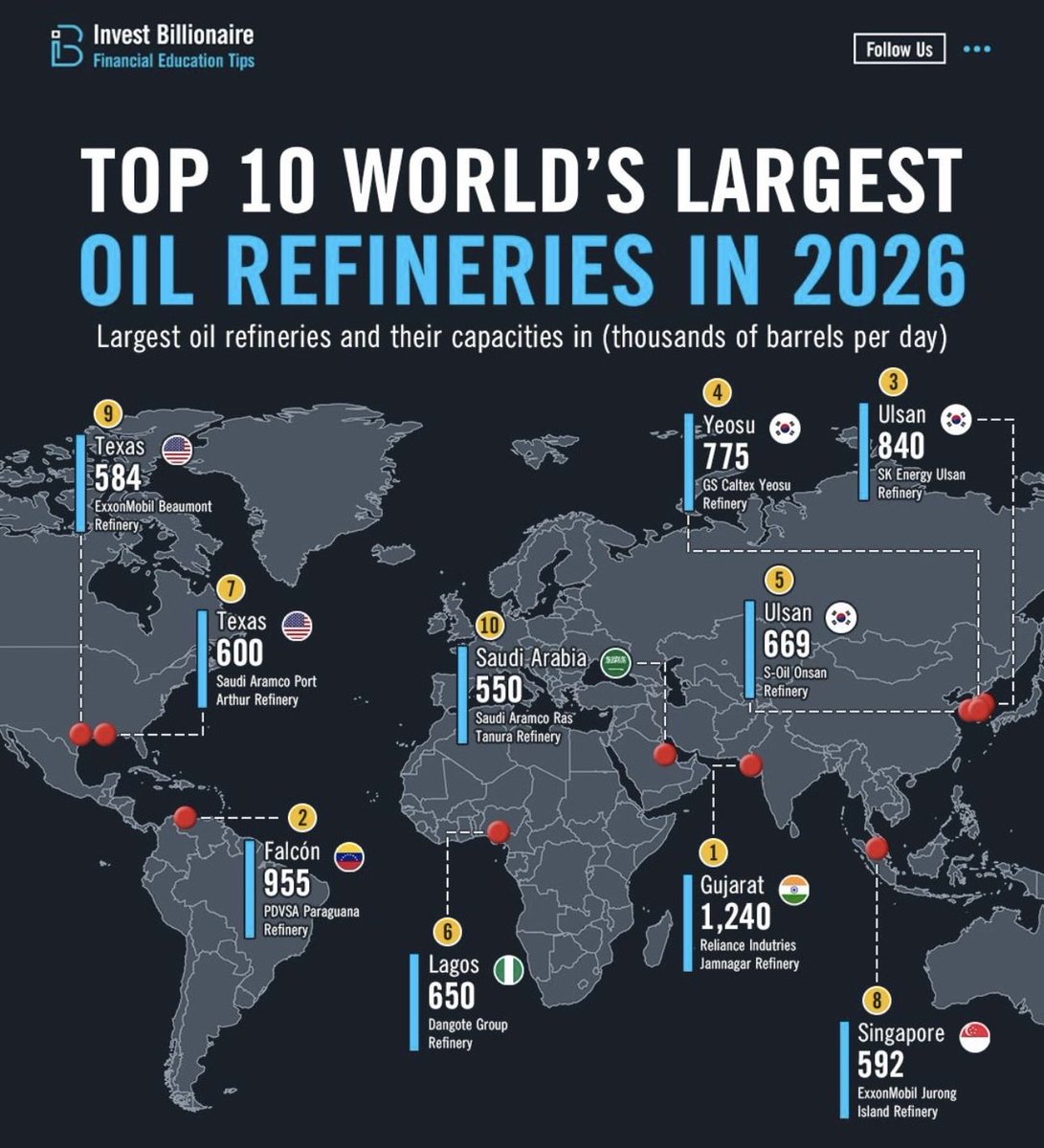
Refining Capacity Is Strategic Power🛢️🏭
Crude oil only matters if you can turn it into usable products.
That is why refineries are so important.
-Gasoline
-Diesel
-Jet fuel
-LPG
-Naphtha
-Petrochemicals
The world’s largest refineries are not just industrial assets.
They are strategic chokepoints in the energy system.
India, South Korea, the US, Nigeria, Singapore, Saudi Arabia, and Venezuela all show the same thing:
Energy security is also about having the capacity to process it.
@jackprandelli Europe's concentration on cleaner energies is commendable. However, with fossil fuels still dominating energy prices, energy costs will still be higher for the EU nations until the renewable coverage is sufficient to offset.