Désolé de jouer les rabat-joie juste après l’IPO d’Anthropic. Mais j’ai lu le dernier rapport de stabilité financière de la BCE, et il fait froid dans le dos.
Son constat : la façon dont on finance l’IA ressemble un peu trop aux subprimes.
Pour faire tourner leurs modèles, les géants de la tech construisent des data centers gigantesques. Cette année, la facture devrait avoisiner les 725 milliards de dollars, un montant tel que leurs bénéfices ne suffisent plus à suivre.
Alors ils empruntent.
Et c’est justement dans leur manière d’emprunter que la BCE retrouve des mécanismes qui rappellent la crise de 2008.
---------
👉 Une partie de la dette est invisible
Imaginez que vous vouliez faire construire une maison sans avoir l’air endetté. Vous demandez à un ami de contracter le prêt à votre place, en lui promettant un loyer pendant vingt ans. Sur le papier, aucun crédit à votre nom. Dans les faits, cet argent, vous le devez bel et bien.
C’est le montage choisi par Meta pour son centre de données en Louisiane : 27 milliards de dollars empruntés par une société partenaire, et absents des comptes de Meta.
Chez Microsoft, ce sont 365 milliards de dollars de loyers promis pour des centres de données qui ne sont même pas encore en service.
Au total, la BCE chiffre ces dettes "invisibles" à plus de 4000 milliards de dollars.
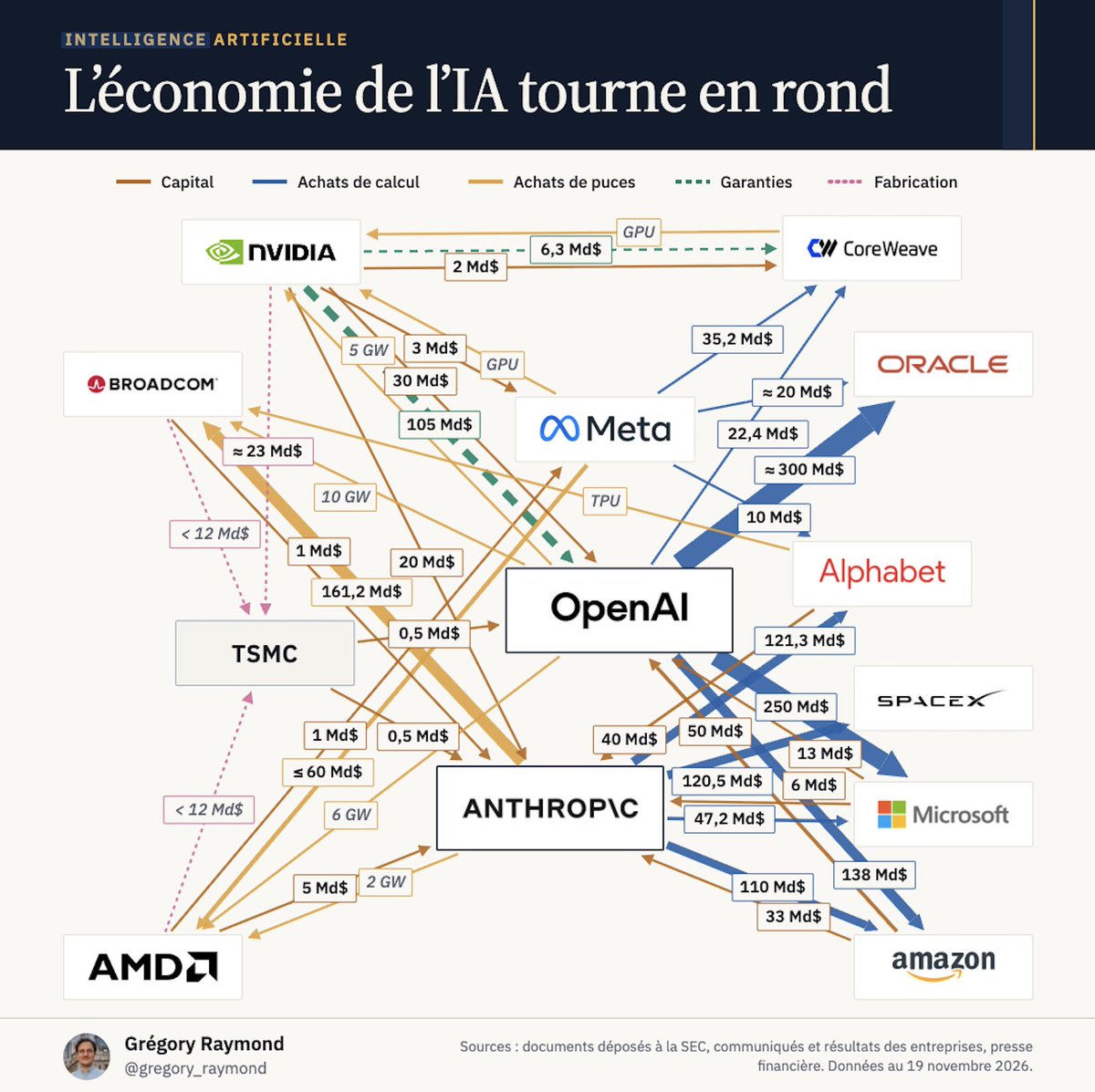
👉 L’argent qui tourne en rond (infographie ci-dessous)
Nvidia fabrique les puces. Il va investir jusqu’à 100 milliards de dollars dans OpenAI (ChatGPT), qui se sert de cet argent pour... acheter des puces Nvidia.
Un peu comme un concessionnaire qui prêterait à ses clients de quoi acheter ses voitures, avant de se féliciter de ses ventes record.
Résultat, tout le monde a l’air de vendre énormément, alors qu’une partie de la demande est financée par le vendeur lui-même.
👉 Des promesses, surtout
D’ici 2030, OpenAI s’est engagé à dépenser quelque 600 milliards de dollars en puissance de calcul. Son chiffre d’affaires 2025 ? 13 milliards. Si les revenus tardent à venir, c’est toute la chaîne qui risque de vaciller : OpenAI d’abord, puis ses fournisseurs, puis ceux qui leur ont prêté.
👉 Qui a prêté ?
Les Américains, pour l’essentiel. Pimco, le gérant d’actifs, a mis environ 10 milliards de dollars dans un seul centre d’Oracle. JPMorgan et le japonais MUFG ont monté pour Oracle un prêt de 38 milliards, et il leur a fallu des mois pour trouver d’autres prêteurs avec qui le partager.
Et l’Europe dans tout ça ?
Nos banques ont prêté environ 75 milliards d’euros au secteur, soit à peine 1% de leurs crédits aux entreprises, un risque que la BCE juge limité. Le point faible est ailleurs. Il se trouve du côté de nos fonds et de nos assureurs, qui ont placé jusqu’à un quart de leurs actions dans la tech américaine et achètent de plus en plus d’obligations émises par les géants de l’IA.
@UK_Daniel_Card Again I have seen any instances of breaking out the Biscuits to warrant the panic level status being portrayed by some. Thats all Im saying.
@UK_Daniel_Card In a boardroom I heard with my own ears, a sales pitch stating military grade security. When pressed they had ex military staff. What a spin 🤦♂️💁♂️🤦♂️ any synergy with bank grade ?
@techspence Agile was born in a US ski resort. It all went downhill. Why? Real documentation went with it and real Systems have nuances. The cool kids haven’t truly been tested. Opinion my own
@mcdermottkc_ As all technology, it has many benefits but too many people think they have raced past the AI finishing post without studying it or understanding it. Where’s Sarah Conor when you need her.
@TheDealMakerGuy They started in Gdansk and still registered there as a HQ. it’s actually built in UAE. I would ask you to check your information. Elements of truth
BARCLAYS PICKED THE WRONG HOMEOWNER
Meet John Galajsza. A @BarclaysUK customer for 35 years. Never missed a mortgage payment. Not one.
I met John in person back in March, at an APPG summit in @UKParliament. He is the real deal.
Back in 2001 Barclays sold him a Woolwich Mortgage Reserve product. Barclays does not even sell that product anymore. It got quietly retired. John stayed locked inside it for years.
Then the same bank he trusted for three and a half decades took him to court to repossess his home.
Loyalty only flows in one direction when you are dealing with a bank.
John could not afford a City law firm to defend himself. Barclays could. They brought in solicitors TLT LLP and a barrister to fight a homeowner over his own front door.
So John found a McKenzie friend, John Robertson, and the judge granted him rights of audience.
That means Robertson stood in that courtroom facing Barclays' paid barristers and argued the case properly. No wig. No retainer. Just someone who read the paperwork properly.
Barclays probably expected this to be over in a few months. A quiet possession order, a quiet eviction, no one watching.
Last week the court sent a sealed order. Case M00CM437, County Court at Chelmsford, District Judge O'Malley presiding. The hearing listed for 17 September 2026 has been cancelled. John has been granted permission to file an Amended Defence and a Counterclaim against Barclays.
Barclays came to repossess his house. Barclays now has to defend itself in the same case.
The order goes further. The possession claim and John's Counterclaim will be case managed and determined together. Barclays must respond by 23 October. John can reply by 6 November. A case management hearing follows after 27 November.
One of the biggest banks in the country is now on the back foot in a case it probably assumed would end quietly at the first hearing.
The order arrived on John and his wife Paula's 48th wedding anniversary. A district judge granting you permission to sue your own bank is one way to mark it.
This case is barely getting started. Right now a homeowner with a McKenzie friend is holding his ground against a bank with a law firm on retainer.
I will be following this closely.
-------
One of the men standing with John and John Robertson at the Royal Courts of Justice was Glenn Cottingham Smith (back left on the image).
He used to run Qbitus Products and Venue 73 in Brighouse. For years he said a person he had trusted as a friend had defrauded him, and for years he tried to get that recognised. The financial and legal strain wore him down.
On 28 March 2026 he took his own life. His case is continuing regardless.
Glenn's story reminded me of @johncock_wayne's, another APPG contact who Bank of America scammed and who has come close to losing his life more than once fighting to be believed.
@stevemiddi1@MLorrM@Victoria_Rixon@JohnCleese